
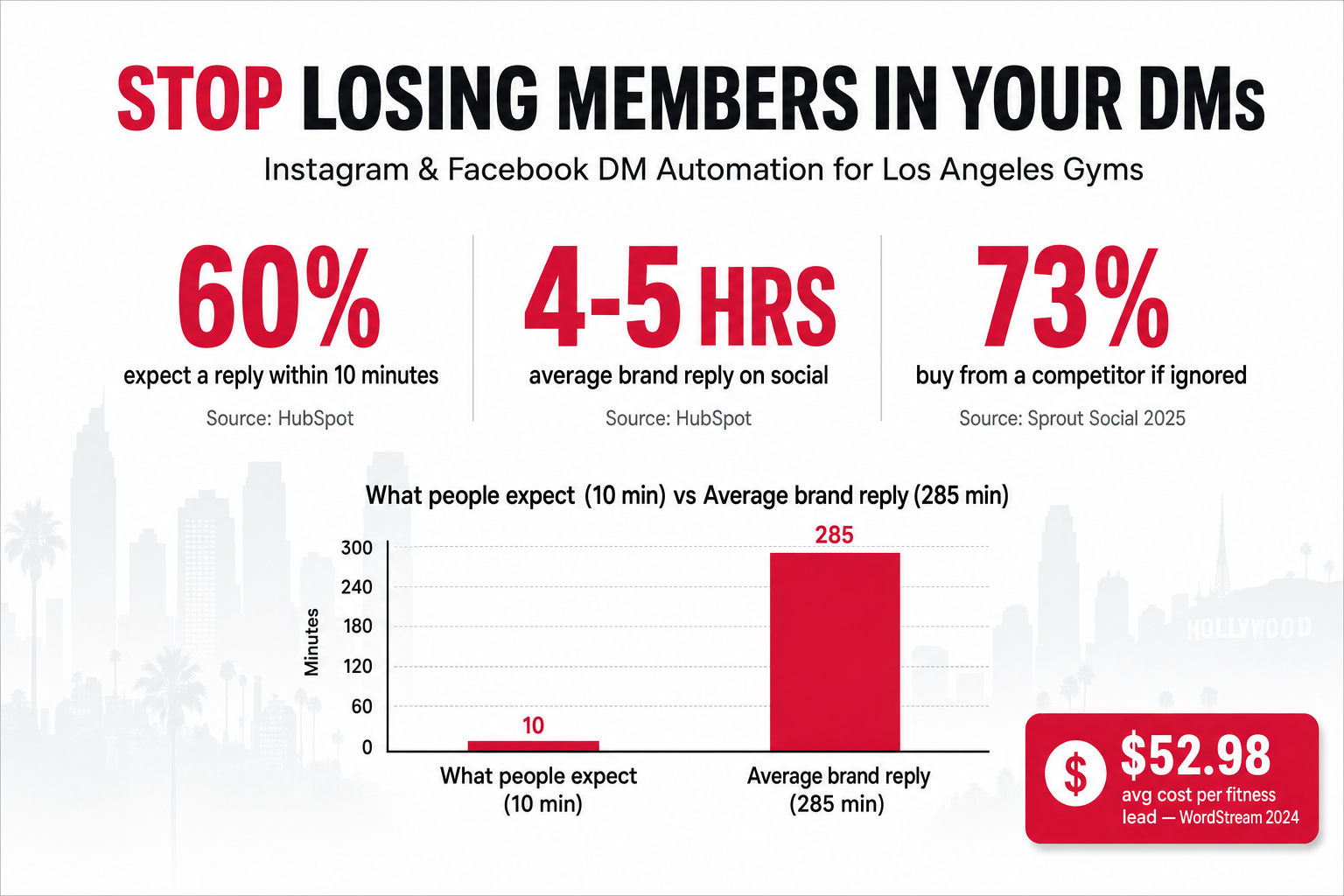
Instagram and Facebook DM automation is a system that instantly replies to your gym’s direct messages and comments — answering the price question, sending the trial link, and booking the class or tour onto your calendar — so no Los Angeles prospect who slides into your DMs at 9 p.m. sits unanswered until you finish coaching tomorrow. It matters because your social inbox is now a primary sales channel, and speed decides who wins: 90% of customers rate an immediate response as important, and 60% define “immediate” as 10 minutes or less (HubSpot) — yet the average brand takes roughly 4 to 5 hours to reply on social (HubSpot). In a city with over 12,000 fitness businesses statewide (IBISWorld), the box in Silver Lake or the reformer studio in Santa Monica two blocks over is one reply away.
I’ve bought Instagram and Facebook ads for gyms and studios long enough to know where the money actually leaks. It’s not the creative. It’s the follow-up. You spend to make a stranger comment “price?” on a Reel — and then that comment sits for six hours because you were on the floor. This post is the operator’s breakdown for LA: why gym leads die in the DMs, what each one costs with real sourced numbers, and how DM automation plugs the leak without making your studio sound like a robot.
Table of contents
- The short answer for LA gym owners
- Why gym leads die in the DMs
- The expectation gap — what LA prospects actually want
- What an ignored DM actually costs
- Speed is the whole game
- What DM automation actually does
- Manual inbox vs. automated DM + booking
- Is DM automation right for your gym?
- FAQ
The short answer for LA gym owners
If you run a CrossFit box in the Arts District, a reformer studio in Santa Monica, a boxing gym in Culver City, or a PT business in the Valley, the compressed verdict is this:
- Your DMs and comments are high-intent leads. When someone comments “price?” on your Reel or messages “do you have a trial?”, they’ve already raised their hand. That’s warmer than any cold ad impression.
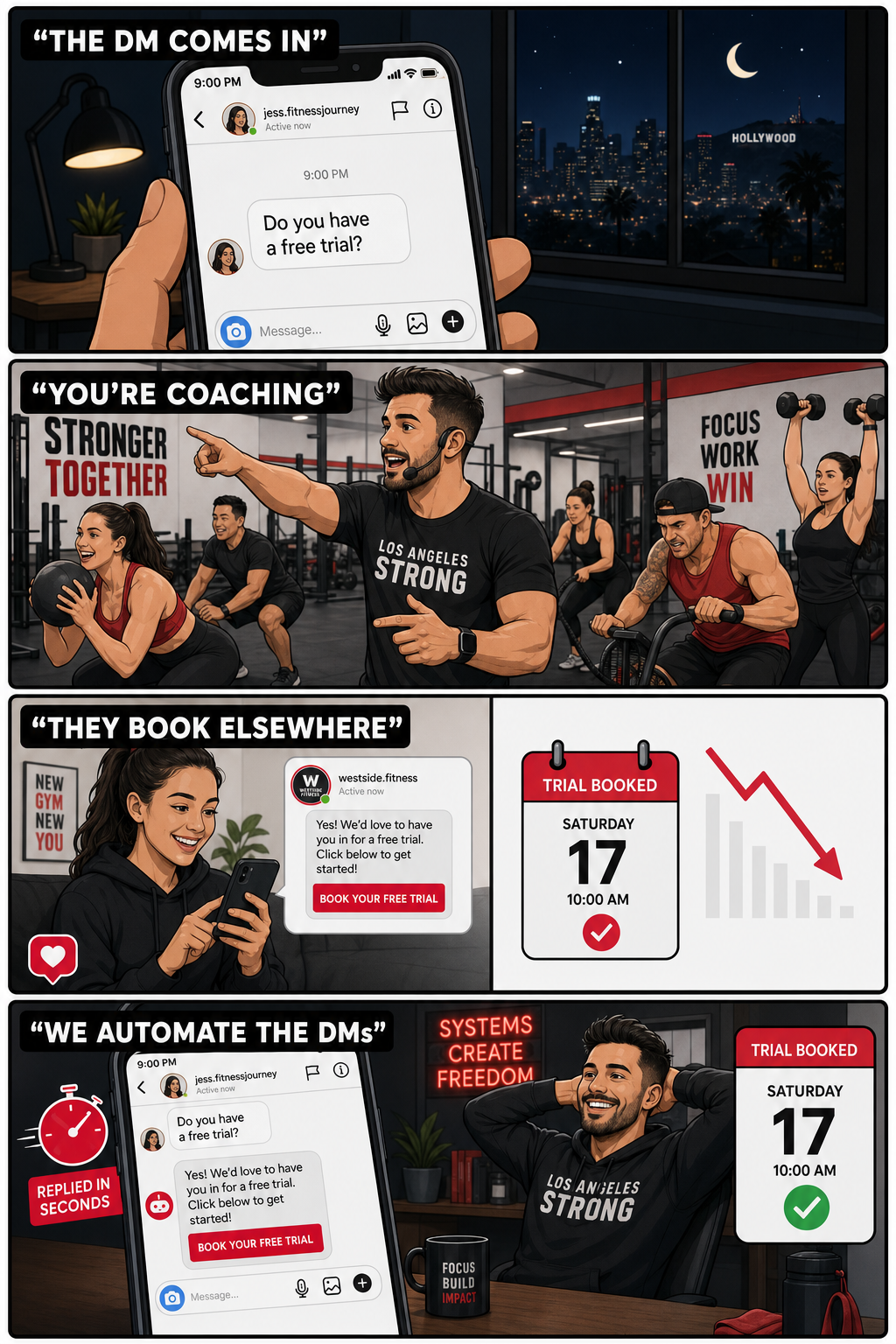
- A slow reply loses them. By the time you finish class and answer at 8 p.m., they’ve messaged three other studios and booked with whoever replied first. The window that decides the sale is measured in minutes, not hours.
- DM automation closes the gap. It replies instantly, 24/7, answers the common questions, captures the lead into your CRM, and books the trial before the prospect can shop the gym down the block.
The rest of this article is the why, with the numbers — and an honest look at when DM automation is worth it and when it isn’t.
Why gym leads die in the DMs
Slow replies at a gym aren’t a discipline problem. They’re structural. A typical week creates four black holes where a message lands and no human can answer:
- Mid-class. Your busiest inbound windows — early morning and early evening — are exactly when your coaches are on the floor running sessions. You can’t stop a WOD to answer “how much is the intro offer?”
- After hours. People research gyms at night, on the couch, after the kids are down. Your studio is dark, but the DMs keep coming. Instagram and Facebook don’t close at 9 p.m.
- Solo operators. If you’re an independent trainer or one-owner studio, you are the coach, the front desk, and the social media manager. Every DM that lands during a session is a coin flip.
- Comment overflow. Run one good Reel or an LA-targeted ad and you get a burst of “price?” and “location?” comments faster than you can type. Miss them, and each one is a lead your ad spend already paid for.
None of this is fixable with willpower or a “reply faster” pep talk. It’s fixable only by putting something in the inbox that never coaches, never sleeps, and never takes lunch. And the behavior isn’t going away — 9 out of 10 consumers say they want to message businesses instead of calling (Twilio), and Meta reports roughly 1 billion people message a business each week across Instagram, Messenger, and WhatsApp (Social Media Today). The DM is the front desk now.
The expectation gap — what LA prospects actually want
Here’s the uncomfortable math. Your prospects expect near-instant replies, and almost no gym delivers them manually.
- 90% of customers rate an immediate response as important, and 60% define “immediate” as 10 minutes or less (HubSpot).
- The average brand takes roughly 4 to 5 hours to respond on social media (HubSpot).
- And when a brand fails to respond, 73% of social users say they’ll buy from a competitor instead (Sprout Social 2025 Index).
Put those together and the gap is the whole problem. A prospect who wants an answer in 10 minutes, waiting 4+ hours, with three other LA studios one tap away. The chart below shows the distance between what people expect and what a manual inbox delivers.
Response time on social, in minutes: customer expectation (≤10 min) vs. the average brand’s actual reply (~4.75 hrs = 285 min). Source: HubSpot. Every minute in that gap is a prospect messaging your competitor.
What an ignored DM actually costs
Here’s the part that stings: most gym DMs are paid leads. You spent money — on Instagram ads, on content, on your coaches making Reels — to make that message land. When it goes unanswered, you’ve paid the acquisition cost and thrown away the conversion.
Run the numbers for a mid-size LA studio. Say you generate 100 DM and comment leads a month between organic content and paid ads. At the health & fitness average of $52.98 per lead (WordStream, 2024), that’s about $5,300 in lead cost. If a slow inbox loses even a third of them, you’ve wasted roughly $1,750 in ad spend that month — before you count what those members were worth.
And they’re worth a lot. The average U.S. gym membership runs about $69/month (Health & Fitness Association) — call it $828 a year, more if they stay longer or upgrade to PT. Lose ten of those a month to slow replies and you’re not down a few messages; you’re down five figures of annual recurring revenue walking to a competitor who simply answered faster. (For the full model, see our breakdown of gym member lifetime value.)
The demand is real, too. A record 77 million Americans — 1 in 4 — belonged to a gym or fitness facility in 2024, up 5.6% year over year (Health & Fitness Association). More people shopping for a gym means more DMs — and a higher cost to every one you drop.
Speed is the whole game
Why does answering in seconds beat answering in hours? Because lead intent decays fast — this is the most replicated finding in sales research.
- Respond within 5 minutes instead of 30, and you’re up to 21x more likely to qualify the lead (Lead Response Management Study).
- Make contact within the first hour, and you’re 7x more likely to qualify it than if you wait until the second hour — and 60x more likely than waiting 24 hours (Harvard Business Review, 2011).
- In that same landmark audit of 2,241 U.S. companies, the average first-response time was 42 hours, and 23% never responded at all (Harvard Business Review, 2011).
Relative likelihood of qualifying a lead by first-response time (× vs. baseline). 21x from the Lead Response Management Study (5-min vs. 30-min); 7x within the first hour from Harvard Business Review, 2011. The takeaway is the same across every study: the first minutes decide the sale.
A human can’t hit 5 minutes at 9 p.m. while coaching a class. Automation can hit it every time. This is the same reason speed to lead and missed-call text-back work so well on the phone side — DM automation is that same principle, applied to the channel where your youngest, most social-native prospects actually live.
What DM automation actually does
DM automation is not a spam bot blasting canned replies. Done right for a gym, it’s a fast, friendly first responder that qualifies and books, then hands warm leads to a human. Here’s the flow:
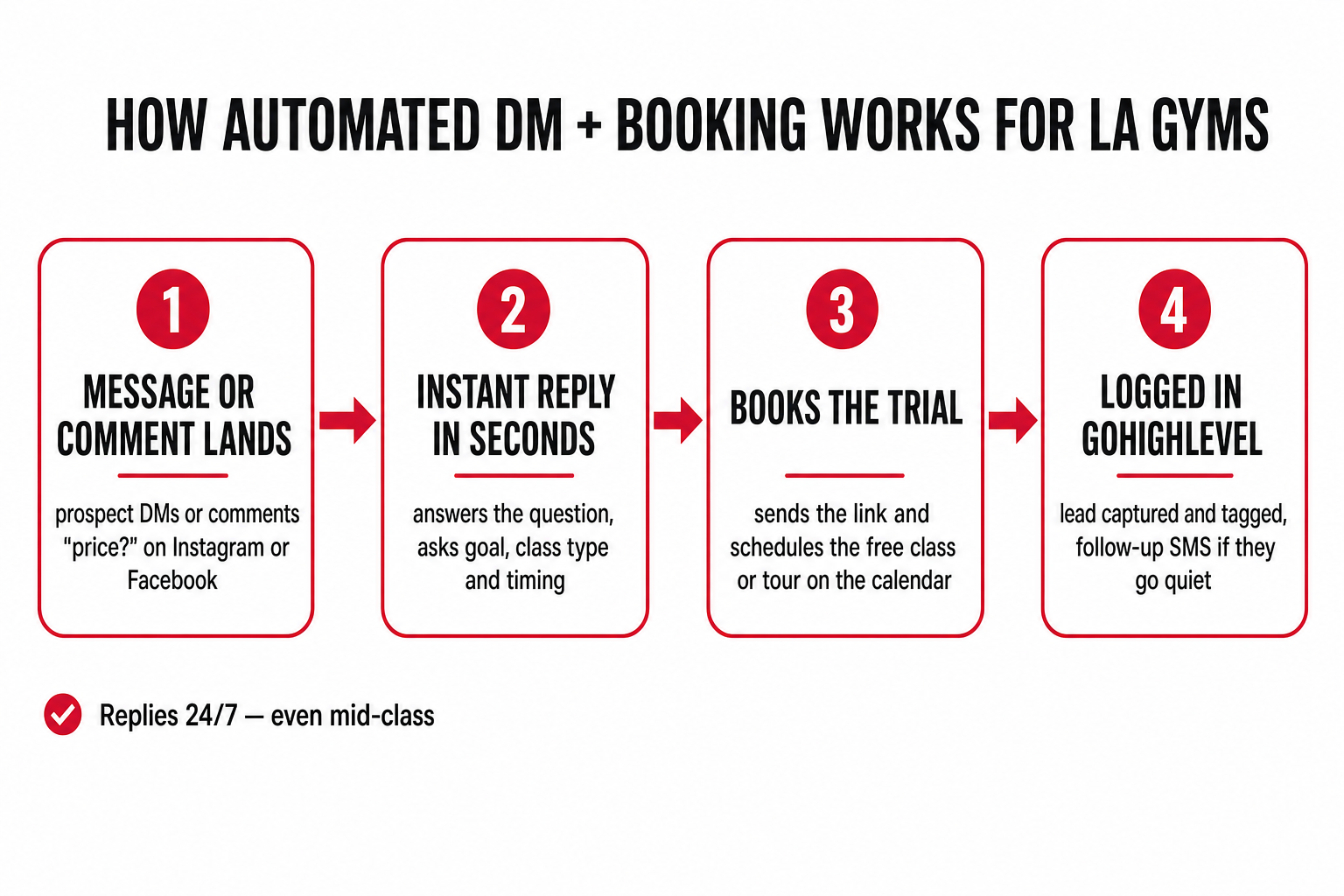
- A message or comment lands. Someone DMs “do you have a trial?” or comments “price?” on your Reel or ad. Comment-to-DM automation can auto-open a private message so the conversation moves to the inbox instantly.
- Instant reply, in seconds. The automation answers the common question (pricing, hours, location, intro offer), then asks a couple of qualifying questions — goal, preferred class, timing.
- It books the trial. It sends the booking link (or offers times directly), reads your live calendar, and schedules the free class, tour, or PT consult — while intent is at its peak.
- Everything is logged in your CRM. The lead is captured in GoHighLevel with tags and source, and if they go quiet, an automated SMS or DM follow-up nudges them back. You can pair it with the AI chatbot on your website and SMS automation so every channel behaves the same way.
Crucially, it hands off to a human whenever the conversation needs one. The automation catches the messages your team was never going to reach in time, qualifies them, and passes the warm, booked prospect to a coach for the tour.
Operator outcome: your social inbox
9 p.m. DM sits until tomorrow · comments unanswered during class · leads shop three other LA studios · paid clicks wasted
Reply in seconds, 24/7 · comment auto-moved to a DM · trial booked onto the calendar · every lead tagged and followed up in GoHighLevel
Manual inbox vs. automated DM + booking
The manual inbox vs. DM automation
| Plan | Manual DMs & comments | Automated DM + booking recommended |
|---|---|---|
| Price | Your time | Included in snapshot |
| Feature 1 | Reply speed: hours (whenever you're free) | Reply speed: seconds, 24/7 |
| Feature 2 | After-hours & mid-class: no reply | After-hours & mid-class: answered instantly |
| Feature 3 | Comments: often missed in the flood | Comments: auto-moved to a DM and answered |
| Feature 4 | Leads captured in your CRM: rarely | Leads captured in your CRM: every one, tagged by source |
| Feature 5 | Follow-up if they go quiet: manual, easy to forget | Follow-up if they go quiet: automatic SMS/DM nudge |
| Feature 6 | Books the trial: only if you get to it in time | Books the trial: on the spot, onto your live calendar |
| See Instagram DM Automation |
The difference isn’t “faster typing.” It’s where the sale gets made. A manual inbox defers the conversation and usually loses it. Automation closes it inside the message that’s already happening — while intent is highest — and never lets a lead fall through because you were on the floor.
Is DM automation right for your gym?
I’d rather you make a good decision than a fast one, so here’s the honest read.
DM automation is a strong fit if you:
- Get regular DMs and comments from Instagram and Facebook (organic or from ads) and can’t answer them all in minutes.
- Spend on social ads or content to drive messages (you’re already paying for those leads — capture them).
- Sell trials, intro offers, tours, or PT consults that need to be booked, not just answered.
- Want every lead logged and followed up automatically instead of lost in an inbox.
It’s less urgent if you:
- Have a dedicated social media manager who genuinely answers nearly every DM in minutes, including nights and weekends.
- Get almost no inbound social volume and run purely on in-person referrals.
Most LA gyms and studios are squarely in the first group. And automation doesn’t replace your voice — you set the tone, the offers, and the guardrails; it just makes sure no message waits. If you want it fully hands-off, our done-for-you social media team runs the content and the inbox so your DMs convert while you coach. Pair it with a strong Instagram content strategy and Google reviews on autopilot and your whole local presence starts compounding.
The bottom line
For an LA gym, studio, or trainer, your social inbox is where your highest-intent prospects raise their hand — and right now most of them are raising it to silence. Nine in ten people want to message businesses, they expect a reply in 10 minutes, and 73% will book with a competitor if you’re slow. Manually, you can’t win that race while coaching a 6 a.m. class.
DM automation fixes the leak at its source: it replies in seconds, 24/7, answers the question, qualifies the prospect, and books them before they can shop around — the five-minute window that makes you 21x more likely to win the lead. In a market with a record 77 million members and over 12,000 competitors in California alone, the cheapest growth most gyms can buy isn’t more ads. It’s finally answering the DM.
Frequently asked questions
What is Instagram and Facebook DM automation for a gym?
It's a system that instantly replies to your gym's direct messages and comments on Instagram and Facebook — answering common questions like price, hours, and intro offers, qualifying the prospect, and booking a free trial, tour, or PT consult onto your calendar. It captures every lead into your CRM and follows up automatically if they go quiet, then hands warm conversations to a human whenever needed.
Will DM automation make my gym sound like a robot?
Not when it's set up right. You write the tone, the offers, and the answers so it sounds like your studio. The automation handles the fast, repetitive first reply — pricing, location, 'do you have a trial?' — and books the appointment. Anything nuanced or personal gets routed to you or a coach. The goal is a fast, friendly first responder, not a spam bot.
How is DM automation different from just replying faster myself?
Speed you can't sustain manually is the whole point. 60% of customers expect a reply within 10 minutes (HubSpot), and responding within 5 minutes makes you up to 21x more likely to qualify a lead (Lead Response Management Study). No owner or coach can hit that at 9 p.m. or mid-class. Automation answers every message in seconds, 24/7, so you never lose a lead to a competitor who replied first.
Does comment-to-DM automation work on Instagram Reels and Facebook posts?
Yes. When someone comments a keyword like 'price' or 'trial' on your Reel, post, or ad, the automation can reply to the comment and open a private DM to move the conversation to the inbox — where it answers questions and books the trial. It turns a public comment (a lead your content or ad already paid for) into a captured, booked prospect.
How much do LA gyms lose to slow DM replies?
The average health & fitness lead costs about $52.98 on Google Ads (WordStream, 2024), and a member is worth roughly $69/month, about $828 a year (Health & Fitness Association). A studio generating 100 social leads a month spends ~$5,300 to create them; losing even a third to a slow inbox wastes ~$1,750 in ad spend monthly — before counting the membership revenue lost to a faster competitor.
How fast can I get DM automation installed?
The Instagram and Facebook DM automations are part of our GoHighLevel fitness snapshot and are installed into your account in about 24 hours. You own it — it runs on your GoHighLevel, your calendar, your social accounts. Or our done-for-you social media team can run the content and the inbox for you. Book a walkthrough to see it reply to a live DM before you decide.
About the author
Cole Hartman is our Local Marketing & Paid Acquisition Lead, based in Tampa, FL. He started out buying Facebook and Instagram ads for personal trainers and martial-arts schools, then learned the hard way that the follow-up behind the ad matters more than the creative. He now pairs paid acquisition with GoHighLevel automation so gyms stop paying for leads that never get answered.