
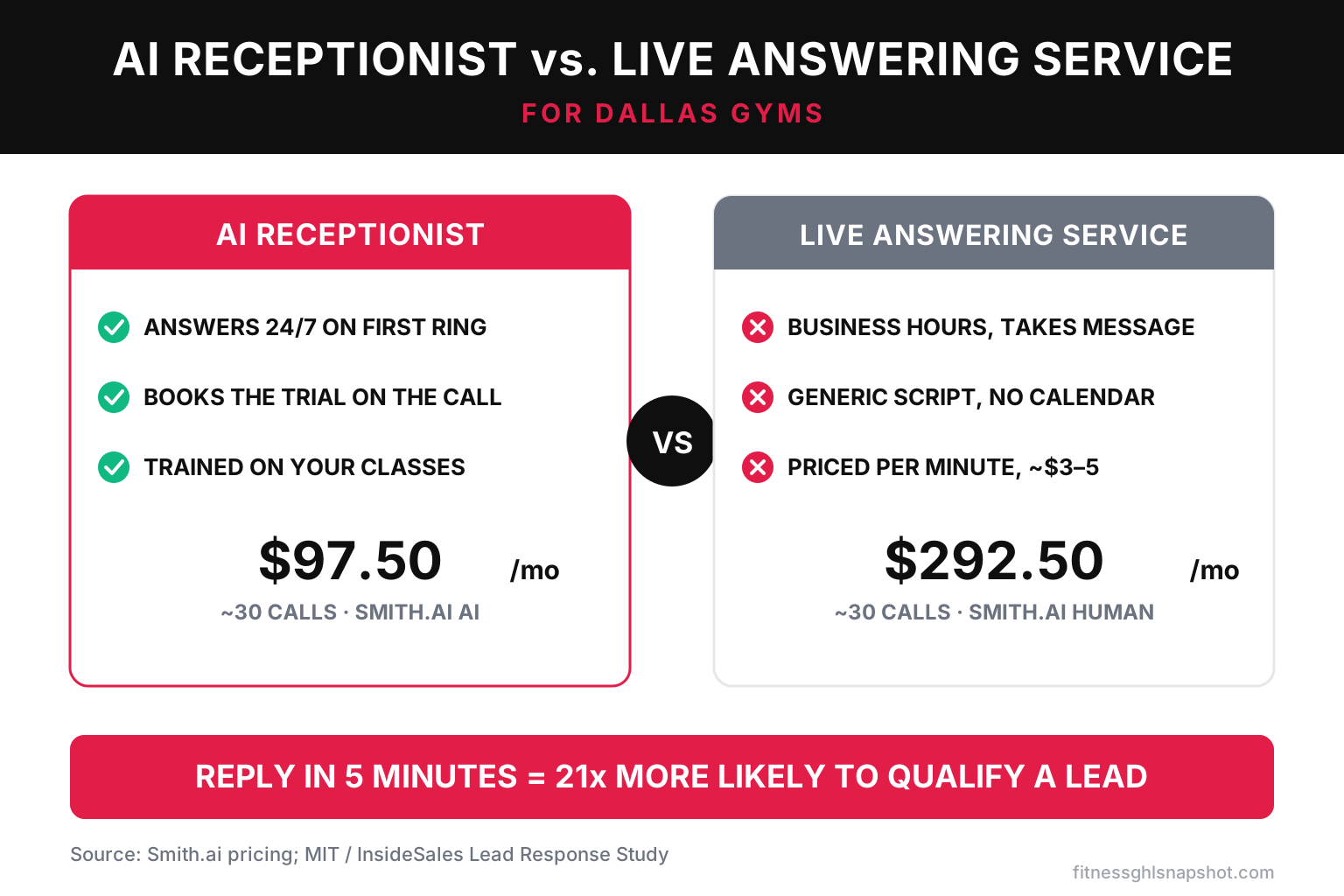
For most Dallas gyms and studios, an AI receptionist books more trials than a traditional live answering service — because it answers every call instantly 24/7, is trained on your classes and calendar so it books the appointment on the call, and costs a fraction of a per-minute human service. A live answering service is still a real upgrade over voicemail, and for some operations it’s the right call. But if your goal is turning inbound phone interest into booked trials and tours, the deciding factors are speed, booking ability, and cost — and on all three, an AI voice agent trained on your gym wins for the typical box, studio, or PT business in Dallas.
I spent eight years on the floor and front desk of a fast-growing CrossFit box before moving into GoHighLevel automation full-time, so I’ve lived the problem this post solves: the phone rings at 8:15 p.m. while you’re coaching, and there’s no good option. This is the honest, numbers-first comparison — voicemail vs. a live answering service vs. an AI receptionist — for Dallas operators deciding how to cover the phone.
Table of contents
- The short answer for Dallas gym owners
- The three ways gyms cover the phone
- What a live answering service costs
- What an AI receptionist costs and does
- Head-to-head: the full comparison
- Speed is the deciding factor
- The math on a missed Dallas call
- Why this matters now in Dallas
- Which should your gym choose?
- FAQ
The short answer for Dallas gym owners
If you run a CrossFit box in Deep Ellum, a reformer studio in Uptown, a martial-arts school in Plano, or a PT business in Frisco, the compressed verdict is this:
- A live answering service beats voicemail — a human picks up and takes a message, so fewer calls die in silence.
- But an answering service rarely books the trial. A generic operator doesn’t know your class schedule, your intro offer, or your live calendar. They take a message; you still have to call the prospect back — by which point they’ve booked at the gym that answered.
- An AI receptionist closes the gap on the same call. It answers instantly, 24/7, is trained on your gym’s offers, reads your real calendar availability, and books the trial or tour before the prospect can shop the box down the street — at a flat cost well below a per-minute human service.
The rest of this article is the why, with sourced numbers, and an honest look at the cases where a human answering service is still the better pick.
The three ways gyms cover the phone
Every Dallas gym owner is really choosing between three ways to handle a call they can’t personally answer:
- Voicemail (the default). Free, and the worst option. The prospect reaches a recording, most don’t leave a message, and the lead is gone.
- A live answering service. A third-party call center answers in your gym’s name and takes a message (some offer appointment-setting). Real humans, but generic ones — priced per minute or per call, and usually limited to a script.
- An AI receptionist. A conversational AI voice agent trained on your gym that answers every call, qualifies the caller, and books onto your calendar — then logs the whole call in your CRM.
Voicemail is a losing game, and I’ve written the full breakdown of what missed calls cost a gym elsewhere. So the real decision for most operators is answering service vs. AI receptionist. Let’s price both.
What a live answering service costs
Live answering services are priced on human time, so they’re inherently expensive at volume. Two reference points from published pricing:
- Ruby, a premium human-only receptionist service, runs roughly $235–$245/mo for ~50 minutes and scales to about $1,600–$1,725/mo for 500 minutes — effectively $3–$5 per minute, billed in increments with no rollover (Ruby).
- Smith.ai lists its human virtual receptionist starting around $292.50/mo for 30 calls (Smith.ai pricing).
That’s the cleanest apples-to-apples signal in the whole market, because Smith.ai sells both a human service and an AI one — so you can see the price of the human layer directly.
The catch isn’t just price — it’s what you get for it. A generic operator doesn’t know that your 6 a.m. metcon is full, that your intro offer is a free week, or that reformer classes have a waitlist. Most services take a message and email it to you. That turns a live call into a callback task, and speed to lead is exactly where gyms bleed prospects.
What an AI receptionist costs and does
An AI receptionist isn’t a phone tree or a robotic “press 1 for hours.” It’s a conversational voice agent that behaves like your best front-desk hire — one trained on your gym who works every hour of every day. For a gym running on GoHighLevel, our AI Caller:
- Answers 100% of inbound calls, day or night, in a natural human-sounding voice — no voicemail, no hold, no ring-out.
- Qualifies the caller — membership interest, class type, PT goals, budget, timeline — the way a sharp front-desk person would.
- Books the trial, tour, intro session, or PT consult directly onto your live calendar, reading real availability.
- Places outbound recall calls to lapsed leads and quiet members, so old lists don’t rot.
- Fires an instant missed-call SMS and logs the full call, transcript, and outcome on the contact record in GoHighLevel.
On cost, the same-vendor comparison is stark: Smith.ai’s AI receptionist starts around $97.50/mo for 30 calls — roughly a third of its $292.50 human plan (Smith.ai pricing). And because our AI Caller ships inside the fitness snapshot, it runs on your own GoHighLevel, your calendar, and your number — a flat, unmetered part of a system you own outright, not a per-minute meter that punishes you for a busy month.
Approximate monthly cost for ~30 handled calls, same vendor (Smith.ai): AI receptionist vs. human virtual receptionist. Source: Smith.ai virtual receptionist pricing (2025; confirm current plans).
Head-to-head: the full comparison
Here’s the honest side-by-side of what happens when a Dallas prospect calls and your desk is empty:
Voicemail vs. answering service vs. AI receptionist
| Plan | Voicemail | Live Answering Service | AI Receptionist recommended |
|---|---|---|---|
| Price | $0 | $235–$1,725/mo | In the snapshot |
| Feature 1 | Only when you can't pick up | Business hours or 24/7 (per plan) | 24/7, answers on the first ring |
| Feature 2 | Prospect reaches a recording | Human answers, ~$3–5/min | Flat cost, unmetered |
| Feature 3 | No knowledge of your gym | Reads a generic script | Trained on your classes and offers |
| Feature 4 | Never books — takes no action | Usually takes a message | Books onto your live calendar |
| Feature 5 | No CRM record | Emailed notes / portal, manual | Full transcript logged in GoHighLevel |
| Feature 6 | Books trial: rarely | Books trial: sometimes | Books trial: on the call |
| — | — | See the AI Caller |
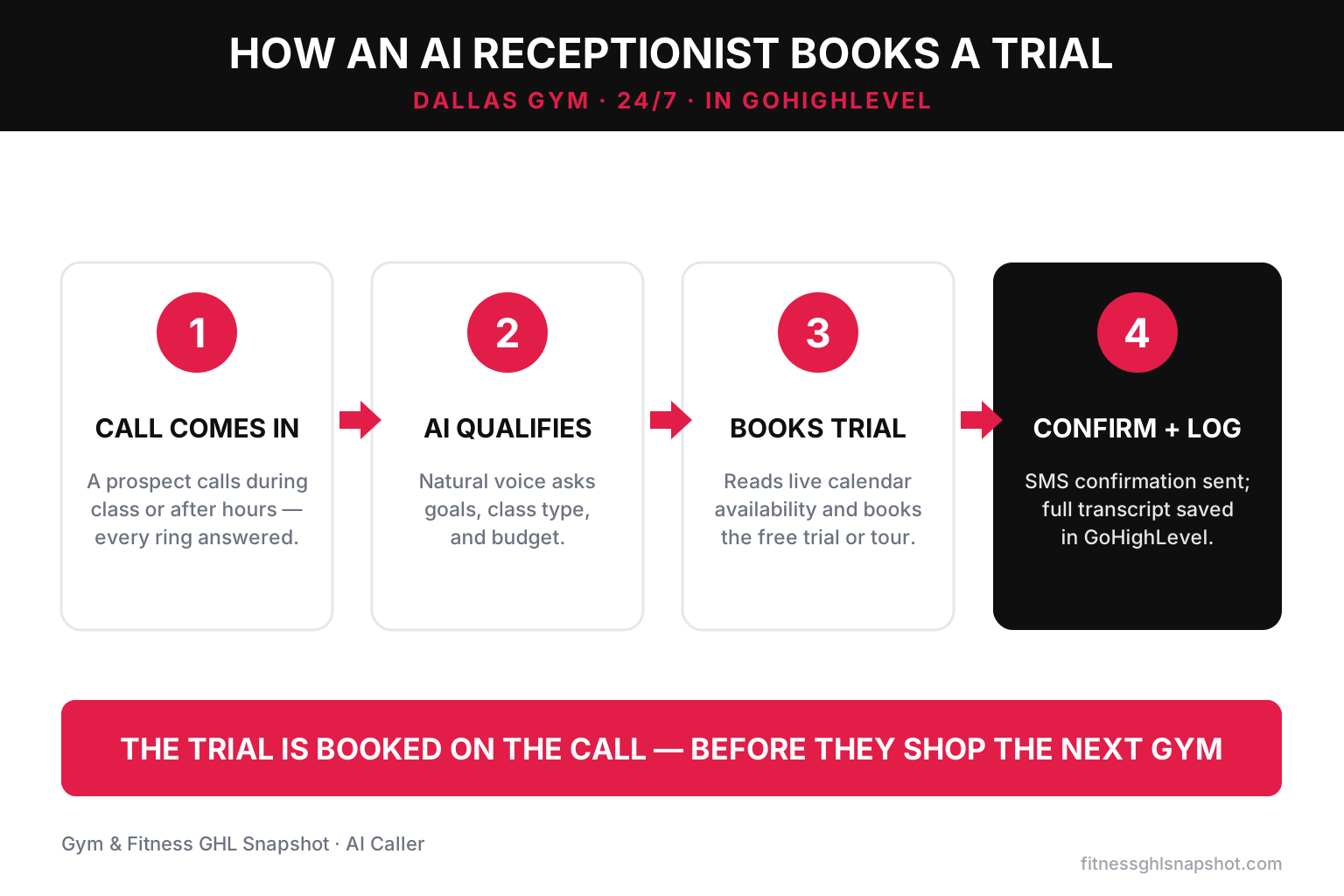
The difference is where the sale gets made. Voicemail defers it and usually loses it. A live answering service reopens it as a callback task on your plate. An AI receptionist closes it on the call that’s already happening — while the prospect’s intent is at its peak.
Speed is the deciding factor
Even when a service does take the message, you lose on speed. A prospect’s intent has a half-life measured in minutes.
The landmark MIT / InsideSales Lead Response study — three years, 15,000+ leads, over 100,000 call attempts — found that contacting a lead within 5 minutes instead of 30 makes you up to 21x more likely to qualify it (MIT / InsideSales). Harvard Business Review’s audit of 2,241 U.S. companies found firms that responded within an hour were 7x more likely to qualify a lead than those who waited just one hour longer — yet the average response time was 42 hours, and 23% never responded at all (HBR, 2011).
Relative likelihood of qualifying a lead by speed of first response — replying within 5 minutes makes you up to 21x more likely than at 30 minutes. Source: MIT / InsideSales Lead Response Management Study.
A “we’ll email you the message” answering service can’t hit five minutes when you’re mid-class or asleep. An AI receptionist doesn’t take a message at all — it books the appointment right then, which is the whole game.
The math on a missed Dallas call
Here’s the part that stings: most gym calls are paid leads. You spent money — on ads, on local SEO, on your sign — to make that phone ring. The average lead in the health and fitness category costs about $52.98 on Google Ads (WordStream 2024 Benchmarks). A caller is further down the funnel than a form-fill — they picked up the phone.
Do the arithmetic for a single Dallas studio taking 120 calls a month. An older small-business study often cited put the share of unanswered calls at roughly 62% (411 Locals, 2016 — dated, directional). Even at a conservative 30% miss rate, that’s ~36 unanswered calls a month — around $1,900 of lead cost ringing out, before you count the membership lifetime value of every prospect who joins the competitor that answered. You don’t need to recover all of them; catching a handful pays for the system many times over, and over a year those saved members compound into real member lifetime value.
Why this matters now in Dallas
Two trends make fixing your phone the highest-ROI move a Dallas operator can make this year.
First, demand is at a record high and the local market is crowded. Texas is home to roughly 7,167 gym, health, and fitness-club businesses in an industry worth about $3.3 billion statewide (IBISWorld), and nationally a record 81 million Americans belonged to a fitness facility in 2025 — up from 77 million in 2024 (Health and Fitness Association). More shoppers and more competitors means more calls — and more gyms one tap away when yours doesn’t answer.
US fitness-facility membership, in millions — a record 81M members in 2025, up 5.2% year over year. Source: Health and Fitness Association.
Second, answering calls with AI is no longer exotic. Gartner reports that 85% of customer-service leaders will explore or pilot customer-facing conversational AI in 2025 (Gartner), and predicts that by 2029 agentic AI will autonomously resolve 80% of common customer-service issues, cutting service costs ~30% (Gartner). The Dallas gyms adopting an AI receptionist now are getting ahead of a curve their competitors will scramble to catch.
Which should your gym choose?
I’d rather you make a good decision than a fast one, so here’s the honest read.
An AI receptionist is the better fit if you:
- Miss calls during classes, after hours, or as a solo operator — and want them booked, not just answered.
- Spend on ads or local SEO to make the phone ring (you’re already paying for those leads — capture them).
- Want every call logged and followed up automatically inside your CRM, not on sticky notes.
- Prefer a flat, owned cost over a per-minute meter that spikes in a busy month.
A live answering service still makes sense if you:
- Need genuine human judgment on complex, non-scripted calls (billing disputes, sensitive member issues, legal/medical nuance).
- Want a warm human voice for a high-touch, premium-priced concierge brand and are happy to pay per minute for it.
- Have very low, unpredictable call volume where any monthly software feels like overkill.
For most Dallas boxes, studios, and PT businesses, the goal is simple — turn phone interest into booked trials — and that’s precisely what an AI receptionist does best. It doesn’t replace your team; it catches the calls your team was never going to reach, then hands the warm, booked prospect back to a human for the tour. Pair it with no-show recovery and reminders so the trials it books actually show up, and with a missed-call text-back safety net underneath.
The bottom line
For a Dallas gym, studio, or trainer, the phone is still where your highest-intent prospects raise their hand. A live answering service is a real upgrade over voicemail — but it’s a generic human who takes a message, priced on the clock. An AI receptionist trained on your gym answers instantly 24/7, books the trial on the call, logs it in your CRM, and does it at a flat cost roughly a third of a comparable human plan.
Speed decides the sale — the five-minute window MIT showed makes you 21x more likely to win the lead — and only one of these options actually hits it. In a Texas market with 7,167 competing gyms and a record 81 million members nationwide, the cheapest growth most Dallas gyms can buy isn’t more ads. It’s finally answering the phone — and booking the trial before it hangs up.
Frequently asked questions
What's the difference between an AI receptionist and a live answering service for a gym?
A live answering service is a third-party call center where human operators answer in your gym's name and usually take a message from a generic script. An AI receptionist is a conversational voice agent trained on your specific gym — it knows your classes, offers, and live calendar, so it qualifies the caller and books the trial or tour on the call itself, then logs the full transcript in your CRM. The answering service defers the sale to a callback; the AI closes it live.
Is an AI receptionist cheaper than an answering service?
Usually, yes. Human answering services are priced on time — roughly $3–$5 per minute for a premium service like Ruby ($235–$1,725/mo), and about $292.50/mo for 30 calls on Smith.ai's human plan. Smith.ai's AI receptionist starts around $97.50/mo for the same 30 calls — roughly a third. Our AI Caller ships inside the fitness snapshot as a flat, unmetered part of a system you own outright.
Will an AI receptionist sound robotic to my Dallas members?
Modern AI voice agents sound natural and conversational, not like a phone tree. Our AI Caller greets the caller, asks qualifying questions, reads live calendar availability, and books the appointment — and it hands off to a human whenever the caller asks. Every call is transcribed and logged so you can review exactly what it said.
Can an answering service book appointments onto my calendar?
Some offer appointment-setting add-ons, but a generic operator working from a script rarely has real-time access to your class capacity, waitlists, and intro offers. Most take a message and email it to you, which turns a live, high-intent call into a callback task — and callback speed is where gyms lose prospects. An AI receptionist reads your live GoHighLevel calendar and books directly.
How fast can I get an AI receptionist installed?
The AI Caller is part of our GoHighLevel fitness snapshot and is installed into your account in about 24 hours. You own it — it runs on your GoHighLevel, your calendar, and your phone number. Book a walkthrough to hear it answer a live call before you decide.
Is it TCPA-compliant to use an AI caller for outbound recalls?
Yes, when configured correctly. Outbound recall calls and missed-call texts run on a compliant A2P 10DLC number, honor STOP opt-outs, and respect quiet hours. Our snapshot ships with those guardrails built in so you stay on the right side of TCPA while reactivating lapsed leads.
About the author
Bryce Kendrick is our Fitness Growth Strategist and GHL Snapshot Lead, based in Austin, TX. He spent eight years managing the floor and front desk at a fast-growing CrossFit box before moving full-time into GoHighLevel automation for gyms. He has built trial-to-member funnels for boxes, F45 franchises, and independent strength studios across Texas, and he writes the way he coaches: direct, numbers-first, and allergic to fluff.