
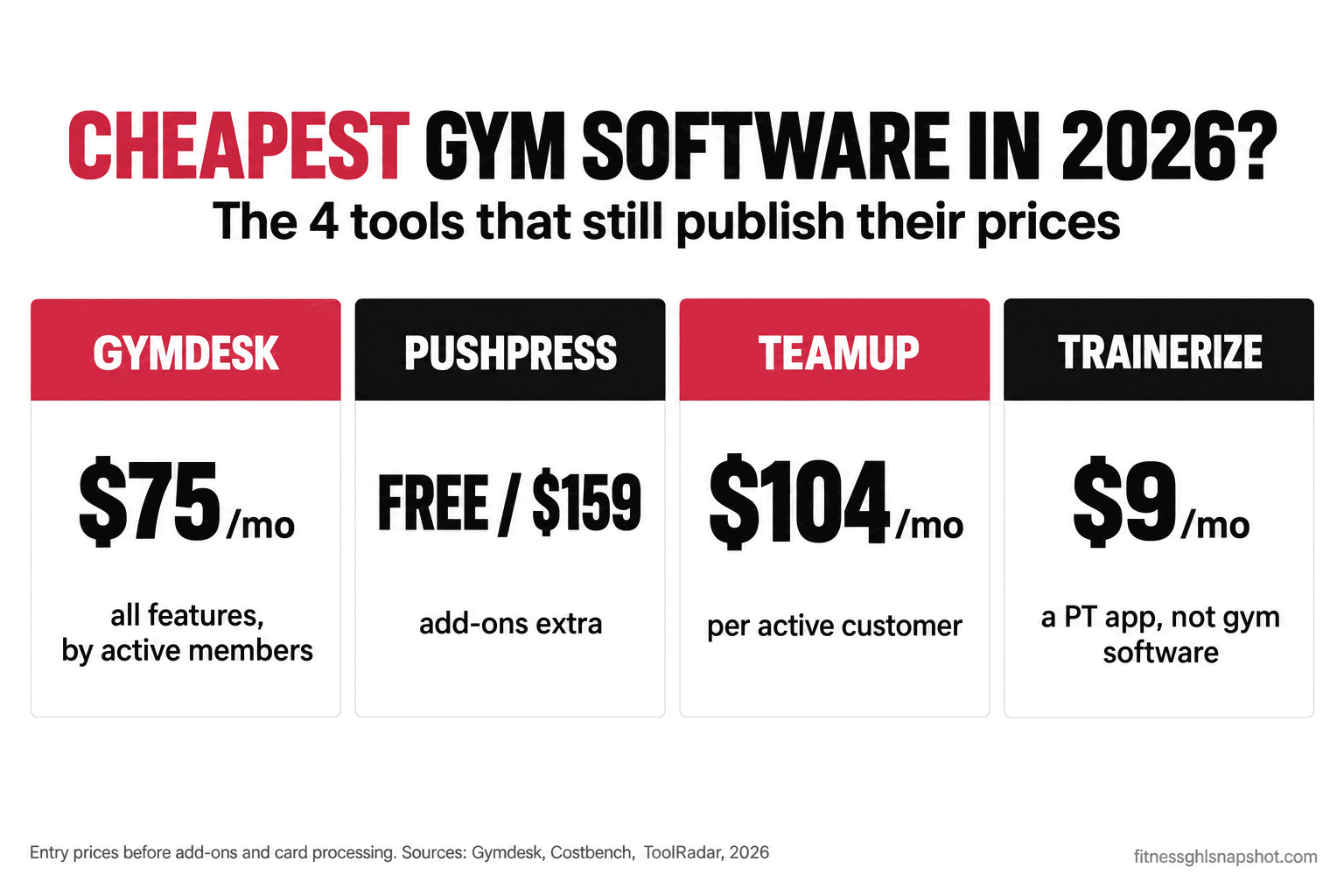
The short version: Gymdesk is usually the cheapest honest price for a real gym, because every feature is in every plan and you pay by active member count, from $75 a month. PushPress starts free but the pieces a growing gym needs are paid add-ons that push the true bill toward $559 a month. TeamUp is fair at roughly $104 to start and scales by active customer. Trainerize is the cheapest on paper, from $9 a month, but it is a personal-training app, not gym management software, so the sticker only looks low because it does less. And here is the part no pricing page admits: none of the four chases a trial lead in the first five minutes or catches a member who is quietly fading, which is the gap that actually costs you money. Below, all four are scored on the eight things that decide the bill.
It is 7:40am. Before the 8am class your phone buzzes with a form fill from 11:52 last night, a trial request from someone who has probably already booked somewhere else. A member who has not scanned in for 19 days is thinking about freezing, and a card that funds three memberships bounced on Saturday. Your gym software did none of that work for you. So you open a tab and type “cheapest gym software.” I have run a box floor and rebuilt the back office for a dozen gyms. Here is the honest answer, and the part most comparison posts skip.
Table of contents
- Why this is the only fair fight in gym software
- The quick verdict
- The 8 things that actually decide the bill
- Run the numbers for your gym: three scenarios
- Steal this: the follow-up copy none of them writes
- Objections owners raise before switching
- The gap all four leave open
- FAQ
Why this is the only fair fight in gym software
Mindbody, Glofox, Wodify, and Mariana Tek all gate the real monthly number behind a sales call. The four tools in this post put a number on the page, so this is the one comparison where you can do the math before anyone emails you a quote. But a published price is a starting line, not a finish line: two tools can both say “$159 a month” and cost $300 apart once processing fees and add-ons land. The question is not who has the lowest sticker, it is who costs the least to run your gym at your size.
The quick verdict
Here is the call most owners land on once they see past the sticker.
The fast read: who each tool is actually for
| Plan | Gymdesk recommended | PushPress | TeamUp | Trainerize |
|---|---|---|---|---|
| Price | $75 to $200/mo by active members | Free, then $159 / $229/mo | About $104 to $309/mo | Free, then $9 to $248/mo |
| Feature 1 | Every feature in every plan, no upsell tiers | Strong free tier for a brand-new gym | Fair, predictable per-active-customer pricing | A coaching app, not gym management software |
| Feature 2 | Bring your own payment processor, no markup | Marketing (Grow) and app are paid add-ons | Strong for class studios, lighter on heavy CRM | Great for online and hybrid PT programming |
| Feature 3 | Best for: an independent gym that wants one clear bill | Best for: a new box starting at zero | Best for: a boutique studio with full classes | Best for: a solo or small PT team coaching remotely |
| See what gym software costs | PushPress vs Wodify breakdown | Why Mindbody feels broken | Mindbody alternatives for small gyms |
Now a like-for-like picture: the realistic base monthly cost for a mid-size gym with about 150 active members, before add-ons and processing fees.
Base monthly software cost for a ~150-member gym, US dollars, before add-ons and card processing (Gymdesk, 2026; Exercise.com, 2024).
The 8 things that actually decide the bill
Forget the feature-count drag race. These eight things decide whether you are happy a year from now, each scored with the way it breaks.
1. The price you pay on day one
Gymdesk charges by active member count, with everything in every plan: $75 a month up to 50 members, scaling to $200 for 201 to 400, custom above (Gymdesk, 2026). No feature paywall, no per-seat fees.
PushPress runs a genuinely free Core plan, then Pro at $159 and Max at $229 a month (Costbench, 2026). A tiny gym can start at $0 plus card fees.
TeamUp starts around $104 a month for 1 to 100 active customers, checked June 2026 (ToolRadar, 2026).
Trainerize is free for 1 client, then Grow at about $9 a month for 2 clients, Pro from roughly $23 for 5 (Costbench, 2026). Cheap, because it is a coaching app, not gym software.
How it breaks: the lowest sticker wins the click and loses the year. Trainerize looks cheapest because it does the least.
2. How the price scales as you grow
You are buying for the gym you will have in 18 months, not today. Gymdesk and TeamUp both scale with size: Gymdesk by active members, TeamUp by active customer, anyone who booked or bought in the prior month (Exercise.com, 2024). TeamUp’s ladder runs up to about $309 a month for 601-plus customers. PushPress scales by plan and add-on, not headcount, so a big gym on Pro still pays $159 for the core then stacks on top. Trainerize Pro scales by roster, up to about $250 a month for 200 clients, with Studio Plus at $248 per location (Costbench, 2026).
How it breaks: active-member pricing charges you more for the members you fought to keep. Fine if the tool earned them for you. It stings if it did not.
3. Payment processing, the tax nobody reads
This is the biggest hidden number in the whole comparison.
Gymdesk lets you connect Stripe, Square, Authorize.net, GoCardless, or Ezypay with no Gymdesk markup, or use its own payments at 2.9% + $0.30 (Gymdesk, 2026). Bringing your own processor is the money move.
PushPress free-plan processing is reported at 4.19% + $0.30 per transaction, lower on paid plans (Costbench, 2026).
Run the math. A gym billing $15,000 a month pays roughly $480 at 2.9% versus roughly $794 at 4.99%, a gap near $3,768 a year (Gymdesk, 2026). That is a vendor illustration, but two points of processing can cost more than your whole subscription.
How it breaks: owners compare the $159 and ignore the 2 percent. The 2 percent is where the money goes.
4. Add-ons and the true full-stack cost
A base price is a trap if the parts you need live outside it.
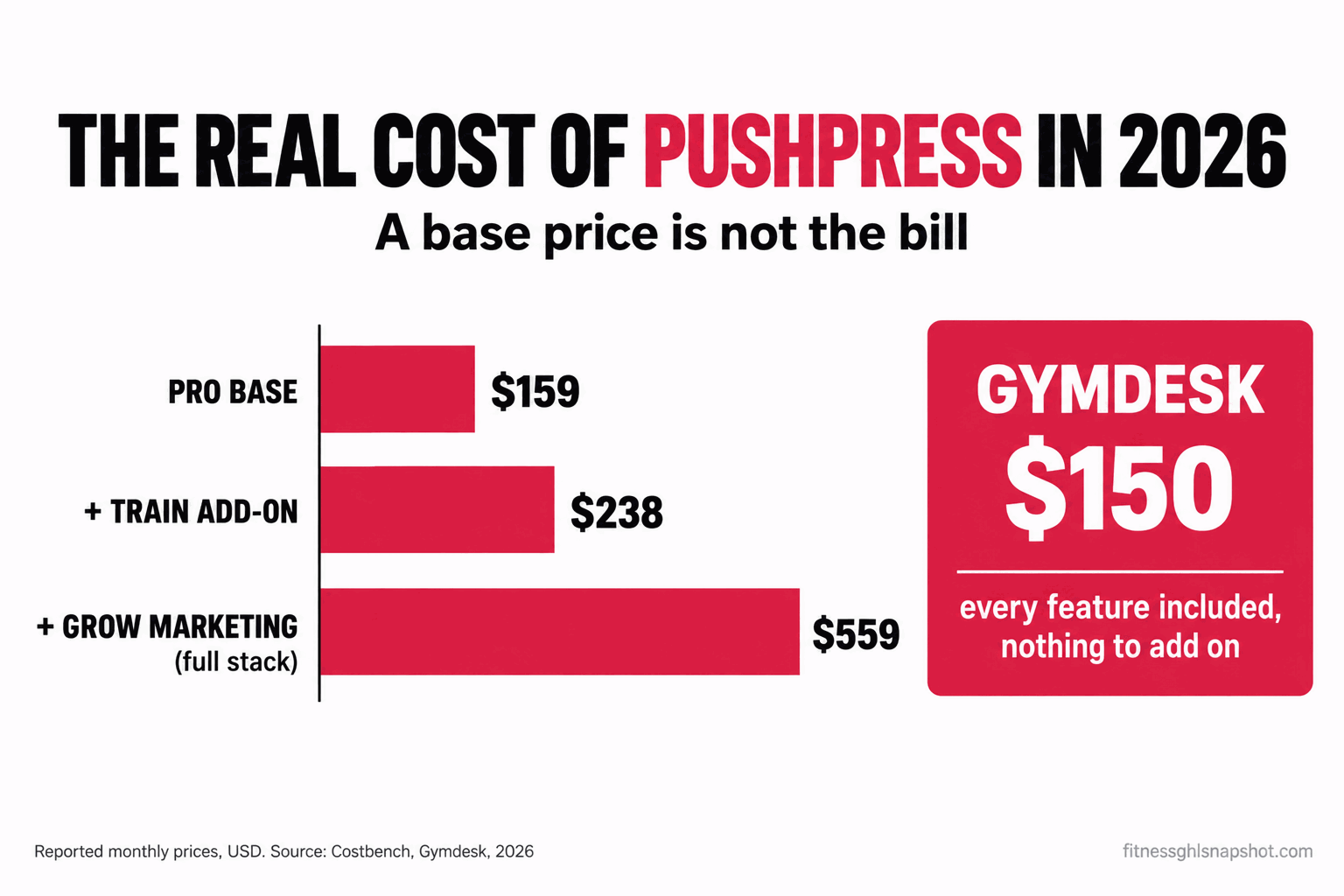
PushPress stacks hardest. The core runs the gym, but performance tracking (Train, $79 a month) and real marketing automation (Grow, $329 a month) are separate, and a branded app is another line (PushPress Grow). A completed stack lands near $559 a month (Gymdesk, 2026).
Trainerize stacks too: Advanced Nutrition is $20 to $45 a month, integrated payments and video coaching about $10 each, a branded app a $169 one-time fee. Gymdesk is the outlier, because there is nothing to add on. Every feature ships in every plan.
So a PushPress bill climbs from a $159 base to $238 with Train, then toward $559 once Grow and a branded app are on (Costbench, 2026). You budget for the base and get billed for the stack. Price the finished setup, not the front door.
5. Contracts, setup fees, and getting your data out
Gymdesk offers a 30-day free trial, no card, no contract (Gymdesk, 2026). PushPress, TeamUp, and Trainerize are month-to-month friendly at entry too, a real plus for all four over the demo-gated Mindbody tier.
How it breaks: the real switching cost is your member data, not the monthly fee. Before you sign, get the export terms for your member list, payment tokens, and attendance history in writing. A vague answer is your answer.
6. What each one is actually built for
Trainerize steps out of the ring here. It is a personal-training and online-coaching app, workout delivery, habit tracking, in-app messaging, and it is excellent at that. It is not a front desk, a class schedule, or a real gym CRM (Costbench, 2026). So the $9 price is honest for what it is and misleading as a “gym software” number. PushPress fits boxes and strength gyms, TeamUp shines for class-based studios like yoga, pilates, and martial arts, and Gymdesk is the generalist that fits most independent gyms.
How it breaks: buying Trainerize to run a 150-member gym means paying for the wrong shape.
7. Lead follow-up and speed to lead
Now the part the pricing pages go quiet on. A booking tool confirms the people who already said yes. It does not fight for the maybes.
All four send a confirmation and a class reminder. What none does out of the box is hit a brand-new web lead inside five minutes, day or night, then chase it until it books or says no. PushPress sells that separately, Grow at $329 a month, a vendor claim of “48% more leads” with no public methodology (PushPress Grow). The other three leave it to you.
The first few minutes decide the sale. A lead that sits in a form overnight is usually booked somewhere faster by morning, which is why we wrote speed to lead for gyms and a full gym lead follow-up sequence.
How it breaks: your software is a filing cabinet for leads, not a closer. The leads still rot.
8. Churn, retention, and payment recovery
The other quiet leak is on the back end. A member stops showing up two weeks before they cancel. A card fails and nobody notices. None of these four, at the base price, runs an at-risk flag before a member ghosts or a dunning sequence that saves a failed payment.
That is the shape of the category. Keeping members and recovering payments is a lifecycle layer, which is what stop silent churn and failed payment recovery for gyms are about.
Run the numbers for your gym: three scenarios
The right answer changes with your shape.
The solo or small PT team, 20 to 100 clients
You coach people and do not run group classes at scale. Trainerize is built for you: start free, grow to about $23 a month on Pro 5 (Costbench, 2026). If you book real appointments, TeamUp’s entry tier around $104 fits too. The trap: your software holds your clients, it does not find new ones, and one missed lead a week is a huge chunk of your growth.
The boutique studio, 80 to 250 members
Yoga, pilates, martial arts, a group-fitness box. Class fill and schedule sanity are the daily fight. TeamUp is strong here, around $159 a month at the 101 to 200 band (Exercise.com, 2024). Gymdesk is the all-in-one at $150 for the same size with nothing paywalled. The trap: waitlists and reminders are handled, but the trial visitor who took one class and vanished is not, and that conversion gap dwarfs the price difference between any two tools here.
The independent gym, 150 to 500 members
You have staff, a mixed base, and real failed-payment leakage. Gymdesk at $150 to $200 a month is the clean choice, features included. PushPress fits a box, but completing the stack with Grow and Train pushes you toward $559 a month. The trap: at your volume, silent churn and dunning are the whole game, and a 3 percent swing in retention outweighs every subscription decision here.
Steal this: the follow-up copy none of them writes
Here is the part worth bookmarking. A GoHighLevel system beats a bare scheduler because these fire automatically, in order, at the right minute. You can run them by hand today, but not through a busy Saturday. Swap the brackets for your details.
Instant lead reply, fires within 60 seconds of any form or DM:
Hey [First name], it’s [Your name] at [Gym]. Saw you want to try a class, love it. I’ve got two spots this week: [Day] at [Time] or [Day] at [Time]. Which works and I’ll lock it in?
Follow-up 2, if no reply, 1 hour later:
Still want that trial, [First name]? Takes 20 seconds to reserve: [booking link]. First class is on us.
Follow-up 3, next morning if still cold:
No rush [First name], but the [Day] class fills fast. Want me to hold a spot or check you for next week instead?
No-show rescue, 15 minutes after a missed trial:
We missed you at [Gym] today, [First name], all good, life happens. Want the same slot next week? Reply YES and I’ll rebook you.
Failed-payment save, the day a card declines:
Hi [First name], quick heads up: your payment this month didn’t go through, probably an expired card. Fix it in 30 seconds so your membership stays active: [update link].
Review ask, after a member hits their 10th class:
[First name], you just hit 10 classes at [Gym]. If the place has been good to you, a quick Google review helps a ton: [review link].
Six messages. None of your four tools sends all six without a paid add-on or a human remembering to. That is the whole point.
Objections owners raise before switching
“Isn’t the cheapest one just the best deal?”
No, and this is the trap the whole post catches. The cheapest sticker usually does the least or hides the most. Trainerize at $9 does not run your gym. PushPress at $0 charges 4.19% on cards and paywalls marketing. Cheapest-to-buy and cheapest-to-run are different numbers.
“I already pay for one of these, do I rip it out?”
Probably not. All four are fine schedulers. The money is not in switching tools, it is in adding the layer none of them runs: instant follow-up, no-show rescue, silent-churn flags, payment recovery. Keep your gym software and bolt the growth layer on top.
“Won’t automated texts annoy my members?”
They annoy people when they are generic blasts. They work when they are timely: a reminder before a class, a heads up that a card failed, a one-tap rebook after a no-show. Those are favors, not spam. Keep them human, keep an easy STOP, and honor the SMS consent rules.
“Do I need to be technical to run this?”
No. Nobody opening a gym signed up to build automation flows. A scheduler you configure yourself is one thing. A full follow-up and retention system is a weekend you do not have, which is the line between buying software and buying an outcome.
The gap all four leave open
Here is the honest summary. For a real gym, Gymdesk is usually the cleanest price, PushPress wins the free start, TeamUp wins full-class studios, and Trainerize is the PT app that barely belongs on a gym-software list. Pick any of them and run a tidy front desk.
But every one is a filing cabinet, not a salesperson. They record the lead, they do not chase it. They bill the card, they do not save the one that failed. That gap is where your money leaks, and comparing $150 against $159 does not fix it.
The system we build lives on GoHighLevel and fills that gap: the instant reply, the timed follow-up, the no-show rescue, the dunning save, the at-risk flag. To run it yourself, start GoHighLevel here. Disclosure: that is our affiliate link, and we may earn a commission at no extra cost to you. Pick your scheduler on price, then add the layer that grows it.
Frequently asked questions
What is the cheapest gym management software in 2026?
For a real gym, Gymdesk is usually the cheapest honest price, from $75 a month up to 50 active members with every feature included. Trainerize is cheaper on paper, from $9, but it is a personal-training app, so the low price reflects a smaller job.
Is PushPress really free?
The Core plan is genuinely $0, but free-plan card processing is reported at 4.19% + $0.30, higher than paid plans, and marketing (Grow, $329) and performance (Train, $79) are paid add-ons. A completed setup runs near $559 a month.
How does TeamUp pricing work?
TeamUp charges by active customer, anyone who booked or bought in the prior month. The 1 to 100 tier is about $104 to $119 a month, scaling to roughly $309 for 601-plus active customers.
Is Trainerize good for running a gym?
Trainerize is excellent for online and hybrid personal training, but it is not built to run a front desk, a class schedule, or a membership engine. It fits a solo or small PT team better than a 150-member gym.
Do any of these tools follow up with leads automatically?
Not out of the box in a real way. All four send a booking confirmation and a class reminder. Fast first-touch follow-up, silent-churn rescue, and failed-payment recovery are either a paid add-on or left to you, which is the gap a GoHighLevel layer fills.