
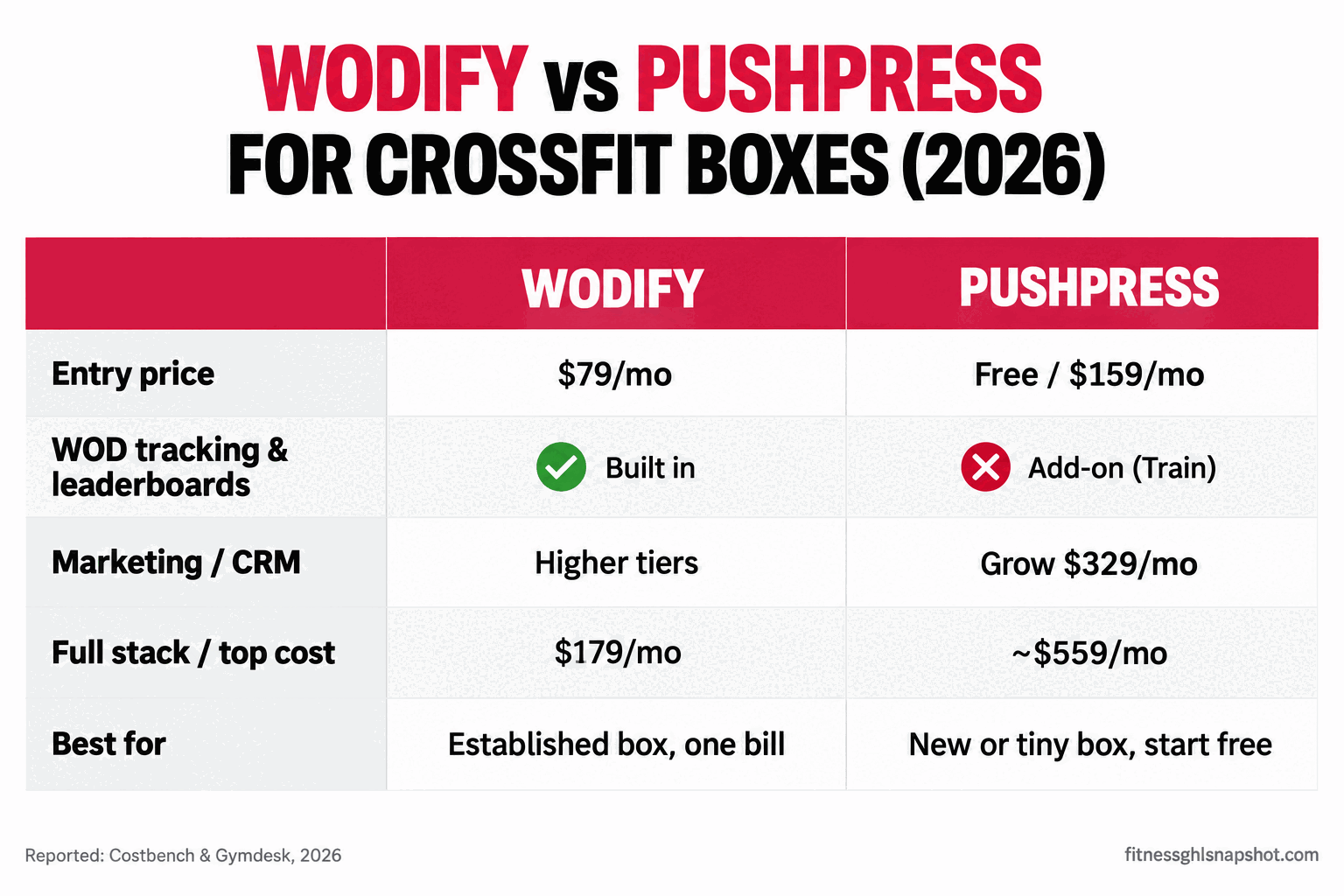
The short version: for most CrossFit boxes, Wodify is the cheaper all-in-one because WOD tracking, programming, and leaderboards are built into the base price (reported at $79 to $179 a month). PushPress has a better free tier and a cleaner core, but the parts a box needs, performance tracking and real marketing, are paid add-ons that push the true monthly cost toward $559. Pick Wodify if you want workout tracking and billing in one bill. Pick PushPress if you are tiny or want to start free. And know this up front: neither one chases your trial leads or catches a fading member, which is the hole that actually costs your box money. Below, both are scored on the eight things that decide a switch, with real prices and sources.
It is 6:05am. You just unlocked the box, and three things are already waiting: a trial lead who filled out your form at 9:48pm, a member who has not badged in for 16 days, and a payment that failed over the weekend. Your software handled none of them. You are Googling “Wodify vs PushPress” between warm-ups because the bill is due. I have run the floor at a box and rebuilt the back office for a dozen more. Here is the honest comparison, and the part most articles leave out.
Table of contents
- Why this call matters more in 2026
- The quick verdict
- The 8 things that actually decide it
- Run it for your box: three real scenarios
- Steal this: the follow-up copy neither tool writes for you
- Objections boxes raise before switching
- The gap both tools leave open
- FAQ
Why this call matters more in 2026
CrossFit is smaller than it was. The worldwide affiliate count fell from 11,366 boxes in March 2024 to 9,899 in March 2025, a 13% drop and a net loss of 1,467 gyms in twelve months, a slide most people trace to the affiliate fee jumping from $3,000 to $4,500, the first hike in more than a decade (Morning Chalk Up, 2025; Fitness Avenue, 2026).
What that means for your box is simple. When the market is shrinking, every trial lead and every at-risk member is worth more, not less. So the comparison below is not “which has more features.” It is “which one actually fits a box, at what real cost, and where does each one let you down.”
Worldwide CrossFit affiliate count, a net loss of 1,467 boxes (13%) in one year (Morning Chalk Up, 2025).
The quick verdict
Here is the call most boxes land on.
Wodify vs PushPress: the fast read for a CrossFit box
| Plan | Wodify recommended | PushPress |
|---|---|---|
| Price | $79 to $179/mo (reported) | Free, then $159 / $229/mo |
| Feature 1 | WOD tracking, programming & leaderboards built in | Performance tracking is a paid add-on (Train) |
| Feature 2 | All-in-one: scheduling, billing, CRM-lite | Clean core; marketing is Grow ($329/mo) |
| Feature 3 | Add-ons and setup raise the true cost | Strong free tier, full stack near $559/mo |
| Feature 4 | Best for: an established box that wants one bill | Best for: a new or tiny box starting free |
| See CrossFit setups | Compare the real costs |
Now the detail. For the wider market, including the demo-gated tools that will not show a number, read what gym software actually costs in 2026 and our Mindbody alternatives for small gyms.
The 8 things that actually decide it
Forget the feature-checklist drag races. These eight things decide whether your box is happy a year from now, each scored with the way it breaks.
1. Price you can actually see
Wodify is reported at three public tiers: Core (recently renamed Essentials) at $79/mo, Growth at $129/mo, and Premium at $179/mo (Costbench, 2026). That is a real change: Wodify spent years demo-gated and expensive, and it dropped its top plan from roughly $400 to $179 in early 2026.
PushPress runs a genuinely free Core plan, then Pro at $159/mo and Max at $229/mo (reported by Gymdesk, 2026). The free tier is the real headline: a box with a handful of members can run on $0 plus processing fees.
How it breaks: the sticker lies both ways. Wodify’s true cost climbs once implementation and add-ons are counted; PushPress’s climbs when you add the pieces a box needs, which is next.
2. WOD tracking, programming, and leaderboards
This is the heart of the decision, where the two tools split hardest. Wodify started as a performance-tracking tool for CrossFit athletes, and it shows. Programming, benchmark tracking, PR history, and leaderboards are baked into the product, not sold separately (Wodify, 2026). For a box whose culture lives on the whiteboard, that is the whole point.
PushPress covers the basics in its core, then sells workout tracking as a separate add-on called Train, which starts around $24/mo for up to 20 clients and scales from there (reported 2026). It works, but it is another line item and another layer to manage.
How it breaks: a box that skips Train to save money runs workouts in a spreadsheet and the leaderboard culture quietly dies. On Wodify, athletes still have to log, and if coaches do not push it, the data goes stale.
3. The member and athlete app
Members touch the app far more than you touch the admin panel. Wodify’s app carries the performance side natively: scores, history, and the leaderboard. PushPress’s member app is clean and well-reviewed for booking and payments, with performance coming through Train. PushPress holds a slightly higher public rating, 4.7 out of 5 across 185 Capterra reviews versus Wodify’s 4.5 across 154 (Capterra, 2026).
How it breaks: an app members ignore is worse than no app, because you stop trusting your own check-in data.
4. Class scheduling, booking, and waitlists
Table stakes, and both do it well. Class templates, capacity caps, reservations, and waitlists are standard on both, so the daily difference comes down to interface taste.
How it breaks: the waitlist that never auto-promotes. A spot opens, nobody gets pinged, and you run a half-empty 6am while a member sits at home assuming they did not make the cut. Confirm your tool auto-fills from the waitlist, and read how to automate class waitlists.
5. Billing, payments, and processing rates
This is the number that quietly eats the most money. PushPress publishes its processing rates: 2.89% on Pro and 2.75% on Max (reported 2026). On a box doing $30,000 a month, the gap between 2.75% and 2.9% is about $45 a month, roughly $540 a year. Wodify bundles processing into its plans with rates that are less publicly posted, so confirm your exact rate before you sign.
How it breaks: failed cards. Every box bleeds revenue through expired and declined cards that nobody chases, and neither tool’s dunning is aggressive by default. If you are not actively recovering failed payments, you lose more than you will ever save on a rate. Here is the fix: failed-payment recovery for gyms.
6. CRM, lead follow-up, and retention
Both tools are weak here, and it is the most important row in the table. Wodify includes CRM and marketing automation in its higher plans. PushPress sells it as Grow, a separate CRM and marketing add-on at $329/mo (reported 2026). On paper, both can send an email. In practice, neither was built to win the race that decides a trial: replying to a new lead in five minutes, then following up on day 1, 3, and 7 until they book. They are schedulers with marketing bolted on, not follow-up machines.
How it breaks: a lead comes in at 9pm, the automated email lands in spam, nobody texts, and by 6am the prospect has booked a trial at the box down the road. Speed is the whole game, and we break down why in speed to lead for gyms.
7. Migration cost and switching
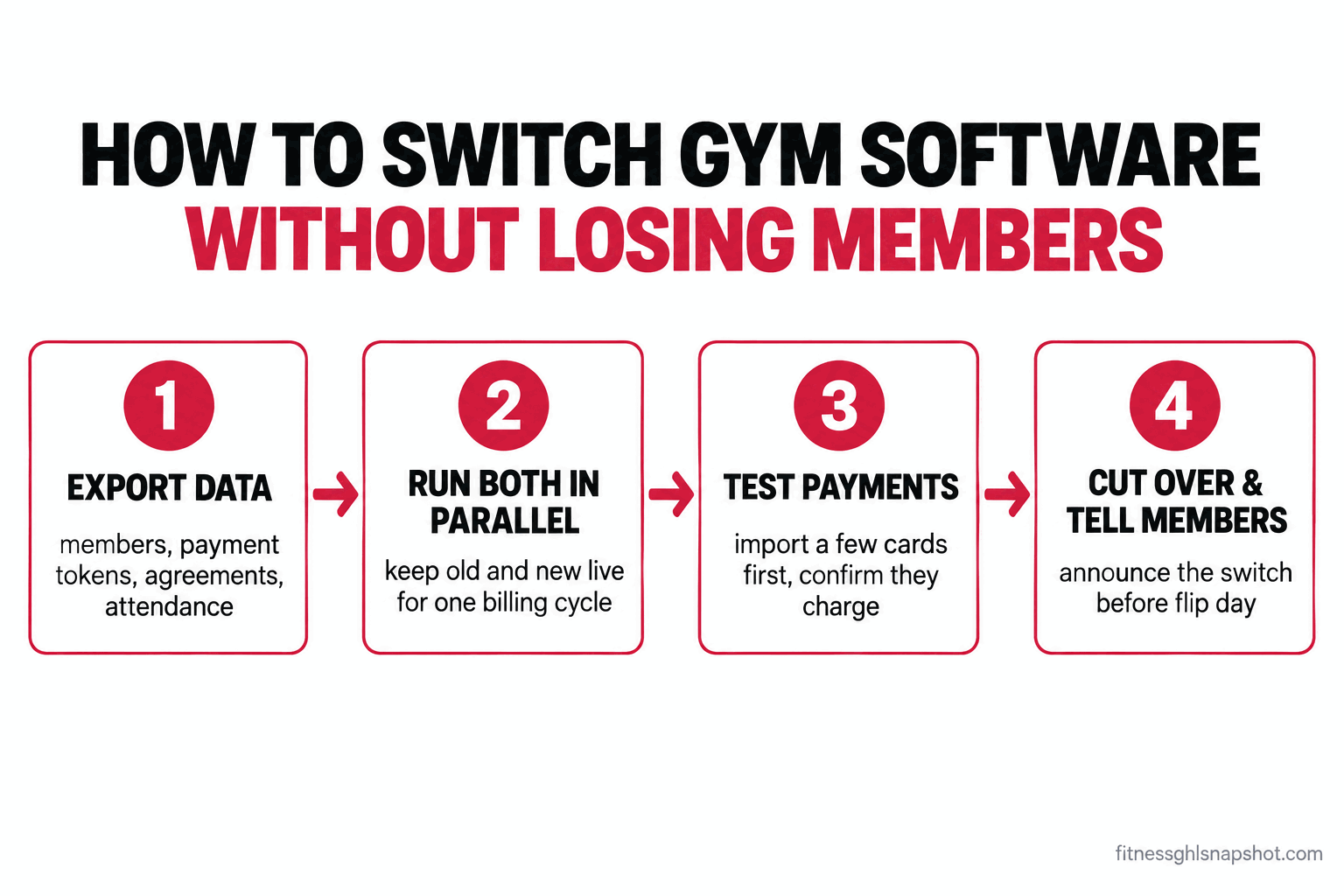
The monthly fee is the easy part; the real bill is the move. Exporting members, payment tokens, agreements, and attendance history, then re-importing them cleanly, is the hard part, and both vendors gate parts of it. Wodify’s documented hidden costs include implementation and training (Costbench, 2026). PushPress’s free tier lowers the entry cost, but you still move your data and retrain everyone.
How it breaks: you cut over on the 1st, the card tokens do not transfer, and half your members get a “payment failed” text that morning. Run both systems in parallel for a cycle, test the payment import first, and tell members before you flip the switch.
8. Support, scale, and who it is really for
Wodify positions itself as the comprehensive all-in-one and scales into multi-location. PushPress keeps a lean core and leans on add-ons as you grow: simpler at the bottom, more moving parts at the top.
How it breaks: on PushPress, growth means stacking add-ons until your “cheap” tool is the $559 full stack. On Wodify, it means paying for tiers you may half-use. Re-price every time you add a location or cross a member threshold.
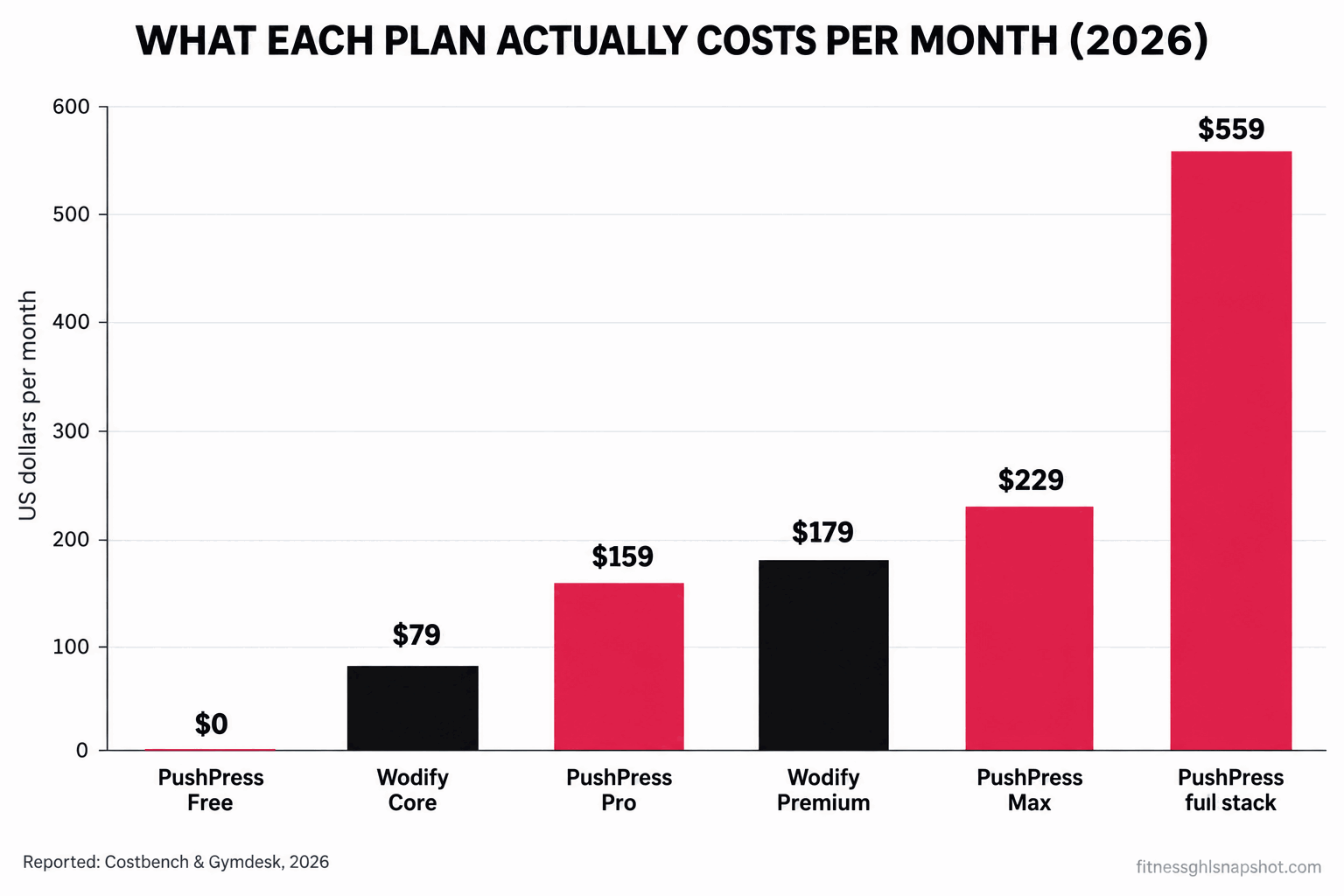
Reported entry-to-full monthly cost, US dollars. Wodify from Costbench, 2026; PushPress tiers and add-ons from Gymdesk and Costbench. Confirm live on pushpress.com/pricing and wodify.com/pricing.
Run it for your box: three real scenarios
The right answer changes with your size.
The solo coach or garage gym (under 30 members). Start on PushPress Free: scheduling and billing at $0 plus processing, and add Train later when you want leaderboards. Wodify’s $79 floor is money you do not need to spend yet. The follow-up is you, your phone, and a saved-reply template, which is fine at this size.
The single established box (150 to 300 members). Wodify’s sweet spot. WOD tracking, programming, and billing in one plan at $129 to $179 beats stacking PushPress Pro ($159) plus Train plus a marketing add-on. You want one login, one bill, and leaderboards members actually use. Do the math on your card volume and confirm the processing rate, because at this revenue it moves real money.
The multi-box operator (300-plus, or several locations). Now total cost of ownership and reporting win. Price both at your real member count across locations, because this is where PushPress’s add-on stack and Wodify’s upper tiers both get expensive. The deciding factor is no longer workout tracking, it is whether you can see revenue, churn, and lead flow across every location in one place, which both tools do least well.
Steal this: the follow-up copy neither tool writes for you
You can pick either tool perfectly and still lose, because the money leaks at the follow-up, and that is on you to build. Paste these wherever your automations live. Keep them short, human, and signed by a real coach, not “The Team.”
Missed-call text-back (fires instantly when a call goes unanswered):
Hey, this is Coach Mike at [Box]. Sorry we missed you, the floor gets loud. Did you want to grab a free intro class this week? I’ve got Tue 6am or Wed 5:30pm open. Which works?
New trial lead, within 5 minutes of the form (text, not email):
[Name], it’s Mike from [Box]. Got your request for a free class, stoked to have you in. Easiest first session is our Saturday 9am intro, no experience needed and we scale everything. Want me to save you a spot?
Trial no-show follow-up (day of, 2 hours after the missed class):
Hey [Name], we missed you at intro today, no stress, it happens. Want me to move you to this week? Tue 6am or Thu 5:30pm. Just reply with one and you’re in.
Day 7, the soft close:
Last nudge, [Name]. I’ll leave your free intro open through Sunday. If now’s not the time, no worries, I’ll check back next month.
Silent-churn check-in (fires when a member has not badged in for 14 days):
Hey [Name], noticed we haven’t seen you in a couple weeks, everything good? No guilt, life happens. If you want, I’ll put you in a specific class so you’ve got a plan to come back to. What day works?
Failed-payment recovery (fires on a declined card, friendly, not threatening):
Hi [Name], quick heads up, the card on your [Box] membership didn’t go through this month. Super common, usually just an expired card. You can update it here: [link]. Shoot me a text if anything’s weird.
Those six messages, running automatically, recover more revenue in a month than the gap between any two software prices on this page. Neither Wodify nor PushPress sends them well out of the box, which is the whole point.
Objections boxes raise before switching
“Switching sounds like a nightmare. Is it worth it?” Only if the new tool fixes a real pain, cost, missing WOD tracking, or members who hate the app. If it is, de-risk it: run both systems in parallel for a cycle, test payment imports, and warn members before you flip. The wrong reason to switch is “it’s cheaper by $40,” because migration costs more than that in time.
“Won’t members find automated texts annoying?” Not if they sound human and offer something useful. The missed-call text and trial follow-ups above get thank-yous, not opt-outs. Annoying is five identical “WE MISS YOU” blasts from “The Team.” Keep it personal, keep it scarce, and always honor STOP, which is the law under the TCPA anyway.
“Do I need to be technical to run this?” No. Both tools are built for gym owners, not engineers. The follow-up layer is more involved, and that is the part most boxes hand off rather than build.
“I already pay for one of these. Should I rip it out?” Probably not. If Wodify or PushPress runs your scheduling and billing fine, keep it. The leak at your box is almost never the scheduler, it is the follow-up layer on top, which you can add without touching what already works.
The gap both tools leave open
After you pick a winner, you have a tool that schedules classes, tracks workouts, and takes payments. What you do not have is anything that reliably answers the 9pm lead in five minutes, runs the day-1-3-7 trial follow-up, catches the member who stopped showing up, and recovers the failed card, automatically, every time.
That layer is not a feature inside a scheduler. It is a follow-up and retention system that sits on top of whatever runs your box, and for most operators it is built on GoHighLevel, where the texting, the automations, and the pipeline live. For the background, start with GoHighLevel for gyms, getting started and how to reduce no-shows. The boxes that survive a shrinking market run both layers, not just the scheduler.
The bottom line
For a CrossFit box, Wodify is usually the better all-in-one, because the WOD tracking and leaderboards your culture runs on are included, not bolted on, and its public pricing is now competitive. PushPress wins at the very bottom (start free) and for operators who want a lean core and do not mind stacking add-ons. But whichever you choose, you are choosing how your box runs, not how it grows. Keeping trials and members in a shrinking market is the real job. Choose the scheduler that fits, then go build the follow-up.
Frequently asked questions
Is Wodify or PushPress cheaper for a CrossFit box?
At the entry level, PushPress is cheaper thanks to its free Core plan, while Wodify starts around $79/mo (reported, Costbench 2026). But once you add workout tracking and marketing, PushPress sells those as add-ons (Train, and Grow at $329/mo), pushing a full stack toward $559/mo, while Wodify bundles more into its $79 to $179 tiers. Price the full setup you will run, not the entry tier.
Does PushPress track CrossFit workouts and leaderboards?
Yes, but through a paid add-on called Train, which starts around $24/mo for up to 20 clients and scales with client count (reported 2026). Wodify includes programming, benchmark tracking, and leaderboards in its base plans, because it began as a CrossFit performance-tracking tool.
Did Wodify lower its prices?
Reporting indicates Wodify moved to three public plans and dropped its top tier from roughly $400 to $179/mo in early 2026, a shift from its older demo-gated model (Costbench, 2026). Confirm current numbers on wodify.com/pricing before signing.
How hard is it to switch between Wodify and PushPress?
The monthly fee is the easy part. The real cost is migrating members, payment tokens, agreements, and attendance history, plus retraining everyone. Run both systems in parallel for one billing cycle, test payment imports first, and tell members before you cut over.
Do Wodify or PushPress follow up with my leads automatically?
Only loosely. Both include some CRM and email features (Wodify in higher tiers, PushPress via Grow), but neither was built to reply to a new lead in five minutes or run a day-1-3-7 trial follow-up reliably. That retention layer is usually built separately, often on GoHighLevel. On ratings, both are well-liked: PushPress holds about 4.7 out of 5 across 185 Capterra reviews, Wodify about 4.5 across 154 (2026).
Related reading: What gym software actually costs in 2026 · Mindbody alternatives for small gyms · Speed to lead for gyms · Stop silent churn before it costs you · CrossFit box automation setups