
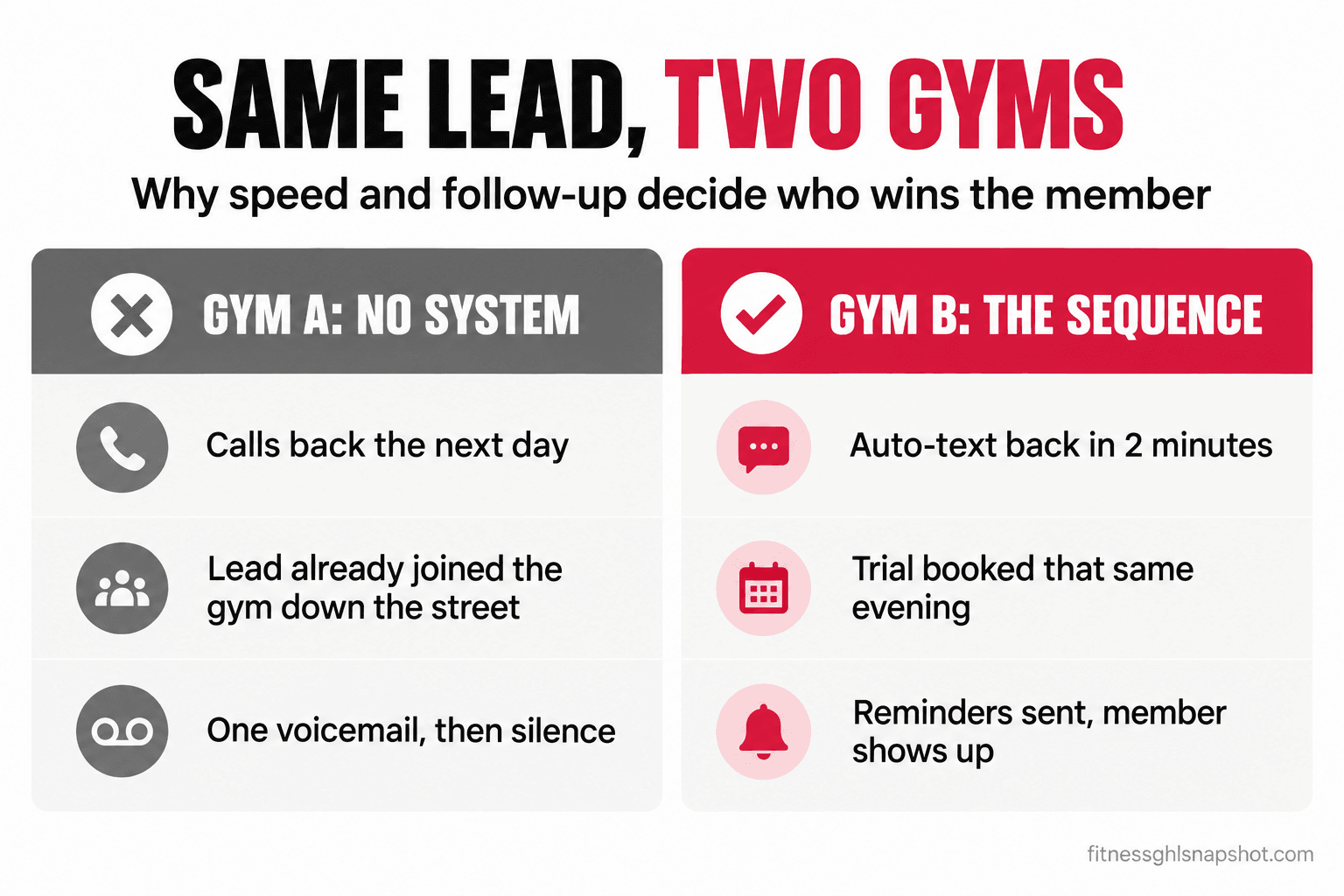
Here is the short version: most of the leads you lose, you lose in the first hour, and then again on day two when nobody follows up a second time. Someone fills out your form or DMs your page at 8pm, you see it the next morning, you call once, you get voicemail, and that is the end of it. Meanwhile they already walked into the gym down the street that texted them back in two minutes. The fix is a follow-up sequence that does what a busy owner cannot: an instant text and a call in the first five minutes, a second touch the same day, a message that answers their real objection on day two or three, a deadline on day four to seven, and a short break-up text around day 14 that pulls back more people than any of the polite ones. Build it once in text, email, and a quick call script, and it runs on every new lead automatically while you coach.
It is 6:10pm and you are spotting someone on a heavy set when the front desk phone rings. You cannot grab it. The caller does not leave a message, because almost nobody leaves a message anymore. What you do not see is that the same person filled out the contact form on three gym websites tonight, yours included, and is sitting on the couch deciding which one feels easiest to just start. The gym that texts back first usually wins, and it is rarely about who has the nicest equipment. It is about who answered.
That lost lead is the most expensive thing in your week, and it is almost entirely preventable. You already paid to get that person to raise their hand. You ran the ad, posted the reel, ranked the page. Letting the lead cool off because the desk was busy means you paid full price for the click and got nothing for it. This post is the system that closes that gap: a complete lead follow-up sequence, stage by stage, with the exact messages to steal, the timing, how each step breaks, and how it changes for a solo trainer, a boutique studio, and a multi-staff gym.
Table of contents
- Why most gym leads never book a trial
- The follow-up sequence at a glance
- Stage 1: The first five minutes
- Stage 2: Day 1, the double-tap
- Stage 3: Day 2 to 3, answer the real objection
- Stage 4: Day 4 to 7, the deadline
- Stage 5: Day 8 to 14, the break-up text
- Stage 6: After they book, make sure they show
- The same sequence at three sizes
- Steal this: the full follow-up message set
- Keep it legal: texting and emailing leads
- Objections operators raise
- FAQ
Why most gym leads never book a trial
Start with how a lead actually behaves, because once you see it you stop blaming the lead. A new inquiry is at peak interest the moment they hit send. They are on your site, they pictured themselves walking in, and for about ten minutes they are ready to say yes to almost anything. Every minute after that, interest drops. Life gets loud. A kid needs dinner, a meeting starts, the moment passes. By the next morning the person who was ready to book is now a person who vaguely remembers filling out a form somewhere.
Speed is only half the problem. The other half is that most gyms follow up exactly once. The owner calls the next day, gets voicemail, maybe leaves one, and crosses the lead off as “not interested.” But a missed call is not a no. People screen unknown numbers all day. They are not ignoring you on purpose, they are busy, and a single attempt on a single channel is almost designed to miss them. The booked trials are hiding in the second, third, and fourth touch, which is exactly where the typical gym stops.
So the leak has two holes. You are too slow on the first touch, and you quit too early on the rest. Close both and you book more trials from the exact same number of leads, with no extra ad spend. That is the whole argument for a sequence: it reacts in seconds, and it keeps politely showing up long after a human would have given up. We made the speed case in depth in speed to lead for gyms; this post is the part that comes after, the full cadence of touches that actually gets the trial on the calendar.
The follow-up sequence at a glance
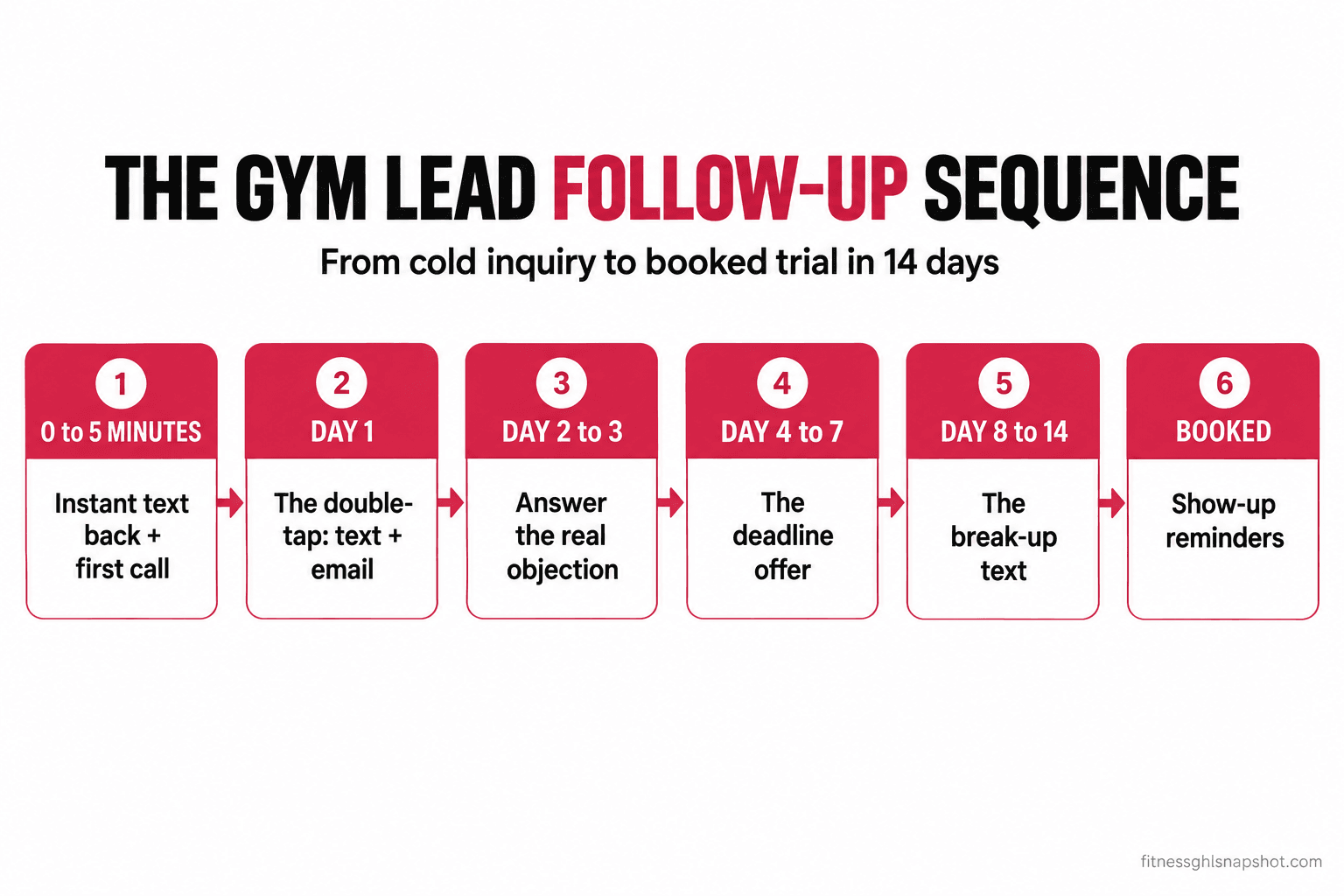
The sequence is six stages across about two weeks. Each one is a message, a call, or a short set of them, tied to a trigger: a form fill, a DM, a date, or the lead going quiet. You are not writing anything fresh each time. You write it once, decide the rules, and the system sends the right message to the right lead at the right moment, forever.
Stage 1 is the first five minutes, where an instant text and a quick call catch the lead while they are still holding their phone. Stage 2 is the rest of day one, a second touch that most gyms skip. Stage 3 is day two to three, where you stop being cheerful and name the real objection. Stage 4 is day four to seven, where a soft deadline gives the fence-sitter a reason to move now. Stage 5 is day eight to fourteen, the break-up, which quietly reactivates more cold leads than anything else in the sequence. Stage 6 kicks in the moment they book: the reminders and nudges that make sure a booked trial turns into someone who actually walks in.
The chart below shows the cadence, touches per window, so you can see the shape. Front-load the first day hard, then taper. You are not nagging. You are present when it matters and light afterward.
The recommended follow-up cadence for a new gym lead, measured in touches per window across the first 14 days. Front-load day one, then taper. Source: the sequence prescribed in this guide.
Stage 1: The first five minutes
The single highest-return thing you can do with a new lead is reply in the first five minutes, and the only reliable way to do that is to automate the first touch. The instant a form is filled or a DM lands, fire a text. Not an email, a text, because a text gets read in the moment and an email waits in a folder. Then, if someone is free, call within those same five minutes while the lead is warm.
Here is the instant text to steal:
Hey [First name], it’s [Your name] from [Gym name], thanks for reaching out! Got your note about getting started. Want me to grab you a free [intro class / trial / tour] this week? Reply with a day that works and I’ll lock it in. 💪
Short, human, one clear ask: give me a day. You are not sending a brochure. You are trying to get one reply, because the second they reply, the conversation is live and the odds of booking jump.
How it breaks. The classic failure is the text that never arrives. On a standard 10-digit business number in the US, carriers filter unregistered automated texts, so if your first message silently does not land, A2P registration is almost always why (more on that below). The second failure is a text that reads like a robot wrote it, all caps and no name, which gets ignored. The third is sending the instant text but having no human ready to actually answer when the lead replies “tonight works,” so the reply sits for three hours and the moment dies again. Automate the open, but watch the inbox, or route replies to whoever is on. If you want the deeper version of catching the ones you physically could not pick up, we wrote missed-call text-back for gyms for exactly that.
Stage 2: Day 1, the double-tap
Most leads will not reply to the first message. That is normal, not a rejection, and it is where almost every gym quits. The double-tap is a second touch a few hours later the same day, on a different channel, so you catch the people who missed or ignored the first one.
If the instant text got no reply, send a follow-up text in the early evening:
[First name], still keen to come check us out? No pressure at all. I’ve got a couple of spots this week, mornings or evenings. Which fits you better?
And pair it with a short email the same day that carries the detail a text cannot, so the lead who wants to research before replying has something to read:
Subject: Your spot at [Gym name] 🏋️
Hi [First name], great to hear from you. Here’s what your first visit looks like: [one line on the intro offer], no commitment, and a coach walks you through everything. Here’s the calendar to pick a time that works: [booking link]. Prefer to just text? Reply to my message and I’ll sort it for you.
How it breaks. The usual mistake is making the second touch a copy of the first, same channel, same words, which trains the lead to ignore you. Change the channel and the angle. The other failure is tone: by touch two some owners get pushy and the message reads as desperate. Keep it light, give an easy out (“no pressure at all”), and offer a choice rather than a demand. A choice between two times is easier to answer than an open “when are you free.”
Stage 3: Day 2 to 3, answer the real objection
By day two, a lead who has not booked is stuck on something, and it is almost never what they say. “I’ll think about it” and silence both usually mean one of three things: it costs more than I expected, I do not think I have the time, or I am nervous I will not fit in. The move on day two or three is to stop asking them to book and start naming the objection for them, so they feel understood instead of chased.
Pick the one that fits your gym and your crowd. For the nervous beginner:
[First name], real talk, most people who message us are a little nervous it’ll be too advanced or everyone will be super fit already. That’s exactly who our intro session is built for. You go at your pace, a coach stays with you the whole time. Want to come see for yourself this week?
For the time objection:
Totally get it if the week looks slammed. That’s the thing most members tell me they worried about too, and then they find the 7am or the lunch slot and it sticks. Want me to find a time that actually fits your schedule instead of the other way around?
How it breaks. The failure here is staying generic. A fourth “want to book?” on day three is noise. The objection message only works if it sounds like you have met this person, so match it to the lead source: a leg-day beginner from a Facebook ad has different nerves than a CrossFit transfer who found you on Google. The other trap is answering a price objection by caving on price immediately. Name it, reframe the value, offer the trial. Discount later, if ever.
Stage 4: Day 4 to 7, the deadline
A fence-sitter will sit on the fence forever unless something makes now better than later. By day four to seven you give them a reason to move: a soft, honest deadline. Not a fake “offer expires in 1 hour” countdown, which operators in this crowd see through instantly, but a real constraint, a class filling up, an intro offer tied to the month, a limited number of onboarding spots.
[First name], quick heads up, I’m holding one of this week’s free intro spots for you but I can only keep it til Friday before I open it back up. Want me to lock it in? Takes 10 seconds: [booking link]
If your offer is monthly, tie it to the calendar honestly:
[First name], our new-member intro rate is set for [month] and it changes on the 1st. If you’ve been meaning to start, now’s the cheapest it’ll be. Want me to get you in before then?
How it breaks. Fake urgency is the fastest way to lose a skeptical lead, and gym shoppers are skeptical because every gym has cried wolf. If you say Friday, mean Friday. The second failure is making the deadline about you (“I need to hit my numbers”) instead of them (“I’m holding your spot”). Frame it as doing them a favor by reserving something, because that is what a held spot is.
Stage 5: Day 8 to 14, the break-up text
The break-up is the message nobody wants to send and the one that quietly outperforms every polite check-in. After a week of no reply, a lead has filed you under “not now.” A cheerful “just checking in!” confirms that filing. A break-up does the opposite: it signals you are about to stop, and people hate losing an option they have not consciously closed.
[First name], I don’t want to keep bugging you, so I’ll close out your file for now. If getting started is still on your list, just reply “yes” and I’ll hold a spot. Otherwise no worries at all, the door’s always open. 🙌
That is it. Short, warm, zero pressure, and a one-word reply to re-open. The surprising part is how many people answer “yes” to a message that offers to go away. You gave them a clean, low-effort moment to decide, which is what they needed all along.
How it breaks. Owners soften the break-up until it is just another check-in (“but if you ever want to, no rush, whenever!”), which kills the one thing that makes it work: the sense that this is the last one. Let it be the last one. The second failure is sending it too early, on day three, when the lead is still warm. Give the earlier stages room to work first. And when someone does reply “yes,” treat it like a brand-new hot lead and jump straight back to Stage 1 speed.
Stage 6: After they book, make sure they show
Booking is not the finish line. A booked trial that no-shows is the same lost lead with extra steps, and intro no-show rates are brutal when nothing reminds the person. The moment a lead books, a second mini-sequence should start: an instant confirmation, a reminder the day before, and a nudge a couple of hours out.
Confirmation: You’re in, [First name]! 🎉 [Day] at [time] with [Coach]. Wear comfy clothes, bring water, show up 10 min early so we can get you set up. Reply here if anything changes.
Day before: Looking forward to seeing you tomorrow at [time], [First name]! We’re at [address]. Parking’s [one line]. Text me if you need anything.
2 hours before: See you at [time], [First name]! Your coach [name] is ready for you. 💪
How it breaks. The big one is no reminder at all, which is where most intro no-shows come from. The second is reminders with no path to reschedule, so a lead whose plan changed just ghosts instead of moving the time. Always include “reply if anything changes,” because a rescheduled trial is a kept lead and a silent no-show is a lost one. For the full playbook on this stage, including win-backs for the ones who still miss, see how to reduce gym no-shows. And once they show and love it, the job shifts to closing them into a membership, which is its own art covered in the trial-to-member conversion playbook.
The same sequence at three sizes
The sequence is the same shape at every size, but who runs it and how heavily you automate changes with your setup.
Solo trainer or small PT team (20 to 100 clients). You are the front desk, the coach, and the closer, so the instant text has to be automated or it will not happen while you are mid-session. Automate Stage 1’s text and the Stage 6 reminders at a minimum, and keep the day-2 through day-14 touches as pre-written templates you fire in a couple of taps between clients. You do not need a big system, you need the first touch off your plate and the words already written so following up takes seconds, not a blank-page decision at 9pm.
Boutique studio (80 to 250 members, a couple of instructors). Now volume is enough that templates alone get messy, and a lead can slip because nobody was sure whose job it was. Automate Stages 1, 2, 5, and 6 fully, and route live replies to whoever is working the desk that shift. The objection message in Stage 3 is where a human touch pays off, so have an instructor personalize it. Your edge over the big-box down the road is that a real person answers fast, so protect the speed and let automation handle the reminders.
Multi-staff gym (150 to 500 members, 3 to 10 staff). Here the risk is leads falling between people. Automate the whole sequence, assign every new lead an owner the moment it comes in, and track where each one is so two staff do not text the same person or, worse, nobody does. This is where a real CRM earns its keep: it fires the cadence, logs every reply, and tells you which lead sources actually book so you stop spending on the ones that do not. If your current tool cannot do that, the SMS automation and AI caller pieces are the parts to add first.
Steal this: the full follow-up message set
Here is the whole sequence in one place, ready to paste into your tool and swap in your details. Build the automated pieces first (the instant text and the booking reminders), then load the rest as templates.
Keep it legal: texting and emailing leads
Every message above is an automated text or email to a lead, and both are governed by law in the US. None of this is legal advice, check your own setup, but here is what follow-up touches.
First, texting consent. Under the Telephone Consumer Protection Act, a reply to someone who just messaged you and handed over their number is on far safer ground than a cold promotional blast. When a lead fills out your form or texts your line, capture clear consent to be contacted, keep marketing messages separate from the transactional replies, always include an opt-out, and honor STOP instantly. The FCC lays out the texting consent framework in its text-messaging rules, and the TCPA allows statutory damages of $500 to $1,500 per message, so this is not a corner to cut.
Second, A2P 10DLC. US carriers require any business sending application-to-person texts over a standard 10-digit number to register its brand and campaigns with The Campaign Registry, and unregistered traffic gets filtered or blocked outright. If your instant text-back silently is not arriving, this is the usual reason. Register before you scale, not after you have lost a month of leads to a filter.
Third, email. Your follow-up emails are governed by CAN-SPAM, which the FTC summarizes in its compliance guide: an accurate sender and subject line, a physical mailing address, and a working unsubscribe you honor. Keep it clean even on the friendly stuff.
Fourth, a myth worth clearing, because it rattles operators. There is no federal “click-to-cancel” rule in force in 2026. The FTC’s version was vacated by the Eighth Circuit on July 8, 2025, and while the agency has signaled it may try again (Crowell & Moring), nothing is in effect now. State auto-renewal laws and the FTC Act still apply, so keep cancellation genuinely easy regardless, which we cover in gym membership cancellation and auto-renewal law in 2026.
Objections operators raise
“Won’t all these messages annoy people and make us look desperate?” Not when they are spaced and warm. A fast reply, one same-day nudge, a message that actually understands why they are hesitating, and a clean break-up are helpful, not annoying. The desperate version is five identical “want to book?” texts in two days. The sequence above changes channel and angle each time and always gives an easy out. People tell you the break-up text in particular is the reason they finally came in, because it was the first one that did not feel like a sales pitch.
“I already text leads back. Isn’t that follow-up?” Texting back once is the first five minutes of a two-week job. The leads you are losing are the ones who did not reply to that first text, and a single message never reaches them. Follow-up is the second, third, and fourth touch across text, call, and email, on a schedule, including the people who went quiet. That is the part a one-off reply never covers, and it is where the booked trials are.
“Do I need to be technical to set this up?” No. Every stage is a trigger and a message: on form fill, send this; a few hours later, send that; when they book, start the reminders. You are deciding the rules and writing the copy, not coding. You can build the simple pieces in whatever tool you already use over a weekend, or have the whole sequence installed done-for-you and wired to your forms, DMs, and calendar.
“My gym software already sends reminders. Why do I need more?” Your booking tool can probably send a reminder for a booked appointment. Platforms like PushPress, Gymdesk, and TeamUp all handle basic member messaging. What they usually do not do on their own is run the whole lead cadence: instant-text a brand-new inquiry in seconds, follow up the ones who ghost, fire the objection message, send the break-up, and tell you which lead sources actually book. Keep the tool that runs your schedule and billing, and add the follow-up layer around it.
The bottom line
Go back to that 6:10pm phone call you could not take. In a gym with no sequence, that lead gets a voicemail the next morning, no reply, and a line through their name, while they are already training somewhere that texted back. In a gym with the sequence wired up, that same lead got a friendly text two minutes after they hit send, a second nudge that evening, a message on day two that named exactly why they were hesitating, a held spot on day five, and a warm break-up on day twelve that finally got a “yes.” They booked, got three reminders, showed up, and loved it.
Same lead. Same gym. Same ad spend. The only difference is that somebody followed up, on time, more than once, while the lead was quietly deciding. You cannot do that reliably from the floor with a client in front of you. A sequence can, and it does it for every new lead, forever, once you build it once.
Frequently asked questions
What is a gym lead follow-up sequence?
A gym lead follow-up sequence is an automated and templated series of texts, emails, and calls sent to every new inquiry over about two weeks, triggered by what the lead does. It typically includes an instant text and call in the first five minutes, a second touch later the same day, a message on day two or three that addresses the lead's real objection, a soft deadline on day four to seven, a short break-up text around day eight to fourteen, and, once they book, a set of reminders that make sure they actually show up. The goal is to catch the lead while interest is high and keep showing up long after a busy owner would have given up, so more inquiries turn into booked trials from the same amount of marketing.
How fast should a gym respond to a new lead?
As close to immediately as possible, ideally within five minutes, which is why the first touch should be automated. A new lead is at peak interest the moment they submit a form or send a DM, and interest drops quickly after that as life gets in the way. A text that fires back in two minutes catches them while they are still holding their phone and deciding, while a callback the next morning often reaches someone who has already contacted other gyms or lost the moment entirely. Automate the instant text so speed does not depend on whether you happened to be near the phone.
How many times should you follow up with a gym lead before giving up?
Plan for at least five or six touches across the first two weeks, not one. Most gyms contact a new lead once, get voicemail or silence, and quit, but a single attempt on a single channel misses most people, who screen unknown numbers and get busy. A practical cadence is two touches in the first day, one on day two or three, one on day four to seven, and a break-up message around day eight to fourteen. Spread across text, call, and email, and always give an easy opt-out so the follow-up stays welcome rather than annoying.
What is a break-up text and why does it work?
A break-up text is a short, warm message sent after about a week of no reply that signals you are about to stop following up, usually along the lines of closing out their file unless they reply to keep it open. It works because people dislike losing an option they have not consciously decided to close, so offering to go away often prompts the reply that cheerful check-ins never got. Keep it genuinely light with a one-word path back in, and when someone answers, treat them like a brand-new hot lead and respond with the same speed you would a fresh inquiry.
Is it legal to send automated texts to gym leads?
Yes, when done correctly. Under the TCPA, replying to someone who just contacted you and shared their number is on much safer footing than a cold promotional blast, but you should still capture clear consent, keep marketing messages separate from transactional replies, include an opt-out, and honor STOP instantly. US carriers also require businesses to register their brand and campaigns for A2P 10DLC or texts get filtered. Follow-up emails fall under CAN-SPAM, so use an accurate sender and subject, include a physical address, and honor unsubscribes. TCPA statutory damages run $500 to $1,500 per message, so consent and opt-out are not optional. This is general information, not legal advice.
Can I build a lead follow-up sequence in my existing gym software?
Often partly. Most gym and booking platforms can send a reminder for a booked appointment and a basic welcome, but many cannot run the full lead cadence on their own: instant-texting a brand-new inquiry within seconds, following up the leads who go quiet, firing an objection message, sending a break-up, and reporting which lead sources actually book trials. A common setup is to keep the software that runs your schedule and billing and add a dedicated automation layer on top for the lead follow-up, or to deploy a prebuilt sequence that installs the whole cadence and wires into your forms, DMs, and calendar.
Written by Bryce Kendrick, Fitness Growth Strategist. Bryce spent eight years running the floor and front desk at a fast-growing CrossFit box before moving full-time into automation for gyms. He obsesses over the seven days around a prospect’s first contact, and he writes the way he coaches: direct, numbers-first, and allergic to fluff.
Related posts
- Speed to Lead for Gyms: Why the First 5 Minutes Decide Who Becomes a Member
- Missed-Call Text-Back for Gyms: Turn Every Unanswered Call Into a Booked Trial
- How to Reduce Gym No-Shows: The Complete 2026 Playbook
- The Trial-to-Member Conversion Playbook
- The Gym Member Onboarding Sequence: The 90-Day Text and Email System