
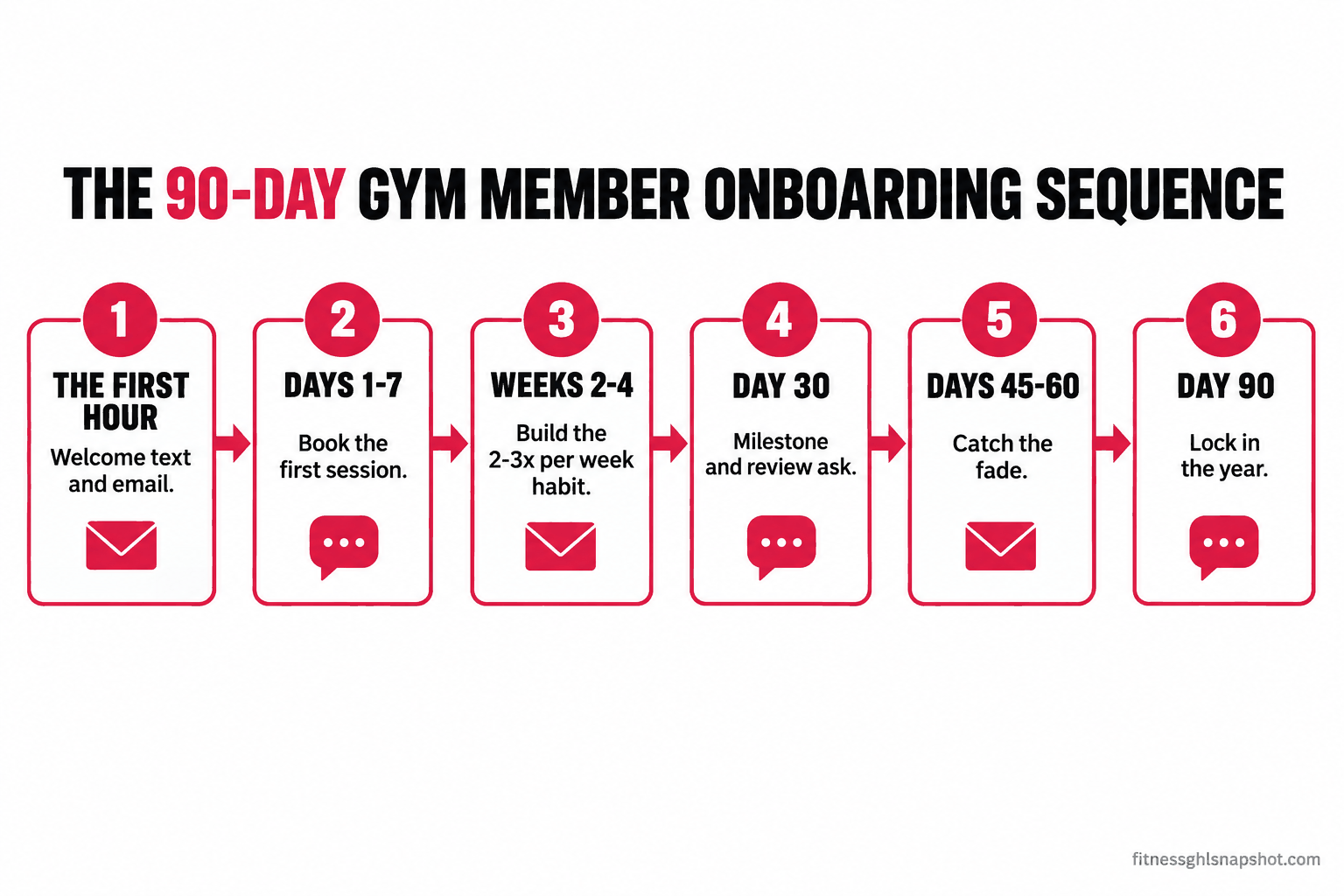
Here is the short version: most of the members you lose, you lose in the first 90 days, and you lose them quietly. They sign up excited, come twice, hit a week where life gets busy, feel awkward about being gone, and never come back. No cancellation call, just a card that keeps billing until they notice and kill it. The fix is an onboarding sequence that does the follow-up a busy front desk cannot: a warm welcome in the first hour, a nudge to book the first real session, a check-in after that first workout, a push to hit the three-visits-a-week habit, a 30-day milestone, a catch for the fade around day 45, and a 90-day checkpoint that locks in the year. Set it up once in text and email, and it runs on every new member automatically while you coach.
It is Tuesday morning and you are looking at last month’s numbers. Twenty-two new members signed up in January. It is now April, and nine of them have not badged in since mid-February. Three already cancelled. The other six are still paying, for now, but you know how this ends, because you have watched it happen every year. They were not unhappy. Nobody complained. They just drifted, and nobody reached out while they were drifting, because the front desk was busy checking in the people who did show up.
That drift is the most expensive thing in your gym, and it is almost entirely preventable. A member who builds a routine in their first month stays for a year. A member who never builds one is gone by spring, and you paid to acquire every one of them. This post is the system that closes that gap: a complete member onboarding sequence, stage by stage, with the exact messages to steal, the timing, how each step breaks, and how it changes for a solo trainer, a boutique studio, and a mid-size gym.
Table of contents
- Why the first 90 days decide whether a member stays
- The onboarding sequence at a glance
- Stage 1: The first hour, before the excitement fades
- Stage 2: Days 1 to 7, get them to a real first session
- Stage 3: Weeks 2 to 4, build the habit
- Stage 4: Day 30, the first milestone and the review ask
- Stage 5: Days 45 to 60, catch the fade
- Stage 6: Day 90, lock in the year
- The same sequence at three sizes
- Steal this: the full onboarding message set
- The compliance note you cannot skip
- Objections operators raise
- FAQ
Why the first 90 days decide whether a member stays
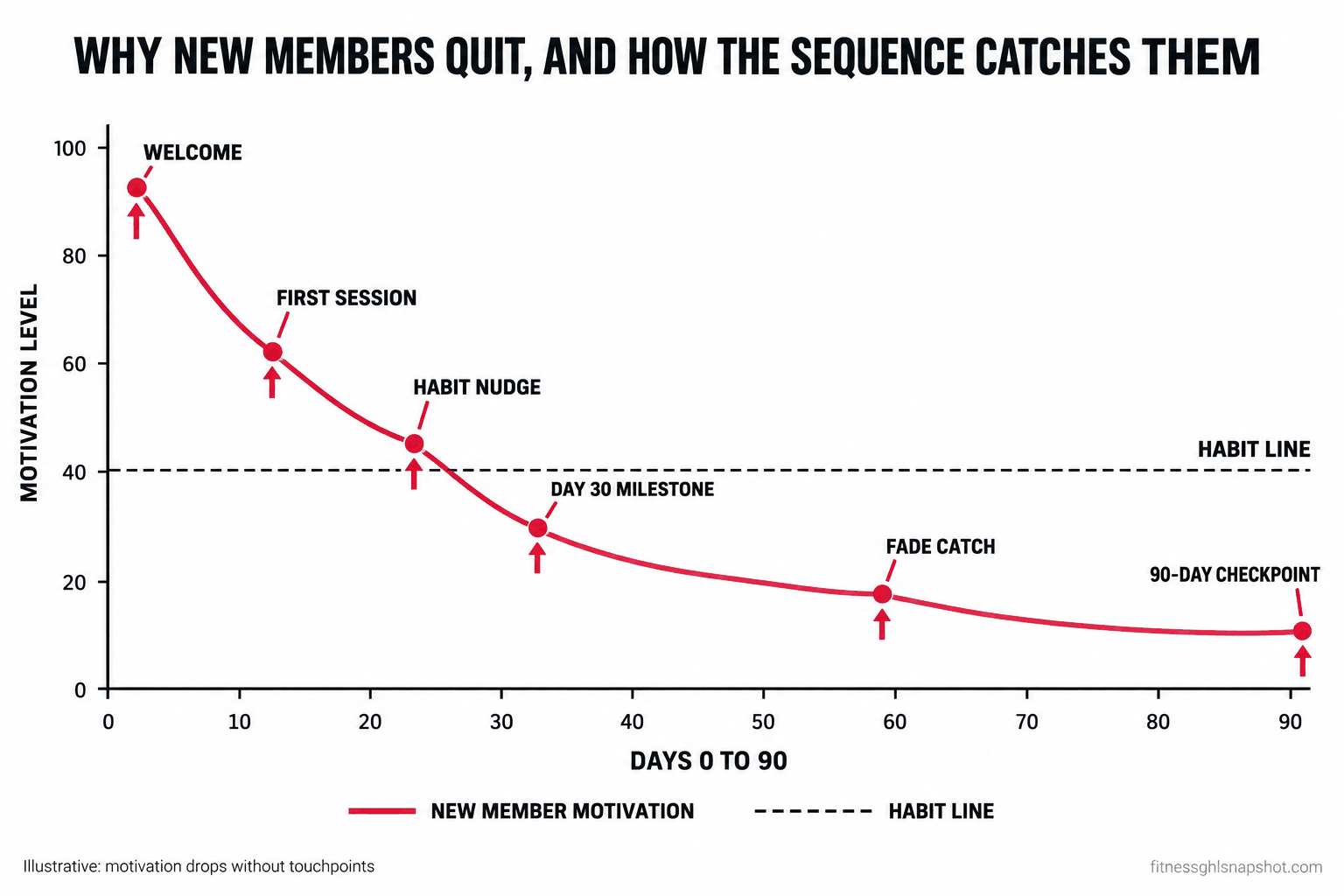
Start with the pattern, because once you see it you cannot unsee it. A new member’s commitment is highest the day they sign up and drops a little every day after unless something keeps it up. The job of onboarding is to turn that first burst of motivation into a habit before it runs out. Miss the window and no retention campaign in the world saves you, because the member has already decided, in their own head, that this is not part of their life.
The mechanism is habit. A member who gets to the gym two or three times a week for their first month has wired it into their routine. The gym is now a place they go, like work or the grocery store. A member who comes twice and then has a busy week has nothing wired in, and the gap grows. By the time they have been gone three weeks, coming back feels like starting over, and starting over feels like admitting they failed. So they do not come back, and they do not call. They just let the membership run until they get around to killing it. That is silent churn, and it is the bulk of what you lose. We wrote the deeper version of catching it in stop silent churn before it hits your billing report.
The money is brutal because you already paid for these people. You ran the ads, did the trial, closed the sale. Losing them in month two means you paid full acquisition cost for a month or two of dues, while keeping them to twelve months is where a member actually becomes profitable, which is the whole argument behind member lifetime value. And the lever that moves 90-day retention is not a better app or a nicer lobby. It is whether anyone reached out, on time, while the member was deciding.
The onboarding sequence at a glance
The sequence is six stages across the first 90 days. Each one is a message, or a short set of messages, tied to a trigger: a signup, a date, a visit, or the absence of a visit. You are not writing anything new each time. You write it once, and the system sends the right message to the right member at the right moment, forever.
Stage 1 is the first hour, while they are still excited. Stage 2 is the first week, where the only goal is getting them to one real session. Stage 3 is weeks two to four, where you build the two-to-three-visits-a-week habit that predicts the whole year. Stage 4 is the 30-day mark, a milestone and your best shot at a five-star review. Stage 5 is the day-45-to-60 danger zone, where you catch members whose visits are dropping before they ghost. Stage 6 is the 90-day checkpoint, where a member who made it this far gets locked in for the long haul. You do not need all six live on day one. If you build only two, build Stage 2 and Stage 5, because those catch the most members.
Stage 1: The first hour, before the excitement fades
The moment someone signs up, they are as motivated as they will ever be. That is the moment to reach them, not three days later with a generic “welcome to the family” blast. The first-hour touch does three jobs: it confirms they made a good decision, it tells them exactly what happens next, and it removes the small frictions that stop a nervous beginner from ever walking in.
Send two things. A short text within minutes, warm and human, from a real name at the gym. Then an email within the hour with the detail: how to book, what to bring, what to expect on a first visit, where to park, and one clear next step. The email is where you kill the anxiety a new member will not admit to, which is that they do not know how any of this works and feel stupid asking.
How it breaks. The classic failure is silence. The member signs up online at 9pm and hears nothing until a mass newsletter the following week, by which point the excitement is gone and the doubt has moved in. The other break is the opposite: a wall of automated emails in the first hour that reads as spam, not welcome. One good text and one good email beat six robotic ones.
What to do. Trigger a text and an email off the signup itself, both within the hour, both signed by a person. Make the single next step obvious: book your first session. That is the only thing Stage 1 needs to accomplish. Everything else is setup for it.
Stage 2: Days 1 to 7, get them to a real first session
Nothing in onboarding matters more than the first real session. A member who trains once in their first week has started. A member who signs up and never comes in has already churned, they just do not know it yet. So the entire first week bends toward one outcome: get them in the door for one proper workout, class, or session.
If they booked during Stage 1, your job is to make sure they show. Send a reminder the day before and the morning of, the same way you would for any booking, because a no-show on a first session is a member you will probably never see. The reminder mechanics are the same ones that cut no-shows across your whole schedule, covered in how to reduce gym no-shows. If they did not book during Stage 1, the week is a gentle, escalating nudge to pick a time, ending with a direct offer of help: reply with your availability and we will book it for you.
After the first session, the follow-up is immediate and personal. A same-day “great first session, here is what I would do next” text turns a one-time visit into a second booking. This is the hinge of the whole sequence.
How it breaks. Two ways. First, you let the booking sit without reminders and the member no-shows the one session that would have hooked them. Second, you get them in for session one and then go quiet, so there is no momentum into session two. A single visit with no follow-up is a dead end.
What to do. Chain reminders onto the first booking, then fire a same-day post-session text that praises the effort and proposes the next session with a specific time. Speed and specificity are everything here, the same principle as speed to lead applied to a brand-new member instead of a brand-new lead.
Stage 3: Weeks 2 to 4, build the habit
This is the stage that decides the year, and it is the one almost every gym skips. After the first session, the member needs to come back, and back again, until showing up stops being a decision and starts being a routine. The target is simple and backed by how habits actually form: two to three visits a week for the first month. Hit that and the membership is sticky. Miss it and you are relying on willpower, which always runs out.
Your sequence watches visit frequency and responds to it. A member who is hitting their rhythm gets encouragement and a nudge toward a goal or a class they have not tried. A member who came once and then went quiet for five days gets a warm, low-pressure “we saved your spot” message before the gap becomes a canyon. You are not nagging. You are making it easy and normal to come back, and you are doing it based on what the member actually does, not on a fixed calendar.
How it breaks. The big failure is treating everyone the same. A member crushing it and a member who vanished after one visit should not get the same email. The other break is waiting too long: a five-day gap in week two is recoverable with a friendly text, but a three-week gap usually is not. The whole point of watching frequency is to act while the gap is still small.
What to do. Segment new members by visits in the trailing seven days. Encourage the active ones toward a second weekly class or a small goal. Re-invite the fading ones fast, with a specific easy next session, before the gap closes the door. The habit you build in weeks two to four is the member you keep in month ten.
Stage 4: Day 30, the first milestone and the review ask
Thirty days in, a member who has been showing up has something worth celebrating, and you should celebrate it. A milestone message at day 30 does two things: it makes the member feel seen, which deepens the relationship, and it is the single best moment to ask for a review, because the member is as happy with you as they are likely to be.
The milestone is a warm, specific note: you have been in X times this month, that is real, here is what is next. For a member who hit their stride, follow it a day or two later with a review ask, because a fresh, genuinely happy member is where five-star reviews come from. Timing the ask to a high point is the entire trick, and it feeds the local-visibility flywheel that brings you the next member.
How it breaks. Asking everyone for a review regardless of behavior. A member who came twice all month and is already drifting does not need a review request, they need a re-engagement message, and asking them to review you is tone-deaf. The other break is a milestone that is obviously automated and generic, which does the opposite of making someone feel seen.
What to do. Fire the 30-day milestone only for members above an attendance threshold, personalize it with their real visit count, and chain the review ask a day later for the happy ones. Route anyone below the threshold into the Stage 5 fade-catch instead. Keep the two paths separate.
Stage 5: Days 45 to 60, catch the fade
This is the stage that saves the most members, and the one that pays for the whole system. Around the six-week mark, the first rush of motivation is spent, real life has reasserted itself, and the members who did not fully build the habit start to slip. Their visits drop from three a week to one, then to none. This is the fade, and it is your last clean shot before it turns into silent churn.
The trigger is behavioral, not calendar-based. When a member who was active drops below their own baseline, say they have not been in for seven to ten days after a month of regular visits, the system reaches out. Not with a guilt trip. With a specific, easy, no-pressure way back in: a saved spot, a favorite class, an offer to adjust their plan, a check that nothing is wrong. Sometimes the fade is a schedule change you fix by switching their class time, sometimes an injury that needs empathy and a path back. You only find out if you reach out.
How it breaks. Reacting too late is the number one failure. A gym that only notices a member is gone when the card declines is months behind. The second break is a cold, mass “we miss you” email that reads as marketing, which a fading member ignores. The message has to feel like a person noticed, because a person (or a system acting like one) did.
What to do. Build a trigger on a drop in visit frequency and fire a warm, specific re-engagement message fast, ideally one that offers a concrete next session or a plan tweak. Done at day 45, this is a save. Done at day 120, it is a win-back campaign, which works too but is far harder. Catch the fade early and you keep members you would otherwise have quietly lost.
Stage 6: Day 90, lock in the year
A member who is still training regularly at 90 days has crossed the line. The habit is built, the gym is part of their week, and the odds they stay a full year are now strongly in your favor. Stage 6 is not about saving this member, it is about deepening the relationship and turning a happy, established member into something more valuable: a referrer, an upgrade, a long-term commitment.
The 90-day message acknowledges the milestone honestly (three months, that is a real commitment, most people never get here) and opens a door. Depending on your model, that door is a referral ask (your happiest members know people like them), a conversation about a goal or a program upgrade, or a nudge toward an annual plan if that fits. This is also the natural moment to make sure their billing is healthy, because an established member lost to a failed card is the dumbest churn there is, and it is fully preventable with failed payment recovery.
How it breaks. Treating day 90 as the finish line and going silent again. Onboarding hands off to ongoing lifecycle communication, it does not just stop. The other break is pushing an upsell on a member who is not ready, which can sour a good relationship. Read the behavior, lead with the acknowledgment, and let the ask be secondary.
What to do. Fire a genuine 90-day milestone, make a single appropriate ask based on the member’s behavior and your model, and roll the member into your normal ongoing communication so the relationship keeps going. A member you onboarded well for 90 days is the member who renews, refers, and quietly pays your rent for years.
Illustrative: share of new members still active at 90 days, grouped by how often they trained in their first month. The shape is the point, more early visits means more members who stay, which is why the whole sequence bends toward building a two-to-three-visit-a-week habit fast. These are example numbers to show the relationship, not a benchmark. Measure your own cohorts.
The same sequence at three sizes
The six stages are universal. How you run them, and which ones matter most, changes with the size of the operation. Every figure here is illustrative. Run your own.
The solo trainer or small PT team (20 to 100 clients)
You are the relationship, so your sequence is lighter and more personal. You do not need a 30-day milestone automation when you see every client in person. What you do need is the first-hour welcome, the first-session push, and the fade-catch, because even with a small book, a client who quietly stops booking is money you feel immediately. Automate the reminders and the “you have not booked this week” nudge so a busy stretch does not let a client slip. Keep the personal touches personal and let the system cover the follow-up you drop when you are training all day.
The boutique studio (80 to 250 members, 2 to 8 instructors)
This is where the full sequence earns its keep, because your model lives on members building a class habit and you have too many new signups to track by hand. All six stages matter. The habit-building stage (weeks two to four) is your highest-value work, since a member who finds two or three classes a week they love is a member for a year. Wire the sequence to class attendance, lean on the 30-day review ask to feed your local reputation, and make the fade-catch fast, because in a class model a member who stops booking disappears quietly and fast. This is the same demand you already paid to acquire, kept instead of lost.
The mid-size or multi-location gym (250 to 500-plus members)
At your volume onboarding is a systems problem. You cannot personally welcome 40 new members a month, so the sequence has to be reliable, segmented, and consistent across locations. Behavioral triggers (visits in the trailing week, drops below baseline) do the watching no front desk can do at scale. Your biggest risk is inconsistency: a member onboarded well at one location and ignored at another. Standardize the sequence, measure 90-day retention by cohort and location, and treat the fade-catch as core infrastructure. Tie it to your billing health so an established member is never lost to a preventable failed card, and pair it with the seasonal reality that the January rush collapses by March unless onboarding is this tight.
Illustrative: 90-day retention for a new-member cohort before and after wiring up the onboarding sequence. The gain comes from catching members during the fade and building the early habit, not from new signups. Illustrative only, measure your own before-and-after.
Steal this: the full onboarding message set
Here is the sequence as copy. Change the names, times, and details, keep the structure, and load it into whatever runs your texting and email. These are the exact messages that turn a nervous signup into a 12-month member.
Stage 1, the first-hour welcome text (within minutes of signup):
Hey [First name], it’s [Coach] from [Gym]. So glad you joined! Your first session is the most important one, let’s get it on the calendar. Reply here or tap to book a time that works: [link]
Stage 1, the first-hour welcome email (within the hour):
Subject: You’re in, [First name]. Here’s exactly what happens next. Welcome to [Gym]! Here’s everything for your first visit so you can walk in knowing the drill: how to book, what to bring, where to park, and what your first session looks like. No experience needed, we’ve got you. Your one next step: book your first session here [link]. Can’t find a time? Just reply to this email and we’ll sort it with you.
Stage 2, the day-before first-session reminder text:
[First name], you’re booked for [6pm tomorrow] at [Gym]. Wear comfy clothes, bring water, and show up 10 min early so [Coach] can walk you through it. Can’t make it? Tap to reschedule, don’t cancel on your first one: [link]
Stage 2, the same-day post-first-session text:
Great first session, [First name]! You showed up and that’s the hard part. Let’s keep the momentum, want to grab [Thursday 6pm] for round two? Tap here: [link]
Stage 3, the habit nudge for an active new member:
[First name], three sessions this week, you’re building something real. Most people who get to 2-3 times a week in month one stick with it for the long haul. Want to try [Saturday’s class] to mix it up?
Stage 3, the gentle re-invite for a fading new member (5+ day gap):
Hey [First name], we saved your spot! Noticed it’s been a few days, totally normal in week two. The hardest part is just getting back in. Want me to book you a time this week? Reply and I’ll handle it.
Stage 4, the 30-day milestone text:
[First name], you’ve trained [10] times this month, that’s 30 days in and a real habit forming. Proud of you. Here’s what I’d focus on next month: [one specific thing]. Keep going.
Stage 4, the review ask (a day later, happy members only):
One quick favor, [First name]? If [Gym] has been good to you this month, a short Google review helps other people find us and means a ton to our small team. Takes 30 seconds: [link]. No worries if not!
Stage 5, the fade-catch (active member drops off around day 45):
Hey [First name], haven’t seen you in about a week and wanted to check in, everything okay? No pressure at all. If your schedule shifted, we’ve got earlier and later class times that might fit better. Want me to find you a slot that works? Reply anytime.
Stage 6, the 90-day checkpoint text:
[First name], 90 days in. Most people never make it this far, and you did. The habit’s built and it shows. Quick one: know anyone who’d love this place as much as you do? Send them my way and I’ll take great care of them: [link]
That fade-catch message is the one to build first if you build nothing else. A member who gets it at day 45 and books one session is a member you kept. The same member with no message is a card that quietly stops clearing in June.
The compliance note you cannot skip
Every message above is an automated text or email, and both are governed by law in the US. None of this is legal advice, check your own setup, but here is what onboarding touches.
First, texting consent. Under the Telephone Consumer Protection Act, a reminder for a session a member booked or a welcome tied to a signup is generally transactional and relies on the prior express consent a member gives when they hand you their number. A promotional blast (“here’s 20 percent off a friend’s membership”) is marketing and needs prior express written consent. Keep the two separate, always include a clear opt-out, and honor STOP instantly. The FCC lays out the consent framework in its text-messaging rules, and the TCPA allows statutory damages of $500 to $1,500 per message, so this is not a corner to cut.
Second, A2P 10DLC. US carriers require any business sending application-to-person texts over a standard 10-digit number to register its brand and campaigns with The Campaign Registry, and unregistered traffic is blocked outright. If your onboarding texts silently are not arriving, this is the usual reason. Register before you scale.
Third, email. Your onboarding emails are governed by CAN-SPAM, which means an accurate sender and subject line, a physical mailing address, and a working unsubscribe you honor promptly. Transactional onboarding emails have more latitude than pure marketing, but keep the unsubscribe clean regardless.
Fourth, two myths worth clearing. Many operators think a federal “click-to-cancel” rule now dictates how memberships and cancellations run. It does not. The FTC’s click-to-cancel rule was vacated by the Eighth Circuit on July 8, 2025, there is no federal click-to-cancel rule in force in 2026, and while the FTC has signaled it may try again, nothing is in effect now (Crowell & Moring). State auto-renewal laws and the FTC Act still apply, so keep cancellation genuinely easy, as covered in gym membership cancellation and auto-renewal law in 2026. The second myth: HIPAA does not apply to a standard gym or PT business, because you are not a health plan, a clearinghouse, or a provider billing standard health transactions. That changes only with medical integration like on-site physical therapy or insurance billing. And if your onboarding uses transformation photos or results stories, the FTC’s endorsement rules expect them to be genuine and typical, or disclosed as not typical.
Objections operators raise
“Won’t all these automated messages annoy new members?” Not when they are the messages a new member actually wants. A welcome, a reminder for a session they booked, a “nice work, want to book the next one” after their first workout, and a check-in when they have been gone a week are helpful, not annoying. The annoying version is the generic marketing blast with no relevance to where the member is. Keep the messages tied to real behavior and milestones, include a clean opt-out, and new members are glad to hear from you. The fade-catch in particular, members tell you it is the reason they came back.
“I already send a welcome email. Isn’t that onboarding?” A single welcome email is the first five minutes of a 90-day job. Onboarding is not one message, it is a sequence that responds to what the member does over three months: gets them to the first session, builds the habit, marks the milestone, and catches the fade. The welcome email is Stage 1. The members you are losing are being lost in Stages 2 through 5, which a one-time welcome never touches.
“Do I need to be technical to set this up?” No. Every stage is a trigger and a message: on signup, send this; the day before a booking, send that; when a member has not visited in seven days, send the other. You are deciding the rules and writing the copy, not coding. You can build it yourself over a few weekends in your booking tool and a messaging platform, or have the whole sequence installed done-for-you and wired to your signups.
“My gym software already has automations. Why do I need more?” Your software can probably send a reminder. Platforms like PushPress, Gymdesk, and TeamUp all do basic member messaging. What they usually do not do on their own is run the whole behavioral sequence: watch visit frequency, segment active members from fading ones, fire a milestone to the happy ones and a fade-catch to the slipping ones, and hand off cleanly at 90 days. Those are the parts that keep members. Keep the tool that runs your schedule and billing, and add the lifecycle layer around it, the way the first 30 days of onboarding sets up the rest.
The bottom line
Go back to those twenty-two January signups. In a gym with no onboarding sequence, nine of them drift off by April and nobody notices until the cancellations and declined cards show up in the report. In a gym with the sequence wired up, each of those nine got a welcome in the first hour, a push to their first session, nudges through the habit-building weeks, a 30-day high-five, and, crucially, a warm “haven’t seen you, everything okay” the week their visits first dropped. Most of them answer that message. Several book a session. The habit holds. They are still training in October, and they brought a friend.
Same twenty-two people. Same gym. The only difference is that somebody reached out, on time, every time, while each member was quietly deciding whether this was going to be part of their life. A busy front desk cannot do that reliably. A sequence can, and it does it for every new member, forever, once you build it once.
Frequently asked questions
What is a gym member onboarding sequence?
A gym member onboarding sequence is an automated series of text and email messages sent to every new member over their first 90 days, triggered by what the member does. It typically includes a first-hour welcome, a push to book and attend a first session, habit-building nudges through the first month, a 30-day milestone and review ask, a re-engagement message when visits start to drop, and a 90-day checkpoint. The goal is to turn a new signup's initial motivation into a lasting habit before it fades, because members who build a routine in their first month are far more likely to stay a full year.
Why do most new gym members quit in the first few months?
Most new members do not quit in anger, they fade. Their motivation is highest at signup and drops over time unless something keeps it up. If they do not build a consistent routine of two to three visits a week in the first month, a single busy week creates a gap, the gap grows, coming back starts to feel like starting over, and they stop showing up without ever calling to cancel. The membership keeps billing until they notice. This quiet drift, not formal complaints, is where most early churn comes from, and it is exactly what a timely onboarding sequence is built to catch.
What is the single most important part of onboarding a new member?
Getting them to a consistent habit of two to three visits a week in their first month, and catching them fast when their visits start to drop. Everything else supports those two things. The first session gets them started, the habit-building weeks turn starting into a routine, and the fade-catch (a warm, specific message the moment an active member goes quiet) saves the members who would otherwise drift off silently. If you can only build two stages, build the first-session push and the fade-catch.
How long should a gym onboarding sequence be?
About 90 days, because that is roughly how long it takes a new habit to stick and it covers the window where most early churn happens. A practical sequence has a cluster of touches in the first week (welcome, first-session booking and reminders, a post-session follow-up), lighter habit nudges through weeks two to four based on visit frequency, a 30-day milestone, a day-45-to-60 fade-catch triggered by a drop in visits, and a 90-day checkpoint that hands off to your ongoing member communication. After 90 days, onboarding becomes normal lifecycle communication rather than stopping.
Are automated onboarding texts and emails to members legal?
Yes, when done correctly. Under the TCPA, transactional texts like a welcome tied to a signup or a reminder for a booked session generally rely on the prior express consent a member gives when they share their number, while promotional texts need prior express written consent. Always include a clear opt-out and honor STOP instantly, and register your brand and campaigns for A2P 10DLC so US carriers deliver your texts. Onboarding emails fall under CAN-SPAM, so use an accurate sender and subject, include your physical address, and honor unsubscribes. Statutory TCPA damages run $500 to $1,500 per message, so consent and opt-out are not optional. This is general information, not legal advice.
Can I build an onboarding sequence in my existing gym software?
Often partly. Most gym and booking platforms can send reminders and a basic welcome, but many cannot run the full behavioral sequence on their own, watching visit frequency, segmenting active members from fading ones, firing a milestone to the happy members and a re-engagement message to the slipping ones, and handing off at 90 days. You can build the simple pieces in your current tool and layer a dedicated automation platform on top for the behavioral parts, or deploy a prebuilt sequence that installs the whole lifecycle layer and wires into your signups and schedule. Keep the software that runs your billing and timetable, and add the follow-up layer around it.
Written by Divya Kapoor, Member Retention & Lifecycle Specialist. Divya ran member experience for a three-location boutique pilates and yoga group before building retention systems full-time. She is the person who noticed that silent churn, not formal cancellations, was eating most of her studios’ revenue, and she writes about the unglamorous lifecycle work that turns new signups into members who stay for years.
Related posts
- The First 30 Days: How Member Onboarding Decides Your 12-Month Retention
- Stop Silent Churn Before It Hits Your Billing Report
- How to Reduce Gym Membership Cancellations: The Save-Flow Playbook
- Gym Member Lifetime Value: How to Calculate It and Increase It
- Failed Payment Recovery for Gyms: The Dunning Playbook