
It is the first Monday of January and your gym has never looked this full. The lot is jammed, the phone will not stop, and there is a line for the squat racks at 6am. You sign 40 new members in three weeks and it feels like the year is made.
Then February arrives and the 6am line is gone. By mid-March the floor is back to the same faces you had in November, the new members have stopped scanning in, and half of those 40 sign-ups are already ghosting their monthly draft. The January rush collapses by March because the surge is a motivation spike, not a habit, and most gyms treat new members like they already decided to stay. They did not. They decided to try. The gyms that keep them build the habit for the member in the first 30 days instead of waiting to see who sticks. Here is how.
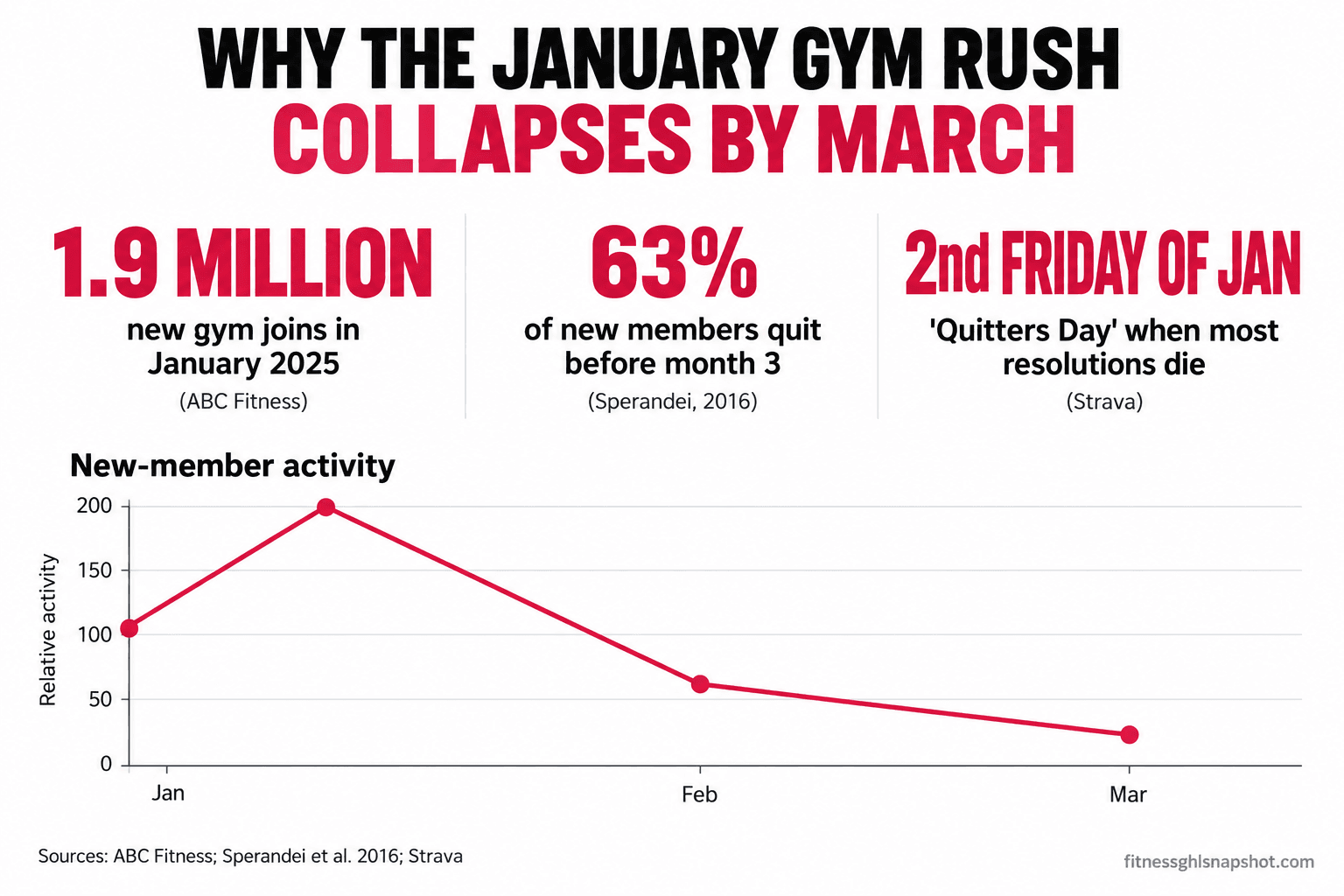
Table of contents
- What happens to your gym in January
- Why the rush collapses by March
- The operator’s year, month by month
- The playbook: how to keep your January members
- Steal these messages
- Run the playbook for your size
- Stay legal while you automate
- Answering the objections
- FAQ
What happens to your gym in January
The rush is not a myth. Across ABC Fitness’s network, January 2025 brought 106 million check-ins and 1.9 million new members in a single month (ABC Fitness). If your gym signs 40 in January and 10 in a normal month, you are normal.
Here is the part most owners miss: the intake is the easy part. The New Year does your marketing for you. People show up already sold on changing their body, so you do not have to convince them to start. You have to keep them once the resolution wears off, and it wears off fast.
Strava studied hundreds of millions of logged workouts and found the day most people abandon their New Year goal is the second Friday of January, now called “Quitters Day” (via Inc.). Not March. Not even February. The motivation that filled your floor fades before the second week is over. Members keep paying, but they have already quit in their heads.
Why the rush collapses by March
The collapse is not about your equipment, your coaches, or your price. It is about how a new member’s first few weeks go. Four things kill the January class every year.
The motivation was borrowed, not built. A resolution runs on a calendar and a feeling, and both expire. If the member does not replace that with a real routine in the first two or three weeks, nothing holds them when the feeling fades.
Nobody made them come back. Most gyms sell the membership and go quiet. The member hears from you again only when their card fails. No booked second visit, no check-in, no reason to return on Wednesday. Silence reads as “we already got your money.”
The first workout was lonely. A new member who cannot find the machine, does not know how to use it, and stands alone in the corner is not coming back. The first session decides more than the sales tour did.
You were too busy to notice. January is your busiest month, so the members who go quiet in weeks two and three slip out during the exact window when your desk has no time to chase anyone. By the time March frees up, they are gone and their draft is bouncing.
None of these is a pricing problem. Every one is a follow-up problem, fixable with a system that runs whether your desk is slammed or not.
The operator’s year, month by month
The January collapse is one act in a predictable cycle. Knowing the cycle tells you where to put your effort.
- 1Oct – Dec
Prep season
Build the welcome sequence, booking flow, and check-ins before volume hits, while you have time to test them.
- 2January
The surge
Biggest intake of the year. The job is not selling. It is getting every new member to book a second and third visit fast.
- 3February
The quiet quit
Motivation fades and attendance drops, but almost nobody cancels yet. Your last cheap chance to re-engage.
- 4March
The collapse
Ghosted members hit their first failed or cancelled draft. Recovery now costs far more than a February check-in.
- 5Apr – Aug
The grind
Steady state. Core retention, referrals, and win-backs carry revenue through the slow middle.
- 6Sep – Oct
Second wave
A smaller back-to-school bump. Run the same playbook, then prep for next January.
The work that saves your January class happens in October and in the first 30 days after each sign-up, not in the March scramble.
The playbook: how to keep your January members
Here is the system, phase by phase. Build it once and it runs on every new member, all year.
Phase 1: Fix your intake before the doors get busy
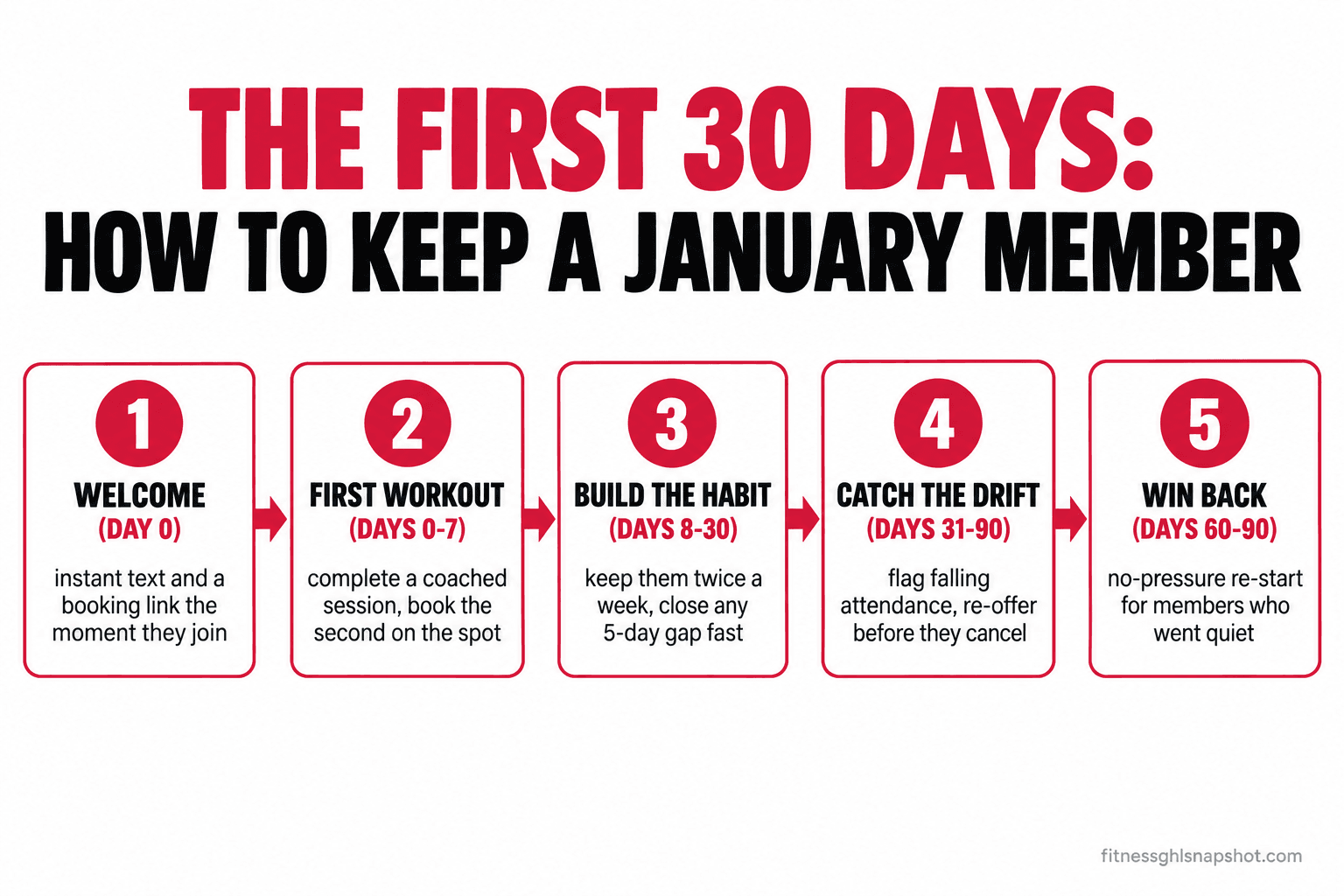
The worst time to build onboarding is the week you need it. Do it in the fall. Get three things live before January: an instant welcome the moment someone joins, a dead-simple way to book their first real session, and a fixed schedule of check-ins for the first 30 days.
How it breaks: owners try to run onboarding by memory during the busiest month of the year. The desk means to text the new member back, then forgets, because 30 other people walked in. Anything that depends on a busy human remembering fails in January.
The fix: automate the welcome and check-ins so they fire on a trigger, not on memory. Booking, reminders, and follow-up run through one appointment and reminder flow.
Phase 2: Win the first workout (days 0 to 7)
The most important thing a new member can do is complete a real first session and book the second before they leave. A booked next visit is the difference between a habit and a one-time try.
How it breaks: the member gets a keycard and is told “come in anytime.” “Anytime” becomes “never.” No date on the calendar means no reason to show up Wednesday instead of scrolling on the couch.
The fix: the day they join, send a warm welcome and a link to book their first coached session. When they finish, book the next one on the spot. Two visits in the first week is the goal.
Phase 3: Build the habit (days 8 to 30)
Weeks two through four are where the resolution becomes a routine or dies. Keep them coming twice a week and make them feel seen. Frequency predicts retention, so frequency is what you protect (Sperandei et al., 2016).
How it breaks: the member misses a couple of days, feels behind, feels embarrassed, and quietly stops. Nobody reaches out, so a three-day gap becomes a three-week gap becomes a cancellation.
The fix: watch for the gap and close it fast. If a new member has not scanned in for five days, a short, human text pulls most of them back. Pair it with a genuine milestone note at their fifth and tenth visit. This is how you stop silent churn before it starts, and it maps to the first 30 days onboarding playbook.
Phase 4: Catch the March drop-off (days 31 to 90)
By day 31 you know who is building a habit and who is drifting. Members who slide from twice a week to once a fortnight in February are the ones who bounce their draft in March. Do not wait for a cancellation.
How it breaks: the gym only reacts to a formal cancellation. But most January members never send one. They stop coming and let a failed card do the quitting for them, which shows up weeks later.
The fix: flag members whose attendance is falling and reach out with a real offer, not a guilt trip: a free session, a swap to a class that fits their schedule, or a quick “what got in the way?” text. Catching a drifting member in February costs one message. Winning them back in April costs a discount and a lot of luck.
Phase 5: Chase the ghosts (win-back)
Some of the January class will go dark no matter what. That list is not dead. These are people who wanted to change something a few weeks ago, and that want does not vanish.
How it breaks: the ghosted list gets ignored because chasing it feels like begging, so the gym re-buys the same person as a cold lead nine months later at full price.
The fix: run a scheduled win-back campaign at 60 and 90 days: a no-pressure check-in, then a real reason to come back, like a fresh challenge start date or a bring-a-friend week. Reactivating a lapsed member is far cheaper than acquiring a stranger.
Phase 6: Answer leads before they cool off
January also brings a flood of inquiries, and the gym that answers first wins them. Contacting a web lead within five minutes rather than thirty makes you about 21 times more likely to qualify them, per the MIT and InsideSales.com Lead Response Management study. Yet one Harvard Business Review analysis found firms took an average of 42 hours to respond, and those answering within an hour were nearly seven times likelier to have a real conversation (HBR, 2011).
Relative odds of qualifying a new lead by response speed. Source: MIT / InsideSales.com Lead Response Management Study.
How it breaks: an inquiry lands at 9pm, the desk sees it at 11am, and the person has already walked into the gym down the road that texted back in two minutes.
The fix: an instant automated reply to every form, missed call, and DM, then a fast human hand-off. A speed-to-lead system means no January inquiry sits overnight, and an AI receptionist books the calls you cannot pick up during the rush.
Steal these messages
The playbook only works if the messages sound like a person, not a system. Here is copy you can lift and adjust to your voice.
None of these shame the member, lead with a discount, or read like a mass blast. Each gives an easy next step and a human to reply to. Route them through SMS automation so they fire on the right trigger, with a real person ready for replies.
Run the playbook for your size
The framework is the same at every size. The staffing and tooling change.
Solo or small PT team (20 to 100 clients). You are the coach, the front desk, and the marketer. You cannot manually text 40 new January clients and also train them, so automation is survival. Automate the welcome, the booking link, and the five-day gap-closer; keep the milestone notes personal since you know each client. A text from you means something the big box cannot match, so let the system make sure it goes out and sound like you.
Boutique studio (80 to 250 members). Your retention lever is the class schedule and the community around it. Get every new member into a specific class with a coach who greets them by name by their second visit. Your gap-closer should offer a different class time, not just “come back.” Boutiques win on belonging, so make a stranger feel like a regular before the resolution fades.
Independent gym (150 to 500 members). Your risk is new members disappearing into the crowd. Assign every January sign-up to a named coach, even if the contact is mostly automated, and use attendance data to flag drifters in February. At your size a 5% retention gain is serious money: Bain found it can raise profit 25% to 95% (Bain / Reichheld). Keeping ten more of your January class past March beats any ad you will run.
Whatever the size, the ceiling is the same. The average gym holds 66.4% of members year to year (HFA, 2025), and beating that is almost entirely a first-90-days problem. The first 90 days start in January.
Stay legal while you automate
All of this runs on texting and email. This is general information, not legal advice, and rules change, so confirm the specifics for your state.
Texting needs consent. Automated and mass texting falls under the TCPA, and business texting now runs through A2P 10DLC registration with the carriers. Get clear opt-in at sign-up, honor STOP instantly, and register your number before you blast the January class. Email drips fall under CAN-SPAM: a real physical address and a working unsubscribe on every send.
You cannot trap them, and you should not want to. Many operators still believe a federal “click-to-cancel” rule is about to force easy online cancellation. It is not. The FTC’s Negative Option Rule amendments were vacated by the Eighth Circuit in July 2025 and are not in effect (FTC). But that is no green light: exposure now runs through older federal law and state auto-renewal statutes, which more than half the states have, California’s among the strictest. We cover what applies in the 2026 gym cancellation and auto-renewal law guide. Make joining and leaving easy, because a trapped member will chargeback, complain, and never refer you.
One good-news note: standard gyms and PT businesses are not covered by HIPAA, since you are not a health plan or a provider transmitting standard health-care transactions. That changes only if you add on-site physical therapy or insurance billing.
Answering the objections
“Won’t members find all these texts annoying?” Only if they are generic and constant. A member who gets a warm welcome, one booking nudge, and a friendly check-in when they go quiet feels looked after, not spammed. The annoyance comes from volume and irrelevance, not contact.
“I already pay for booking software. Why do I need this?” Booking software books classes. It does not chase the member who stopped booking. Most gym platforms are records systems, not follow-up systems. This retention layer sits on top and reaches out, alongside whatever you use to schedule and bill.
“I’m not technical. Can I run this?” You set it up once and it runs itself. You are not building automations at 6am in January. The $997 Fitness Snapshot installs the sequences, flags, and booking flows into a GoHighLevel account for you in 24 hours. Your job is to keep the messages sounding like you and show up for the replies.
The bottom line
Go back to that full lot on the first Monday of January. The 40 new members are not the win. They are the raw material. Whether they are still there in March is decided by their first 30 days.
The rush will collapse again at every gym that treats a sign-up as a finished sale. It will not collapse at yours if you build the habit before the motivation runs out: win the first workout, protect the frequency, catch the drift in February, and chase the ghosts before you write them off. That is not more hustle. It is one system, built in the fall, running quietly on every new member while you coach.
Frequently asked questions
When exactly do most January gym members quit?
Earlier than owners expect. Strava's data points to the second Friday of January, 'Quitters Day,' as the moment most people abandon their resolution. Formal cancellations and failed drafts then show up in February and March. A peer-reviewed study found roughly 63% of new members quit before their third month (Sperandei et al., 2016).
How many new members should I expect in January?
Most gyms see their single biggest intake of the year in the first three weeks. Across ABC Fitness's 30,000+ clubs, January 2025 brought 1.9 million new joins and 106 million check-ins in one month (ABC Fitness). Your surge scales with your marketing, but January will almost always be your peak.
What is the single most important thing to do with a new member?
Get them to complete a real first session and book the second before they leave. A booked next visit turns a one-time try into the start of a habit, and frequency in the first weeks is the strongest predictor of whether a member stays.
Is it cheaper to keep a January member or win back a lapsed one?
Keeping is far cheaper. Catching a drifting member with a February check-in costs one message. Winning them back after they cancel in March usually costs a discount plus new acquisition effort. Reactivating a lapsed member still beats acquiring a stranger, which is why a scheduled win-back campaign is worth running.
Is automated texting to members legal?
Yes, with consent. US business texting falls under the TCPA and now requires A2P 10DLC registration. Get clear opt-in at sign-up, honor STOP immediately, and register your number. Email drips must follow CAN-SPAM. This is general information, not legal advice, so confirm the rules for your state.