
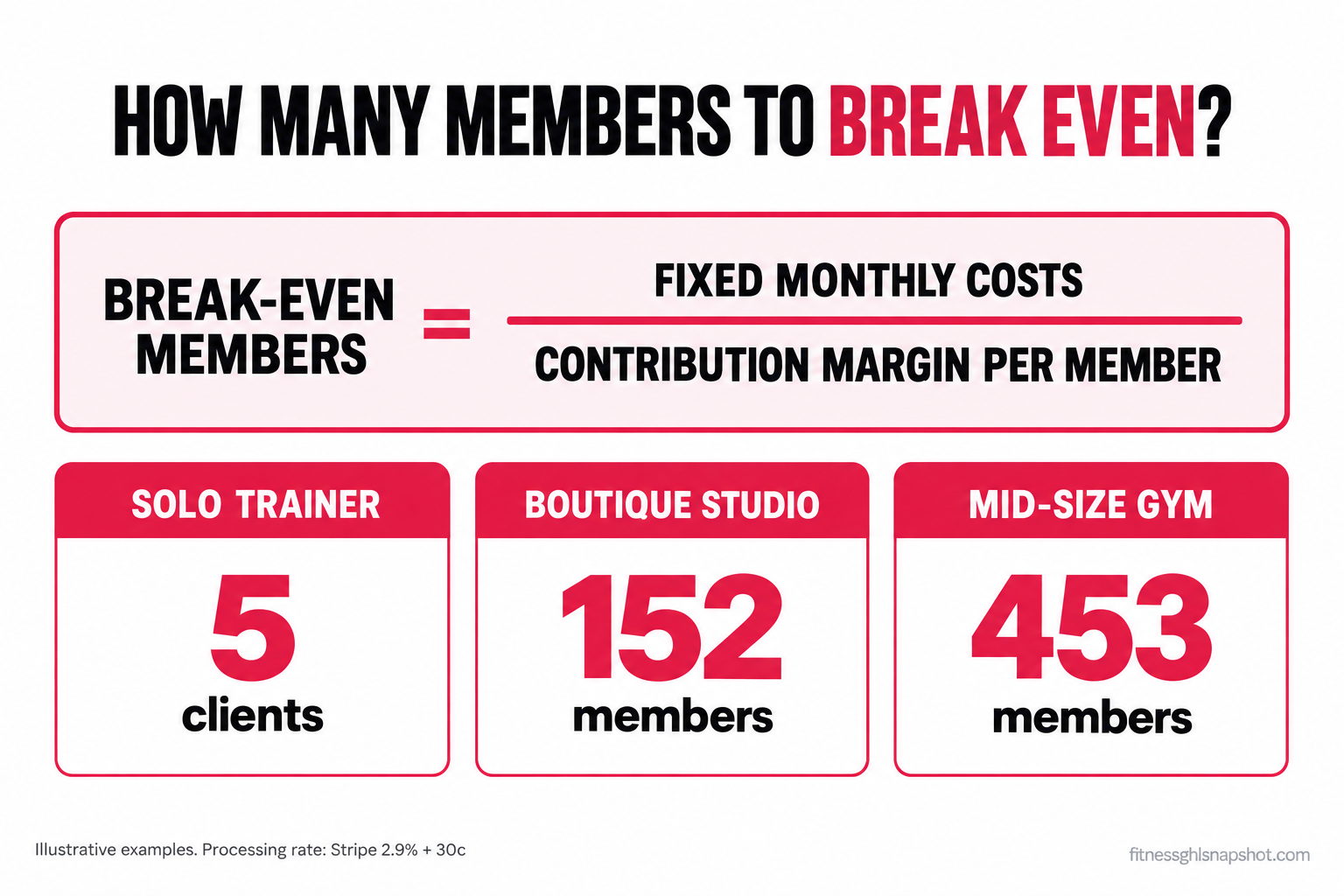
Here is the short version: your gym’s break-even point is your total fixed monthly costs divided by your contribution margin per member (the membership price minus the small variable cost of serving that member). For most independent gyms and studios, that number is higher than owners guess, because rent and payroll are fixed whether 40 people show up or 400. And break-even is not a finish line you cross once. Churn pushes it back up every month, so the real target is break-even plus the members you replace just to stand still. Get this one number right and every other decision (pricing, hiring, whether to run that January promo) gets easier.
It is the 3rd of the month and you are looking at a bank balance that does not match the busy floor you watched all week. The 6am class was packed. The schedule looks full. So why is the account this tight? Because “full” and “profitable” are two different numbers, and most owners only track the first. You know your member count. You probably cannot say how many members you need before the business stops losing money. That is the number this post is about.
Table of contents
- What “break-even” actually means for a gym
- The break-even formula, step by step
- The real numbers to plug in (with sources)
- The churn math everyone skips
- Break-even is the floor, not the goal
- Three worked examples
- How the break-even calculation breaks
- Steal this: the break-even worksheet
- The contract angle: auto-renewal and failed payments
- Questions operators ask
- FAQ
What “break-even” actually means for a gym
Break-even is the point where total revenue equals total cost. Below it, you lose money every month. Above it, every extra member is mostly profit. The reason it trips up gym owners is the split between two kinds of cost.
Fixed costs stay the same no matter how many members you have this month. Rent is rent. Your head coach’s salary is fixed. Insurance, your software subscription, the loan on the rig, the base marketing spend: all fixed. They land whether you sign 10 members or 100.
Variable costs only happen when you serve a member, and for a gym that list is short: the card-processing fee on their monthly charge, maybe a towel or consumables. That is usually it. A gym is a high-fixed-cost, low-variable-cost business, which is exactly why break-even matters. Your costs barely move with volume, so the number of members you carry is the difference between profit and panic. The upside once you clear break-even is real: serving one more member costs almost nothing, so most of that member’s payment drops to the bottom line. The hard part is climbing there while paying full rent and full payroll the whole way up.
The break-even formula, step by step
Here is the whole thing. You need three numbers.
Break-even members =
    Total fixed monthly costs
    ÷ contribution margin per member

where:
  contribution margin per member =
      average monthly membership price
    − variable cost per member (mostly card processing)
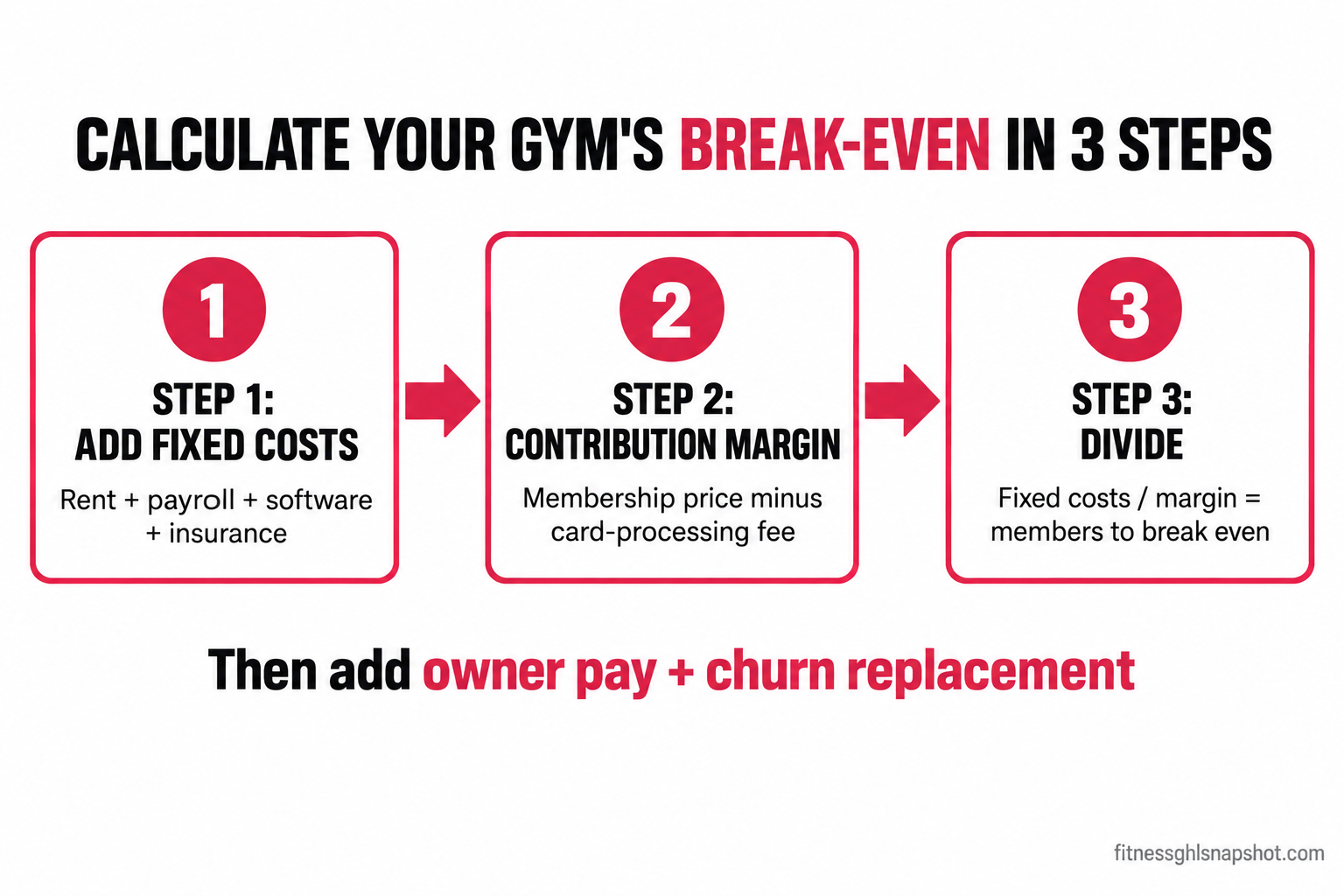
Step 1: Add up every fixed monthly cost. Rent, payroll (including your own pay), software, insurance, utilities, equipment loans, and baseline marketing. This is what you cover before you earn a dollar.
Step 2: Find your contribution margin per member. Take your average monthly membership price and subtract the variable cost of serving one member. At Stripe’s standard 2.9% + 30¢ rate (Stripe), a $140 membership costs about $4.36 to collect, so your contribution margin is roughly $135.64. Add towel or consumable pennies if you have them.
Step 3: Divide. Fixed costs ÷ contribution margin = the members you need to break even. Fixed costs of $20,000 and a contribution margin of $135 means about 148 members before the business stops losing money.
That is the core of it. The rest of this post is about getting the inputs right, because a break-even number built on wrong inputs lies to you with confidence.
The real numbers to plug in (with sources)
The formula is only as honest as what you feed it. Here is where owners either use real figures or the flattering ones, and the flattering ones are how gyms go broke while “looking full.”
Rent. Use your actual lease number, including CAM (common area maintenance), triple-net charges, and any percentage-of-revenue clause. Not the base rent minus the extras. This is almost always your first or second biggest fixed cost.
Payroll, including yours. Count every wage plus payroll taxes (add roughly 10 to 12% on gross wages). For context, the US Bureau of Labor Statistics puts 2024 median pay for fitness trainers and instructors at $46,180 a year, about $22.20 an hour, with the field projected to grow 12% from 2024 to 2034 (U.S. Bureau of Labor Statistics). Translate per-session instructor pay into a monthly number, and pay yourself in this line. A break-even that assumes you work for free is not break-even, it is a slow way to quit.
Software. Your management platform is a fixed cost you can look up. Published 2026 pricing runs about $75 to $200 a month for Gymdesk and $159 a month for PushPress Pro (PushPress on G2), while several bigger platforms hide the number behind a demo. We broke the market down in what gym software actually costs in 2026; use your real all-in figure, add-ons included.
Everything else. Utilities, insurance, equipment leases, cleaning, music licensing, and the marketing you spend every month regardless of promotions.
The variable side. For most gyms this is just card processing. If members pay through your platform, the processor takes a cut of every charge, and at scale it is not small.
Notice the membership number. GoodRx reports the typical US member pays around $65 a month, with budget gyms at $10 to $30 and premium at $100+ (GoodRx). If your average membership is low, your contribution margin is thin and you need a lot of members to cover fixed costs. Price is not just a marketing lever. It is the single biggest input to your break-even count.
The churn math everyone skips
Here is the part almost nobody puts in the spreadsheet. Break-even is not a number you hit once and forget. Members leave, cards fail, people move or get hurt. So the count you need is not static. It drifts down every month unless you refill it.
Say you run at 400 members and lose 4% a month. (Four percent is a common working assumption, not a law. Measure your own by pulling last month’s cancellations and failed payments and dividing by member count.) Four percent of 400 is 16, so 16 people walk out monthly and you have to sign 16 just to stay at 400. Sign 12 and you shrink. Sign 20 and you grow.
Now layer that onto break-even. If your break-even is 148, holding 148 is not a one-time achievement. It is a monthly refill job, and your effective target is break-even plus your monthly churn, replaced, forever. This is why gyms that “feel busy” still struggle: they run hard just to replace the members leaking out the back and never climb above the profit line. We covered catching that leak early in stop silent churn before it hits your billing report.
Lowering churn does two things to your break-even at once: it cuts the replacements you need, and it raises your average member’s lifetime value, the multiplier on everything acquisition earns you. A member who stays 20 months instead of 10 does not just double their revenue, they halve the acquisition pressure on your break-even.
Break-even is the floor, not the goal
Clearing break-even means you stopped losing money. It does not mean you made any. If your math assumed zero salary, then “break-even” is you working full time for nothing while the bills get paid. That is not a business, it is an expensive hobby with a lease.
So set a target above break-even. Add two things to your fixed-cost total before you divide:
- Owner pay. A real monthly number you want to take home. Put it in the fixed-cost stack.
- A profit margin. A cushion for slow months, equipment replacement, and reinvestment. Even 10 to 15% of revenue keeps you out of the paycheck-to-paycheck trap.
Rerun the formula with owner pay and margin included and you get your profit target member count, the number that actually matters. Break-even keeps the doors open. The profit target is what lets you sleep.
Three worked examples
The formula is the same for everyone. The numbers, and the lesson, change a lot with size. Every figure below is illustrative. Plug in your own.
Example 1: the solo personal trainer (20 to 60 clients)
You train in person and online, rent space by the session, and take payments through an app. No payroll but yourself.
- Fixed costs: space rental $600, software $60, liability insurance $60, phone and misc $80. Total: $800/mo.
- Average client price: $200/mo.
- Variable cost: processing on $200 is about $6.10. Contribution margin ≈ $194.
- Break-even: 800 ÷ 194 = about 5 clients.
- With $4,000 owner pay: (800 + 4,000) ÷ 194 = about 25 clients.
The lesson: break-even is trivially low, so the risk is never covering costs. It is undercharging and under-retaining. Five clients keep the lights on, but you need 25 to earn a living, and every client who quits costs you nearly $200 a month in margin.
Example 2: the boutique studio (80 to 250 members, 2 to 8 instructors)
You run classes, waitlists, and packages. Fill rate and retention decide everything.
- Fixed costs: rent (2,000 sq ft) $6,000, instructor and front-desk payroll $12,000, software $200, plus utilities, insurance, and base marketing $1,800. Total: $20,000/mo.
- Average membership: $140/mo.
- Variable cost: processing $4.36 plus small consumables ~$4. Contribution margin ≈ $132.
- Break-even: 20,000 ÷ 132 = about 152 members.
- With $6,000 owner pay: (20,000 + 6,000) ÷ 132 = about 197 members.
The lesson: payroll is your biggest lever and biggest risk. Add one full-time hire and your break-even jumps 40 to 60 members overnight. If you sit at 160 members, you are barely above break-even and nowhere near paying yourself properly, even though the classes look full. That is the most common trap in boutique fitness.
Example 3: the mid-size or multi-location gym (250 to 500+ members)
Multiple staff, bigger space, real payment volume. Now the percentages bite.
- Fixed costs: rent $12,000, payroll $28,000, software $450, plus utilities, insurance, equipment leases, and marketing $6,000. Total: $46,450/mo.
- Average membership: $110/mo (higher volume, lower price).
- Variable cost: processing $3.49 plus consumables ~$4. Contribution margin ≈ $102.50.
- Break-even: 46,450 ÷ 102.50 = about 453 members.
- With $10,000 owner pay: (46,450 + 10,000) ÷ 102.50 = about 551 members.
The uncomfortable lesson: your break-even is enormous. A 250-to-500-member gym that needs 453 members just to break even is running on a razor. That is why a full-looking gym can still be a stressful, low-margin business, and why every point of churn matters far more than it does for the solo trainer.
Illustrative break-even member counts from the three examples above, using the fixed costs and contribution margins shown. Your number depends on your rent, payroll, and average membership price. Stripe processing rate used for variable cost.
Look at the gap between break-even and paying yourself. For the boutique studio, break-even is 152 but a proper owner salary needs 197. That 45-member gap is the difference between “surviving” and “running a real business,” and it is the range most independent studios live in.
Illustrative for the boutique studio: members needed to break even, to pay the owner $6,000/mo, and to run comfortably with margin. The distance between the first two bars is the profit gap most studios underestimate.
How the break-even calculation breaks
This is the part nobody else writes, and it is where the number actually goes wrong.
1. You count all revenue as if it lands. Your software shows $30,000 in “expected” revenue, but failed cards, freezes, and discounts mean you collect less. How it breaks: you think you cleared break-even when you only invoiced it. What to do: use collected revenue, not billed, and treat failed-payment recovery as found money, because a card that fails silently is a member you already have, walking out unbilled.
2. You forget processing. Owners routinely leave the card fee out of the margin. How it breaks: at 400 members paying $110, counting a 3% fee versus forgetting it is over $1,300 a month, which is a staff shift you thought you could afford. What to do: always subtract the processing fee before you divide.
3. You do not pay yourself. The most common one. How it breaks: “break-even” is really “break-even if I work free,” so you feel broke at a number that looks fine. What to do: put your target salary in the fixed-cost stack from day one.
4. You ignore churn replacement. You hit the count once and relax. How it breaks: attrition drags you back below it within two or three months and you do not notice until the bank balance does. What to do: track gross adds and cancellations, and set your real target at break-even plus expected monthly churn.
5. You forget seasonality. January signups make a February calculation look great, then March collapses. How it breaks: you plan hiring and rent off a peak month. What to do: use a rolling three-month average, and read why the January rush collapses by March before you staff up for a surge that will not last.
Steal this: the break-even worksheet
Copy this and fill in your own numbers. It takes about 20 minutes with a recent bank statement and your billing report.
Part A: monthly fixed costs
Rent (incl. CAM / triple-net)     $ ______
Payroll (gross wages)             $ ______
Payroll taxes (~10–12% of wages)  $ ______
Your owner salary                 $ ______
Software (all-in, incl. add-ons)  $ ______
Insurance                         $ ______
Utilities                         $ ______
Equipment loans / leases          $ ______
Baseline marketing                $ ______
Other (cleaning, waste, music)    $ ______
                        TOTAL  =   $ ______   ← this is F
Part B: contribution margin per member
Average monthly membership price  $ ______   ← this is P
Processing fee (P × 0.029 + 0.30) $ ______
Consumables per member            $ ______
        Contribution margin = P − fees = $ ______   ← this is M
Part C: the answers
Break-even members        =  F ÷ M                      = ______
Profit-target members     = (F + margin) ÷ M            = ______
Monthly churn to replace  = current members × churn %   = ______
Real monthly target       = break-even + churn replaced = ______
Now the useful part: three ways to lower the number. Break-even drops when F falls or M rises, in this order of impact:
- Raise price or average membership value. A $10 increase on a $130 membership raises M by nearly 8%, cutting your break-even count by roughly the same. The fastest lever, and the one owners fear most.
- Cut churn and failed payments. Every member you keep is one you do not reacquire. Recovering failed cards and reducing membership cancellations raises collected revenue with zero acquisition spend.
- Trim fixed cost carefully. Renegotiate the lease at renewal, right-size software, and question fixed marketing that is not producing booked trials. Cut fixed cost last, because cutting staff usually cuts service, which raises churn, which raises break-even right back.
The contract angle: auto-renewal and failed payments
There is a legal wrinkle that touches the revenue side of your break-even, and a lot of operators have it backwards. If you assumed the federal government now forces a one-click cancel button on your memberships, check the date. The FTC’s “click-to-cancel” Negative Option Rule was vacated by the Eighth Circuit on July 8, 2025, before it took effect (Sidley Austin). There is no federal click-to-cancel rule in force in 2026 (Crowell & Moring).
Why does that matter here? Your recurring revenue depends on auto-renewal, and auto-renewal is governed by state law, not the vacated federal rule. More than half of states have auto-renewal statutes, with California’s among the strictest, requiring clear disclosure and an easy cancellation path. Run compliant auto-renewals and clean billing consent so your recurring revenue is both legal and collectible. Sloppy consent leads to disputes and chargebacks, and a chargeback is a member you counted toward break-even who now costs you the payment plus a dispute fee. Compliant recurring billing protects the collected-revenue number your whole calculation rests on.
Questions operators ask
“I don’t know my exact churn rate. Can I still do this?” Yes. Start with break-even and profit-target counts, which only need costs and price. Then estimate churn by pulling last month’s cancellations plus failed payments and dividing by member count. A rough number beats ignoring it, and you can tighten it later.
“Isn’t this just accountant stuff I can skip?” It is the single most important operating number you have, and you do not need an accountant to divide two numbers. Do it once, honestly, then watch it move as you change price, staff, or retention. Owners who know their break-even make calmer, faster decisions than owners flying on member count alone.
“My software already shows revenue. Why bother?” Because it shows billed revenue and a member count, not the number you need. It will happily show 300 members and a big invoice figure while you are two hires past your real break-even. The formula turns your data into a decision.
“Do I need new software to fix a high break-even?” Not necessarily. The two levers that move break-even most are price and retention, and both are mostly process, not tools. Retention and follow-up fail at most gyms because nobody has time to do them by hand, which is what automation is for. Keep the tool that runs your front desk, and add a layer that keeps members and collects payments. If you want the platform we build that layer on, you can start GoHighLevel here.
The bottom line
Your break-even is the most honest number in your business. It does not care how packed the 6am class looked. It is fixed costs divided by contribution margin per member, and for most independent gyms it is higher than you think, because rent and payroll do not flex with attendance.
Do the math once, properly: real fixed costs including your own salary, real contribution margin with the processing fee subtracted, and the churn you replace every month to hold your count. Then set your target above break-even, not at it. That is the number that tells you whether to raise price, whether you can afford the hire, and whether the January promo is worth running.
Go back to that 3rd-of-the-month bank balance. It was not lying. The floor was full and the account was tight because “full” was below your break-even plus churn, and nobody had done the division. Now you can.
Frequently asked questions
How do I calculate the break-even point for my gym?
Divide your total fixed monthly costs by your contribution margin per member. Fixed costs are rent, payroll (including your own salary), software, insurance, utilities, and baseline marketing. Contribution margin is your average monthly membership price minus the variable cost of serving one member, which for most gyms is just the card-processing fee (about 2.9% + 30¢ per charge). If your fixed costs are $20,000 and your contribution margin is $132, you need about 152 members to break even.
How many members does a gym need to be profitable?
More than it needs to break even. Break-even only covers costs; profitability requires adding owner pay and a profit margin on top of fixed costs before you divide. In our boutique studio example, break-even is about 152 members but paying the owner $6,000 a month requires about 197. Your profit-target count is (fixed costs + owner salary + margin) divided by contribution margin per member.
What counts as a fixed cost versus a variable cost for a gym?
Fixed costs stay the same regardless of member count: rent, payroll, software subscriptions, insurance, equipment loans, and baseline marketing. Variable costs happen per member served, and for a gym that is mostly the payment-processing fee plus small consumables like towels. Because gyms are high-fixed-cost, low-variable-cost businesses, the number of members you carry is what decides profit or loss.
Why does my gym feel busy but still not make money?
Because a full schedule is not the same as clearing break-even plus churn. If your break-even is 450 members and you sit at 400, you lose money no matter how packed classes look. Churn also drags you down every month, so you can sign new members steadily and still stay flat. Track collected revenue and your break-even count, not just attendance.
How does churn change my break-even number?
Churn turns break-even from a one-time target into a monthly refill job. If you lose 4% of members a month at 400 members, that is 16 people you must replace just to stay level. Your effective target is break-even plus your monthly churn, replaced continuously. Lowering churn cuts the replacements you need and raises member lifetime value, which is why retention is the highest-impact way to reduce break-even.
Written by Bryce Kendrick, Fitness Growth Strategist. Bryce spent eight years managing the floor and front desk at a fast-growing CrossFit box before moving full-time into automation for gyms. He writes the way he coaches: direct, numbers-first, and allergic to fluff.