
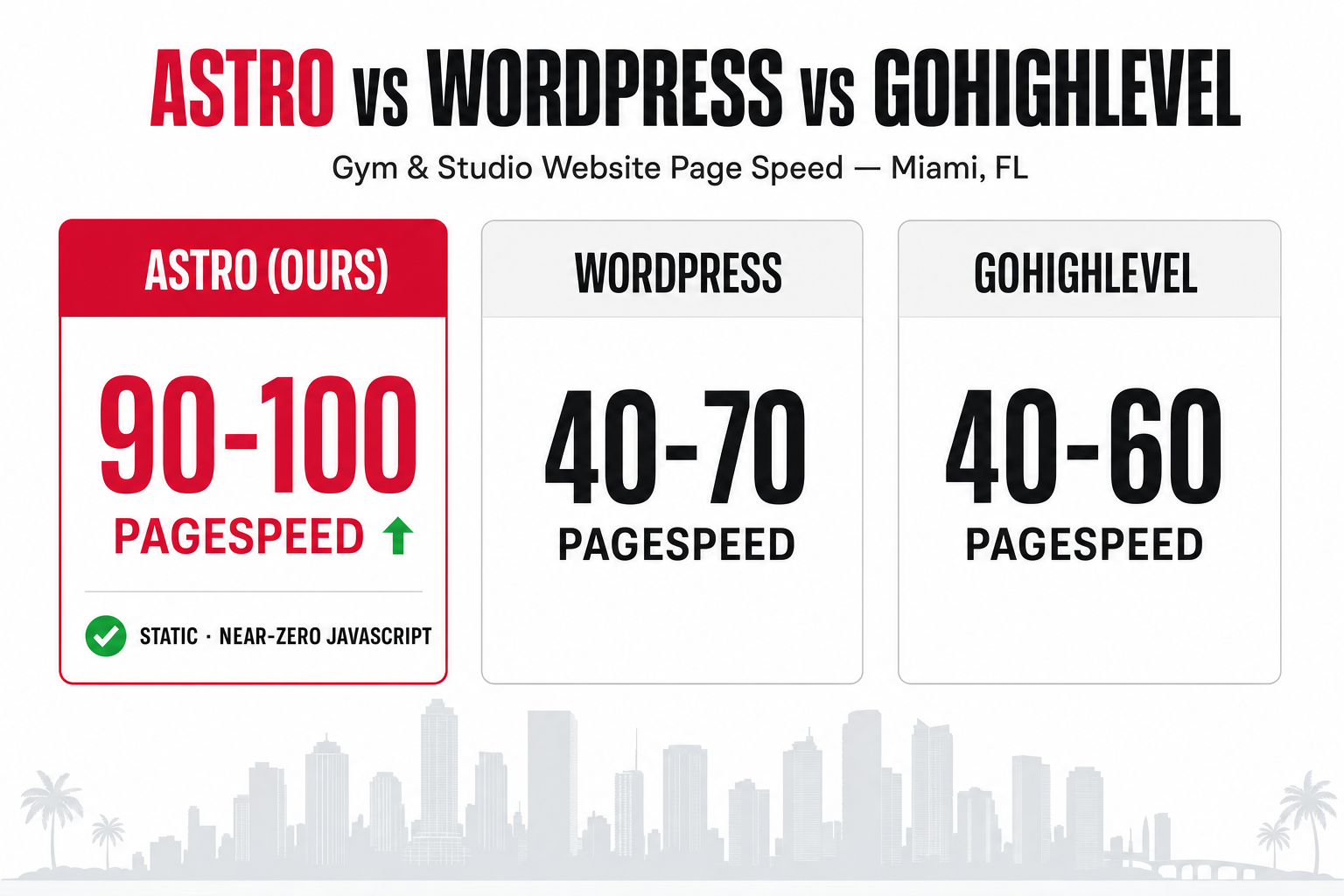
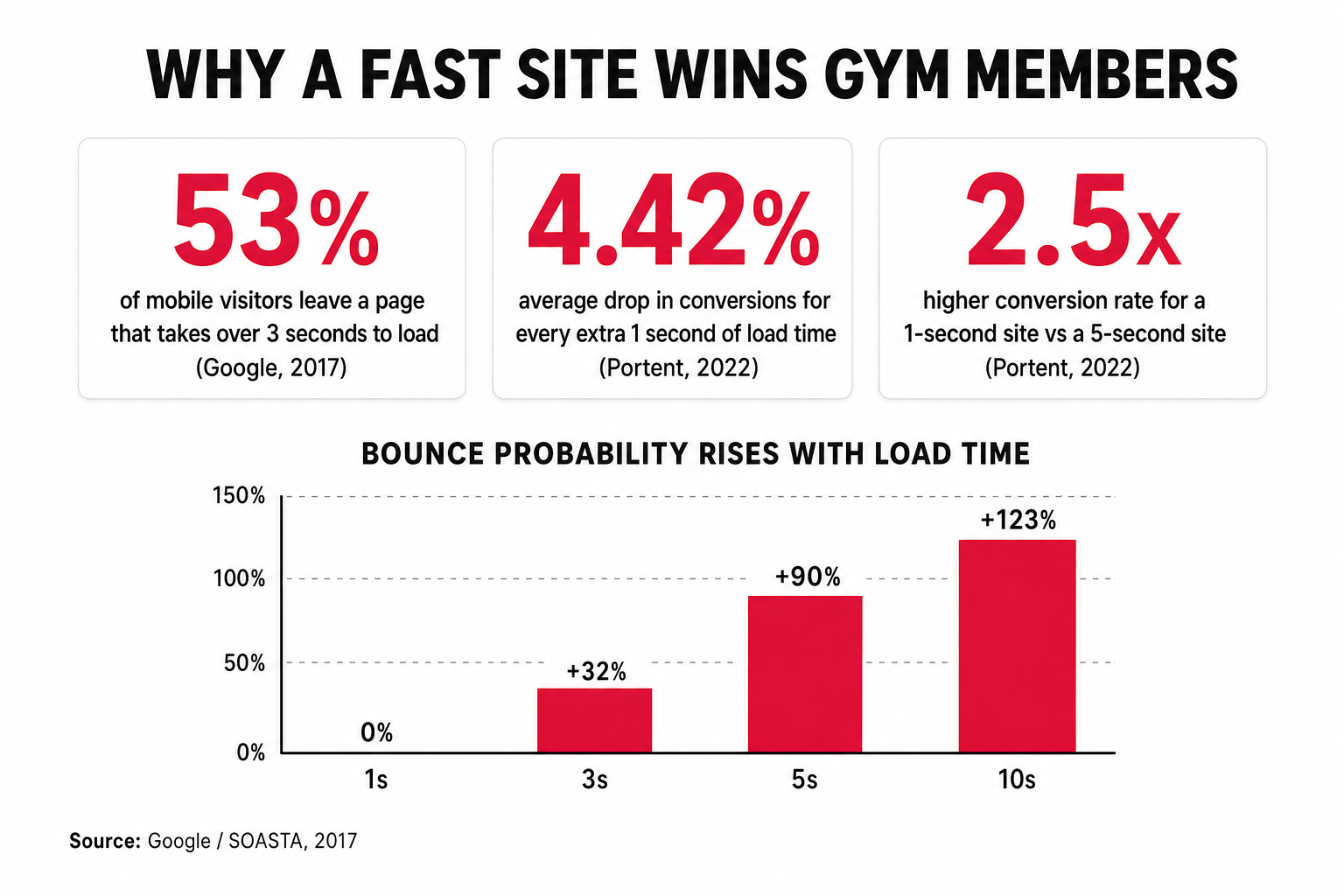
For a Miami gym, studio, or personal-training business, an Astro-built website beats a typical WordPress or GoHighLevel (GHL) site where it actually matters: page speed, Core Web Vitals, and local SEO — the three levers that decide whether a prospect books the free trial or bounces back to Google. Astro ships static-first pages with almost no JavaScript, so it routinely earns a 90–100 Google PageSpeed score, while plugin-heavy WordPress and page-builder GHL sites commonly land in the 40–70 range. That speed gap isn’t cosmetic — Google found 53% of mobile visits are abandoned when a page takes longer than 3 seconds to load (Think with Google). In a market as competitive as Miami fitness, a slow site is a leak you can see in your trial numbers.
I’ve bought Facebook and Instagram ads for gyms and martial-arts schools long enough to watch great creative die on a slow landing page. You can win the auction, nail the hook, and drive a $30 click — then lose the sale because the page took five seconds to paint on a phone with two bars of LTE outside a Wynwood coffee shop. This post is the operator’s comparison: what each platform actually does to your speed, the sourced data on what slow costs a gym, and how to decide what to build your Miami studio site on in 2026.
Table of contents
- The short answer for Miami gym owners
- Why website speed decides who becomes a member
- What a slow gym site actually costs — the data
- Why WordPress and GoHighLevel sites get slow
- What Astro does differently
- Astro vs WordPress vs GoHighLevel: head-to-head
- Speed, Core Web Vitals, and Miami local SEO
- When WordPress or GHL still makes sense
- What a done-for-you Astro gym site costs
- FAQ
The short answer for Miami gym owners
If you run a CrossFit box in Doral, a reformer studio in Brickell, or a PT business in Coral Gables and you’re choosing what to build (or rebuild) your website on, here’s the compressed verdict:
- Build on Astro if you want the fastest possible site, the best shot at ranking in Miami local search, and full control of your SEO and schema. This is what wins trials.
- WordPress is flexible and familiar, but it gets slow fast under plugins and page builders — and staying fast becomes an ongoing maintenance job.
- GoHighLevel’s built-in site builder is convenient if you already run your CRM and funnels in GHL, but its page-builder pages are heavier and typically score lower on PageSpeed, and fine-grained SEO control (meta, schema,
llms.txt) is limited.
The rest of this article is the why, with the numbers. Speed isn’t a vanity metric for a gym — it’s the difference between a prospect landing on your trial offer and reading it, versus tapping “back” before it loads.
Why website speed decides who becomes a member
Fitness is a mobile, local, impulse-driven purchase. Someone decides “okay, I’m finally doing this,” searches “gym near me” or “pilates Brickell” on their phone, and taps two or three results in a 90-second burst. The gym whose page loads first and cleanest gets read. The ones that stall get closed.
Google’s own research quantifies it: the probability that a visitor bounces climbs sharply as load time grows. Going from a 1-second to a 3-second load raises bounce probability 32%; 1 to 5 seconds raises it 90%; 1 to 10 seconds, 123% (Think with Google).
Increase in mobile bounce probability vs a 1-second load, by page load time. Source: Google / SOASTA, 2017.
Now layer in your ad spend. If you’re paying for Instagram and Facebook traffic to a trial-offer page — like most Miami gyms fighting for attention — every bounce is money you already spent, walking to the studio down the street. Speed to the page is the twin of speed to the lead: both are about not losing the prospect in the seconds when their intent is highest.
What a slow gym site actually costs — the data
Bounce is only half the story. The visitors who stay also convert at lower rates when your site drags. Portent’s analysis of over 100 million page views found conversion rates fall an average of 4.42% for every additional second of load time between 0 and 5 seconds — and a site that loads in 1 second converts about 2.5x better than one that loads in 5 (Portent).
The effect is strong enough that a fraction of a second moves real money. In Google-commissioned research by Deloitte (“Milliseconds Make Millions”), a mere 0.1-second improvement in mobile load time lifted retail conversion rates 8.4% and travel conversions 10.1% (web.dev). Your gym isn’t a retailer, but the mechanism is identical: a faster page keeps more people on your trial offer long enough to act.
Why WordPress and GoHighLevel sites get slow
Neither WordPress nor GoHighLevel is “bad.” They get slow for structural reasons.
WordPress powers roughly 43% of all websites (W3Techs), which means most agencies default to it. But a typical WordPress gym site loads a theme, a page builder (Elementor, Divi), and a stack of plugins — sliders, forms, booking widgets, analytics, chat — each adding CSS and JavaScript the browser must download, parse, and run. The web-wide result shows up in the data: the median mobile page in 2025 weighs about 2.56 MB, including roughly 697 KB of JavaScript and 1,059 KB of images (HTTP Archive Web Almanac 2025). On a phone, that JavaScript is the expensive part — it blocks the page from becoming interactive.
Median mobile page weight by resource type (KB), 2025. JavaScript and images dominate — exactly what plugins and page builders pile on. Source: HTTP Archive Web Almanac 2025.
GoHighLevel’s website and funnel builder is genuinely convenient — if your CRM, calendars, and automations already live in GHL, building the site there keeps everything in one place. The trade-off is that its drag-and-drop page builder outputs heavier markup than a hand-built static site, tends to score lower on PageSpeed, and gives you limited control over technical SEO details — editable meta tags, structured data (schema), and a maintained llms.txt for AI answer engines. For funnels and landing pages inside a campaign, that’s fine. For the website that has to rank in Miami and load instantly, it’s a compromise.
What Astro does differently
Astro is a modern web framework built around a simple idea: ship HTML, not JavaScript. By default, an Astro page renders to static HTML at build time and sends near-zero JavaScript to the browser. Interactive pieces — a booking widget, an image carousel, a chat bubble — are isolated “islands” that load their own small bit of JavaScript only where needed, instead of shipping a heavy framework for the whole page (Astro Docs — Islands Architecture).
For a gym site, that architecture means:
- Less to download. No page-builder runtime, no plugin pile-up. The browser gets a lightweight HTML document it can paint almost instantly.
- Faster on cheap phones and spotty signal — which is most of your real-world Miami traffic, not the fiber connection at your desk.
- Served from the edge. Static pages deploy to a global CDN (Cloudflare), so a visitor in Miami is served from a nearby location, not a single origin server.
That’s why an Astro gym site routinely earns a 90+ Google PageSpeed score — often a perfect 100 — while comfortably passing Core Web Vitals. It’s the same framework this very blog runs on.
Astro vs WordPress vs GoHighLevel: head-to-head
Here’s the side-by-side on the factors that decide trials and rankings for a fitness business:
Gym website platforms compared
| Plan | Astro (Our Build) recommended | WordPress | GoHighLevel Builder |
|---|---|---|---|
| Price | $497 + $97/mo | Varies (hosting + plugins) | Bundled in GHL plan |
| Feature 1 | Google PageSpeed: 90-100 (guaranteed 90+) | Google PageSpeed: 40-70 (plugin-dependent) | Google PageSpeed: 40-60 (builder overhead) |
| Feature 2 | Ships near-zero JavaScript by default | Heavy JavaScript from themes & builders | Page-builder markup, heavier pages |
| Feature 3 | Full control of meta tags & schema/JSON-LD | SEO control good — but plugin-managed | Limited meta/schema control |
| Feature 4 | Location & local-SEO pages built in | Location pages possible with more setup | Location pages limited |
| Feature 5 | Maintained llms.txt for AI answer engines | llms.txt needs a plugin or manual work | No native maintained llms.txt |
| Feature 6 | Managed hosting, domain & SSL included | You manage hosting, updates & security | Hosting bundled, less SEO flexibility |
| See website plans | — | — |
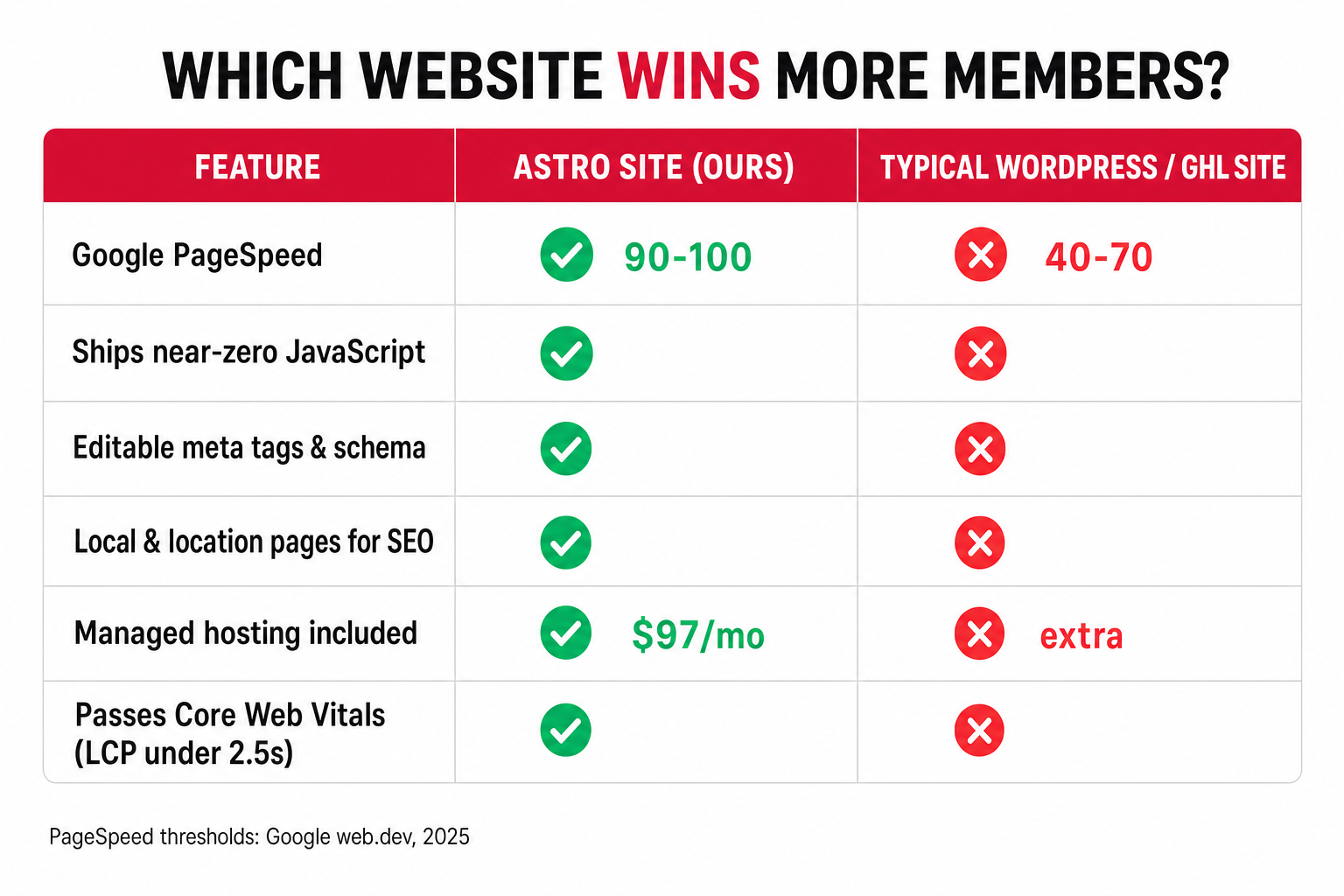
The PageSpeed ranges above reflect what these platforms typically produce for a content-and-conversion site like a gym’s — WordPress and GHL scores vary with theme, plugins, and how the pages are built, while Astro’s static-first output is fast by design. Google’s own guidance defines a “good” experience by Core Web Vitals thresholds like an LCP of 2.5 seconds or faster (web.dev); a lean Astro page clears that bar far more easily than a plugin-laden one.
Speed, Core Web Vitals, and Miami local SEO
Speed isn’t only about the visitors already on your page — it’s about whether Google shows your page to Miami searchers at all.
Core Web Vitals (which measure loading, interactivity, and visual stability) are a confirmed part of Google’s page-experience ranking signals, and Google predominantly uses the mobile version of your site for indexing and ranking (Google Search Central). Translation: if your gym’s site is slow on phones, you’re fighting an uphill battle to appear in the Map Pack and organic results for “gym in Miami,” “CrossFit Wynwood,” or “yoga near me.”
That local visibility is worth fighting for, because local intent converts fast: 76% of people who run a “near me” style search on a smartphone visit a related business within a day (Think with Google). A fast, well-structured Astro site — with proper location pages, schema, and clean metadata — is built to capture exactly that traffic. (For the full local playbook, see our guide to local SEO for gyms.)
When WordPress or GHL still makes sense
To be fair — this isn’t “Astro for everything.”
- Stick with WordPress if you have an in-house person who maintains it well, you rely on a specific WordPress-only plugin ecosystem, or you publish a high volume of content through a workflow your team already knows. WordPress can be fast; it just takes ongoing discipline to keep it that way.
- Use the GoHighLevel builder for campaign funnels and quick landing pages that live inside a GHL automation — where being in the same system as your CRM and pipelines matters more than a perfect PageSpeed score. That’s exactly what GHL is great at, and it’s why our fitness snapshot runs your automations there.
The nuance: many gyms use both — an Astro marketing site that ranks and converts, feeding leads into GoHighLevel where the trial follow-up, no-show recovery, and retention automations actually run. You don’t have to pick one tool for your whole business; you pick the right tool for the website.
What a done-for-you Astro gym site costs
You don’t need to learn a framework or hire a developer. Our Get a Website service builds Miami gyms and studios a blazing-fast Astro site for $497 one-time + $97/month, with a guaranteed 90+ Google PageSpeed score. The monthly covers managed Cloudflare hosting, your domain, SSL, and ongoing maintenance — plus up to 10 change requests a month, so you’re never nickel-and-dimed for edits.
You get the fast site and the local SEO structure — location pages, schema, and clean metadata — designed to rank in Miami and capture “near me” searches. Add automatic blog posting for $197/month total, and we publish two niche, locally-relevant posts a week to keep you climbing. Running multiple locations? There’s a bulk plan that builds up to 5 sites for $1,200 one-time + $297/month. (Want to see the underlying build first? Here’s the prebuilt gym website feature.)
The bottom line
For a Miami gym, studio, or trainer, the website’s job is to load instantly, rank locally, and turn a “gym near me” tap into a booked trial. On the metrics that decide that — page speed, Core Web Vitals, and SEO control — an Astro site wins against a typical WordPress or GoHighLevel build. WordPress and GHL each have their place (content workflows and CRM-linked funnels, respectively), but the site that has to win the trial should be as fast as the sport your members show up to play.
Speed is the cheapest competitive edge you’ll ever buy, and most of your competitors have left it on the table.
Frequently asked questions
Is an Astro website really faster than WordPress or GoHighLevel for a gym?
Yes, by design. Astro renders static HTML and ships near-zero JavaScript by default, so there's far less for a phone to download and run. That's why Astro sites routinely score 90-100 on Google PageSpeed, while plugin-heavy WordPress and page-builder GoHighLevel sites commonly land in the 40-70 range. Speed varies with how any site is built, but Astro's static-first architecture starts fast and stays fast.
Why does website speed matter so much for a Miami gym specifically?
Fitness is a mobile, local, impulse purchase. Prospects search 'gym near me' or 'pilates Brickell' on their phones and tap a few results at once. Google found 53% of mobile visitors leave a page that takes over 3 seconds to load, and conversions drop about 4.42% per extra second (Portent). In a competitive market like Miami, a slow site loses trials to the studio down the block that loaded first.
Does page speed affect my Google ranking?
Yes. Core Web Vitals are part of Google's page-experience ranking signals, and Google indexes the mobile version of your site first. A fast, well-structured site is easier to rank for local searches like 'gym in Miami' — and 76% of nearby smartphone searches lead to a visit within a day, so ranking locally directly drives foot traffic.
I already run my automations in GoHighLevel. Do I have to leave it?
No. Many gyms run an Astro marketing site for speed and SEO, then feed leads into GoHighLevel where trial follow-up, no-show recovery, and retention automations run. You use the right tool for each job: Astro for the website, GHL for the CRM and funnels. Our fitness snapshot lives in GHL and works alongside the Astro site.
What does a done-for-you Astro gym website cost?
Our Get a Website service is $497 one-time plus $97/month, with a guaranteed 90+ Google PageSpeed score. The monthly includes managed hosting, domain, SSL, maintenance, and up to 10 change requests. You can add automatic blog posting for $197/month total, and multi-location bulk plans build up to 5 sites for $1,200 one-time plus $297/month.
About the author
Cole Hartman is our Local Marketing & Paid Acquisition Lead, based in Tampa, FL. He started out buying Facebook and Instagram ads for personal trainers and martial-arts schools, then learned the hard way that the funnel — and the page — behind the ad matter more than the creative. He writes about ad funnels, Google review flywheels, page speed, and turning local visibility into booked trials.