
When off-the-shelf gym software stops scaling, the fix isn’t another subscription — it’s owning the software your studio actually runs on: a member-management CRM shaped around your programs, a branded member portal and booking app, unified data instead of five disconnected tools, and custom AI agents that work inside them. For a New York City studio, the moment usually arrives the same way: you’re paying for Mindbody, Glofox, or Zen Planner seats you barely touch, exporting to spreadsheets to answer basic questions, and still can’t get the one screen your front desk needs. That’s not a discipline problem. It’s what happens when a business outgrows generic tools built for the average gym — and in a market as dense and expensive as New York, the drag shows up in your margins fast.
I ran member experience for a three-location boutique studio group before I moved into building automation systems full-time, so I’ll say it plainly: the tools that got you to 200 members are rarely the tools that get you to 2,000. This is the operator’s breakdown for NYC — the exact points where off-the-shelf platforms break down, what the sprawl costs you with real sourced numbers, and what “custom software” actually means for a gym or studio (spoiler: it’s not a two-year enterprise project anymore).
Table of contents
- The short answer for NYC studio owners
- Why NYC gyms outgrow off-the-shelf software
- Pain #1: You’re renting features you never use
- Pain #2: Your data lives in silos
- Pain #3: Manual admin is eating your team
- Pain #4: You can’t build the one thing your studio needs
- The cost of doing nothing
- What “custom software” actually means for a gym
- Build vs. buy: off-the-shelf, snapshot, or custom
- Is custom software right for your NYC gym?
- FAQ
The short answer for NYC studio owners
If you run a reformer studio on the Upper East Side, a CrossFit box in Williamsburg, a boxing gym in Harlem, or a multi-location group across the five boroughs, the compressed verdict is this:
- Off-the-shelf is fine — until it isn’t. Generic platforms are built for the average studio. The day your operation stops being average — multiple locations, a hybrid model, a program no template supports — is the day the tool starts fighting you.
- The cost is quiet, not loud. You rarely get one big bill. You get per-seat fees, payment-processing cuts, paid add-ons, and hours your team burns re-keying data between tools that don’t talk. It compounds.
- Custom software is no longer an enterprise-only move. With AI-assisted development, a small team can ship a member CRM, a branded booking app, or a custom AI agent in weeks — and you own the code, not a seat.
The rest of this article is the why, with the numbers — and an honest look at when building your own software pays off and when you should just deploy an owned automation layer instead.
Why NYC gyms outgrow off-the-shelf software
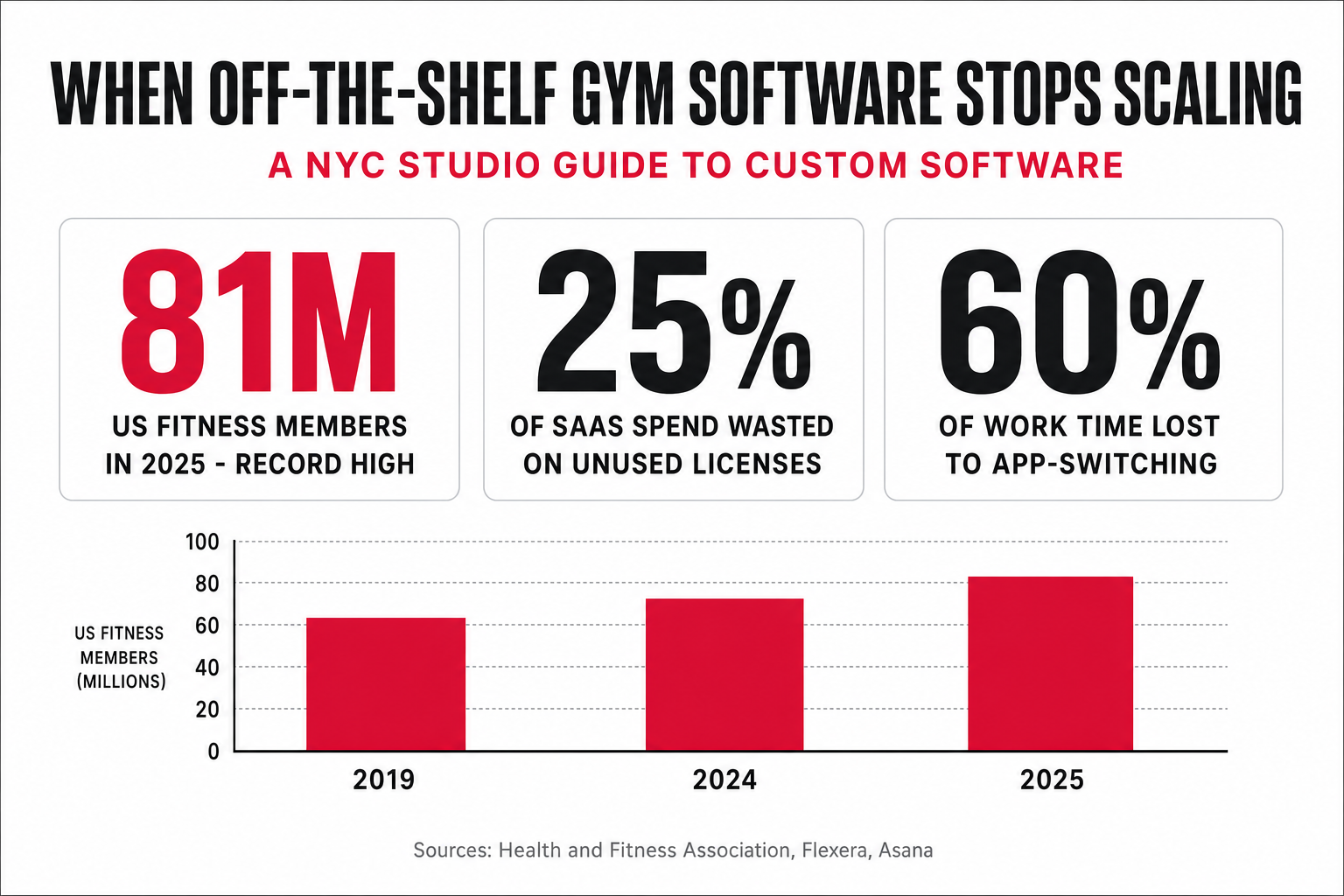
More people are training than at any point in history. A record 81 million Americans — about 1 in 4 — belonged to a gym, studio, or fitness facility in 2025, the highest on record and up 5.2% over 2024, which itself hit 77 million (Health and Fitness Association). Boutique studios were the single most popular facility type (HFA 2024 report).
US fitness-facility membership, in millions, 2022–2025 — four straight years of growth to an all-time high. Source: Health and Fitness Association.
That growth is good news and a trap. Every new member is more contacts, more class bookings, more payments, more waivers, more churn signals — more data. Off-the-shelf platforms handle the first few hundred members fine. Past that, the seams show. Here are the four that send NYC operators looking for something built for them.
Pain #1: You’re renting features you never use
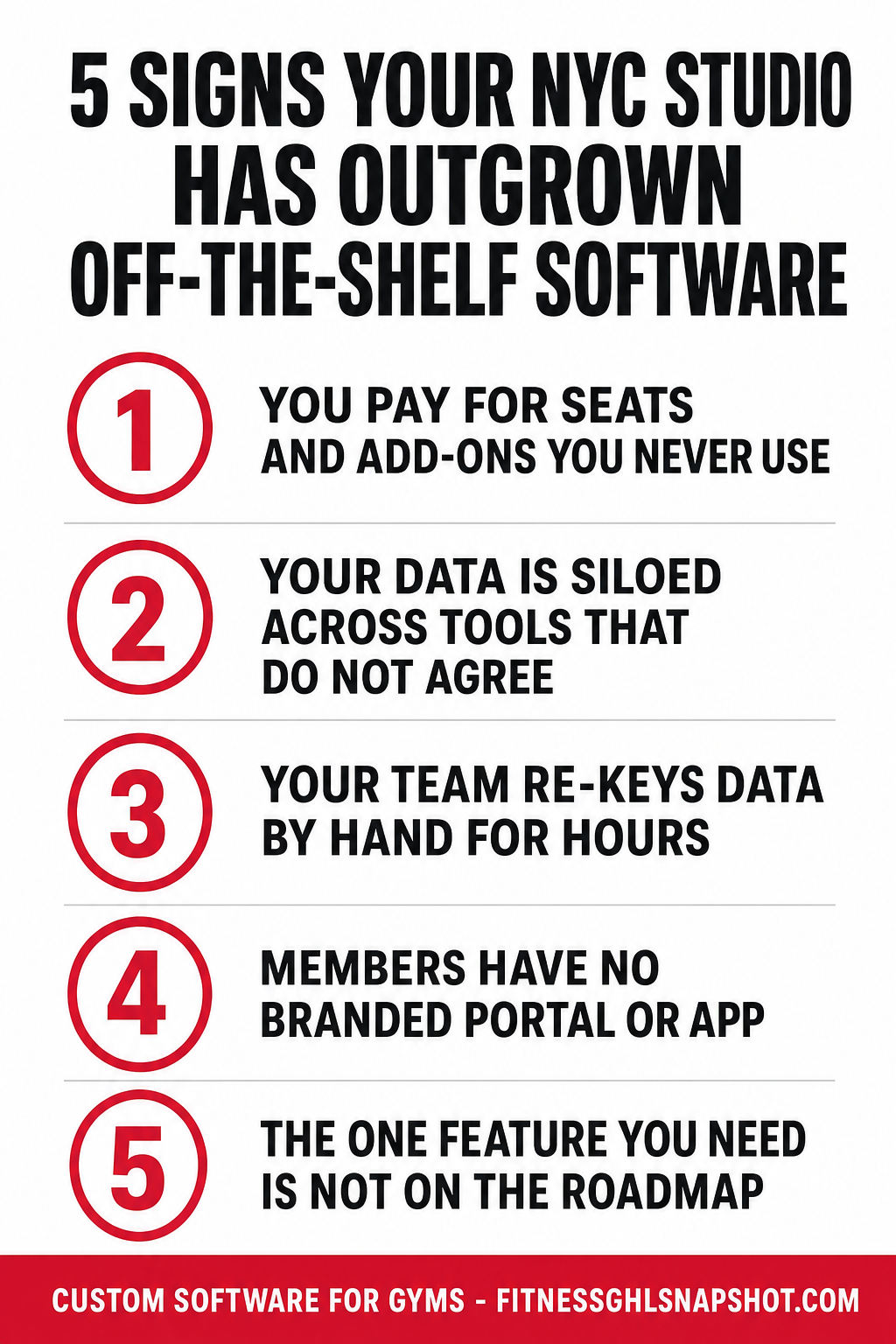
Off-the-shelf gym platforms price by the seat and the tier. You pay for reporting you don’t run, a marketing suite you replaced, and a booking flow your members find clunky — then pay again for the one add-on you actually wanted. Every capability is a line item, and the stack quietly outgrows its value.
This isn’t a gym problem; it’s a SaaS problem, and the data is brutal. The average organization now runs 220 SaaS applications (Productiv, 2024 State of SaaS). Roughly 25% of all SaaS spend is wasted on licenses nobody uses, with about 15% of apps sitting as pure shelfware (Flexera, 2024 State of ITAM). At enterprise scale, that waste averages $18 million a year, and about half of SaaS licenses go unused for 90+ days (Zylo, 2024 SaaS Management Index).
Pain #2: Your data lives in silos
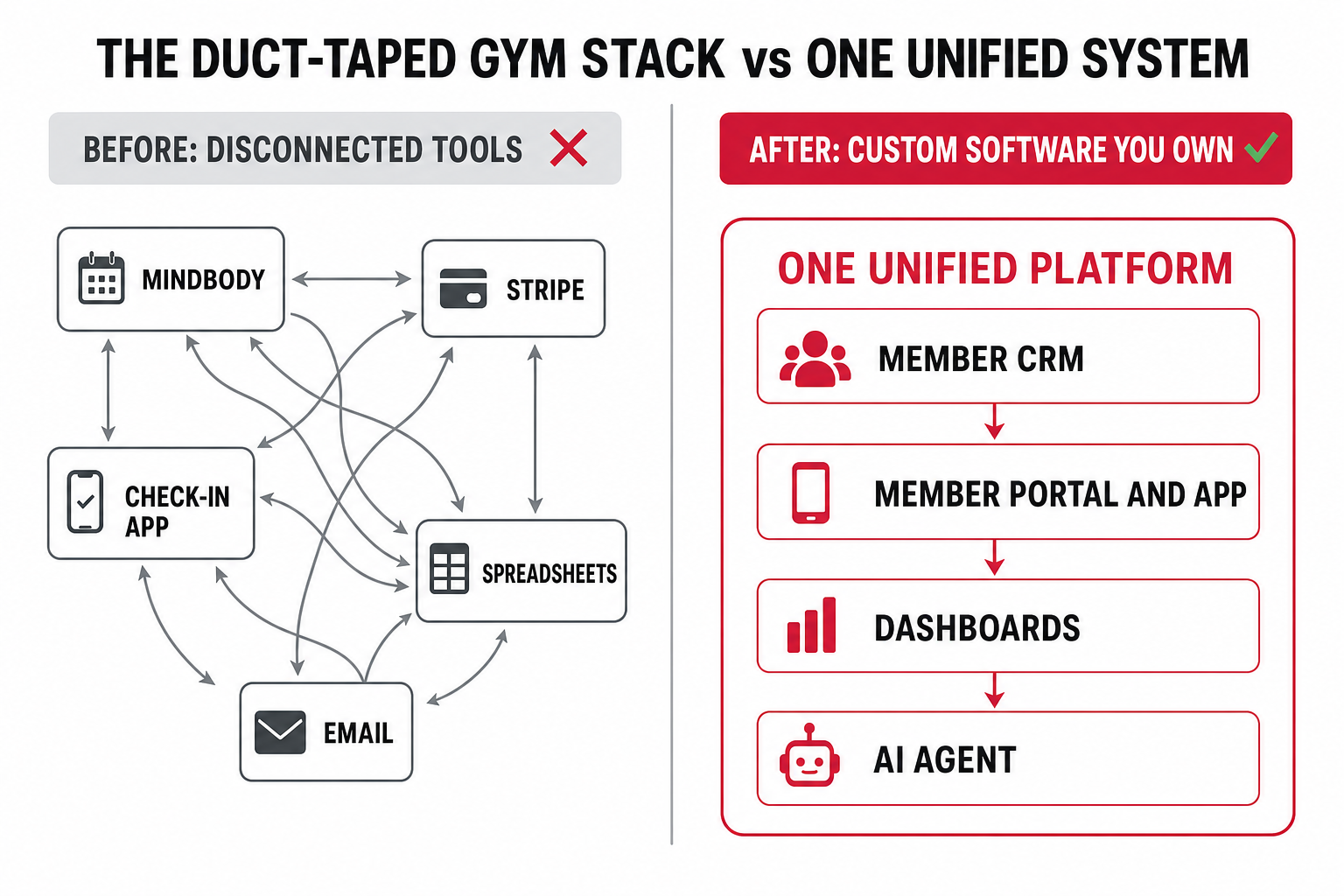
Ask a simple question — “which trial members from last month are most likely to cancel?” — and watch how many tools you have to open to answer it. Leads in one platform. Payments in Stripe. Attendance in a check-in app. Marketing in another tool. Nothing agrees, so nobody trusts the numbers, so decisions get made on gut instead of data.
Customers notice the seams too. Salesforce’s research found that while 79% of customers expect consistent interactions across a business, 55% still feel like they’re dealing with separate departments rather than one company, and 56% have to repeat information they’ve already given (Salesforce, State of the Connected Customer). For a member, that’s getting a “we miss you” email the day after they renewed — the classic tell of disconnected data.
The frustrating part is how much of this is automatable. McKinsey found that 69% of data-processing and 64% of data-collection activities can be automated with already-proven technology (McKinsey Global Institute). The re-keying your front desk does by hand between tools is exactly the work software should be doing — if the tools were connected. Unifying that data into one source of truth is one of the most common custom builds we ship, and it’s the same instinct behind migrating a studio’s stack onto GoHighLevel.
Pain #3: Manual admin is eating your team
Every disconnected tool adds a tab, and every tab adds a tax. Workers switch between about 9 apps a day, and hopping among 10+ apps costs roughly 3.6 hours a week in lost efficiency (Asana, Anatomy of Work). Zoom out and it’s worse: only about 40% of a knowledge worker’s time goes to the skilled work they were actually hired for — the other 60% is “work about work,” the coordination, searching, and status-chasing between tools (Asana).
How a knowledge worker’s time splits: only ~40% on the skilled work they were hired for vs. ~60% on coordination, searching, and app-switching. Source: Asana, Anatomy of Work Index.
Translate that to a front desk and it’s trials that never get followed up, no-shows nobody recovered, and cancellations that slipped through because the save-flow lived in someone’s head instead of in software. The fix is never “hire someone to work the tools harder.” It’s making the software carry the busywork — which is exactly why a dedicated GHL VA or an automated system pays for itself: it does the coordination your team is currently doing by hand.
Pain #4: You can’t build the one thing your studio needs
This is the pain that finally tips operators over. Generic tools are built for the average gym, so they can’t speak your studio — trials, class packs, on-ramp, belt ranks, reformer waitlists, attendance streaks, hybrid memberships. You need one screen, one automation, one member experience the platform simply won’t let you build. And your members? They’re stuck signing waivers over email and managing their membership by texting the front desk, because there’s no branded portal or app where they can just do it themselves.
Off-the-shelf says no. Custom software says: describe it, and we’ll build it. A member portal and booking app under your brand. A CRM that models your exact pipeline. Class and attendance dashboards that show show-rate by time slot and churn-risk by cohort — the kind of lifetime-value math generic reporting buries.
The cost of doing nothing
None of these pains announce themselves. There’s no invoice that says “silent churn” or “hours lost to re-keying.” They compound quietly:
- Margin leaks through seats and add-ons you don’t use, every single month.
- Members slip away because disconnected data means the retention nudge fires late or not at all — the exact mechanism behind silent churn.
- Your team burns out doing coordination software should handle, so the human work — the tour, the coaching, the relationship — gets less of them.
- You can’t move fast because the one feature that would differentiate your NYC studio isn’t on the roadmap of a company serving 50,000 average gyms.
The status quo isn’t free. It’s just billed in ways that don’t show up on one line.
What “custom software” actually means for a gym
“Custom software” used to mean a six-figure, year-long enterprise build. It doesn’t anymore. With AI-assisted development — we build on Claude Code and the latest agentic-AI SDKs — a small team ships the same software far faster, so timelines are typically half what traditional dev shops quote. Here’s what gyms and studios actually commission:
- A member-management CRM built for your studio — trial pipelines, membership tiers, class packs, renewals, attendance streaks, churn-risk scoring. Your own alternative to Mindbody, Glofox, or Zen Planner, shaped around how you really operate.
- A branded member portal and booking app — where members book classes, join waitlists, sign waivers, manage billing, and track progress, on the web or in the app stores, under your brand.
- Class and attendance dashboards — show-rate by class time, capacity utilization, retention cohorts, revenue per member, and roll-ups across every location.
- Unified data pipelines — connect Mindbody, Glofox, Zen Planner, PushPress, Trainerize, Stripe, and your check-in system into one layer so leads, payments, attendance, and marketing finally agree.
- Custom AI agents — fitness-trained chat and voice agents that qualify leads, book trials, answer program questions, and recover no-shows, plugged into your own data.
That last one is where the timing gets interesting. Gartner predicts that by 2029, agentic AI will autonomously resolve 80% of common customer-service issues without human intervention, driving a 30% cut in operational costs (Gartner). The studios building custom AI into their front desk now are getting ahead of a curve their competitors will scramble to catch. And critically, you own the code — full IP transfer, deployed to your infrastructure, running under your accounts. No per-seat meter.
Build vs. buy: off-the-shelf, snapshot, or custom
Custom isn’t automatically the answer — and I’d rather you make a good decision than a fast one. Gartner also predicts that over 40% of agentic-AI projects will be canceled by the end of 2027 on cost and unclear value (Gartner), which tells you scope discipline matters. For most studios, the right first move is an owned automation layer, not a ground-up build. Here’s the honest three-way:
Off-the-shelf vs. GHL snapshot vs. custom-built
| Plan | Off-the-Shelf Platform | GHL Fitness Snapshot recommended | Custom-Built Software |
|---|---|---|---|
| Price | Subscription | $997 one-time | Custom quote |
| Feature 1 | Rented, priced per seat and tier | You own the automation layer | You own 100% of the code (full IP transfer) |
| Feature 2 | Generic — built for the average gym | Fitness-specific, configurable to your studio | Built exactly to your spec |
| Feature 3 | Your data locked in their silo | Unified in your GoHighLevel account | One source of truth you design |
| Feature 4 | Per-seat fees, processing cuts, paid add-ons | One-time snapshot, no per-seat meter | Fixed-price project, no rent-forever trap |
| Feature 5 | Fixed feature roadmap you don't control | 50+ workflows installed in ~24 hours | Member portal, CRM, dashboards, AI agents |
| Feature 6 | Best for: just getting started | Best for: most gyms and studios | Best for: outgrown off-the-shelf, need bespoke |
| — | See pricing | Get a quote |
For a lot of NYC operators, the smart path is a hybrid: deploy the snapshot to own your automation layer in 24 hours, then commission custom software or GHL development for the specific pieces — a member app, a bespoke dashboard, an AI agent — that off-the-shelf will never build. You don’t have to boil the ocean to stop the leak.
Is custom software right for your NYC gym?
Here’s the straight read.
Custom software is a strong fit if you:
- Run multiple locations or a hybrid model that generic platforms fight you on.
- Pay for seats, tiers, and add-ons you barely use — and the bill keeps climbing.
- Waste hours re-keying data between tools that don’t talk to each other.
- Need a member experience (a branded portal, a specific booking flow, a custom AI agent) the platform simply won’t build.
- Want to own your software and data outright instead of renting forever.
It’s less urgent if you:
- Are a single studio under a few hundred members that an off-the-shelf tool still serves well.
- Haven’t yet deployed an owned automation layer — start there; it solves most of this for a fraction of a custom build.
- Can’t yet name the one screen or workflow you’d build first (scope it before you build it).
Most growing NYC studios sit in the first group on at least two counts. And you don’t have to choose all-or-nothing: start by owning your automation layer, then build custom where it actually moves the needle. If you also want a hand running the day-to-day, a dedicated GHL VA can operate the system so you don’t have to.
The bottom line
For an NYC gym or studio, off-the-shelf software is a fine place to start and a bad place to get stuck. As you scale, generic platforms bill you for seats you don’t use, silo the data you need, and refuse to build the one thing that would set your studio apart — while your team burns 60% of its time on coordination software should handle. With a record 81 million Americans now training and AI-built software finally within reach of a boutique studio’s budget, the cheapest growth lever most operators are ignoring isn’t another subscription. It’s owning the software they run on.
You probably don’t need to build everything. But when off-the-shelf stops scaling, the move is to own your automation layer and build custom where it counts — so the software finally fits the studio, instead of the other way around.
Frequently asked questions
When should a gym move off Mindbody or Glofox to custom software?
The tipping point is usually one of four things: you're paying for seats and add-ons you don't use, your data is siloed across tools that don't agree, your team wastes hours re-keying information by hand, or you need a member experience the platform simply won't build (a branded app, a specific booking flow, a custom AI agent). If two or more of those describe you, it's worth scoping a custom build. If none do, an off-the-shelf tool or an owned automation layer is still the right call.
Isn't custom software far more expensive than a monthly subscription?
It's a different cost model. A subscription is rent you pay forever, per seat, plus processing fees and add-ons. Custom software is a fixed-price project you own outright — no per-seat meter. Because we build with Claude Code (AI-assisted development), timelines and cost are typically about half what a traditional dev shop quotes, and the software has no recurring license fee. For many multi-location studios, the owned build pays back against years of climbing subscription bills.
Do I have to rip out GoHighLevel to get custom software?
No — the opposite. Most studios keep GoHighLevel as the automation layer and layer custom software on top or beside it: a branded member app, a bespoke dashboard, a unified data pipeline, or a custom AI agent plugged into GHL. We also build GHL integrations and migrations directly. You can start with the fitness snapshot and add custom pieces only where off-the-shelf falls short.
What can you actually build for a gym or studio?
Common builds include a member-management CRM (a Mindbody or Glofox alternative shaped to your studio), a branded member portal and booking app, class and attendance dashboards, data integrations that unify Mindbody, Stripe, and your check-in system, and custom AI agents for lead intake, no-show recovery, and member support. If you can describe it, we can usually build it — from a single automation to a full multi-tenant platform.
Do I own the code and my data?
Yes — 100%. Full IP transfer is included by default. We retain no licenses, no royalties. The code lives in your repository, deploys to your infrastructure, and runs under your accounts. Your member data stays yours, in one source of truth you control — not locked inside a vendor's silo.
How long does a custom build take for a studio?
It depends on scope. Simple AI agents run about 2–3 weeks, voice agents 2–4 weeks, member portals and dashboards 4–8 weeks, and full member-management platforms 8–14 weeks. Because we use AI-assisted development, those timelines are typically half what traditional dev shops quote. The fastest way to a real estimate is a quote call where you describe what you need in plain English.
About the author
Divya Kapoor is our Member Retention and Lifecycle Specialist, based in Denver, CO. She ran member experience for a three-location boutique pilates and yoga group before joining the snapshot team to design retention systems — and she’s the one who noticed that silent churn and scattered data, not formal cancellations, were eating most of her studios’ revenue. She writes about onboarding, retention, and the unglamorous data work that keeps studios full.