
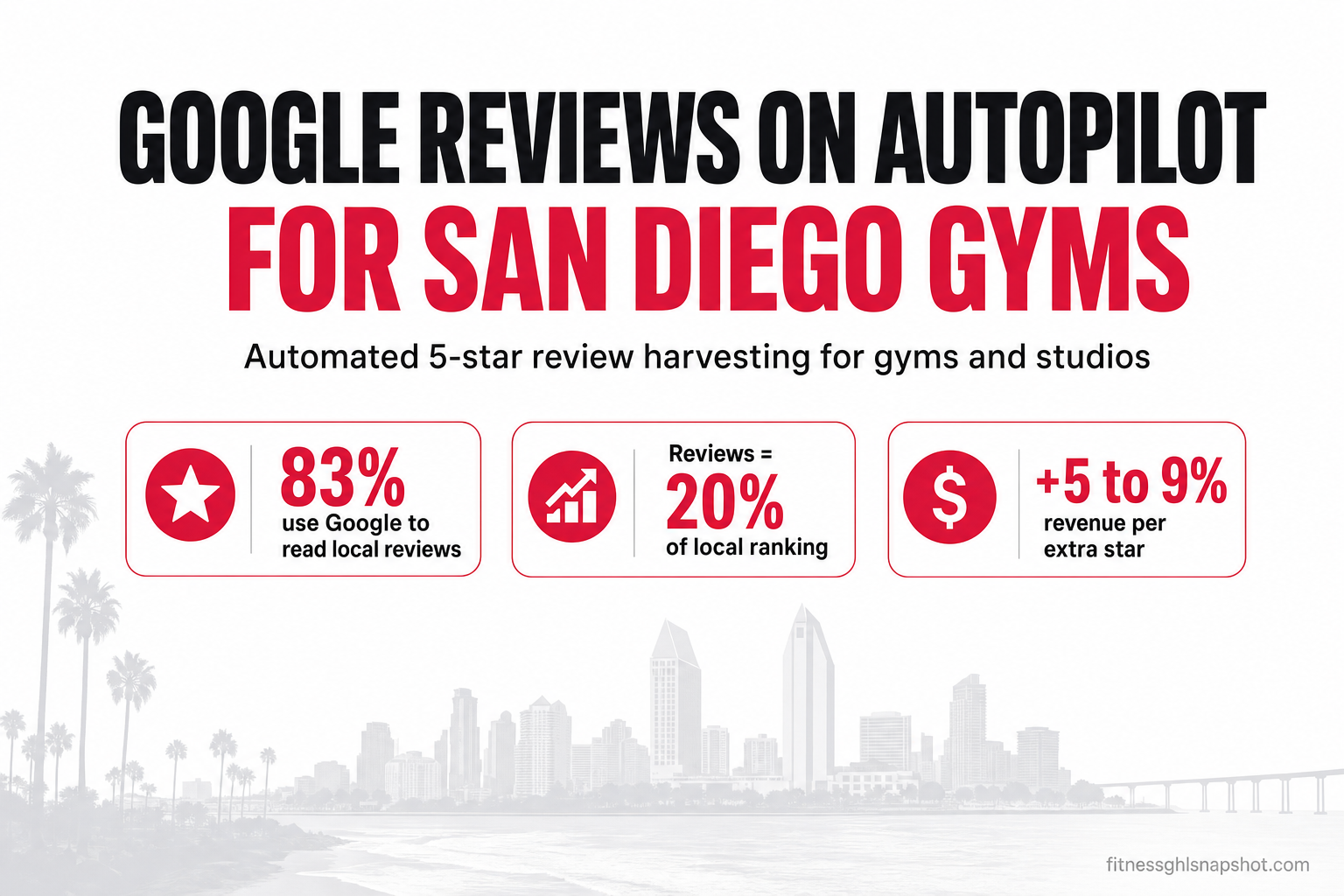
Getting Google reviews on autopilot means your gym asks every happy member for a review automatically — a timed text and email fires after a class check-in or a payment, routes the happy ones straight to your Google listing, and auto-replies to each review — so a steady stream of fresh 5-star reviews lands without anyone at the front desk remembering to ask. For a San Diego gym, that flywheel is the whole ballgame in local search: 83% of consumers use Google to read reviews of local businesses (BrightLocal Local Consumer Review Survey 2024), and review signals now drive about 20% of Google local-pack ranking (Whitespark 2026 Local Search Ranking Factors). In a metro of 3.3 million people (USAFacts) with a gym on every other block from North Park to Pacific Beach, the studio that shows up in the map pack with the most recent 5-star reviews wins the trial.
I spent years buying Facebook and Instagram ads for trainers and studios before I learned the cheaper lever was already sitting in the building: your existing members. Get a fraction of them to leave a Google review every month and you climb the map, earn trust before a prospect ever calls, and convert more of the traffic you already pay for. The catch is that reviews don’t happen on their own — you have to ask, at the right moment, every time. That’s exactly what a machine does better than a busy front desk. This is the San Diego operator’s playbook for automating it.
Table of contents
- The short answer for San Diego gym owners
- Why Google reviews decide which San Diego gyms fill classes
- The real problem: reviews don’t happen on their own
- How review harvesting on autopilot works
- Manual asking vs autopilot harvesting
- Replying to reviews is half the game
- Keep it compliant with Google’s policies
- Is review automation right for your San Diego gym?
- FAQ
The short answer for San Diego gym owners
If you run a CrossFit box in North Park, a reformer studio in La Jolla, a martial-arts academy in Chula Vista, or a PT business in Pacific Beach, here’s the compressed verdict:
- The map pack is your storefront. When someone searches “gym near me” or “pilates studio San Diego,” Google shows three local results. Reviews — how many, how recent, and your star average — heavily influence which three, and which one gets tapped.
- You already have the reviews you need. They’re walking through your door every day. You just aren’t asking them at the moment they’re happiest — right after a great class.
- A human will never ask consistently. Your front desk is coaching, cleaning, and closing. An automated system asks every qualifying member, every time, at the perfect moment — and never forgets.
The rest of this article is the how, with the numbers — and an honest look at when done-for-you review automation is worth it and when it isn’t.
Why Google reviews decide which San Diego gyms fill classes
Reviews aren’t a vanity metric. They’re a ranking factor, a trust signal, and a revenue lever at the same time.
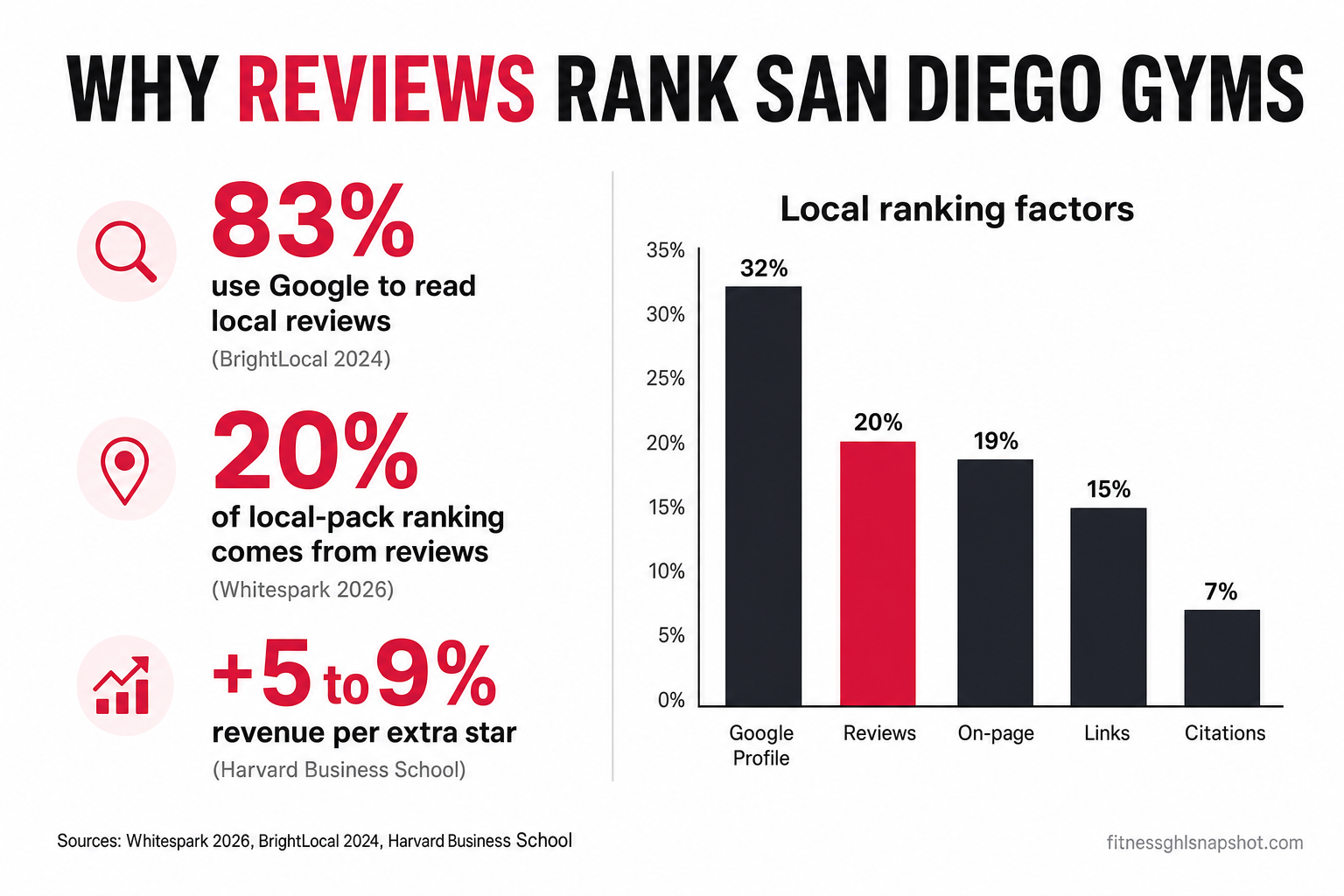
They decide if you get found. Reviews make up roughly 20% of Google local-pack ranking weight, up from 16% in 2023 — second only to your Google Business Profile itself, and ahead of on-page SEO and backlinks (Whitespark 2026). For a local business, few investments move the map more than a steady flow of fresh reviews.
Approximate share of Google local-pack ranking weight by factor, 2026. Review signals are the second-largest factor at ~20%. Source: Whitespark 2026 Local Search Ranking Factors.
They decide if you get chosen. Even after you rank, the prospect reads before they call. 83% of consumers use Google to read reviews of local businesses, and 91% say a business’s reviews shape their overall perception of it (BrightLocal 2024). A San Diego mom comparing three boxes for her kid’s summer trial is going to pick the one whose reviews are recent, plentiful, and answered.
They decide how much you earn. The most rigorous study on this is Harvard Business School’s — Michael Luca combined Yelp ratings with state revenue data and found a one-star increase in rating drives a 5–9% increase in revenue, an effect that shows up for independent businesses and barely moves the needle for big chains (HBS, 2011). Your independent studio is exactly the kind of business that gains the most from a better, fresher rating.
And demand has never been higher. A record 81 million Americans — 26.1% of the population — belonged to a gym or studio in 2025, up 5.2% year over year, with Gen Z (18–24) posting the highest membership rate of any age group at 35.5% (Health & Fitness Association). More San Diegans are shopping for a gym than ever — and they’re checking Google first.
The real problem: reviews don’t happen on their own
Here’s the uncomfortable truth behind every gym stuck at 40 reviews: happy members almost never leave a review unprompted. They finish a great class, feel good, and walk out — the thought never crosses their mind. The only reliable way to get reviews is to ask, and the data is clear that asking works.
69% of consumers recall leaving a review after a business prompted them in the past year, up from 60% the year before, and the share who say they “always” leave a review when asked climbed to 19%, up from 12% in 2023 (BrightLocal 2024). Read that again: roughly one in five people will leave a review every time you ask. If a 250-member studio simply asked members after class, the math on 10–20 new reviews a month is not hard.
So why doesn’t it happen? Because “ask every happy member at the right moment” is a task humans are terrible at and machines are perfect at. Your coaches are running the floor. Your front desk is checking people in. Nobody is standing there three hours after class thinking, I should text Sarah for a review. The ask gets skipped 95% of the time — not from laziness, but because it’s an interruption to real work.
There’s a second reason automation matters: velocity and recency. Google and consumers both reward fresh reviews. Whitespark’s data shows a business earning 4+ new reviews a week consistently outranks a competitor with a bigger but stale pile (Whitespark 2026). A one-time review push in January does nothing for you in June. You need a drip that never stops — and a person will never keep that up. A workflow will.
How review harvesting on autopilot works
“Review harvesting” is just a system that asks the right member for a review at the right time and sends the happy ones to Google — running on your GoHighLevel without anyone lifting a finger. Here’s the exact flow we install for a San Diego gym.
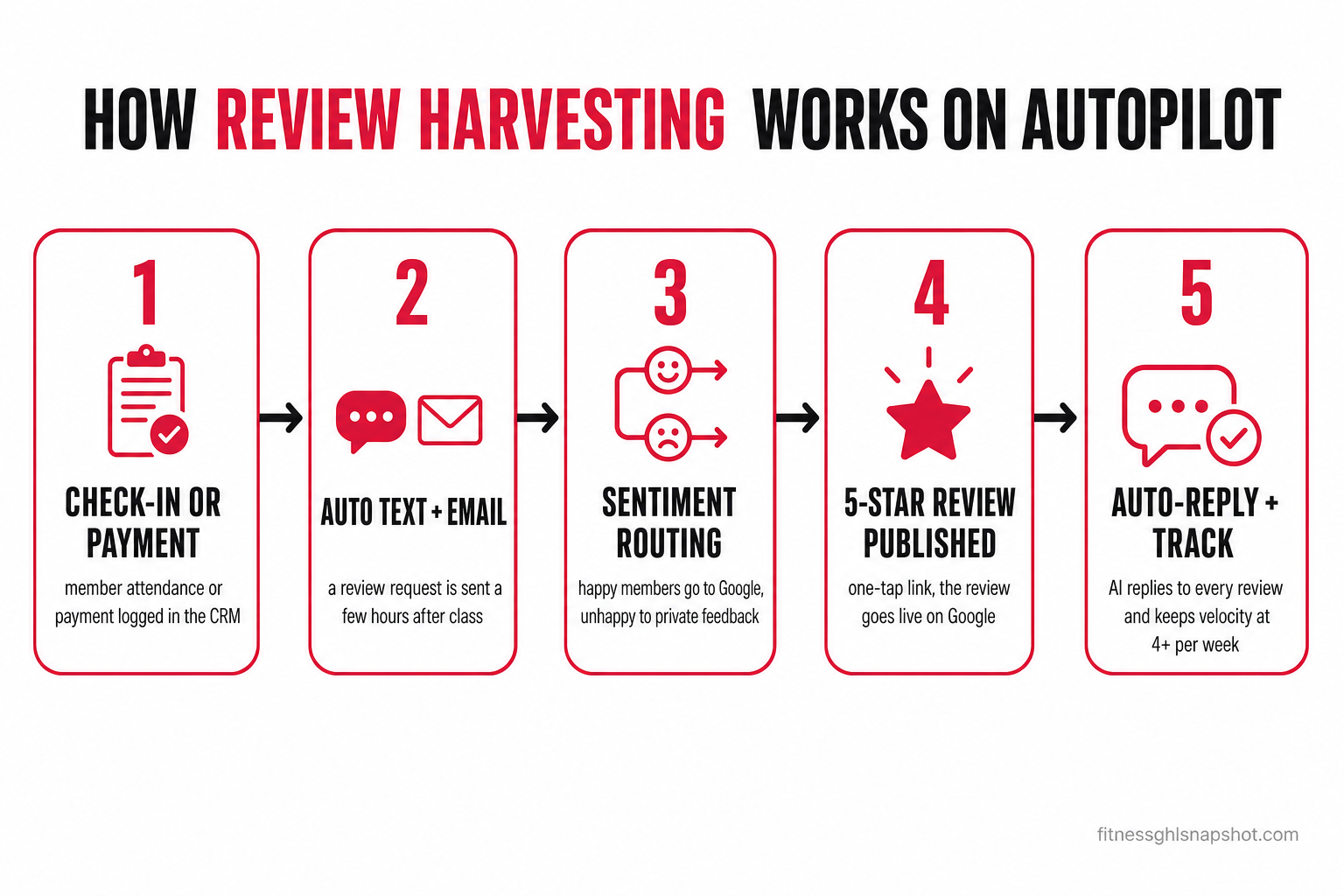
- Trigger — a check-in or payment fires the workflow. When a member’s attendance is logged or a payment clears, GoHighLevel starts the review sequence for that contact. That’s the signal they’ve had a real experience worth reviewing.
- Timed ask — a text and email go out a few hours later. Not three days later, when the glow has faded. A short SMS lands while the class still feels good: “Hey [name] — how was today’s session at [gym]?” SMS is the workhorse here because it actually gets read.
- Sentiment routing — happy to Google, unhappy to you. Members who respond positively get a one-tap link straight to your Google review page. Anyone who signals frustration is routed to a private feedback path that lands in the owner’s inbox — so you fix the problem before it becomes a public 2-star review, not after.
- Publish — the 5-star review goes live. The happy member taps through and posts. Because the link is pre-filled and frictionless, far more of them finish than with a “please review us sometime” flyer.
- Auto-reply and track — every review gets a response, velocity gets monitored. The system replies to each new review automatically and keeps the weekly drip going, so you hold that 4+/week velocity Google rewards.
The whole thing is frequency-capped so no member is ever pestered — asked at most a couple of times in a 90-day window, then left alone. For the deeper mechanics of timing, sentiment forks, and the exact message copy, see our full playbook on getting 10+ Google reviews a month for your gym — this post is the San Diego, done-for-you version of that system.
Manual asking vs autopilot harvesting
Here’s the honest side-by-side of the three ways a San Diego gym handles reviews:
Three ways to collect gym reviews
| Plan | Manual / DIY | Front-desk reminder | Autopilot harvesting recommended |
|---|---|---|---|
| Price | Default | Better | Best |
| Feature 1 | Ask when someone remembers | Staff hands out a QR card | Every member asked automatically |
| Feature 2 | Happens ~5% of the time | Depends on a busy human | Fires after each check-in / payment |
| Feature 3 | No sentiment routing | Ask timing is inconsistent | Sentiment routing protects your average |
| Feature 4 | Bad experiences post publicly | Still no private-feedback path | Unhappy members caught privately |
| Feature 5 | Reviews go stale between pushes | Velocity is lumpy | Steady 4+/week velocity |
| Feature 6 | Result: stuck at 40 reviews | Result: slow, uneven growth | Result: a growing 5-star flywheel |
| — | — | See review harvesting |
The difference isn’t effort or luck — it’s consistency. Manual asking depends on a human remembering during the busiest part of their day. Autopilot harvesting asks every qualifying member, every time, at the moment they’re most likely to say yes. Over a year, that’s the gap between 40 reviews and 400.
Replying to reviews is half the game
Collecting reviews is only half the flywheel. Replying to them is the other half — and it’s where most gyms quietly lose trust. 88% of consumers say they’d use a business that responds to all of its reviews, versus just 47% for a business that doesn’t respond at all (BrightLocal 2024). A wall of glowing reviews with zero owner replies reads as absent; the same wall with a warm reply under each one reads as a gym that cares.
Percentage of consumers who would use a local business based on whether it replies to reviews. Responding to every review nearly doubles consideration. Source: BrightLocal Local Consumer Review Survey 2024.
Replying by hand to every review is another job nobody at the gym has time for. So our Google review reply automation drafts and posts an on-brand response to each new review — thanking the happy ones by name, and flagging any critical one to the owner for a personal touch. Notably, consumers don’t penalize this: in BrightLocal’s test, 58% actually preferred the AI-assisted reply over the human-written one (BrightLocal 2024). Done right, automated replies read as attentive, not robotic.
Keep it compliant with Google’s policies
Automation makes it easy to cross a line if you’re not careful, so the system is built to stay clean:
- Never incentivize reviews. No “leave a review, get a free class.” That violates Google’s review policies and can get your reviews stripped or your listing penalized. The workflow asks for honest feedback — nothing more.
- Route sentiment, don’t fake it. Sending happy members a review link and unhappy members a private path is fine — you’re helping people find the right channel, not filtering out or suppressing published reviews. You never edit or gate what someone posts to Google.
- Respect consent and quiet hours. Review-request texts run on a compliant A2P 10DLC number, honor STOP opt-outs, and never fire in the middle of the night — the same TCPA guardrails that ship with the rest of the snapshot.
Play it straight and the flywheel compounds. Cut corners and Google will eventually claw the reviews back.
Is review automation right for your San Diego gym?
I’d rather you make a good call than a fast one, so here’s the honest read.
Review automation is a strong fit if you:
- Have an active member base checking in for classes or PT — you’re sitting on ungathered reviews.
- Compete in a crowded San Diego search result and want to climb the map pack.
- Are stuck at a review count that hasn’t moved in months because asking is manual.
- Want bad experiences caught privately instead of posted publicly.
It’s less urgent if you:
- Are pre-launch with almost no members yet (build the base first).
- Already run a disciplined, automated review system that’s consistently adding fresh reviews every week.
Most San Diego gyms and studios are squarely in the first group — plenty of happy members, not enough reviews, and no time to ask. Automation closes that gap without adding a task to anyone’s day. Pair it with solid local SEO fundamentals and a strong first-30-days onboarding flow, and the reviews reinforce everything else you’re doing to fill classes.
The bottom line
For a San Diego gym, Google reviews are the storefront: they decide whether you show up in the map pack, whether the prospect picks you over the box down the street, and — per Harvard’s data — how much revenue each star is worth. Reviews drive about 20% of local ranking, 83% of consumers read them, and one in five members will leave one every time you ask. The only thing standing between your gym and a 5-star flywheel is a consistent ask — and that’s the one thing a busy front desk can’t deliver.
Automating review harvesting fixes it at the source: every happy member asked at the perfect moment, sentiment routed to protect your average, every review answered, and a fresh drip that keeps Google interested week after week. In a metro of 3.3 million shopping for a gym on their phones, the cheapest growth you can buy isn’t more ads. It’s finally asking the members you already have.
Frequently asked questions
What does 'Google reviews on autopilot' actually mean for a gym?
It's an automated workflow running on your GoHighLevel that asks every qualifying member for a review at the right moment — a timed text and email after a class check-in or payment — routes happy members to your Google listing, sends unhappy ones to a private feedback path, and auto-replies to every review. Nobody at the front desk has to remember to ask; the system does it every time.
How many more Google reviews can a San Diego gym realistically get?
It depends on your active member base, but the lever is simply the ask. BrightLocal found 69% of consumers recall leaving a review after being prompted, and 19% now 'always' leave one when asked. A studio with a few hundred members that asks after every class can realistically add 10–20 fresh reviews a month — versus staying flat when asking is manual.
Is sentiment routing (sending happy members to Google) against the rules?
Asking for honest feedback and pointing happy members to a public review link while giving unhappy members a private way to reach you is a widely used, compliant practice — you're helping people find the right channel, not editing or suppressing what they post to Google. What you must never do is incentivize reviews (no free class for a review) or gate/alter published reviews, both of which violate Google's policies. Our workflow is built to stay on the right side of that line.
Does replying to reviews really matter?
Yes — a lot. BrightLocal's 2024 survey found 88% of consumers would use a business that replies to all its reviews, versus 47% for one that never responds. Replying signals an attentive, well-run gym. Our Google review reply automation drafts and posts an on-brand response to each new review and flags critical ones to the owner for a personal touch.
Why is review recency and velocity important for local ranking?
Google rewards fresh, steady review activity. Whitespark's 2026 data shows a business earning 4+ new reviews a week consistently outranks a competitor with more total reviews sitting stale. A one-time review push fades fast; an automated drip keeps your velocity up every week, which is exactly what helps you hold a spot in the San Diego map pack.
How fast can review automation be installed on my gym's GoHighLevel?
Review harvesting is part of our GoHighLevel fitness snapshot and is installed into your account in about 24 hours. It runs on your GoHighLevel, your calendar, your Google Business Profile, and your phone number — and you own it. Book a walkthrough to see the full flow before you decide.
About the author
Cole Hartman is our Local Marketing & Paid Acquisition Lead, based in Tampa, FL. He started out buying Facebook and Instagram ads for personal trainers and martial-arts schools, then learned the hard way that the funnel behind the ad — and the Google review flywheel around it — matters more than the creative. He writes about local SEO, review automation, and turning local visibility into booked trials.