
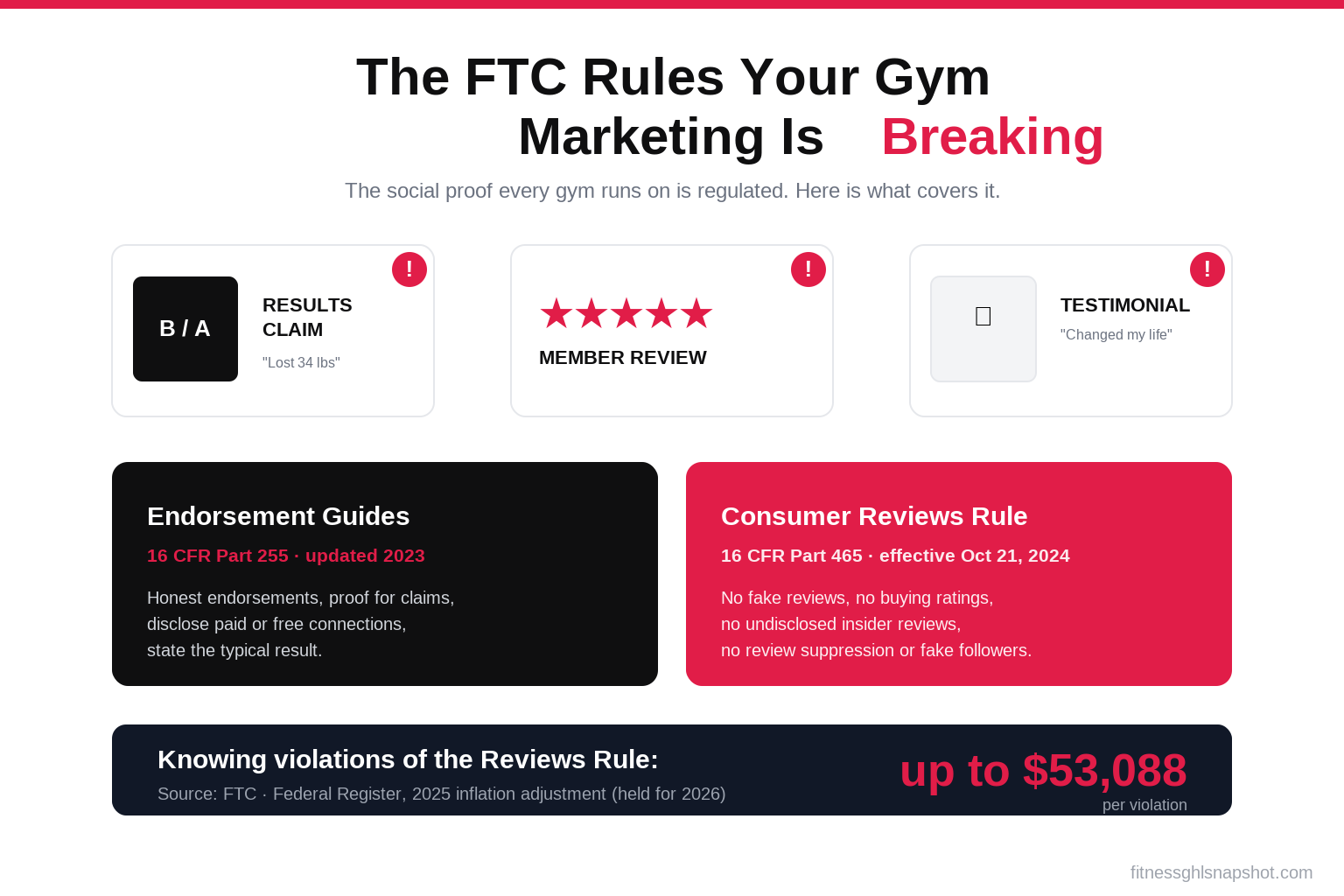
Here is the short version: your gym’s marketing runs on social proof, and most of that social proof is quietly breaking two federal rules. Before-and-after photos, “she lost 30 pounds in 8 weeks” captions, member testimonials, and the five-star reviews you ask for all fall under the FTC Endorsement Guides and, since October 2024, a formal rule on consumer reviews that carries civil penalties up to $53,088 per violation. The fixes are small and mostly free: have proof for the results you advertise, tell people what a normal member can actually expect, disclose when a testimonial was paid for or incentivized, and never buy, fake, or strong-arm a review. This post walks every rule, how it breaks in a real gym, disclosure copy you can paste, and a 10-minute audit.
It is a Tuesday and you are building next week’s Instagram posts. You drop in a client’s before-and-after, type “Jess lost 34 lbs training with us, you can too,” and add a carousel of five-star screenshots. Last month you gave three members a free month for leaving a Google review. Your lead trainer, who you employ, posts glowing reviews of your own gym from her personal account. None of that feels risky. All of it is regulated, and two of those moves can draw a penalty. Here is what the rules actually say, and how to keep every bit of your social proof without the exposure.
Table of contents
- Why your marketing is the compliance risk nobody mentions
- The two rulebooks, in plain English
- Before-and-after photos and results claims
- Testimonials and member reviews
- The 2024 Reviews Rule: what is now flat-out banned
- Trainers, influencers, and paid shout-outs
- Steal this: disclosure copy you can paste
- Run it for your size: solo, studio, multi-location
- Objections operators raise
- The 10-minute marketing-compliance audit
- FAQ
Why your marketing is the compliance risk nobody mentions
Ask a gym owner about legal risk and they picture the membership contract or a slip-and-fall. Fair. But the thing you do every single day, at volume, in public, is marketing. Transformation posts, review screenshots, “our members get real results” copy. That is where the Federal Trade Commission actually looks, because deceptive advertising is its core job.
The reason this flies under the radar is that the fitness playbook was built before the rules got sharp. In 2023 the FTC finished its first major rewrite of the Endorsement Guides since 2009. In 2024 it turned decades of guidance on fake and paid reviews into a binding rule with money attached. The marketing stayed the same. The rules moved.
None of this means you stop using social proof. It means three small changes: prove the results you claim, be straight about what is typical, and disclose anything you paid for or that came from inside the house. Do that and your marketing gets more credible, not less.
The two rulebooks, in plain English
There are two documents to know. They overlap, but they do different jobs.
The Endorsement Guides (16 CFR Part 255). These tell you how to use any endorsement, which means a testimonial, a review, a trainer’s recommendation, or an influencer post. The core rules: an endorsement has to reflect the person’s honest experience, the advertiser needs proof for any claim the endorsement makes, and any “material connection” between you and the endorser has to be disclosed clearly. The FTC finished updating them in 2023, the first refresh in about 14 years (Federal Register, 2023).
The Consumer Reviews and Testimonials Rule (16 CFR Part 465). This is newer and sharper. It took effect October 21, 2024, and it flat-out bans specific review practices: fake reviews, buying positive or negative reviews, undisclosed insider reviews, fake “independent” review sites you control, suppressing honest negative reviews with threats, and buying fake followers or engagement (FTC Q&A).
The difference matters. The Guides are guidance: they describe how the FTC reads the law when it decides something is deceptive. The Rule is a rule: break it knowingly and a court can order civil penalties. The 2025 inflation adjustment set that maximum at $53,088 per violation, and the FTC’s 2026 notice left it there (Federal Register, 2025). “Per violation” is the scary part. A batch of fake reviews is not one problem. It can be counted many times over.
Before-and-after photos and results claims
This is the big one for gyms, so start here. A before-and-after is an implied claim. When you post “Jess lost 34 lbs,” you are not just sharing a story. You are telling a prospect, “train here and you can get this.” The FTC reads it the same way a customer does.
Two rules apply. First, you need a reasonable basis for the claim. If you advertise objective results, you are expected to have real support for them, and for weight-loss claims the FTC’s bar is competent and reliable scientific evidence. A pile of happy testimonials does not meet that bar on its own (FTC health claims guidance). For a gym this is less about lab studies and more about not advertising outcomes you cannot back up.
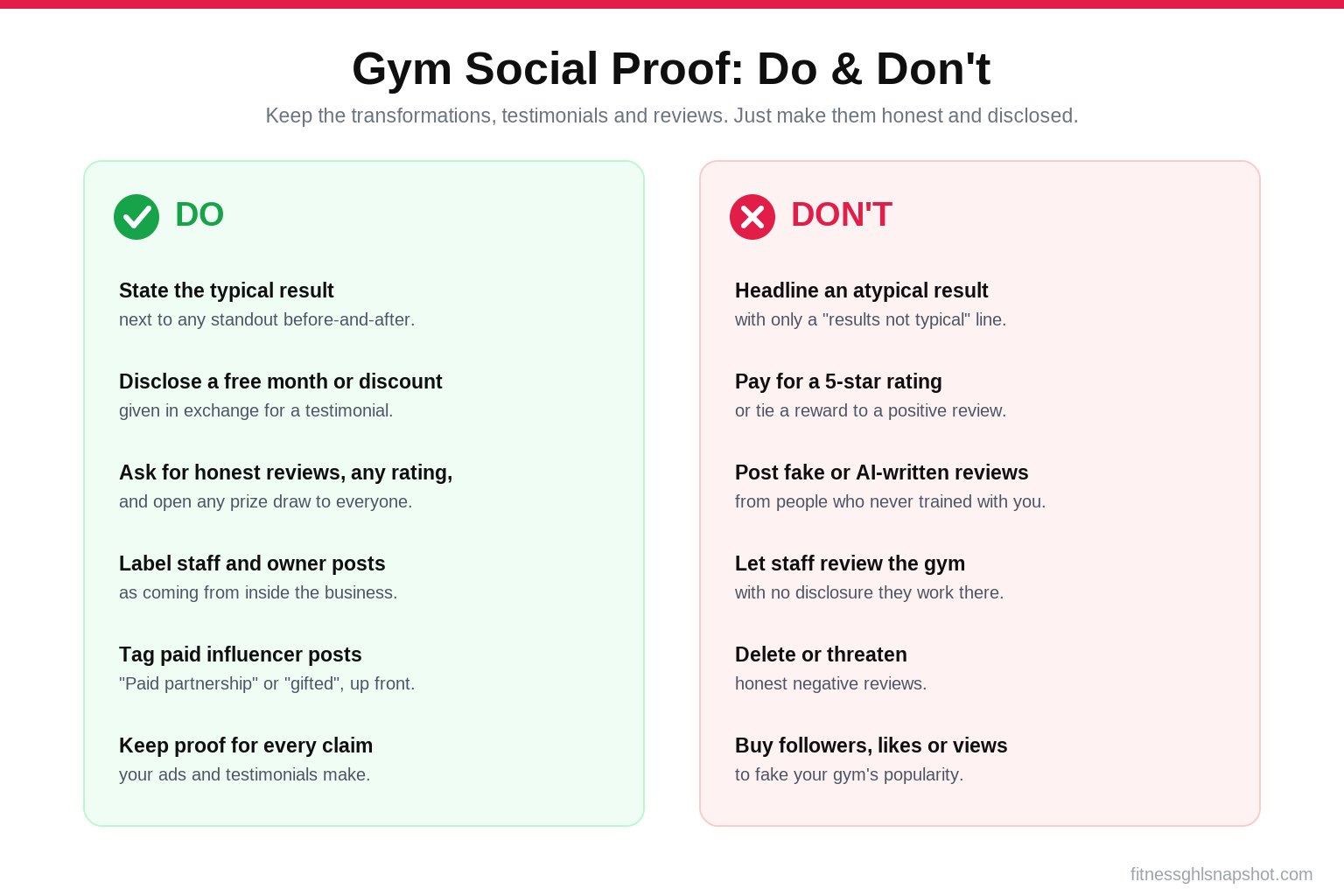
Second, and this is the one gyms get wrong constantly: if the result you show is better than typical, you have to say what typical is. Jess losing 34 pounds may be real and still misleading, because most members will not lose 34 pounds. The FTC’s own guidance is blunt about this. If you feature an exceptional result and do not have proof that people generally achieve it, the ad “must make clear to the audience what the generally expected results” are (FTC Endorsement Guides FAQ). A tiny “results not typical” line does not cure it. The FTC has said for years that this kind of disclaimer does not fix a misleading impression. You disclose the real, generally expected result.
The FTC also warns the fitness and weight-loss space specifically. Its “Gut Check” guide lists claims that experts say simply cannot be true, like losing substantial weight without diet or exercise. It defines “substantial” weight loss as roughly a pound a week sustained for more than four weeks, or more than 15 pounds total (FTC Gut Check guide). If your ad implies that kind of result, you had better be able to support it.
So what does a compliant transformation post look like? Show the real result, make clear it is above average if it is, and state what a typical member can expect. “Jess lost 34 lbs in our 12-week program. Most members who finish lose 8 to 12 lbs. Your results depend on your starting point and effort.” That is still a great ad. It is just true.
Testimonials and member reviews
A testimonial is an endorsement, so the Endorsement Guides apply. Three rules keep you clean.
It has to be honest and real. The member has to have actually said it and actually believe it. You cannot write a testimonial and attribute it to a member, and you cannot edit a quote so it says more than the member meant.
You need support for the claims inside it. If a testimonial says “I never get injured here” or “I lost 40 pounds,” that is a claim you are now making through the member’s mouth, and you need a basis for it just as if you said it yourself.
You have to disclose material connections. This is the one gyms trip on. If you gave a member anything of value in exchange for the testimonial, say a free month, a discount, swag, or a prize entry, that connection has to be disclosed clearly, right where people see the testimonial. The FTC’s examples of connections that need disclosing include payment, free or discounted products, discounts and codes, contest entries, and employment or family relationships (FTC Endorsement Guides FAQ).
Reviews are testimonials too. Which brings up the move half of gyms make: offering members something to leave a Google review. You can ask for reviews. You can even offer an incentive for leaving one. What you cannot do is tie the reward to the review being positive, and you have to disclose the incentive. “Leave us a 5-star review and get a free month” is the exact thing the rules prohibit, because the reward is conditioned on sentiment. “Leave us an honest review, positive or not, and you are entered to win a month free” is allowed, as long as you disclose that incentive on the reviews you then use in marketing.
The 2024 Reviews Rule: what is now flat-out banned
The Endorsement Guides describe how to do it right. The Consumer Reviews Rule lists what you can no longer do at all, with penalties attached. Here is the whole list in gym terms (FTC Q&A).
Fake or false reviews (section 465.2). You cannot write, create, sell, or buy reviews from people who never used your gym. That includes made-up reviews, reviews bought from a service, and AI-generated reviews presented as real member voices. If you knew or should have known a review was fake, using it is a violation.
Buying reviews conditioned on sentiment (section 465.4). You cannot pay for, or incentivize, a review that is tied to a particular rating. The incentive itself is fine. Conditioning it on a positive review is the problem.
Insider reviews without disclosure (section 465.5). Reviews from you, your family, your employees, or your agents cannot be posted or used in advertising without a clear disclosure of that relationship. Your front-desk lead posting “best gym in town” from a personal account, with no disclosure, is exactly what this bans. Note that paid outside influencers sit under the Endorsement Guides instead, but your own staff sit squarely here.
Fake independent review sites (section 465.6). You cannot run a “best gyms in [city]” site that looks independent but secretly exists to funnel people to your own gym.
Review suppression and threats (section 465.7). You cannot use intimidation or bogus legal threats to get an honest negative review taken down, and you cannot falsely claim a review portal shows all reviews when you are quietly burying the bad ones.
Fake social proof (section 465.8). You cannot buy fake followers, likes, or views that you knew or should have known are fake to pump up your gym’s apparent popularity.
Illustrative maximum civil-penalty exposure under the 2024 Consumer Reviews Rule, at the 2025–2026 cap of $53,088 per knowing violation (Federal Register, 2025). Penalties are assessed per violation and courts weigh many factors, so treat this as a ceiling, not a prediction. The point is that fake or bought reviews are not a slap on the wrist anymore. The FTC has already started enforcing: in late 2025 it sent warning letters to companies over practices it believed broke the Rule, just over a year after it took effect (Arnold & Porter, 2026).
Trainers, influencers, and paid shout-outs
Gyms love local influencers and trainer shout-outs. Both are endorsements, so both need disclosure when there is a material connection.
If you pay a local fitness influencer to post about your gym, give them a free membership, or run an affiliate deal where they earn per signup, that connection has to be disclosed in the post itself. The disclosure has to be clear and conspicuous and close to the message. The FTC has been explicit that vague tags do not count. “#ambassador,” “#sp,” “Gifted,” or a bare “thank you” are not enough, and burying “disclosure” in a comment or behind a “more” link does not cut it (FTC Endorsement Guides FAQ). Plain language like “Paid partnership with [Gym]” or “[Gym] gave me a free membership to try this” is what works.
Your own trainers are a special case. They are insiders. If a trainer you employ reviews your gym or hypes it online, that is an insider endorsement, and under both the Guides and the Reviews Rule it needs a disclosure that they work there. A customer reading “this place changed my life” assumes a neutral member wrote it, not someone on payroll. That gap is the whole reason the rule exists.
If you want the credibility of trainer and member stories without the exposure, the trick is a system that captures consent and tags the relationship at the source, so every story you publish already carries the right disclosure. That is a workflow problem, and it is very solvable.
For the review side specifically, our Google reviews playbook for gyms covers the honest ask that still earns a flood of five stars, and our review harvesting feature shows the automated version.
Steal this: disclosure copy you can paste
This is the part to bookmark. Real, usable copy for the places compliance actually lives in a gym. Adapt the bracketed parts, and for a big campaign have your attorney confirm the specifics.
1. Typical-results line (under any standout before-and-after):
[MEMBER]'s result is above average. In our [PROGRAM], most members
who finish lose [X to Y lbs / typical outcome] over [TIME]. Your
results depend on your starting point, effort, and consistency.
2. Incentivized-testimonial disclosure (next to any testimonial you gave something for):
[MEMBER] received [a free month / a discount] for sharing their
story. Their experience is their own and was not scripted by us.
3. Compliant review request (text or email to a happy member):
Hi [FIRST NAME], would you share an honest review of your experience
at [GYM]? Good or bad, it genuinely helps us. Here's the link:
[LINK]. [If you run a prize:] Everyone who leaves a review this
month, whatever the rating, is entered to win a free month.
4. Staff / insider disclosure (any review or post from you or an employee):
Full disclosure: I [own / work at / coach at] [GYM]. This is my
honest take as someone on the inside.
5. Paid or gifted influencer post (the creator posts this, up front):
Paid partnership with [GYM]. / [GYM] gave me a free membership to
try and share my honest experience.
Run these through software instead of a staffer for one reason: consistency. The failure mode is never the one post you thought about. It is the 50 posts, review requests, and member stories that went out while nobody was watching the disclosure. A flow that attaches the right line automatically, every time, is how you keep social proof at volume without the risk. The same logic applies to your texting consent, which our SMS marketing guide for gyms walks through.
Run it for your size: solo, studio, multi-location
The rules are identical for everyone. The priorities are not.
The solo trainer or small PT team (20 to 100 clients)
You are the brand, so your biggest exposure is your own posts. Two fixes handle most of it. First, add a typical-results line to every transformation you post, and stop headlining your single best client as if they are the norm. Second, if you ever give a client something for a testimonial or review, disclose it and never tie it to a rating. You do not need a legal department. You need a saved caption template and the discipline to use it. If clients review you on Google, ask honestly and leave it at that.
The boutique studio (80 to 250 members, 2 to 8 instructors)
Now you have staff and volume, which means insider reviews and incentivized reviews become the live risks. Set one rule for instructors: if you post about this studio, disclose that you work here. Kill any “5-star review for a free class” promo and replace it with an honest ask plus an optional prize draw open to all ratings. If you run challenges, build the typical-results language into the ad template so it is never skipped. This is the size where an informal “just ask members for reviews” habit quietly turns into a pile of undisclosed incentivized reviews.
The mid-size or multi-location gym (250 to 500-plus members)
You have real marketing output: paid influencers, multiple locations posting, ongoing review campaigns. Standardize. One disclosure policy every location and contractor follows, one approved transformation-ad template with typical results baked in, and one review process that routes honest feedback and tags incentives automatically. If you use agencies or influencers, put the disclosure requirement in the contract, because you carry the liability for their posts, not just they. Multi-location is also where fake-engagement temptation shows up on social. Do not. It is now a named violation.
Objections operators raise
“Everyone uses before-and-afters, why would the FTC come after my gym?” Because the rule applies by the practice, not the size. You are unlikely to be the FTC’s top target, but a disgruntled member, a competitor, or a state attorney general can all raise it, and the fix is so cheap that carrying the risk makes no sense. You also just make better ads when they are honest.
“If I show typical results instead of my best transformation, won’t my ads convert worse?” Usually not, and often better. A believable range beats a too-good-to-be-true number that triggers a prospect’s skepticism. “Most finishers lose 8 to 12 pounds” reads as real. “Lose 34 pounds” reads as a pitch. Honest social proof converts the people who actually stick.
“I already have 200 Google reviews I asked for. Am I in trouble?” Probably not, if they are from real members giving honest opinions. The problem is only reviews that are fake, reviews where you paid for a positive rating, or insider reviews with no disclosure. Asking happy members for honest reviews has always been fine and still is.
“Do I have to take down old posts?” You do not need to nuke your history. Going forward, use the compliant templates, and for live ads still running, add the typical-results language and any missing disclosures. The risk lives in what you are actively publishing and spending on.
The 10-minute marketing-compliance audit
Run this today. Every “no” is a to-do.
- Does every before-and-after or results claim you are actively running state what a typical member can expect, not just show your best case?
- Have you removed or rewritten any “results not typical” disclaimer you were leaning on to excuse an atypical result?
- Can you support the objective claims your ads and testimonials make, especially any weight-loss numbers?
- Does every testimonial come from a real member who actually said it and believes it?
- When you gave a member anything for a testimonial or review, is that disclosed right next to it?
- Is every review incentive you offer open to all ratings, never tied to a positive one?
- Do reviews or posts from you or your staff disclose that relationship?
- Do paid or gifted influencer posts carry a clear “paid partnership” or “gifted” disclosure, not just a vague tag?
- Have you stopped buying any followers, likes, or views, and are you not threatening anyone over honest negative reviews?
- Is there a system that attaches the right disclosure automatically, so volume does not become your weak point?
The bottom line
Your gym’s social proof is its best sales tool, and almost none of it has to change in spirit. You keep the transformations, the testimonials, and the reviews. You just make them honest and disclosed: prove what you claim, tell people what is typical, flag anything you paid for or that came from inside the house, and never fake or buy a review. That is the whole game. The Endorsement Guides and the 2024 Reviews Rule are not asking you to be quiet about your results. They are asking you to be straight about them, which is also how you build the kind of trust that actually converts.
If you want the platform our own review and testimonial system runs on, you can sign up for GoHighLevel through our partner link. And for the other half of gym compliance, contracts, cancellation, and texting, read our companion guide on gym cancellation and auto-renewal law in 2026.
Frequently asked questions
Can my gym legally use before-and-after photos?
Yes. Before-and-after photos are legal as long as they are real and not misleading. The catch is that if the result you show is better than what a typical member gets, you have to disclose what people can generally expect, not just add a tiny 'results not typical' line. The FTC's position is that such a disclaimer does not cure a misleading impression. Show the real result, say it is above average if it is, and state the typical outcome.
Is it legal to offer a free month for a Google review?
You can offer an incentive for leaving a review, but you cannot tie it to the review being positive, and you have to disclose the incentive on any review you then use in marketing. 'Leave a 5-star review and get a free month' is prohibited because the reward is conditioned on sentiment. 'Leave an honest review, any rating, and you're entered to win a free month' is allowed with disclosure.
What is the FTC penalty for fake gym reviews?
Knowing violations of the 2024 Consumer Reviews and Testimonials Rule (16 CFR Part 465) can draw civil penalties up to $53,088 per violation under the FTC's 2025 inflation adjustment, which was held at that level for 2026. Penalties are assessed per violation and courts weigh several factors, but the takeaway is that fake, bought, or sentiment-conditioned reviews now carry real financial exposure.
Do my own employees need to disclose when they review my gym?
Yes. Reviews or endorsements from company insiders, including owners, family, and employees, require a clear and conspicuous disclosure of that relationship under both the FTC Endorsement Guides and the 2024 Reviews Rule (section 465.5). A staff member posting a glowing review from a personal account with no disclosure is exactly what the rule prohibits.
Do I need a disclaimer on client testimonials?
You need two things, not a generic disclaimer. First, if the testimonial describes an above-average result, disclose the typical result. Second, if you gave the member anything of value for the testimonial (a free month, a discount, a prize entry), disclose that material connection right next to the testimonial. If the testimonial is unpaid and describes a typical experience, a plain 'individual results vary' note is reasonable but not a substitute for stating typical results on standout claims.
Does this apply to a solo personal trainer or just big gyms?
It applies to every advertiser regardless of size. The FTC Endorsement Guides and the Reviews Rule are triggered by the marketing practice, not revenue. A solo trainer who posts an undisclosed incentivized testimonial has the same type of exposure as a chain. The upside is that the fixes (typical-results lines, incentive disclosures, honest review asks) take an afternoon to set up.