
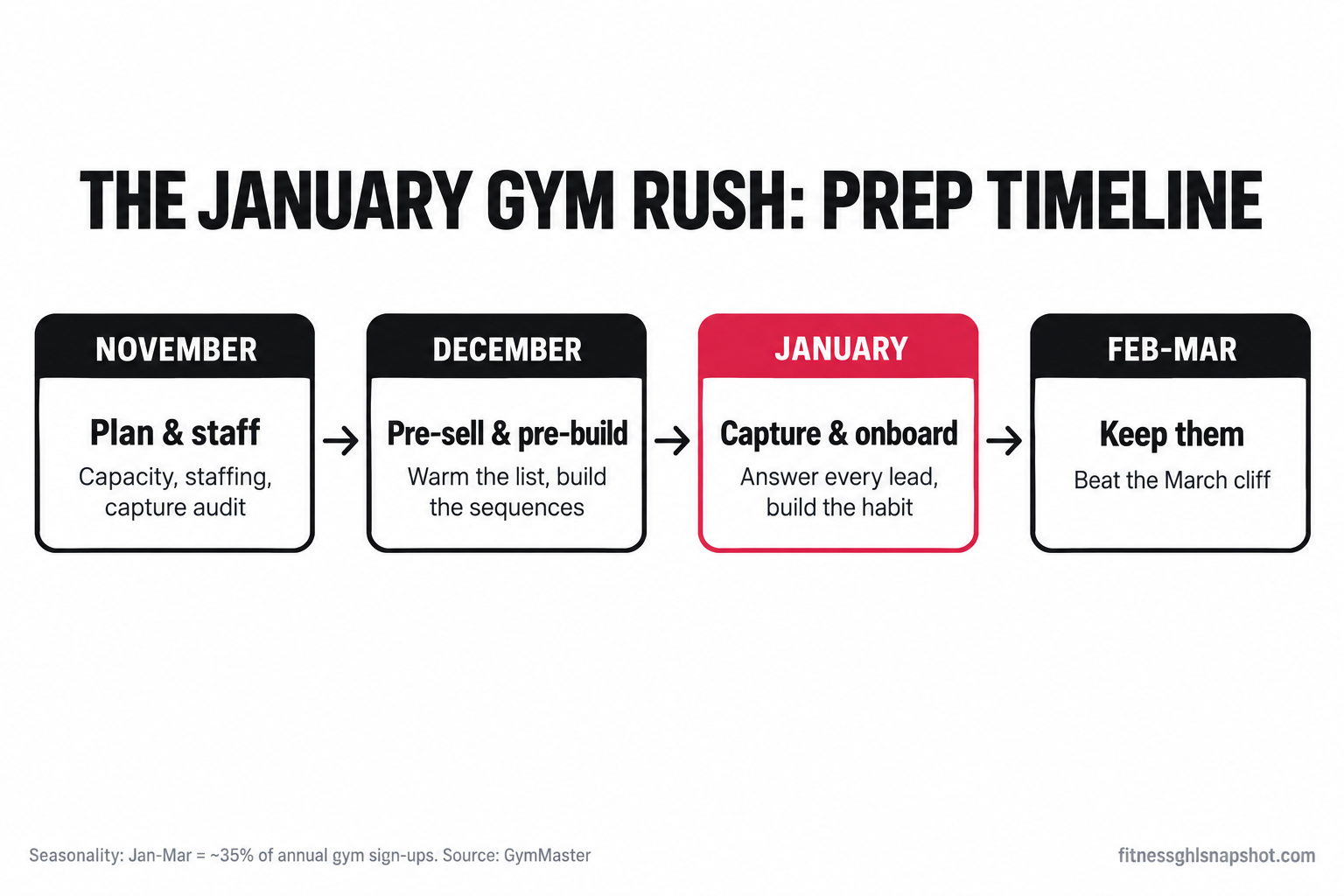
Here is the short version: January hands you more new leads than any other month, and most of them are wasted because nobody prepped for the volume. The gyms that still have those members in June did the work now, in November and December. They planned their capacity and staffing, fixed how leads get captured and answered, pre-built the follow-up and onboarding sequences before the first signup, and set the retention play that carries January joiners past the March cliff. This is that checklist, in the order you should run it, with the exact texts to steal.
It is January 6th. Your phone has eleven missed calls, your Instagram has four unread DMs asking about memberships, two people are standing at the front desk while your one morning coach runs a packed 6 a.m., and the new year “first week free” post you threw up last night already has thirty comments. This is the best demand you will see all year. And right now, half of it is leaking out the back, because the lead that called at 7:40 while you were coaching never got a call back, and the person who booked a trial is waiting on a text you have not sent. The rush is not the problem. Being unprepared for the rush is the problem, and the fix is not something you can do on January 6th. You do it now.
Table of contents
- What the January rush actually is
- What a wasted January costs you
- The prep calendar at a glance
- November: capacity, staffing, and the capture audit
- December: pre-sell and pre-build the sequences
- Early January: capture every lead the day it lands
- Mid-January: the onboarding that makes them stick
- Late January: fill classes and kill no-shows
- February and March: beat the cliff
- The printable January prep checklist
- Three real January scenarios
- The rules: texting, auto-renewal, and results claims
- Questions operators ask about the January rush
- FAQ
What the January rush actually is
The January rush is a demand spike, not a marketing win. People decide in late December that this is the year, and they act in the first two weeks of January. You do not create that intent, you catch it, and the amount you catch depends entirely on whether you were ready for the volume.
The seasonality is real and it is lopsided. In North America, the cooler months of January through March account for roughly 35% of all annual gym sign-ups, while May, the slowest month, is just 3.6% (GymMaster). That is the single most important number for how you run your year: a third of your new members walk in across one quarter, front-loaded into January. Miss that window and you cannot make it up in the spring, because the demand simply is not there later.
New sign-ups as a share of the year, by period, in North America. January through March drives about 35% of annual joins, roughly 11.7% per month, while May bottoms out at 3.6% and the back half of the year runs thin. Source: GymMaster. The takeaway: your demand is front-loaded into one quarter, so the capture has to be ready before it arrives.
Here is the catch that makes prep non-negotiable. Those January joiners are the least sticky members you will sign all year. They are acting on a resolution, not a habit, and the national engagement picture is already thin: a record 77 million Americans, 25% of people aged six and up, held a fitness membership in 2024, but average attendance has settled at just 1.5 visits per week, down from 2.1 in 2019 (HFA, 2025). A new member who never builds past one or two visits a week is the one who quietly disappears by March. So the January rush is two jobs stacked on top of each other: capture a flood of leads in two weeks, then build a habit fast enough that it survives February. Both jobs are won by preparation, and we break down the retention half in detail in why the January gym rush collapses by March.
What a wasted January costs you
The cost of a bad January is not the January revenue. It is the year. Every member you sign in January who stays is paying you for twelve months. Every lead you drop is a member your competitor signs, because they called three gyms that morning and the one that answered got them.
Run the math on your own gym. Say January brings you 60 serious leads. If your capture is tight and you sign 40% of them, that is 24 new members. If your capture leaks, phone calls missed during class, DMs answered the next day, trial-bookers who never got a reminder, and you sign 20%, that is 12. The difference is 12 members. At a $140 average membership that stay an average of ten months, that one gap is about $16,800 in lost lifetime revenue from a single January, and you felt busy the whole time. That is why the lifetime value math matters more in January than any other month: each dropped lead is not a $140 miss, it is a ten-month miss.
Here is the good news: almost none of that loss is a marketing problem. You do not need more leads in January. You need to stop dropping the ones you already get, and you need to turn them into members who come back. Both are operations problems, and operations problems are solved with a plan you build in advance. The rest of this post is that plan.
The prep calendar at a glance
The gyms that win January do six things on a calendar, and the order matters more than any single tactic. Do them out of order, or wait until the rush is on you, and you are reacting instead of running a system.
The arc: November, plan your capacity and staffing and audit how leads actually get captured and answered. December, pre-sell to your warm list and pre-build every follow-up and onboarding sequence so it is ready to fire. Early January, capture every inbound lead the day it lands. Mid-January, run the onboarding that turns a resolution into a habit. Late January, fill your classes and kill no-shows as volume peaks. February and March, run the retention push that beats the cliff. Each stage below has the setup, the exact copy, and how it breaks.
November: capacity, staffing, and the capture audit
November is planning month. Nobody is signing up yet, which is exactly why it is the right time to decide how you will handle it when they do. Three jobs here.
Plan your capacity. Look at last January’s numbers (or December, scaled up). How many trials did you run? Which class times filled first? Where did you turn people away or cram a class to the point that regulars stopped coming? Decide now how many trial slots you can actually deliver well per week, which classes you will add or expand, and where your real ceiling is. A rush you cannot physically serve is not an opportunity, it is a reputation problem waiting to happen.
Staff for the spike, not the average. The January crush is a front-desk and intake problem before it is a coaching problem. A rough rule of thumb from the floor: you want enough intake coverage that no serious lead waits more than a few minutes for a human, and no new member’s first class is taught by a coach too slammed to learn their name. That usually means adding front-desk or intake hours in the first three weeks of January, briefing every coach on the trial-to-member handoff, and deciding who owns lead response when the phone and the DMs both light up. Put it on the schedule in November while you still can hire or shift hours.
Audit your capture. This is the one most gyms skip, and it is the one that decides the month. Walk your own funnel like a stranger. Call your gym during a class and see how long until someone calls back. DM your own Instagram asking about memberships and time the reply. Fill out your website form and see what happens. Book a trial and count how many reminders you get. Wherever the trail goes cold is exactly where January leads will leak out, at ten times the volume. Fix the leaks now. The most common one is the call that comes in while you are coaching and never gets returned, which is the entire reason missed-call text-back exists.
How it breaks. The classic November mistake is assuming “we’ll figure it out in January.” You will not. January is when you are busiest and least able to build anything. The second mistake is planning marketing without planning intake. More leads into a broken capture system just means more leads wasted, louder.
December: pre-sell and pre-build the sequences
December does double duty. Your members are distracted by the holidays and your leads are not quite ready to buy, so you use the quiet to pre-sell the warm list and build every automated sequence you will lean on in January.
Pre-sell the warm list. You already have a list of people who inquired, did a trial, or cancelled and might come back. December is when you warm them for a January start. A soft “doors open January 2nd, want me to hold you a spot” beats a cold January blast, because you are reaching people who already know you. This is also the month to run a real database reactivation campaign against old leads, and to line up any referral program push, because your current members know people who are about to resolve to get in shape.
Steal this (the December pre-sell text):
Hey [First name], we’re opening a fresh round of memberships January 2nd and I’m giving the people who’ve trained with us first dibs before we promote it. Want me to hold you a spot so you start the new year ready to go? Just reply YES and I’ll take care of the rest.
Pre-build the sequences. This is the heavy lifting of the whole year, done in the quietest month. Before January 1st, every one of these should exist and be tested: the missed-call text-back, the speed-to-lead follow-up sequence for new inquiries, the trial confirmation and reminders, the no-show follow-up, and the new-member onboarding sequence. Write them once in December and they run themselves in January while you coach. Build them in January and they are not ready when you need them.
How it breaks. Two ways. First, you pre-sell with no capacity plan behind it, so you book more January starts than you can serve and the experience falls apart. Pre-sell to the number November said you can handle, not to infinity. Second, you “mean to” build the sequences and never finish, so January arrives and you are answering everything by hand at the worst possible time. Finish the build before you take the holidays off.
Early January: capture every lead the day it lands
This is the two-week window that the whole year hinges on. Leads come in faster than you can answer them by hand, from more places than you can watch, and the one rule that matters is simple: nothing goes cold. Speed is the entire game, because a resolution-driven lead is calling several gyms and signing with whoever responds first.
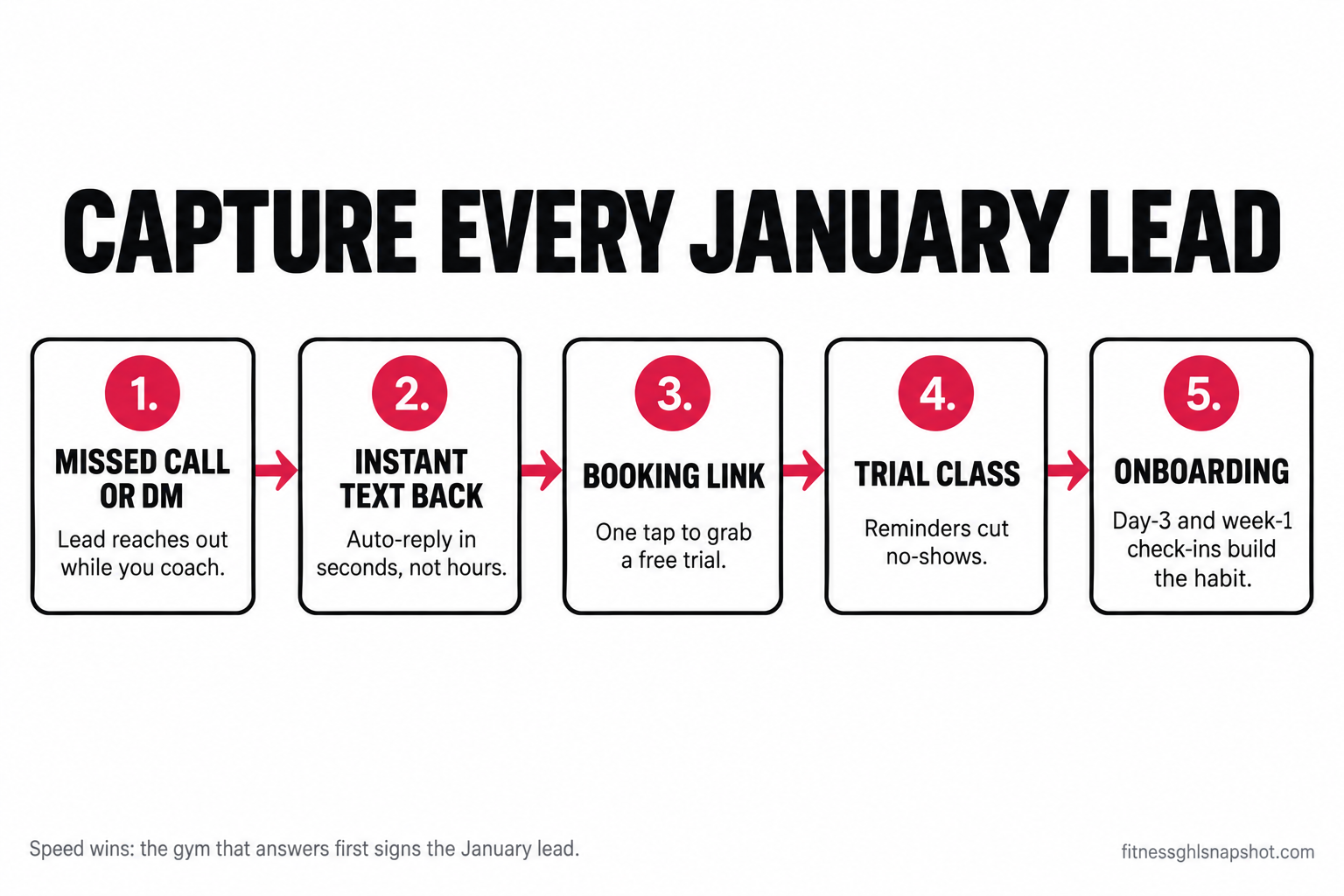
How to set it up. Three things fire automatically the moment a lead comes in. A missed call sends an instant text back so the caller you could not answer gets a reply in seconds, not hours. A new inquiry (form, DM, or ad) triggers a fast first response and a booking link. And every channel, texts, Instagram DMs, Facebook, missed calls, feeds into one place so nothing hides in an app nobody checked. If your messages are scattered across five inboxes right now, the one-inbox fix is the prerequisite for surviving January volume.
Steal this (the missed-call text-back):
Hi [First name], this is [Gym], sorry we missed you! We’re probably on the floor coaching. Were you asking about getting started? I can grab you a free trial this week, here’s the link to pick a time: [link]. Or just reply here and I’ll help you out.
Steal this (the new-lead first response):
[First name], thanks for reaching out to [Gym]! Great time to start. Want me to save you a free trial class this week? Reply with a day that works or tap here to pick a time: [link]. Any questions before you come in, just ask.
How it breaks. The number-one failure is relying on a human to catch everything during the busiest two weeks of the year. They cannot, and the leads that fall through are gone, because they already signed somewhere faster. The reason speed to lead is the single biggest fix for a gym is that response time, not ad spend, decides who wins the January lead. The second failure is a booking link buried three clicks deep. Make booking a trial one tap from the first message.
Mid-January: the onboarding that makes them stick
Capturing the lead is half the job. The other half is turning a January resolution into a habit before the resolution fades, and that happens in the first two weeks of membership. A new member who gets to their third and fourth visit is on the way to staying. One who signs up, comes once, and hears nothing is already gone, they just have not told you yet.
How to set it up. The day someone joins, a structured onboarding sequence starts: a warm welcome and what to expect, a nudge to book the next two sessions (not “come back sometime,” specific days), a day-3 check-in, and a one-week “how’s it going” that invites a real reply. The goal is to get them to visit three or four times in the first two weeks, because attendance is the single best predictor of who stays. The full version lives in the new-member onboarding sequence and the first 30 days playbook, and January is when running it on purpose pays the most.
Steal this (the day-3 onboarding check-in):
Hey [First name], you’re three days in, how are you feeling? First week is always the hardest to build the routine. Want me to help you lock in your next two sessions so it sticks? What works better, mornings or evenings?
How it breaks. The deadliest mistake is treating a January signup as a finish line. The sale is the start. If onboarding is “welcome, see you around,” the resolution fades and they drift, and by late February you have a cancellation you never saw coming. The second failure is making the first class forgettable. In the rush, a January newcomer gets lost in a packed room and nobody learns their name, which is exactly why the November staffing plan matters: protect the first-visit experience even when volume is high. Getting the trial-to-member handoff right is what converts the rush into revenue instead of churn.
Late January: fill classes and kill no-shows
By the back half of January you have volume, and volume creates two new problems: classes that fill unevenly and a no-show rate that climbs as resolution energy dips. Both waste the capacity you planned for in November.
How to set it up. Turn on automated class reminders and a real waitlist. A reminder the day before and the morning of cuts no-shows, and an automated waitlist fills the spot the second someone cancels, instead of leaving a paid-for seat empty. When a member no-shows, a same-day friendly follow-up gets them rebooked before the gap becomes a pattern. The mechanics of this are in automating class waitlists and reducing gym no-shows, and January is when they earn their keep, because this is your highest-demand, highest-no-show month at once.
Steal this (the class reminder plus waitlist offer):
Reminder: you’re booked for [class] tomorrow at [time], [First name]! Can’t make it? Tap here to reschedule so we can give your spot to someone on the waitlist: [link]. See you there.
How it breaks. Letting no-shows slide because you are busy. A January newcomer who no-shows twice with no follow-up has quietly decided it is not happening, and silence confirms it. A warm same-day nudge, “missed you today, want me to grab you a spot tomorrow,” saves far more of them than you would guess. The other failure is a manual waitlist, which never gets worked in time, so empty seats sit empty on your busiest classes.
February and March: beat the cliff
Everything above is about getting January joiners in and coming back. February and March are about keeping them through the point where resolution energy runs out and the schedule starts to thin. This is the cliff, and it is predictable, which means you can plan for it.
How to set it up. Watch attendance and act on the dip. When a January joiner’s visits drop off (no visit in 10 to 14 days for someone who had been coming), fire a warm check-in, not a guilt trip. Run a goal with a deadline across February and March, a six-week program or a simple attendance streak, so there is a concrete reason to keep showing up after the novelty fades. And turn on failed-payment recovery, because the first billing cycles after a January signup are when cards decline and an unfixed decline is a member who quietly stops paying and assumes they quit. The habit-building muscle here is the same one that beats silent churn all year.
Steal this (the February re-engagement nudge):
Hey [First name], noticed we haven’t seen you this week, totally normal this time of year. The people who push through February are the ones still here in the summer. Want me to help you pick two realistic days to get back in? I’ll save you a spot.
How it breaks. Assuming the January work is done once they are members. It is not. The members you fought to sign in January are the ones you lose in February if nobody is watching. The fix is systematic: let attendance and billing data trigger the save so it happens on time, not whenever someone remembers to look.
The printable January prep checklist
Here is the whole thing in one list. Work it top to bottom. If you only have time for a few, do the November capture audit and the December sequence build, because those two decide how much of the rush you actually keep.
Three real January scenarios
The checklist is the same, but what you emphasize changes with your size and model. Here is how it plays out for three setups.
The solo or small-team personal trainer (20–100 clients)
Your January risk is being the bottleneck. You are the coach, the front desk, and the follow-up, so when the leads come in while you are training a client, they wait, and waiting loses them. Lean on: the missed-call text-back and an instant booking link, so a lead you cannot answer in the moment still gets a reply and a time. The trap: trying to do all the follow-up by hand during your busiest month. You cannot, and the leads you drop are gone. Automate the first touch so your human time goes to the sessions, not to chasing texts. At your scale, two or three extra January clients who stay is a serious raise.
The boutique studio (80–250 members, classes and waitlists)
Your January risk is class capacity and the first-visit experience. The rush fills your best time slots fast, and a newcomer lost in a packed, chaotic class does not come back. Lean on: the November capacity plan (add classes before you need them), a real waitlist so full classes still turn over, and an onboarding sequence that makes a first-timer feel seen even when the room is full. The trap: overbooking trials you cannot deliver well, which turns your biggest demand month into a wave of bad first impressions. Serve the number you planned for, not every warm body.
The mid-size or multi-location gym (250–500+ members)
Your January risk is scale and invisibility. The volume is huge, the leaks are small per lead, and no front-desk person can watch hundreds of inbounds and new members by hand. Lean on: fully automated capture, onboarding, and failed-payment recovery, because at your volume manual is not an option. The trap: a 20% capture gap on 200 January leads is 40 members, which at $140 over ten months is real six-figure money walking out while everyone feels slammed. The fix is systematic, not heroic: sequences that respond, onboard, and watch billing for you.
Illustrative lifetime revenue at stake in a single January from capture and retention, at a $140 average membership held ten months: 3 extra kept members (solo), 7 (studio), and 12 (mid-size). Your number depends on your rate and lead volume; the point is that each January member is a ten-month decision, not a one-month one.
The rules: texting, auto-renewal, and results claims
Three rules touch this checklist, and getting them wrong costs more than a slow January.
Texting. Every automated text here needs consent. Under the TCPA and the A2P 10DLC rules carriers enforce, you need permission to text, a clear opt-out (reply STOP), and a properly registered number (FCC, TCPA). In practice this is easy: members and leads opt in when they inquire or join, and good software handles STOP automatically. Do not buy a list and blast strangers a January offer.
Auto-renewal. The memberships you sign in January renew automatically, and that is governed by law. If you think a federal rule made this simple, check the date: the FTC’s “click-to-cancel” Negative Option Rule was vacated by the Eighth Circuit on July 8, 2025, and is not in effect (Sidley, 2025). Your real obligations run through state auto-renewal laws, which more than half the states have, with California’s among the strictest (California ARL, Cal. Bus. & Prof. Code 17600). Translation: your January sign-up terms, renewal, and cancellation path have to be clear and disclosed up front, not a surprise later.
Results claims. A new-year transformation challenge is great marketing, but if your copy shows before-and-after photos or implies a specific result, the FTC Endorsement Guides apply (FTC Endorsement Guides). Use honest, typical outcomes and a plain “results vary” line, and make sure any member photos are real and disclosed.
Questions operators ask about the January rush
“Isn’t the January rush just free members? Why prep so hard?” Because free demand is not free revenue. The leads show up on their own, but whether they become members who stay depends entirely on how fast you respond and how well you onboard, and both of those have to be built before the rush. The gyms that treat January as “members will just come” are the ones watching those members cancel by March.
“I’m a one-person operation. Can I actually do all this?” Yes, and you need it more than anyone, because you are the bottleneck. You will not build sequences by hand in January while you are coaching. The point of doing it in November and December is that the capture and follow-up run automatically when you are busiest, so your limited time goes to actual sessions instead of chasing texts.
“Won’t automated texts feel impersonal and annoy new members?” Not if they are written like a human and timed right. A fast, friendly “sorry we missed you, want a free trial this week” beats silence every time, and members read a same-day reply as good service, not spam. The annoying version is the generic blast to everyone. The good version is the right message at the right moment, which is what the sequences above are.
“I already run a January promo. Isn’t that enough?” A promo brings leads to the door. It does nothing about what happens after they arrive, which is where almost all the loss is. The promo is the easy part. The capture, the onboarding, and the February retention are the parts that decide whether the promo made you money, and those are what this checklist builds.
The bottom line
The January rush is the best demand your gym gets all year, and most of it leaks out because nobody prepared for the volume. You cannot fix that on January 6th with eleven missed calls and a packed floor. You fix it now. Plan your capacity and staffing in November, audit and patch your lead capture, pre-build every follow-up and onboarding sequence in December, and set the February retention play before the first joiner’s energy fades.
Do that and January stops being a chaotic blur you survive and becomes the quarter that carries your whole year. The leads get answered in seconds, the new members get onboarded into a real habit, the classes fill and turn over, and the people you fought to sign in January are still training in June. The work is not hard, but it has to be done in advance, because the one thing you will not have in January is time.
Frequently asked questions
When should I start preparing for the January gym rush?
November. November is for planning capacity and staffing and auditing your lead capture, and December is for pre-selling your warm list and building every follow-up and onboarding sequence so it is ready to fire. By January you are too busy to build anything, so the system has to exist before the first lead calls. Waiting until January means reacting all month instead of running a plan.
How big is the January gym sign-up surge?
In North America, the three cooler months of January through March account for roughly 35% of all annual gym sign-ups, while May, the slowest month, is just 3.6% (GymMaster). That means about a third of your new members for the whole year arrive in one quarter, front-loaded into January. You cannot make up a missed January later in the year, because the demand is not there.
Why do so many January members quit by March?
They joined on a resolution, not a habit, and a habit takes a few weeks of consistent visits to form. National engagement is already thin, with members averaging only about 1.5 visits a week in 2024, down from 2.1 in 2019 (HFA). A January joiner who does not get to their third and fourth visit in the first two weeks drifts, and the drift turns into a quiet cancellation by March unless onboarding and a February retention push catch them first.
What is the single most important thing to fix before January?
Lead response speed. January leads are calling and messaging several gyms at once, and the one that responds first usually wins. Set up a missed-call text-back and an instant first response with a one-tap booking link so no inbound ever goes cold, even when you are coaching. A dropped January lead is not a $140 miss, it is a ten-month miss.
How should I staff for the January rush?
Staff for the spike, not the average. Add front-desk and intake hours for the first three weeks of January so no serious lead waits more than a few minutes for a human and no new member's first class is taught by a coach too slammed to learn their name. Brief every coach on the trial-to-member handoff and decide in advance who owns lead response when the phone and the DMs both light up. Put it on the schedule in November while you can still hire or shift hours.
Do I need to worry about legal rules when I text January leads and sign new members?
Yes. Texting needs consent, a clear opt-out (reply STOP), and a registered number under the TCPA and A2P 10DLC carrier rules. The memberships you sign auto-renew, which is governed by state auto-renewal laws (more than half the states have them, with California's among the strictest), since the federal FTC click-to-cancel rule was vacated in July 2025 and is not in effect, so disclose your renewal and cancellation terms clearly at the point of sale. And any transformation-challenge marketing should follow the FTC Endorsement Guides with an honest results-vary disclosure.
Written by Bryce Kendrick, Fitness Growth Strategist. Bryce spent eight years managing the floor and front desk at a fast-growing CrossFit box before moving full-time into automation for gyms. He has built trial-to-member funnels for boxes, F45 franchises, and independent strength studios across Texas, and he obsesses over the seven days around a prospect’s first class.
Related posts
- Why the January Gym Rush Collapses by March (and How to Keep Those New Members)
- Speed to Lead for Gyms: Why the First Five Minutes Win the Member
- Missed-Call Text-Back for Gyms: Stop Losing Leads You Never Answered
- The Gym Member Onboarding Sequence That Builds a Habit
- Automate Class Waitlists and Fill Empty Spots