
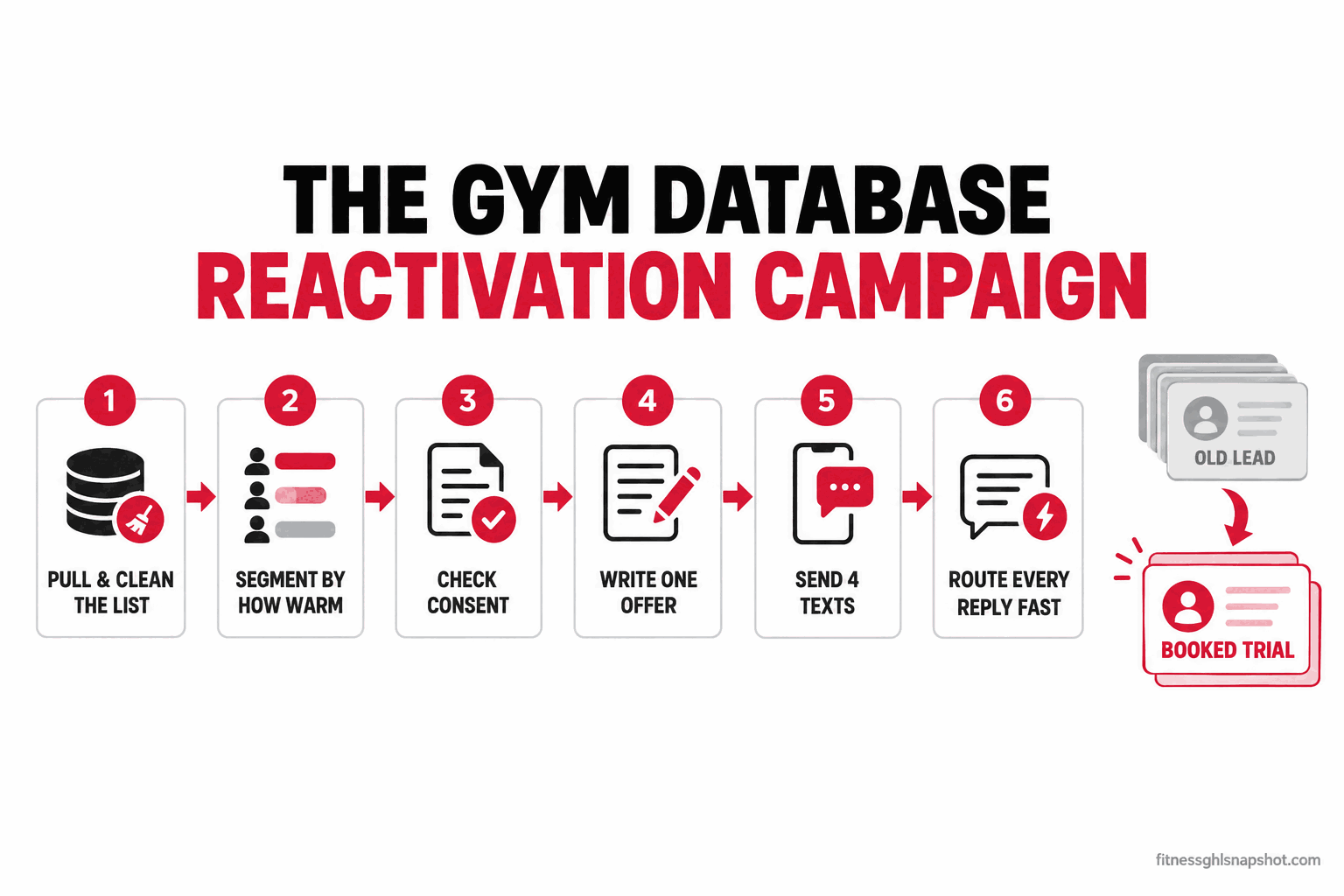
Here is the short version: the cheapest leads you will ever work are the ones already sitting dead in your system. The person who booked a trial in March and no-showed. The form fill from a Facebook ad you forgot about. The DM that said “how much?” and then went quiet. You paid to get every one of them, and almost none of them ever heard from you again. A database reactivation campaign is a short, time-boxed burst of texts to that old list with one clear offer, and done right it books trials this week for close to zero new ad spend. The catch is consent: you cannot blast marketing texts to a cold list and hope. So this guide does both halves, the campaign that works and the compliance that keeps you out of trouble, stage by stage, with the exact messages to steal.
It is a slow Tuesday. The schedule has gaps, the new-lead flow is thin, and you are staring at your ad account wondering whether to throw another few hundred dollars at Facebook to fill next week. Before you do that, open your CRM and look at the contact count. Most gym owners I work with have somewhere between a few hundred and a few thousand people in there. Scroll down. A huge share of them are not members. They are leads who raised their hand once, months or years ago, and then nothing. You already bought that list. You are about to pay full price for strangers while a warm-ish pile of people who once wanted what you sell sits untouched.
That pile is the most overlooked asset in a gym. Reactivating it will not replace getting new leads, but when you need bookings fast and do not want to spend more on ads, it is the highest-return hour you can work. This post is the full system: how to pull and segment the list, clear the consent hurdle before you send a word, the exact four-text sequence, how to handle the replies, and how it scales from a solo trainer to a multi-staff gym.
Table of contents
- What a database reactivation campaign actually is
- The math: why your old list beats cold ads
- Stage 1: Pull and clean the list
- Stage 2: Segment by how warm they were
- Stage 3: Clear the consent gate before you send
- Stage 4: Write one offer worth replying to
- Stage 5: The four-text sequence
- Stage 6: Handle the replies fast
- Steal this: the full reactivation message set
- The same campaign at three sizes
- Keep it legal: texting a cold list
- Objections operators raise
- FAQ
What a database reactivation campaign actually is
A database reactivation campaign is a short, deliberate push to the people already in your system who never became members. Not new leads. Not current members. The in-between pile: old form fills, trial no-shows, expired pass holders, people who DM’d once and ghosted, the challenge sign-ups from eighteen months ago. You contact them again, usually by text because text gets read, with one clear offer and a reason to act now. You run it for a week or two, then you stop.
It is easy to confuse this with two other things, so be clear on the difference. Reactivating leads is not the same as your new-lead follow-up sequence, which fires the second someone fresh raises their hand. And it is not a member win-back campaign, which targets people who actually joined and then cancelled. Reactivation sits in the middle: people who wanted in, got close, and never crossed the line. They know who you are. They had intent once. That is exactly why they convert cheaper than a stranger, and exactly why you have to be careful about how you reach them.
The reason this works is simple. Interest does not vanish, it fades. The person who booked a trial in spring and got busy did not decide your gym was wrong for them. Life got loud. A job changed, a kid got sick, the gym down the street was closer that month. Six months later a lot of those reasons are gone. They were never going to call you out of the blue, but a well-timed text with a low-friction offer gives them the nudge, and a chunk of them say yes.
The math: why your old list beats cold ads
Run the numbers on your own list and the case makes itself. This is arithmetic, not a stat I am quoting at you, so plug in your real figures.
Say you have 600 old leads in the system with valid consent to text (we will get to consent). You send a reactivation campaign. A realistic reply rate on a warm-ish list with a good offer might land somewhere in the single digits to low teens as a percentage. Say 8 percent reply, so about 48 conversations. Of those, maybe a third book a trial, so 16 trials. Of those, maybe 10 show up, and maybe 5 become members. Your inputs will differ. The point is the shape: a pile you already own turns into members for the cost of the texts.
Now price it against cold acquisition. If your cost per booked trial from paid ads is 40 dollars, those 16 trials would have cost around 640 dollars in fresh ad spend. The reactivation campaign produced them for the price of a few hundred text segments, a few dollars. That gap is the whole argument. You are not replacing ads. You are harvesting spend you already made and never collected on.
Illustrative reactivation funnel for a 600-contact list at an 8% reply rate. Your rates will differ by list age, offer, and how fast you answer replies. Source: the worked example in this guide, not a published benchmark.
Five new members from an afternoon of setup is not a fantasy, and it is not guaranteed either. A list you never cleaned, with stale consent and a weak offer, produces almost nothing and a pile of opt-outs. The difference between those outcomes is the work in the next five stages. Put the cost per booked trial side by side and you can see why operators run this before they touch the ad account.
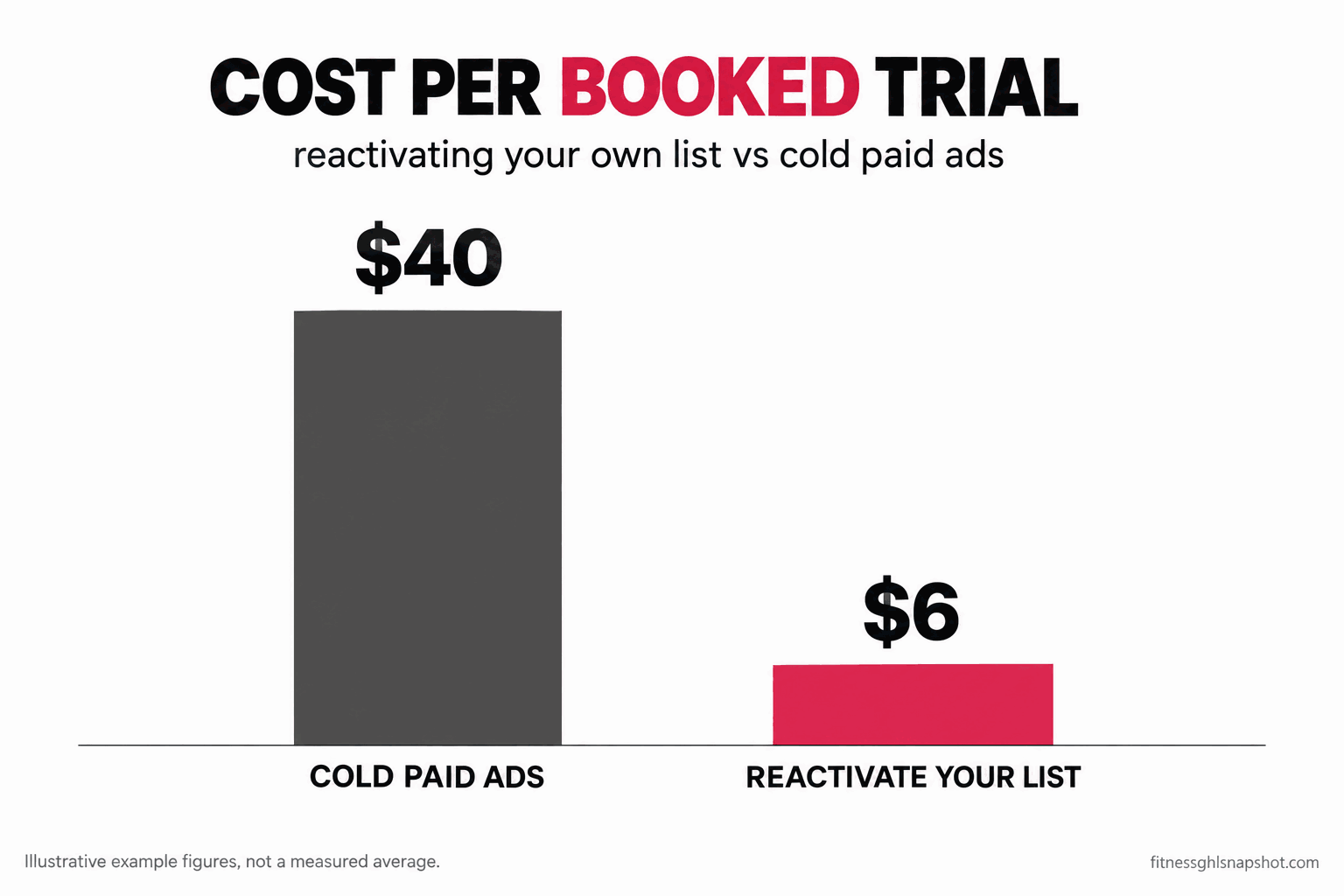
Illustrative cost per booked trial, comparing cold paid ads against reactivating leads you already own. Figures are example inputs for the scenario above, not a measured average. Source: the worked example in this guide.
Stage 1: Pull and clean the list
Before you write a single message, you need to know who is actually in your database and whether you can legally reach them. Open your CRM, your old booking tool, your email platform, and anywhere else leads piled up. If you run GoHighLevel, this lives in one place. If you are still spread across Mindbody, a spreadsheet, and your phone’s contacts, this stage is where you pull it together.
Export everyone who is a lead and not a current member. Then clean it. Remove anyone who already opted out of texts or email, anyone whose number is clearly junk, and anyone who is already an active member. Dedupe so one person does not get the same text twice from two records. This is boring and it is the difference between a campaign that lands and one that gets you flagged.
How this stage breaks. The most common mistake is texting people who already told you to stop. An opt-out is permanent until they opt back in, and ignoring it is both illegal and the fastest way to get your number blocked by carriers. The second mistake is treating ancient records as fair game. A phone number from three years ago may belong to someone else now, and the consent you had may be stale or gone. If you cannot tell when or how someone gave permission to text them, that record does not go in the send. Clean hard. A smaller list you can stand behind beats a big list that gets you in trouble.
Stage 2: Segment by how warm they were
Not every dead lead is the same, so do not send them the same text. One generic blast to a list of 600 strangers-who-sort-of-know-you reads as spam, and spam gets opt-outs and complaints. Segmenting takes ten extra minutes and roughly doubles your reply rate because each group gets a message that fits where they actually left off.
Split the list into a few simple buckets:
- Trial no-shows and recent inquiries (0 to 90 days). The warmest group. They raised their hand recently and nothing closed. Reference the specific thing: the trial they booked, the class they asked about.
- Older form fills and DMs (3 to 12 months). Interest has cooled but they remember you. A fresh offer and a light touch work here.
- Cold and ancient (12 months plus). Lowest intent, oldest consent, highest risk. Reach these last, carefully, and only if consent is solid. For many gyms this bucket is not worth the risk and is better left alone.
- Expired pass or challenge holders. People who bought a one-time thing and never converted to a membership. These often convert best because they already paid you once and liked it.
Write one short variation of your offer per bucket. Same core deal, different first line. The warm group hears “you booked a trial back in March and we never got you in.” The expired-pass group hears “your challenge wrapped up a while back, want to come finish what you started.” Specific beats generic every time.
How this stage breaks. Over-segmenting is a trap too. If you build eleven micro-segments you will never launch, because the setup balloons and you freeze. Three to five buckets is plenty. The other failure is segmenting by data you do not actually have. If your records do not reliably say who was a trial no-show versus a form fill, do not pretend they do. Use the segments you can trust and lump the rest into one careful “older lead” group.
Stage 3: Clear the consent gate before you send
This is the stage most “just text your old list” advice skips, and it is the one that can cost you real money if you get it wrong. In the US, marketing texts sent with an autodialer or mass-texting tool to a mobile number generally require prior express written consent, and that standard did not go away in 2025. The Eleventh Circuit vacated the FCC’s one-to-one consent rule on January 24, 2025 in Insurance Marketing Coalition v. FCC, but that struck down a narrow new restriction. The older heightened written-consent standard for marketing calls and texts remains in force.
In plain terms: you can text someone marketing messages if, at some point, they gave you clear written permission to do so, usually by checking a box or submitting a form that said you might text them. A phone number you scraped, bought, or typed in from a business card does not count. A lead who filled out your trial form and agreed to your terms usually does, as long as that consent is documented and not stale.
Then there is the plumbing. US carriers now route business texting through a registration system called A2P 10DLC, where you register your brand and each campaign before you send. Unregistered business traffic gets filtered or hit with extra fees, which means a big unregistered blast may not even get delivered. If you text through GoHighLevel, Twilio, or a similar platform, you have to complete this registration first. It takes a few days, so start it before the campaign, not the morning of.
How this stage breaks. The expensive failure is treating an old lead list as blanket permission to market. It is not. If you cannot show consent for a contact, leave them out, or reach them on a channel where you have permission, like email that follows CAN-SPAM. The FTC can seek penalties of up to 53,088 dollars per violating email, and TCPA text violations carry statutory damages per message that stack fast on a big send. None of this should scare you off the campaign. It should scare you off the lazy version of it. If you want the deeper read on the rules that govern gym member messaging and cancellations, we covered the landscape in gym membership cancellation and auto-renewal law in 2026. For the official consumer-facing rules, the FCC’s guide on unwanted texts is the plain-language anchor.
Stage 4: Write one offer worth replying to
A reactivation campaign lives or dies on the offer. These people already ignored you once. “We miss you, come back” is not a reason to reply. You need one specific, low-friction, time-boxed thing that makes replying the easy choice.
Good reactivation offers share three traits. They are low commitment, so a free week or a no-strings class beats “sign up for a 12-month membership.” They have a deadline, because an open-ended offer gets saved for later and later never comes. And they ask for a tiny yes, usually a single word reply like “YES” or “IN,” not a link, a form, and a credit card. The job of the first text is to start a conversation, not to close a sale.
Pick one offer for the whole campaign so your setup stays simple. A free week back. A no-cost “bring a friend” class. A reset challenge with a start date. Whatever fits your gym and your margins. Then make it expire. “This week only” or “the next 10 people” gives the fence-sitter a reason to move now instead of filing your text under “maybe someday.”
How this stage breaks. Two ways. First, a vague offer with no deadline, which gets polite “maybe later” replies that go nowhere. Second, an offer that is too good and attracts the wrong people, the deal-chasers who take the free week and never pay. The fix is to make the offer about getting back in the door, not about being cheap. A free week that leads into a real conversation about membership converts better than a steep discount that trains people to wait for the next sale.
Stage 5: The four-text sequence
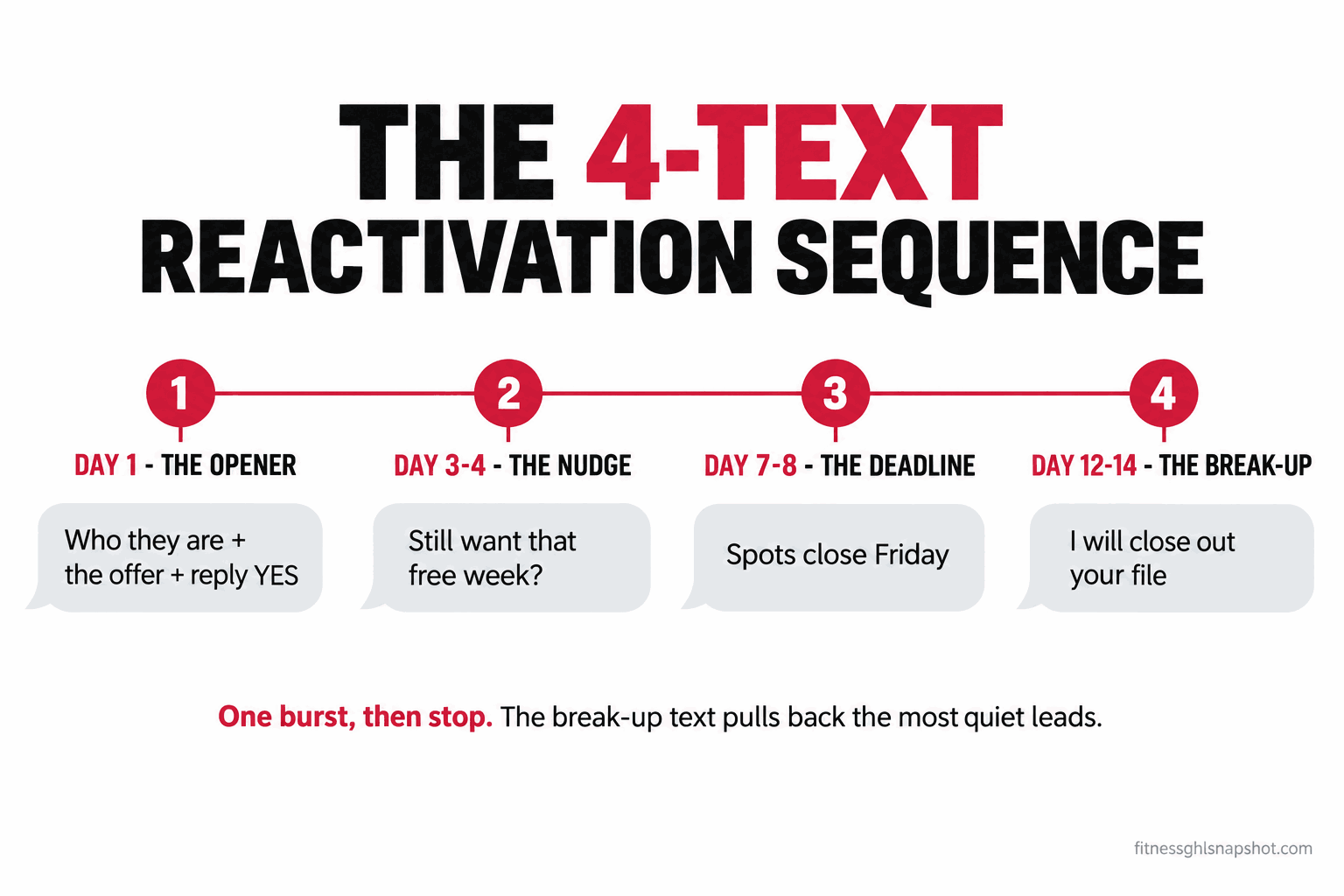
Keep the sequence short. This is a burst, not a drip. Four texts over about two weeks, then you stop and let the repliers become conversations. More than that and you are nagging a cold list, which is how you earn opt-outs.
Here is the shape:
- Text 1, the opener (day 1). Reference who they are and what they left off, then the offer and the tiny yes. This does most of the work.
- Text 2, the nudge (day 3 to 4). Short, friendly, assumes they got busy. “Still want to grab that free week? Just reply YES and I’ll set it up.”
- Text 3, the deadline (day 7 to 8). The offer is closing. “Heads up, the free-week spots close Friday. Want one before they’re gone?”
- Text 4, the break-up (day 12 to 14). The one most gyms are scared to send, and the one that pulls back the most quiet leads. “Haven’t heard back, so I’ll close out your file and stop texting. If you ever want back in, you know where we are. Door’s open.”
The break-up works because it removes the pressure and triggers loss aversion at the same time. People who ignored three cheerful texts will reply to “I’ll stop texting you” because it is the last call and it respects their time. Expect a surprising share of your total bookings to come from that final message.
Front-load nothing after day one. The opener carries the campaign. Each later text is a lighter tap. The chart below shows the cadence so you can see the taper.
The four-touch reactivation cadence across roughly two weeks: one text per window, then stop. Source: the sequence prescribed in this guide.
How this stage breaks. Sending too fast is the big one. Four texts in four days feels like harassment and gets you reported. Space them out. The other failure is sending all four no matter what. The moment someone replies, they leave the sequence and go to a human conversation. A person who already said “YES, set it up” should never get the day-7 deadline text. Make sure your automation pulls repliers out of the burst.
Stage 6: Handle the replies fast
The campaign’s only product is replies. Everything up to now exists to make someone text “YES” back. If that reply sits for six hours while you coach, you have thrown away the whole effort, because the interest that made them reply fades just as fast as it did the first time. We made the full case for this in speed to lead for gyms, and it is doubly true here because these are people who already slipped away once.
So before you launch, decide who is answering replies and how fast. For a solo trainer that might be you with notifications on. For a bigger gym it is a named person on shift with the inbox open, or an automation that replies instantly to confirm and book while a human follows up. The goal is a reply within minutes, not hours, during the hours you are open. Have a simple booking path ready: a link to self-book the free week, or a two-line back-and-forth that lands a time on the calendar.
How this stage breaks. The classic failure is a great send with nobody watching the inbox. The texts go out Monday at 10am, replies pour in, and the owner checks the phone at 7pm between clients. By then half the warm replies have cooled again. The other failure is answering but not booking. A reply is not a trial. You need to turn “YES” into a specific time on the calendar in that same conversation, then send reminders so they actually show, the same way you would for any trial. Two-way text that reminds and confirms is exactly what SMS automation for gyms is built to do.
Steal this: the full reactivation message set
Copy these, swap in your gym name, offer, and booking details, and keep the tone human. Short, lowercase-friendly, like a text from a person, not a brand. Add your opt-out language per the compliance rules above.
Opener, warm segment (trial no-shows, 0 to 90 days):
Hey [First name], it’s [Your name] from [Gym]. You booked a trial with us back in [month] and we never got you in. We’re running a free week this month, no strings. Want me to grab you a spot? Just reply YES. (Reply STOP to opt out.)
Opener, older form fills (3 to 12 months):
Hi [First name], [Your name] at [Gym] here. You checked us out a while back and the timing wasn’t right. We’ve got a free week open this month if you want a fresh start. Reply YES and I’ll set it up. (STOP to opt out.)
Opener, expired pass or challenge holders:
Hey [First name], it’s [Your name] from [Gym]. Your [challenge/pass] wrapped up a while ago and we’d love to get you back in. Free week on us this month. Want to come finish what you started? Reply YES. (STOP to opt out.)
Text 2, the nudge (day 3 to 4):
Hey [First name], still want that free week? Takes me two minutes to set up. Just reply YES and pick a day that works.
Text 3, the deadline (day 7 to 8):
Quick heads up [First name], the free-week spots close Friday. Want one before they’re gone? Reply YES and I’ll hold a spot for you.
Text 4, the break-up (day 12 to 14):
[First name], I haven’t heard back so I’ll close out your file and stop texting. If you ever want back in, you know where we are. Door’s always open. 🙏
Reply handler, when someone says YES:
Love it. Here’s the link to pick your first day: [booking link]. Grab whatever works and I’ll see you there. Anything you want me to know before your first session?
That set is the entire campaign. Seven messages, written once, that you can run every quarter on the new pile of leads that went cold since last time.
The same campaign at three sizes
The framework does not change with gym size. What changes is who does the work and how much you automate.
Solo trainer or small PT team (20 to 100 clients). Your list is small, maybe a couple hundred leads, and your relationships are personal. You can almost send these by hand from your own phone, which actually helps because the texts feel one-to-one. Segment into two buckets, warm and old. You answer the replies yourself with notifications on. Your edge is speed and warmth: you will out-convert any big gym because people are texting back a real person they sort of know. Your risk is consent and registration, since a personal phone blasting 200 marketing texts can get flagged. Use a proper texting tool with A2P registration, not your own number.
Boutique studio (80 to 250 members). You have a real list, a few hundred to a couple thousand leads, and probably a front desk or a part-timer. Build three to four segments and write a variation per bucket. Run the sequence through your CRM so the timing and the opt-outs are automatic. Assign one person to own the inbox during open hours for the two weeks the campaign runs. Your edge is that a studio has specific, nameable offers (a reformer intro, a beginner course, a challenge) that make a sharp reactivation hook. Your risk is a thin front desk that lets replies sit.
Multi-staff gym (150 to 500 members). Your list is big, which is the opportunity and the hazard. A big send to a poorly maintained list is where opt-outs and complaints pile up, so Stage 1 cleaning matters most for you. Automate the whole sequence, use instant automated replies to catch the first “YES” and book it, and have a named staffer handle the human follow-up. Stagger your sends across a few days instead of blasting everyone at 10am Monday, both to stay under carrier limits and so your team is not buried in replies they cannot answer fast. Your edge is volume: even a modest reply rate on a few thousand contacts fills a lot of trials. Your risk is treating it as a one-and-done blast instead of a maintained, repeatable system.
For any size, the underlying value is the same: you are collecting on money you already spent. If you want to see what that pile is actually worth before you work it, the math in gym member lifetime value shows why even five reactivated members is a bigger number than it looks once you count the full membership, not just the first month.
Keep it legal: texting a cold list
Worth its own section because this is where good intentions turn into fines. The short rules, in operator language:
- No consent, no marketing text. Prior express written consent is still the standard for marketing texts to US mobile numbers. A lead who opted in on your form qualifies. A number you have but no record of permission for does not. The one-to-one consent rule was vacated in January 2025, but the written-consent requirement for marketing survived.
- Honor opt-outs fast and broadly. Since the FCC revocation rule took effect in April 2025, a person can opt out by any reasonable wording, not just “STOP,” and you must honor it within 10 business days. Make STOP easy and catch the plain-English versions too.
- Register your texting. A2P 10DLC brand and campaign registration is not optional for business texting in the US. Unregistered sends get filtered or penalized.
- Email has its own rules. If you reach old leads by email instead, CAN-SPAM requires a real physical address, a working unsubscribe honored within 10 business days, and no deceptive subject lines, with penalties up to 53,088 dollars per email.
None of this is a reason to skip the campaign. It is the reason to run the clean version, which also happens to be the version that works better, because a list you maintain and respect replies at a far higher rate than one you abuse. This is not legal advice, and the rules shift, so when in doubt check the current FCC and FTC guidance or ask a lawyer who knows TCPA before a big send.
Objections operators raise
“Won’t this annoy people and wreck my reputation?” Only if you do it lazily. A clean, segmented campaign with a genuine offer and an easy opt-out reads as a helpful nudge, not spam. The people who do not want it reply STOP and you lose nothing. The ones who were on the fence thank you for the reminder. Annoyance comes from blasting everyone the same generic message five times in a week, which is exactly what the segmenting and the four-touch cap prevent.
“My list is old, isn’t the consent dead?” Sometimes, which is why Stage 3 is a gate, not a suggestion. Consent does not expire on a fixed clock, but the older and vaguer it is, the riskier the send. If you have documented opt-in from a form, you are usually fine to reach out. If you have a number and no record of permission, leave them out or find a channel where you do have consent. When unsure, reach the oldest, coldest contacts by email with a clear unsubscribe instead of text.
“I already pay for Mindbody (or PushPress, or a spreadsheet). Do I need another tool?” You need two things: a place that holds consent and opt-out status cleanly, and a way to send and automate texts that is A2P registered. Some gym platforms do parts of this; most do not do the sequencing and reply routing well. That gap is why a lot of operators run reactivation through a dedicated CRM like GoHighLevel while keeping their booking tool for classes. You do not have to rip anything out to start.
“I’m not technical. Can I actually set this up?” The thinking is harder than the clicking. The hard parts are deciding your segments and writing the offer, both of which this post just handed you. The build itself, a few workflows and a consent check, is a weekend of learning or a day of done-for-you setup. You do not need to be a developer. You need the list, the offer, and the discipline to answer replies fast.
“What if barely anyone replies?” Then you learned your list cheaply and you fix the inputs: a sharper offer, tighter segments, a better opener, cleaner consent. A weak reactivation costs you a few dollars in texts and an afternoon. A weak month of ads costs you hundreds. The downside is small and the lesson is reusable, which is the opposite of how cold ads fail.
Frequently asked questions
How often should I run a database reactivation campaign?
Quarterly is a good rhythm for most gyms. Every month a new batch of leads goes cold, so every few months you have a fresh pile worth working. Running it more often than that risks re-hitting the same people before enough new cold leads have accumulated, which pushes your opt-out rate up. Clean the list each time and only include contacts you have not messaged recently.
Text or email for reactivation?
Text gets read far more and faster, so it is the primary channel when you have valid consent and A2P registration. Email is the fallback for contacts where your text consent is weak or missing, and it is cheaper to send at scale. Many gyms run both: a text sequence to the consented, well-documented portion of the list and a CAN-SPAM-compliant email to the rest.
What reply rate should I expect?
It varies too much to promise a number, which is why the funnel in this guide is labeled illustrative. A warm, recent, well-segmented list with a strong offer replies at a much higher rate than an old, generic blast. Rather than chase a benchmark, run the campaign once, measure your own reply-to-booking-to-member rates, and use those as your baseline for next quarter.
Is it legal to text old leads who filled out a form months ago?
Generally yes, if that form captured prior express written consent to receive texts and you can document it, and if your texting is A2P 10DLC registered with a working opt-out. The age of the lead matters for deliverability and annoyance, not strictly for consent, but very old or undocumented consent is risky. When you cannot show permission, do not text them. This is general information, not legal advice.
What's the difference between reactivation and a win-back campaign?
Reactivation targets leads who never became members: old form fills, trial no-shows, expired pass holders. A win-back targets former members who joined and then cancelled. The messages differ because the relationship differs. A lapsed member knows exactly what they are coming back to; a cold lead needs a lower-friction reason to try you at all. We cover the member side in the gym win-back campaigns guide.
Can I automate the whole thing or do I need to send manually?
You can and should automate the sequence, the timing, the opt-out handling, and the pull-out when someone replies. What you should not fully automate is the human conversation after the reply. The first automated response can confirm and share a booking link instantly, but a person booking a real trial converts better when a human picks up the thread quickly. Automate the busywork, keep the conversation human.
The leads are already in your system. You paid for them once. A clean, consented, well-timed reactivation campaign is how you finally collect on that spend, and it is the first thing to reach for on a slow week before you spend another dollar on strangers. Build it once, run it every quarter, and the pile that used to just sit there becomes a schedule you can refill on demand.