
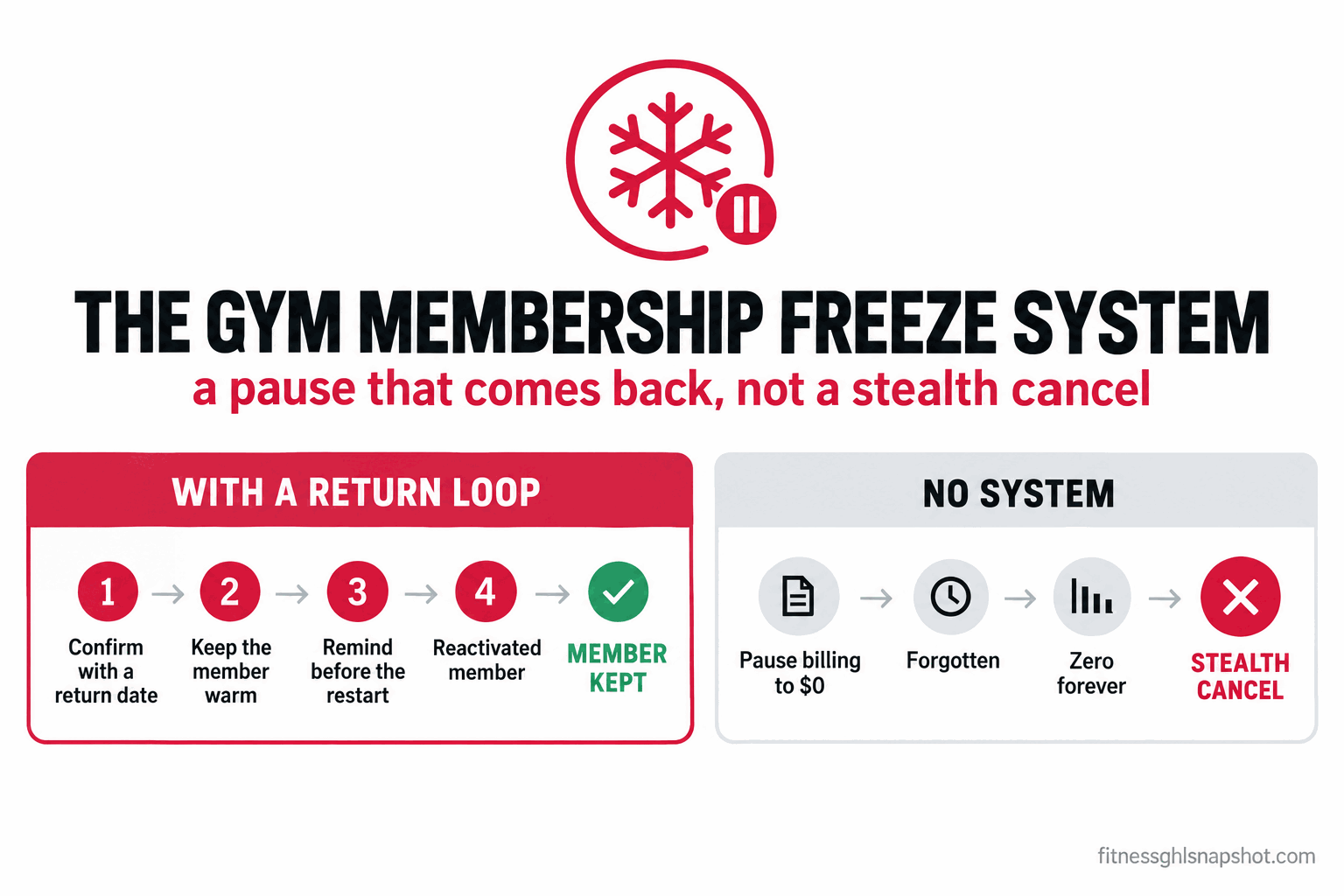
Here is the short version: a membership freeze is only a save if the member comes back. Most gyms get the first half right and the second half wrong. A member asks to pause, you say yes, you flip their billing to zero, and then nobody touches that account again. No return date on the calendar, no reminder, no plan to turn billing back on. So the freeze quietly becomes a cancel you never counted, and you find out months later when you scan the roster and wonder where they went. The fix is to treat a freeze as a loop with a closing date, not an exit. Take the request through one door instead of five, set a policy that caps the pause and protects your dues, confirm it instantly with the return date baked in, keep the member warm while they are out, and reach out before the return date so turning billing back on is a yes, not a surprise. Build that loop once and a freeze starts doing what it is supposed to do: keeping a member you were about to lose.
It is the first of the month and you are doing payroll when a text comes in from a member you like. “Hey, can I freeze my membership for a couple months? Work is crazy and I’m traveling.” You text back “no problem, you’re paused,” flip her to a hold in your software, and get back to payroll. It feels like a win. You kept a member who might have cancelled. Three months later you are reviewing the roster and her name is sitting at zero dollars with no end in sight. You never set a return date. You never reminded her. She was not avoiding you. She just assumed you would say something when it was time, and you assumed the software would handle it, and neither of you did. She is not a frozen member anymore. She is a cancelled one who never had to make the call.
That gap is where most gym revenue leaks out, and it is quieter than a formal cancellation. Nobody fills out a cancel form. Nobody disputes a charge. A paying member simply becomes a non-paying one, and the hold that was supposed to protect the relationship turns into the thing that ended it. This post is the full freeze-and-return system that closes the gap: how to take the request cleanly, set a policy that does not bleed you, confirm it with the return date built in, keep the member warm, reactivate them on time, and win them back if they ghost. Stage by stage, with the texts to steal and how it changes from a solo trainer to a multi-staff gym.
Table of contents
- Why a freeze quietly becomes a cancel
- What a freeze-and-return system actually is
- Stage 1: Take the request through one door
- Stage 2: Set a freeze policy that protects your revenue
- Stage 3: Confirm the freeze with the return date built in
- Stage 4: Keep the paused member warm
- Stage 5: Reactivate before the return date, not after
- Stage 6: Win back the ones who ghost at the end
- The texts to steal
- The same system at three sizes
- Keep it legal: freezing, restarting, and auto-renewal law
- Objections operators raise
- FAQ
Why a freeze quietly becomes a cancel
Start with the math on why keeping a member matters, because it reframes what a freeze is worth. The fitness business runs on retention, and retention is not great on average. In the Health & Fitness Association’s 2025 benchmarking data, average annual member retention came out around 66.4%, which another way to say is that roughly one in three members leaves every year (HFA 2025, via Gymdesk). New members are even shakier. Academic work cited in the same roundup found nearly half of new members cancel within their first six months, and in one study of over 5,000 members, 63% stopped training before month three (Gymdesk). You are fighting an uphill battle to keep anyone past the honeymoon period.
Now layer on how expensive it is to replace the ones you lose. Estimates put the average cost to acquire a new gym member around $437 once you blend organic and paid channels (Athletech News). That figure moves a lot by market and is an industry estimate, not a guarantee, but the direction is not in doubt: a member you keep is worth far more than the dead month a freeze costs you. We put real numbers on that in the gym member lifetime value breakdown. A paused member at zero dollars this month still has a return date and a history with you. A cancelled member is a $437 hole to fill from scratch.
Here is the cruel part. The member who asks to freeze is one of your good ones. They did not ghost you. They did not dispute a charge. They sent a polite message because they respect you enough to ask, and they fully intend to come back. The data backs up that intent: 53% of gym members said they have stopped attending without ever formally cancelling (Zenoti 2026), which is the silent churn we cover in stop silent churn before it empties your gym. A freeze request is the opposite of silent. It is a member raising their hand and telling you exactly when they plan to return. And most gyms respond by flipping a billing toggle and then never speaking to them again.
That is the leak. Not the freeze itself, which is a good thing members genuinely want, but the missing return step. The freeze gets granted and the loop never closes.
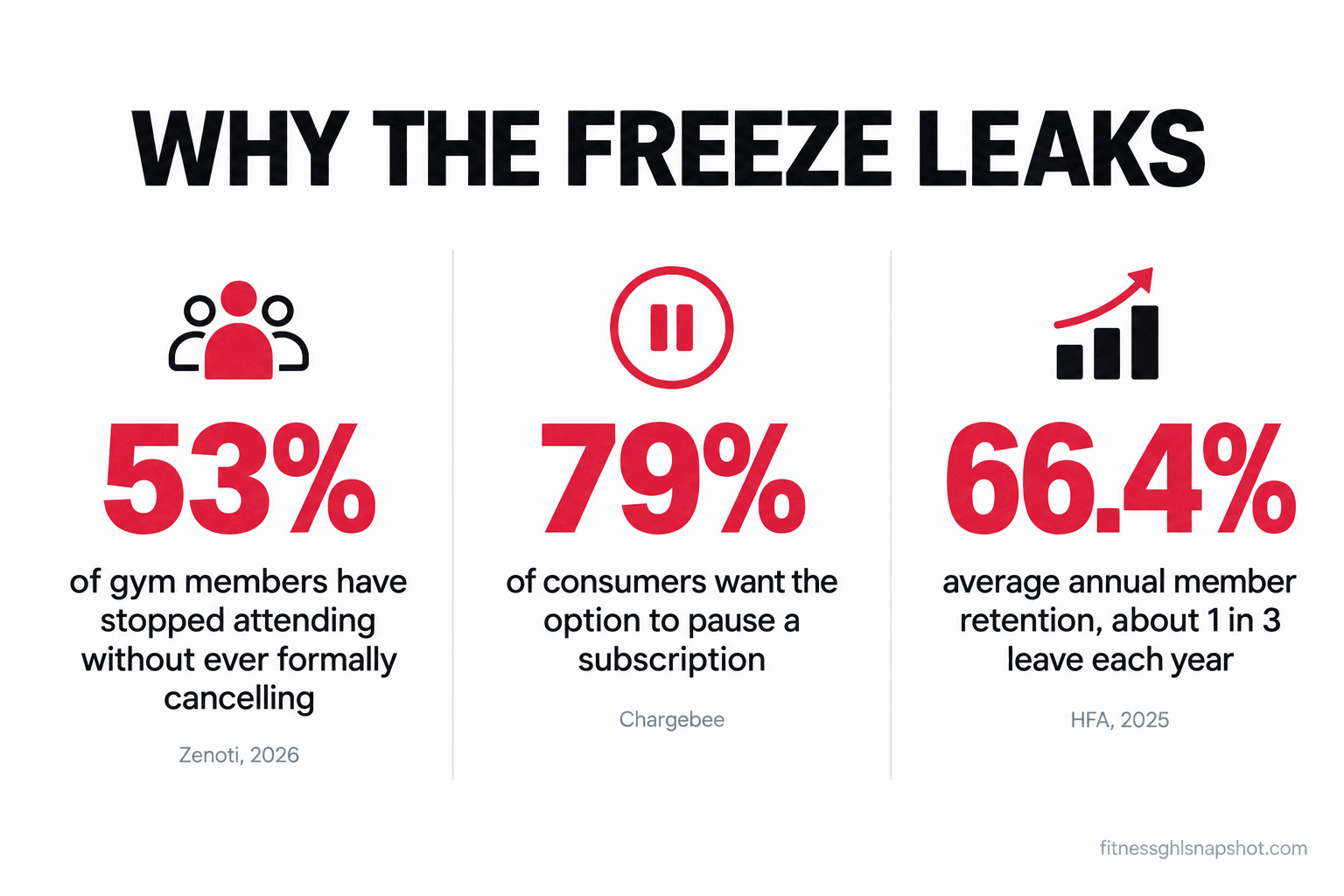
Below is a look at how much people want a pause option in the first place, which is why fighting the request is the wrong instinct.
Consumer demand for subscription flexibility (% of consumers). 79% want the option to pause, 58% have paused instead of cancelling in the past year, and the pause option ranks nearly as high as easy cancellation (82%) in purchase decisions. Source: Chargebee, Power of Pause.
What a freeze-and-return system actually is
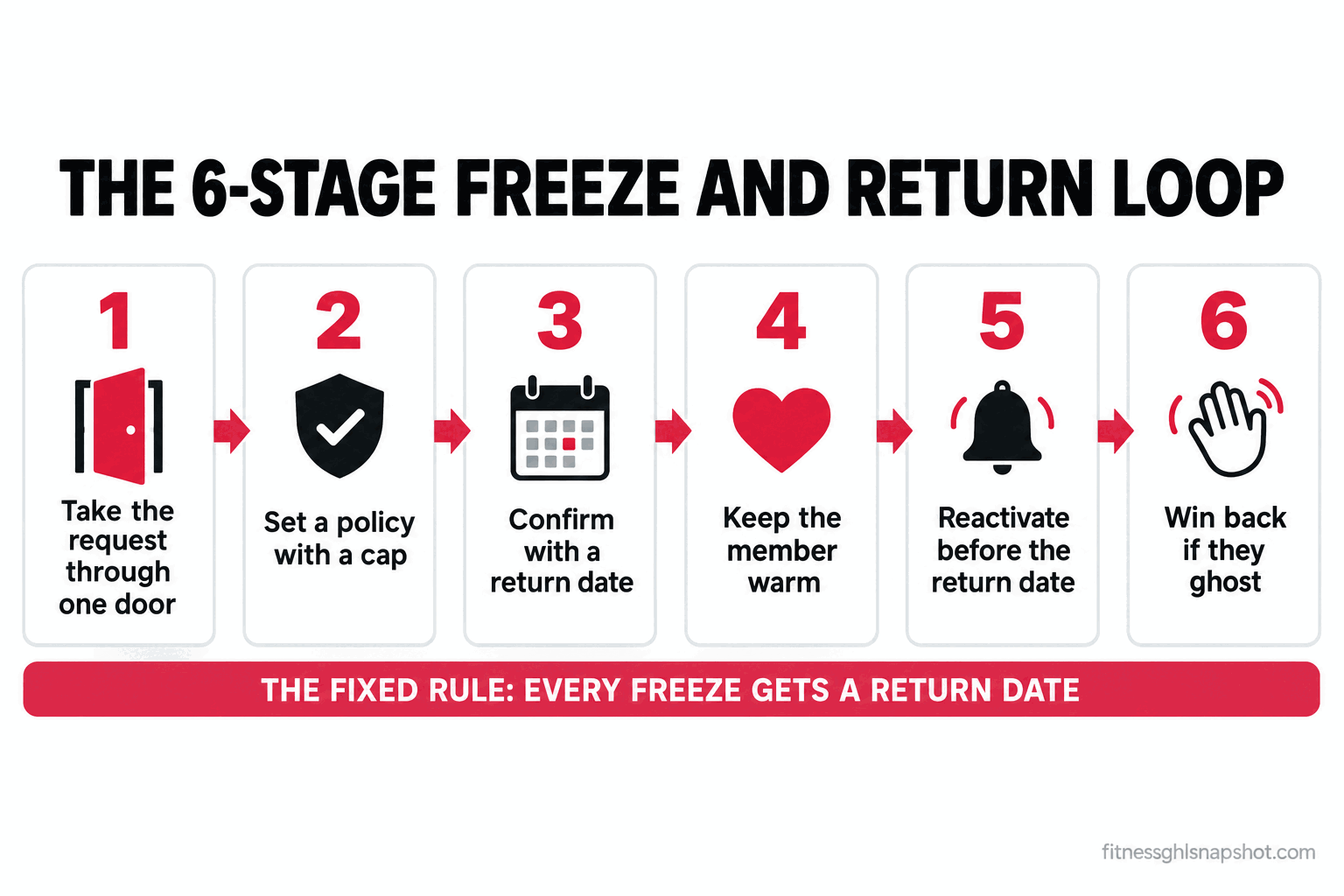
A freeze-and-return system is not a billing setting. It is a loop with six stages and a hard end date, and the billing toggle is only one small piece in the middle of it. The point of the loop is that from the moment a member asks to pause, the return is already scheduled. You are not hoping they come back. You have a date, a reminder before that date, and a message queued to turn billing back on, all set the day the freeze starts.
Think of it as five moving parts around one fixed rule. The request comes in through a defined door so it does not get lost in your DMs. A policy decides how long the pause can run and whether it costs anything. A confirmation goes out instantly with the return date stated plainly. The member gets one warm touch while they are out so the gym does not go silent on them. And a reminder fires a few days before the return date so reactivating is a conversation, not an ambush. The fixed rule underneath all of it: no freeze is ever open-ended. Every single one has an end date on the calendar the day it begins.
Done right, this is mostly automated. The intake form, the confirmation, the mid-freeze touch, the pre-return reminder, and the reactivation nudge can all run on their own inside a customer relationship tool with workflows and two-way texting. GoHighLevel, the platform our own system is built on, does this natively, and so do most modern CRMs built for local businesses. Automation handles the loop. A human still owns the relationship and handles the judgment calls. The six stages below are the whole build.
Stage 1: Take the request through one door
The first failure happens before the freeze even starts, at the point where the member asks. Right now that request can come in five ways: a text to your business line, an Instagram DM, a Facebook message, a word at the front desk, or an email. Whichever one you happen to see gets handled. The rest wait, and a freeze request that waits a week while the member keeps getting billed turns a goodwill moment into a refund fight. Pick one door and route everything to it, which is the same consolidation problem we lay out in full in one inbox for your gym.
The cleanest door is a short freeze request form, linked from a saved text reply and pinned in your member communications, that captures the three things you actually need: who they are, how long they want to pause, and why. The reason matters, because “traveling for work” and “money is tight right now” lead to different offers, and because it tells you whether a freeze is even the right answer or whether this is really a cancellation wearing a freeze costume. When the form comes in, it creates a task with an owner, so the request never sits unseen.
How it breaks. The request gets handled verbally at the desk and never recorded anywhere, so there is no form, no task, and no trail. Two weeks later the member swears they asked to freeze and you have no record, and now you are refunding dues and apologizing. Make the request go through the form every time, even when someone asks in person: “Totally, let me text you the quick freeze link right now so your pause is locked in and dated.” The second failure is treating every freeze request as automatic. Some members who ask to pause are actually done, and a freeze just delays the cancel. Ask the reason so you can tell the difference and respond to each one honestly.
Stage 2: Set a freeze policy that protects your revenue
A freeze with no rules is a free pass to stop paying, and if you hand those out with no structure, the smart members learn to freeze every slow month. The fix is a written policy that makes a freeze genuinely useful for a real life interruption while keeping it from becoming a loophole. You need to decide four things and then apply them the same way every time.
First, the maximum length. Most gyms land on one to three months per freeze, with a cap on how many months a member can freeze in a rolling year. Open-ended freezes are the enemy, because they are the ones that become stealth cancels. Second, whether the freeze costs anything. Plenty of gyms charge a small hold fee, five to ten dollars a month, which keeps the account live, covers your fixed costs, and gently discourages freezing on a whim while still being a fraction of full dues. A paid hold also keeps the billing relationship technically active, which matters for the legal piece below. Third, the reactivation terms: the member comes back at the same rate they left on, which is the main reason a freeze beats a cancel for them, since cancelling means losing a grandfathered price. Fourth, what a freeze does to any contract end date, so a three-month pause pushes the commitment out three months rather than letting someone freeze their way out of a term.
How it breaks. The policy exists in your head but not on paper, so you apply it differently depending on your mood and who is asking, and members talk. One gets three free months and another gets charged a hold fee for the same request, and now you have a fairness problem. Write the policy down, put it where members can see it, and apply it identically. The other failure is no cap at all, which is how you end up with a roster full of permanently frozen members you are too polite to call. A cap with a hard return date is what makes the freeze a save instead of a leak.
Stage 3: Confirm the freeze with the return date built in
This is the stage that separates a real system from a billing toggle, and it is the one most gyms skip. When you grant the freeze, the confirmation that goes back to the member must state the return date in plain language and that date must simultaneously get written onto your calendar and into the automation. Not “we’ll pause you for a bit.” A date. “Your membership is paused through March 1. Billing restarts that day at your current rate of $X.” The member hears a clear end. Your system hears a trigger.
The reason this matters so much is that the return date is what makes every later stage possible. The mid-freeze touch, the pre-return reminder, and the reactivation nudge all key off that one date. Set it at confirmation and the rest of the loop runs itself. Skip it and you are back to a member sitting at zero dollars with no trigger attached, which is exactly the hole we started with. The confirmation should also set expectations: tell the member you will check in before the return date so nothing is a surprise, which turns the eventual reactivation into a promise kept rather than a billing ambush.
How it breaks. The freeze gets granted but the return date lives only in the confirmation text, not in the system, so there is no automation attached to it. The member gets the message, you both move on, and no reminder ever fires because nothing is watching that date. Put the date in the workflow, not just in the reply. The second failure is a vague confirmation that never names the restart date or the rate, which leaves the member able to claim, honestly, that they never agreed to be billed again on a specific day. Name the date and the dollar amount every time, in writing.
Stage 4: Keep the paused member warm
A frozen member is still a member, and the fastest way to turn a pause into a permanent goodbye is to go completely silent the moment billing stops. If the only contact they had from you was the day they paused and the day you want their money back, the reactivation feels transactional and cold. One warm, no-ask touch in the middle of the freeze keeps the relationship alive without being annoying. It is not a sales message. It is a “we’re still here and we remember you” message, timed to the midpoint of the pause.
What that touch says depends on why they froze. The member who paused for travel gets a light “hope the trip’s going well, your spot’s waiting.” The member who paused because money got tight does not want a chirpy check-in, they want to know you are not going to pressure them, so that touch is softer and makes clear the return is on their terms. Either way, you are doing the opposite of what silent churn does to a member. You are proving the gym noticed they were gone, which is the single thing most lapsed members say never happened.
How it breaks. The warm touch turns into a sales pitch, so a member mid-freeze dealing with a real life thing gets a “come back now, here’s 20% off” text that reads as pushy and tone-deaf. Keep the mid-freeze touch genuinely no-ask; the selling, if any, happens at the return date. The other failure is skipping this stage because it feels optional. It is the cheapest insurance in the loop: one warm text at the midpoint costs nothing and raises the odds the return conversation lands on a member who still feels like part of the gym.
Stage 5: Reactivate before the return date, not after
Here is the stage that actually closes the loop, and timing is everything. The reactivation reminder fires a few days before the return date, not on it and definitely not after. The goal is a conversation, not a charge that surprises somebody. A few days of lead time lets the member confirm they are ready, extend the freeze if their situation has not changed, or tell you they are done, and all three of those are better outcomes than a silent billing restart that triggers a dispute and a cancellation in the same afternoon.
The pre-return message is simple and warm: the freeze is ending on the date you both agreed, billing restarts at the same rate, and here is one easy way to confirm, extend, or talk to a human. Give them a path for each. A member who is ready just confirms. A member who needs another month can extend within your policy cap, which keeps them a member instead of forcing a yes-or-cancel choice they will answer with cancel. A member who is truly done cancels gracefully and gets tagged for win-back later. The restart then happens as a confirmed, expected event, which is the difference between a reactivated member and a chargeback. This is also where the two-way texting earns its keep, because the whole exchange happens by text in minutes, and you can wire it with the SMS automation that runs the rest of your member messaging.
How it breaks. The reminder fires on the day billing restarts, or not at all, so the member’s card gets charged out of nowhere after three quiet months. Best case they are annoyed. Worst case they dispute the charge, which costs you a fee and the member, and they tell their friends the gym “snuck a charge in.” Give yourself the few days of lead time. The second failure is making the restart a yes-or-cancel ultimatum with no extend option, which pushes a member who needed just two more weeks straight into cancelling. Offer the extend, within your cap, and you keep members you would otherwise force out.
Stage 6: Win back the ones who ghost at the end
Some members will not respond to the pre-return reminder. The freeze ends, the reminder goes unanswered, and you are left with a member who has gone quiet. Do not just flip billing back on and hope, and do not just cancel them and move on. This is a specific win-back moment, because a member who froze and went quiet is far warmer than a cold lead from a form six months ago. They were paying you weeks ago. They have a history, a locker code, a favorite class.
Run a brief, respectful win-back over a week or two: one text that gently notes the freeze has ended and asks where their head is at, a follow-up with a low-friction reason to come back like a free week or a session with their favorite coach, and a final clean message that makes cancelling easy if that is where they are. The point is not to trap anyone. It is to give a warm, lapsed member a graceful on-ramp back before you write them off. The ones who come back are the cheapest members you will ever “acquire.” We lay out the full approach in gym win-back campaigns that bring lapsed members back.
How it breaks. You treat the end of an unanswered freeze as an automatic cancel, so a member who was one text away from coming back gets quietly dropped. Or you keep billing a non-responsive frozen account, which generates disputes and bad reviews. The right move is the short win-back in between: a few warm touches, then a clean outcome. Tag every true cancel for a win-back run later, because a member who leaves respected is one you can often get back, the whole premise of reactivating dead gym leads.
The texts to steal
The loop only works if the messages are already written, because a message you have to compose in the moment is a message that does not get sent on a busy day. Below is a starter set you can paste in and tune to your gym. Keep them warm and human, name the dates and dollar amounts plainly, and always give one clear next step.
The same system at three sizes
The freeze loop is the same idea at every size, but who runs it and how much you automate changes with your setup.
Solo trainer or small PT team (20 to 100 clients). You are the whole system, so the risk is purely that a freeze falls off your mental list while you are coaching. You do not need a policy document pinned to a wall, you need a return date you cannot forget. Use a single freeze link you text out, and let the automation own the two touches you will otherwise miss: the pre-return reminder and the warm mid-freeze check-in. Set the return date the moment you pause someone, and let the system carry it. For you, the whole value is that the reminder fires without you remembering it exists.
Boutique studio (80 to 250 members, a couple of instructors). Now the risk is inconsistency, because freezes are getting handled by whoever is at the desk and everyone applies the rules a little differently. Write the policy down, make the freeze form the only way to start a pause, and route every freeze request to the one person who owns retention so the voice and the rules stay consistent. The member-facing touches run on automation, but a single human owns the frozen list and watches the return dates, because those conversations save or lose real monthly revenue and deserve a steady hand.
Multi-staff gym (150 to 500 members, 3 to 10 staff). Here the frozen list becomes an operations number, not a pile of favors. Every freeze flows through the form, gets a return date and an owner automatically, and shows up on a report the manager watches: how many members are frozen, when each returns, and what share reactivate versus cancel. That reactivation rate is a management metric worth tracking alongside your core gym numbers. At this size automation is not optional, because no human can hand-track fifty return dates across a team without some slipping, and every slip is a member turning into a stealth cancel.
Keep it legal: freezing, restarting, and auto-renewal law
Pausing and restarting a membership is exactly the moment consumer-protection law pays attention to, because you are stopping and then resuming automatic charges. None of this is legal advice, check your own setup with a lawyer, but here is what to keep clean.
First, the one myth to clear, because it changes how you think about the whole flow. There is no federal “click to cancel” rule in force in 2026. The Federal Trade Commission’s version was vacated by the US Court of Appeals for the Eighth Circuit on July 8, 2025, so the rule that most content still says is coming never took effect (Fenwick & West). That does not mean anything goes. It means the operative rules are state law and the existing FTC Act, not one tidy federal regulation.
Second, state auto-renewal law, which is where the real teeth are and where restarting billing after a freeze actually lands. California’s Automatic Renewal Law was amended by AB 2863 with changes that took effect July 1, 2025, and they are strict: you must get the consumer’s express affirmative consent to the auto-renewing charge, let members who signed up online cancel online at will, offer cancellation through the same medium the member used to enroll, and send an annual reminder disclosing the product, the charge, and how to cancel (Cooley LLP). More than half the states have some version of an auto-renewal statute, with California’s among the strictest. The practical read for a freeze: when billing restarts, you are re-triggering an auto-renewing charge, so the member needs to have clearly agreed to that restart on that date, which is exactly why the dated confirmation in Stage 3 and the pre-return reminder in Stage 5 are not just good service, they are your compliance trail.
Third, the texts. Every message in this loop is an automated business text, which puts you under the Telephone Consumer Protection Act. Keep clear consent to text, keep the freeze and reactivation messages transactional rather than promotional blasts, always honor STOP, and register your number for A2P 10DLC business texting before you rely on any of it, because unregistered traffic gets filtered by carriers and your reminder silently never arrives. TCPA damages run $500 per message, and $1,500 for willful violations, with no aggregate cap (Nextiva). The deeper breakdown of auto-renewal and cancellation rules for gyms lives in gym membership cancellation and auto-renewal law in 2026.
Objections operators raise
“Won’t everyone just freeze instead of paying?” They will not, if your policy has a cap and a small hold fee, and the data says the demand for a pause is real and healthy, not a mass exodus. In Chargebee’s research, 79% of consumers wanted a pause option and 58% had used one instead of cancelling (Chargebee). People who freeze are overwhelmingly people who would otherwise have cancelled, not members who were happily paying. A capped, dated freeze converts a cancel into a pause with a return date. That is a trade you want every time.
“Isn’t a freeze just a delayed cancel?” It is, if you skip Stages 4 and 5. A freeze with no mid-point touch and no pre-return reminder absolutely becomes a cancel, which is the exact problem this whole system fixes. A freeze with a return date on the calendar, a warm check-in, and a reactivation nudge is the opposite: it is a structured path back for a member who told you when they wanted to return. The difference between a save and a stealth cancel is entirely in whether you close the loop.
“My gym software already has a freeze button. Doesn’t that cover it?” The button covers the billing toggle, which is one stage out of six. Almost no scheduling or billing platform automatically sets a return-date reminder, sends a warm mid-freeze touch, and runs a win-back if the member goes quiet. Check yours: can it text the member three days before the restart with an extend option? If it just flips billing to zero and back, it is handling the easy part and leaving the part that actually saves the member to you, by hand, which is where the loop breaks. The broader save-flow mechanics, including where the freeze fits, are in how to reduce gym membership cancellations.
“Do I need to be technical to set this up?” No. Every stage here is a form, a few saved messages, and a date-based reminder, all of which you configure once in a CRM built for local business and then leave running. You link the request form, write the six texts above once, set the policy rules, and the automation fires the reminders off the return date on its own. You can build the basics yourself over a weekend, or have the whole loop installed done-for-you and connected to your member list so it just runs.
The bottom line
Go back to that member who texted you during payroll. In a gym with no freeze system, you paused her, got back to work, and found her zeroed-out account three months later, a quiet cancel you never saw coming and a $437 hole to fill. In a gym with the loop, the same text started something that ran on its own: a dated confirmation that named her March 1 return, a warm check-in at the midpoint, and a reminder three days before the restart that gave her a one-tap way to confirm. She replied READY, you booked her first class back, and her billing restarted as a yes instead of a surprise.
Same member. Same freeze request. The only difference is that one gym treated the pause as an exit and the other treated it as a loop with a closing date. A freeze is one of the few retention tools your members are actively asking you for, and it is nearly free to offer. It just has to come back around. Build the return into the freeze from day one, and the pause stops being the thing that loses members and starts being the thing that keeps the ones you were about to lose.
Frequently asked questions
What is a gym membership freeze system?
A freeze system is the full loop a gym runs when a member pauses, not just the billing toggle. It has six stages: taking the request through one defined door, applying a written policy that caps the length and may charge a small hold fee, confirming the freeze with a specific return date and rate in writing, sending one warm no-ask touch during the pause, reminding the member a few days before the return date with an easy way to confirm or extend, and running a short win-back if they go quiet. The fixed rule underneath all of it is that no freeze is ever open-ended, so the pause comes back around instead of quietly becoming a cancellation.
Why do frozen gym memberships turn into cancellations?
Because most gyms grant the freeze and then never close the loop. A member asks to pause, the gym flips billing to zero, and nobody sets a return date, sends a reminder, or plans the reactivation. Months later the account is still at zero and the member has moved on. They usually did not intend to quit; 53% of gym members say they have stopped attending without ever formally cancelling, so a frozen account with no return trigger just joins that silent-churn pile. The fix is to attach a hard return date and automated reminders to every freeze the moment it starts, so restarting billing is an expected, confirmed event.
Should I charge a fee to freeze a gym membership?
A small hold fee, often five to ten dollars a month, is common and does three useful things: it covers a slice of your fixed costs during the pause, it gently discourages freezing on a whim, and it keeps the billing relationship technically active, which can matter for auto-renewal compliance when you restart. The fee should be a clear fraction of full dues so the freeze still feels like a favor to the member, not a penalty. Whatever you decide, write it into a policy and apply it identically to everyone, because inconsistent fees, where one member freezes free and another pays, create a fairness problem members notice and talk about.
How long should a gym membership freeze last?
Most gyms cap a single freeze at one to three months and limit how many total months a member can freeze within a rolling year. The cap is the most important part, because open-ended freezes are the ones that become stealth cancellations. Pair the length cap with a rule that a freeze pushes any contract end date out by the same amount, so a member cannot freeze their way out of a commitment, and with a reactivation term that brings them back at the same rate they left on. The specific numbers matter less than having a written limit and a hard return date on every freeze.
Is it legal to restart billing after a membership freeze?
Yes, when the member has clearly agreed to the restart, which is exactly the moment auto-renewal laws govern. California's Automatic Renewal Law, amended by AB 2863 effective July 1, 2025, requires express affirmative consent to the auto-renewing charge, online cancellation at will for online sign-ups, cancellation through the same medium used to enroll, and an annual reminder; more than half of US states have some auto-renewal statute. The practical safeguard is to state the exact restart date and dollar amount in writing when you grant the freeze and to remind the member before billing resumes, which both serves the member and documents their agreement. The automated texts also fall under the TCPA, so keep consent clean, honor STOP, and register for A2P 10DLC. This is general information, not legal advice.
Is a freeze option actually good for retention, or does it just lose revenue?
It is good for retention when you run the full loop, because the members who ask to freeze are overwhelmingly ones who would otherwise cancel outright. In Chargebee's consumer research, 79% of consumers wanted the option to pause a subscription and 58% had paused instead of cancelling in the past year. A paused member keeps a return date, their rate, and their history with you, while a cancelled member is a full re-acquisition cost to replace, estimated to average several hundred dollars per gym member. A short, capped, dated freeze trades a dead month for a kept member, as long as you actually bring them back.
Written by Divya Kapoor, Member Retention & Lifecycle Specialist. Divya ran member experience for a three-location boutique pilates and yoga group before moving full-time into retention systems. She is the person who noticed that silent churn, not formal cancellations, was eating most of her studios’ revenue, and she builds the lifecycle automations that catch members before they ghost.