
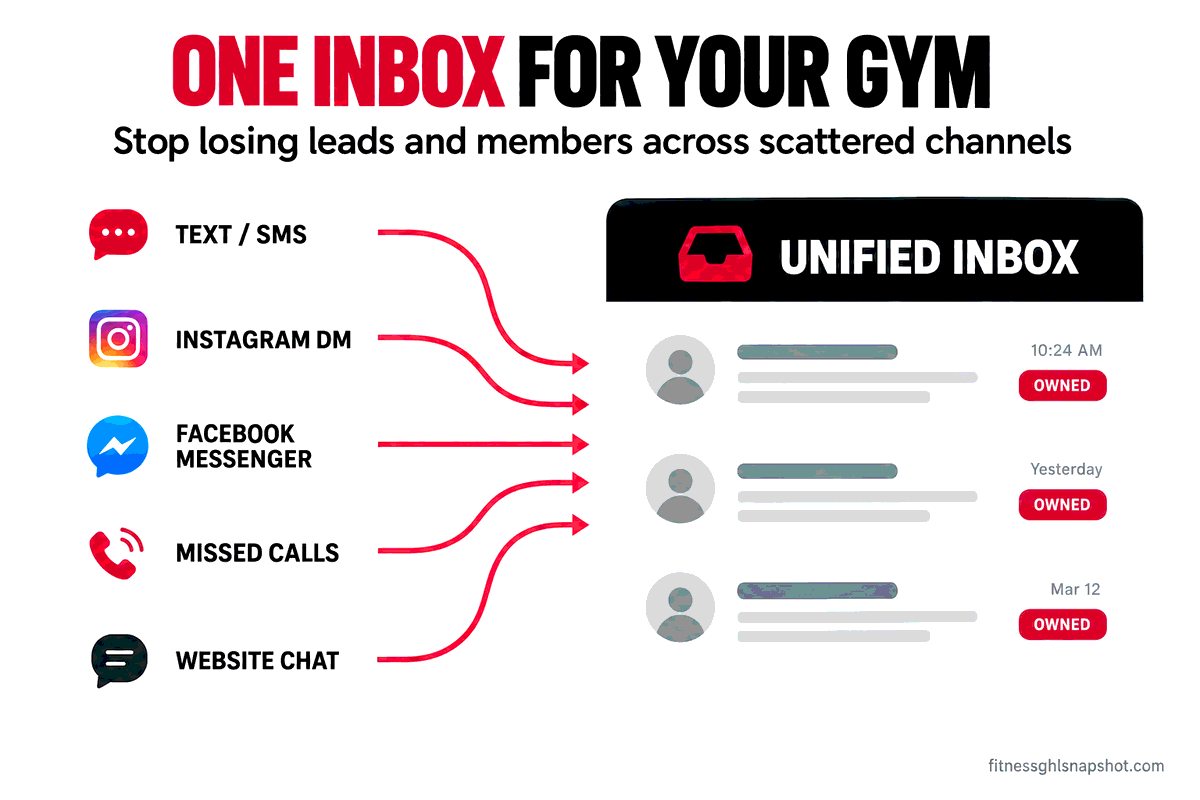
Here is the short version: your gym does not have a lead problem, it has a scatter problem. Messages come in through at least five doors, a text to your business line, an Instagram DM, a Facebook message, a missed call, and the chat box on your site, and no single person or screen sees all of them. So a trial inquiry sits unread in Instagram for nine hours, a member asking to freeze gets no reply and quietly cancels instead, and a missed call at 6pm never gets a callback because nobody knew it happened. The fix is not working harder. It is pulling every one of those channels into one inbox, giving each conversation an owner, setting a rule for how fast you reply, and loading a handful of saved replies so answering takes seconds. Build it once and every message, from every door, lands in one place where someone is responsible for it.
It is a Tuesday night and you are coaching the 6pm class. During that hour, three things happen that you will not find out about until tomorrow. Someone fills out the chat box on your website asking if you have a beginner class. A member you have not seen in two weeks sends an Instagram DM saying she wants to pause her membership. And the front desk phone rings twice with no voicemail. By the time you sit down the next morning, the website lead has booked at the studio down the street, the member has decided pausing is too much hassle and will just cancel, and the two callers are gone with no trace. None of that was a marketing failure. You paid to get every one of those people. They reached out. You just were not looking at the right screen.
That is the quiet leak in almost every independent gym, studio, and training business. You run one main software tool for billing and scheduling, plus a business phone, plus Instagram, plus Facebook, plus whatever chat widget is on the site, and each one is its own island with its own notifications. This post is the system that drains the leak: how to get every message, from every channel, into a single inbox where it gets seen, owned, and answered fast. Stage by stage, with the saved replies to steal, how each piece breaks, and how it changes from a solo trainer to a multi-staff gym.
Table of contents
- Why gym messages fall through the cracks
- What one inbox actually means
- Step 1: Map every door a message comes through
- Step 2: Pull every channel into one place
- Step 3: Give every conversation an owner
- Step 4: Set a response-time standard
- Step 5: Load the saved replies
- Step 6: Automate the first touch and after-hours
- Step 7: Watch the numbers
- The same system at three sizes
- Keep it legal: texting, DMs, and consent
- Objections operators raise
- FAQ
Why gym messages fall through the cracks
Start with how a message actually moves through your business, because once you map it you stop blaming yourself for being disorganized. The problem is structural. A text to your business line pings one device. An Instagram DM lives inside the Instagram app, which only one person’s phone is logged into. Facebook messages sit in a Page inbox nobody opens unless they remember to. Missed calls leave a notification that disappears when the phone restarts. The web chat emails someone, or it does not. Five channels, five places, zero overlap.
Now add a human who is coaching, cleaning, selling, and occasionally sleeping. You cannot watch five screens while you are spotting a deadlift. So the channels you happen to glance at get answered, and the rest wait. The cruel part is that the message you miss is random. It is not the low-value one. It is whichever one came in while you were busy, and a brand-new trial lead is exactly as likely to land at 6pm as a spam comment.
The cost shows up in two places. New leads go cold, which we have written about at length in speed to lead for gyms. And members slip quietly away, because a member who messages to ask a question or pause a membership and hears nothing back often just stops showing up, which is the exact silent churn covered in stop silent churn before it empties your gym. Both come from the same root. A message was sent to a door you were not watching.
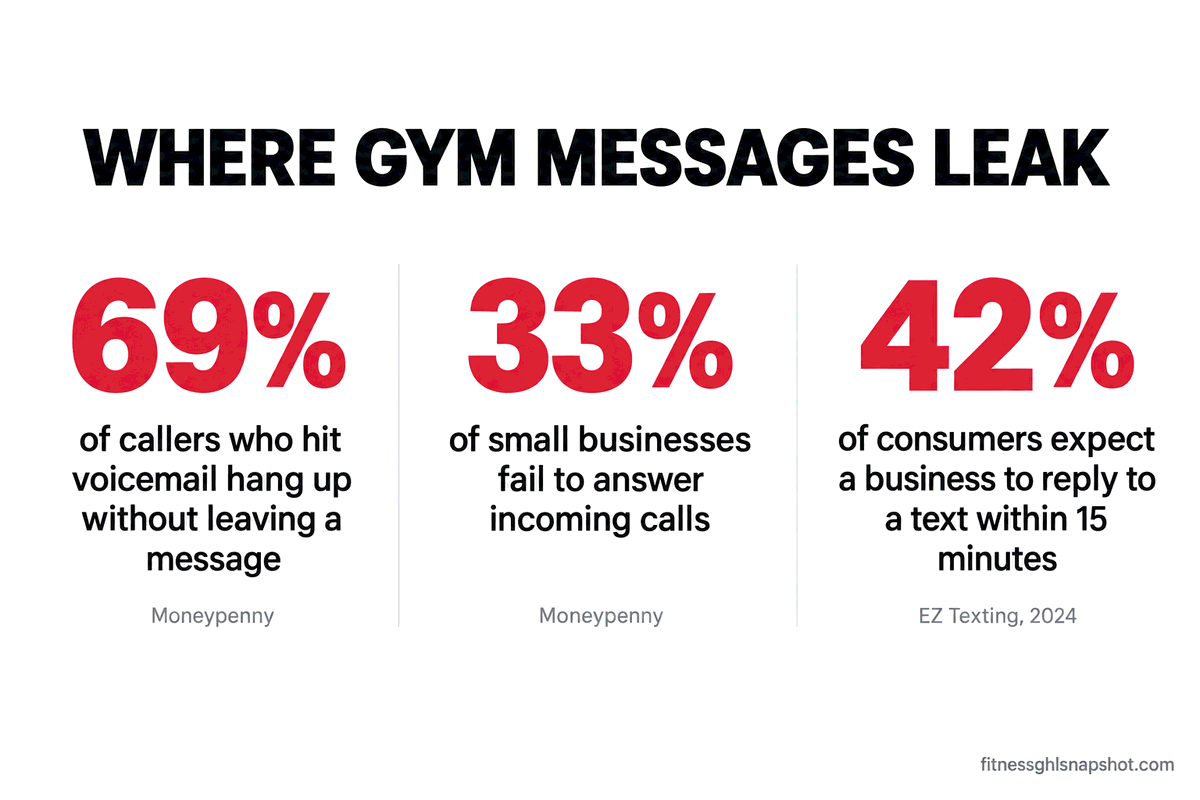
Phone calls are the clearest example of the leak, and there is real data on how bad it gets. In Moneypenny’s small business call report, a third of the businesses surveyed, 33%, failed to answer their incoming calls, and 69% of callers who were sent to voicemail hung up without leaving a message (Moneypenny). So a missed call is not a caller who will try again later. Most of the time it is a caller who is already gone, and you never even knew they rang.
What one inbox actually means
One inbox does not mean one more app to check. It means the opposite. It means every channel, text, Instagram, Facebook, calls, web chat, and email, feeds into a single screen, so there is exactly one place to look instead of five. A DM and a text and a missed-call text-back all show up as threads in the same list. You reply from that one screen, and the reply goes back out through whatever channel the person used. They never know you consolidated anything. They just know you answered.
This matters because consolidation is what makes speed possible, and speed is what wins in this market. People expect businesses to reply like a friend would, fast and on their phone. In the same 2024 EZ Texting report, text messaging became the top channel consumers picked for reaching a business, at 35%, ahead of email at 31% and phone at 29%, and 42% said they expect a reply within 15 minutes (EZ Texting). You are not going to hit a 15-minute reply window by rotating through five apps between sets. You hit it by having one inbox that shows you everything the moment it arrives.
The chart below shows the shape of the problem. These are the channels a typical independent gym fields messages on, and the point is not any single number, it is that no human is watching all of them at once.
Illustrative volume of inbound conversations per week by channel for a typical independent gym, showing how inquiries spread across at least five separate inboxes. The exact mix varies by gym; the point is that the messages are scattered, not concentrated. Source: composite based on the channels covered in this guide.
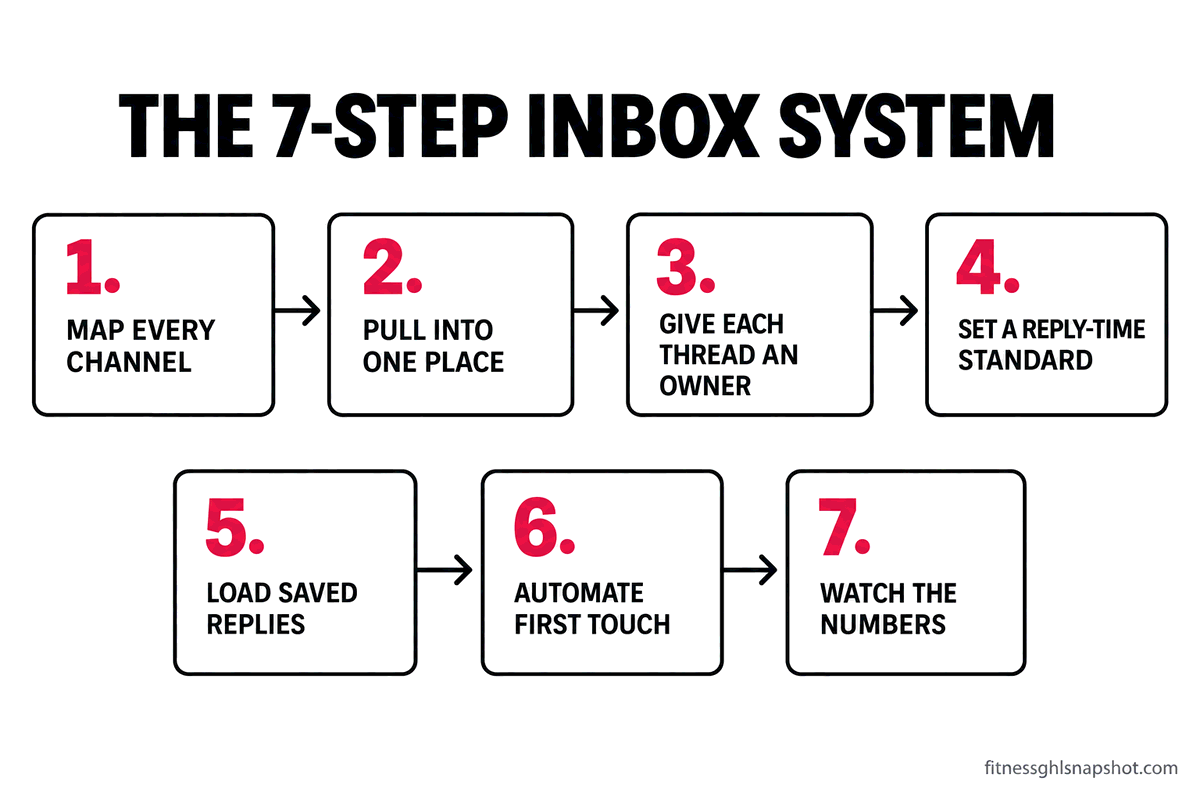
The seven steps below are the whole build, from mapping your channels to watching the numbers that prove it is working. Do them in order once, and the inbox runs itself after that.
Step 1: Map every door a message comes through
Before you consolidate anything, spend 20 minutes listing every way a human can currently send your gym a message. Most owners are surprised it is more than they thought. The usual list: your business phone number (calls and texts), the website contact form, the website chat widget, Instagram DMs, Instagram comments, Facebook Messenger, Facebook comments, your Google Business Profile messages, and the generic info@ email. That is nine doors, and you are probably actively watching three of them.
Write each one down, then mark two things next to it: who currently checks it, and how often. Be honest. “Instagram, me, when I remember” is a real and common answer, and it is exactly where leads die. The doors with no owner or a vague owner are your leak, and you cannot fix a leak you have not located.
How it breaks. The map goes stale the moment you run a new ad or add a new link. Launch a Facebook lead campaign and suddenly Messenger is a primary sales channel, not an afterthought. A new “Book now” button on Google pushes people into Google messages you have never opened. Redo this map any time you change your marketing, not once a year. The second failure is forgetting the channels you personally do not use. Younger members and trial leads live in Instagram DMs whether or not you check them, so a door you ignore is still a door they use.
Step 2: Pull every channel into one place
Now connect those doors to a single inbox. This is the technical heart of the system, and the good news is you do not build it from scratch. A customer relationship tool with a unified conversations inbox connects to your phone number, your social accounts, your web chat, and your email, and pipes them all into one threaded view. GoHighLevel, the platform our own system is built on, does this natively, and most modern CRMs built for local businesses have some version of it. The job is connection, not coding: you link each account once, and from then on new messages flow in automatically.
Prioritize by where your leads actually come from. If you run Instagram and Facebook ads, connect those first, because that is where paid leads land, and nothing stings like paying for a DM that sits unread. The specifics of handling social messages well are their own craft, and we go deep on them in the Instagram DM automation and Facebook Messenger automation pieces. Then connect your phone line for texts and missed-call capture, then the web chat, then email last.
How it breaks. The classic failure is a half-connected inbox: you link Instagram and texts but never finish Facebook and Google, so you think you have one inbox when you actually have “most of one” plus two orphan channels still leaking. Finish the connection list before you trust it. The other trap is connecting a personal social account instead of the business Page or professional account, which limits what the inbox can pull in and can get flagged. Use the business accounts, and confirm each one shows a live test message landing in the inbox before you move on.
Step 3: Give every conversation an owner
A unified inbox with no ownership rules is just a faster way to watch messages pile up. The fix is routing: a rule that decides, the instant a message arrives, whose job it is to reply. Ownership is what turns “someone should get that” into “that one is mine.”
Keep the rules as simple as your team allows. A solo operator owns everything by definition, so the rule is just “me, and the auto-reply covers me when I am coaching.” A small team can route by shift: whoever is working the desk owns every new thread that comes in during their hours, full stop. A bigger gym can route by type: new sales inquiries to the person who sells, billing and membership questions to the manager, everything else to the desk. The point is that every thread has exactly one name on it, and that name can see it in the shared inbox.
How it breaks. The two failure modes are mirror images. Either nobody owns a thread, so it waits for “somebody,” or everybody piles onto the same hot lead and the person gets three slightly different replies from your gym in ten minutes, which looks chaotic and unprofessional. A shared inbox that shows assignment and read status kills both: you can see a thread is already claimed and already answered, so you leave it alone, and you can see an unclaimed one and grab it. If your current setup cannot show who is handling what, that is the single most important thing to fix here.
Step 4: Set a response-time standard
Speed only improves if you make it a number everyone knows. Pick a target reply time and write it on the wall. For new leads, aim for under 15 minutes during open hours, because that is what people now expect and because fast replies to new inquiries convert far better than slow ones. Harvard Business Review’s study of online sales leads found that companies that reached a new lead within an hour were far more likely to have a real conversation with that person than those who waited even an hour longer (Harvard Business Review). For existing members, same-day is usually fine, but set the number so it is a standard, not a mood.
The standard is what forces the rest of the system to actually get used. If the rule is “reply to new leads in 15 minutes,” then the auto-reply, the saved replies, and the routing all stop being nice-to-haves and become the only way to hit the number on a busy day. Review your inbox’s response-time report every week against the target. If you are missing it, the fix is almost always a missing saved reply or a missing automation, not a lazy team.
Step 5: Load the saved replies
Here is where the system gets fast enough to survive a real day. You answer the same handful of questions over and over: how much is it, where are you, what are the class times, can I bring a friend, how do I pause. Write the best version of each answer once, save it as a snippet, and from then on replying is picking a template and tapping send. A 90-second typed reply becomes a 5-second one, which is the difference between hitting your 15-minute standard and not.
Below is a starter set you can paste into your inbox today and tune to your gym. Keep them warm and human, not robotic, and always end with one clear next step.
How it breaks. The mistake is writing saved replies that sound like saved replies: stiff, generic, no name, no next step. A template that reads like a form letter is worse than a slow human reply. Write them in your actual voice, leave the merge fields for the name and the details, and always close with a question or a booking link so the conversation keeps moving. The other failure is letting them go stale, a saved reply that quotes last year’s price is a fast way to tell a lead the wrong number.
Step 6: Automate the first touch and after-hours
A human cannot be first every time, so let automation take the first touch and buy you the time to be second. Two automations matter most. The first is an instant auto-reply on new inquiries: the moment a form, DM, or chat comes in, a friendly message fires back within seconds acknowledging them and asking one simple question. The second is a missed-call text-back: when a call goes unanswered, an automatic text goes out right away, because we know from the Moneypenny data that most missed callers will not leave a voicemail or call again, but they will often reply to a text. We cover that specific play in full in missed-call text-back for gyms.
The point of the first touch is simple: nobody ever hits total silence. A lead who gets an instant “got your message, what day works?” feels attended to even if the real human reply comes 20 minutes later. An after-hours auto-reply does the same job overnight, so a 9pm inquiry is greeted instead of ignored until morning. The deeper lead cadence that runs after this first touch, the follow-ups that turn a reply into a booked trial, is its own system, laid out in the gym lead follow-up sequence.
How it breaks. The big one is an auto-reply that overpromises and then nobody follows up, so the lead gets “we’ll call you right back!” and hears nothing for a day, which is worse than no promise at all. Match the auto-reply to what you can actually deliver, and make sure a human thread owner picks it up. The second failure, specific to texts on a standard business number, is that your automated messages silently do not send because your number is not registered for business texting (more on that below). Test that your auto-reply actually lands on a real phone before you rely on it.
Step 7: Watch the numbers
You cannot improve what you do not look at, so once the inbox is running, check three numbers every week. First, response time: how fast are you replying on average, and are you hitting the standard from Step 4? Second, first-response rate: what share of new conversations get any reply at all, because the goal is 100% and the gap is your leak. Third, channel source: which door your booked trials and saved members actually came through, so you know where to spend time and money.
That third number is the quiet gold. Most owners have a gut feeling about where leads come from and are often wrong. When every conversation lives in one inbox tagged by channel, you can finally see that, say, Instagram DMs book twice the trials of your paid search, or that your web chat is all tire-kickers. That tells you where to point your marketing, which is the kind of decision we dig into in the gym owner’s scorecard.
How it breaks. The failure here is tracking nothing because it feels like overkill for a small gym. It is not. Even a once-a-week glance at response time and unanswered-thread count catches a leak before it costs you a month of leads. The other trap is drowning in dashboards, do not build a 30-metric report, watch the three above and act on them.
The same system at three sizes
The inbox is the same idea at every size, but who runs it and how heavily you automate changes with your setup.
Solo trainer or small PT team (20 to 100 clients). You are the only owner, so the win is purely about not missing things while you coach. Connect your phone, Instagram, and web chat into one inbox app on your phone, turn on the instant auto-reply and missed-call text-back so nothing hits silence, and load the saved replies so you can answer a DM in five seconds between clients. You do not need routing rules, you need one screen and two automations so your busy hours stop costing you leads.
Boutique studio (80 to 250 members, a couple of instructors). Now the risk is that a message slips because nobody was sure whose job it was. Connect every channel, and set a simple shift rule: whoever is working the desk owns every new thread during their hours. Keep the member-pause and cancellation threads flowing to the one person who handles retention, because those conversations save or lose real revenue and deserve a consistent voice. Automation handles the first touch and after-hours, humans own the live replies.
Multi-staff gym (150 to 500 members, 3 to 10 staff). Here the inbox becomes an operations tool, not just a convenience. Route by type: sales inquiries to the sales closer, billing and membership to the manager, general questions to the desk, and make assignment and read status visible so two staff never reply to the same person. Watch the response-time and channel-source reports as management numbers. This is where a real CRM earns its keep, because it is the only way to run one inbox across a team without threads falling between people. The SMS automation and AI caller pieces are the parts to add first if your current tool cannot route and report.
Keep it legal: texting, DMs, and consent
Pulling messages into one inbox does not change the rules on what you can send, and most of what flows through this system is texts, which are governed by law in the US. None of this is legal advice, check your own setup, but here is what to keep clean.
First, texting consent. Under the Telephone Consumer Protection Act, replying to someone who just messaged you and handed over their number is on much safer ground than a cold promotional blast. When a lead fills out a form or texts your line, capture clear consent to be contacted, keep marketing messages separate from these transactional replies, always include an opt-out, and honor STOP instantly. The FCC lays out the texting consent framework in its text-messaging rules, and TCPA damages run $500 to $1,500 per message, so this is not a corner to cut.
Second, A2P 10DLC. US carriers require any business sending application-to-person texts over a standard 10-digit number to register its brand and campaigns with The Campaign Registry, and unregistered traffic gets filtered or blocked outright. If your instant auto-reply or missed-call text-back silently is not arriving, this is almost always why. Register before you scale, not after you lose a month of replies to a carrier filter.
Third, email. The emails that flow through the same inbox fall under CAN-SPAM, which the FTC summarizes in its compliance guide: an accurate sender and subject line, a physical mailing address, and a working unsubscribe you honor.
Fourth, a myth worth clearing, because it changes how you handle those cancellation DMs. There is no federal “click-to-cancel” rule in force in 2026. The FTC’s version was vacated by the Eighth Circuit on July 8, 2025, so the federal rule most content still says is coming is not in effect. State auto-renewal laws and the FTC Act still apply, though, so keep cancellation genuinely easy regardless of what a saved reply says, which we cover in gym membership cancellation and auto-renewal law in 2026.
Objections operators raise
“I already answer my DMs fast. Why do I need an inbox?” Because answering DMs fast only covers the door you happen to watch. The leads and members you are losing are the ones who came through the door you were not in at the time, the missed call during class, the web chat at 9pm, the Facebook message you forgot the password to. One inbox is not about replying faster to the channel you already check, it is about seeing the four you do not. You cannot answer a message you never saw.
“Isn’t this just another app and another login to manage?” It is the opposite. Right now you are managing five apps and five logins, the phone, Instagram, Facebook, Google, email, each with its own notifications. A unified inbox replaces all of that with one screen. You check one place instead of five, and you reply from that one place no matter which channel the person used. It is less to manage, not more.
“My gym software already has a message feature. Doesn’t that cover it?” Sometimes partly. Many gym platforms can send a member a reminder or a billing notice, but most do not pull your Instagram DMs, Facebook messages, missed-call texts, and web chat into one view with routing and response reporting. Check whether yours actually connects your social channels and your phone line, not just emails your own members. If it only talks to existing members through one channel, it is not a unified inbox, and the leads coming in through social and calls are still leaking.
“Do I need to be technical to set this up?” No. Every step here is connect-and-configure, not code. You link each account once, set a couple of routing rules, write your saved replies, and flip on two automations. You can wire the basics together yourself over a weekend in whatever CRM you choose, or have the whole thing installed done-for-you and connected to your accounts so it just works.
The bottom line
Go back to that Tuesday night class. In a gym with five scattered inboxes, the website lead, the member who wanted to pause, and the two missed calls are all gone by morning, and you never even knew about half of them. In a gym with one inbox, all four landed in the same place the second they arrived. The website lead got an instant auto-reply and a booked trial by the time you finished coaching. The member who wanted to pause got a warm reply offering a freeze and stayed. The two missed calls got an automatic text-back, and one of them replied and booked.
Same night. Same gym. Same number of messages. The only difference is that every message went to one screen with an owner and a reply instead of scattering across five apps nobody was watching. You cannot watch five inboxes while you coach. One inbox can watch itself, greet everyone instantly, and hand you a clean list of conversations that actually need you, so the busy nights stop quietly costing you members.
Frequently asked questions
What is a unified inbox for a gym?
A unified inbox is a single screen that pulls every message channel your gym uses, text, Instagram DMs, Facebook Messenger, missed-call texts, website chat, and email, into one threaded list. Instead of checking five separate apps, you see and reply to every conversation in one place, and your reply goes back out through whatever channel the person originally used. It usually lives inside a customer relationship tool or CRM built for local businesses. The goal is to stop leads and members from slipping through the cracks because a message landed in an app nobody was watching, and to make it possible to reply fast and consistently no matter how busy the floor is.
Why do gyms lose leads across different message channels?
Because each channel is its own island with its own notifications, and no single person watches all of them at once. A text pings one phone, an Instagram DM lives in the Instagram app, Facebook messages sit in a Page inbox, missed calls leave a fading notification, and the web chat emails someone or nobody. A busy owner who is coaching and running the floor can only glance at a couple of these, so whichever message arrives while they are busy waits, and a brand-new trial lead is just as likely to land in an unwatched channel as spam is. The fix is consolidating every channel into one inbox so nothing depends on which app you happened to open.
How fast should a gym reply to messages and leads?
For new leads, aim for under 15 minutes during open hours. In EZ Texting's 2024 consumer survey, 42% of people said they expect a business to respond to a text within 15 minutes, and research on online sales leads consistently shows that faster first responses convert far better than slow ones. For existing members, same-day is usually fine. The practical way to hit a 15-minute standard on a busy day is not to type faster, it is to use an instant automated first touch, saved replies for common questions, and a single inbox so you are not rotating through five apps between sets.
Can I connect Instagram and Facebook DMs to one inbox?
Yes. Most modern CRMs and conversation tools built for local businesses, including GoHighLevel, can connect your Instagram professional account and Facebook business Page so DMs and messages flow into the same inbox as your texts, calls, and web chat. You link each account once through the tool, confirm a test message lands, and from then on new messages arrive automatically and you reply from the one screen. Use your business or professional accounts, not personal ones, because personal accounts limit what can be pulled in and can be flagged. Connect whichever channels your leads actually come through first, usually social if you run paid ads.
Is it legal to send automated texts to gym leads and members?
Yes, when done correctly. Under the TCPA, replying to someone who just contacted you and shared their number is on much safer footing than a cold promotional blast, but you should still capture clear consent, keep marketing messages separate from transactional replies, include an opt-out, and honor STOP immediately. US carriers also require businesses to register their brand and campaigns for A2P 10DLC or automated texts get filtered, which is the usual reason an auto-reply silently fails to send. Emails that run through the same inbox fall under CAN-SPAM, so use an accurate sender and subject, a physical address, and a working unsubscribe. TCPA damages run $500 to $1,500 per message. This is general information, not legal advice.
Does a unified inbox replace my gym management software?
Usually not, and it does not have to. Most gyms keep the software that runs their scheduling, check-ins, and billing, and add a unified inbox and automation layer around it for conversations. The inbox handles the messaging and lead-response side, the first-touch automations, saved replies, routing, and response reporting, while your existing platform keeps running the schedule and payments. Some all-in-one CRMs can do both, but a common and lower-risk setup is to leave your core gym software in place and connect a dedicated conversations tool on top so your texts, social DMs, calls, and chat finally live in one place.
Written by Cole Hartman, Local Marketing & Paid Acquisition Lead. Cole started out buying Facebook and Instagram ads for personal trainers and martial-arts schools, then learned the hard way that the funnel behind the ad matters more than the creative. He now pairs paid acquisition with follow-up systems so gyms stop paying for leads that die unread in a DM.
Related posts
- Speed to Lead for Gyms: Why the First 5 Minutes Decide Who Becomes a Member
- Missed-Call Text-Back for Gyms: Turn Every Unanswered Call Into a Booked Trial
- The Gym Lead Follow-Up Sequence: The Texts, Emails, and Calls That Book Trials
- Stop Silent Churn Before It Empties Your Gym
- The Gym Owner’s Scorecard: 10 Numbers to Track Every Month