
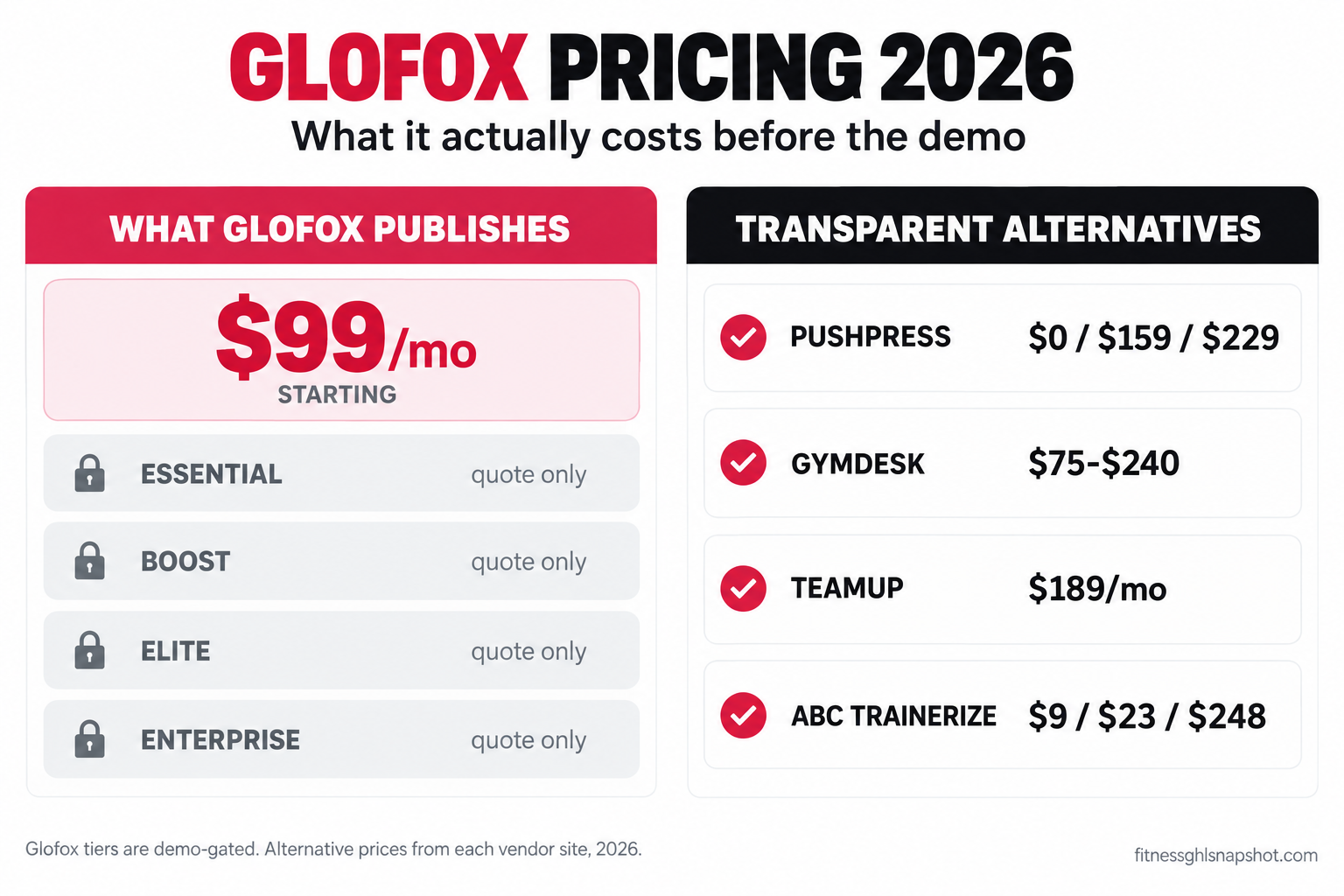
Short version: Glofox advertises one number, “plans starting at $99 a month,” and then routes you into a quote form for everything else. Its four plans (Essential, Boost, Elite and Enterprise) are all demo-gated, so the real price for the tier a studio actually needs is a number you only get on a sales call. Reviewers put the working tiers somewhere between roughly $150 and $600+ a month, before a setup fee, before a platform fee that reportedly sits on top of normal card processing, and before the annual contract with quarterly upfront billing that several report on the upper plans. By comparison, PushPress, Gymdesk, TeamUp and Trainerize all publish their full prices on their own websites. This is the whole teardown, with sources, so you can budget before you book the call.
It is a Tuesday and you are trying to do one simple thing: find out what Glofox would cost your studio. You open the pricing page expecting a grid. Instead you get a form. Business type, number of locations, your details, and then “Pricing,” which is not a price but a promise that someone will call you. I have signed these contracts and sat through these demos for gyms and studios, and the move is always the same. Show one friendly number up top, hide the real one until you are on a call with a rep who knows their floor and their ceiling while you know neither. So let’s find the real number together, before anyone picks up the phone.
Table of contents
- What Glofox actually publishes (and what it hides)
- What Glofox reportedly costs by tier in 2026
- The costs the sticker price never shows
- What Glofox actually costs, by studio size
- Four alternatives that publish their prices
- Steal this: force a real number out of the demo
- The contract is a cost: cancellation and lock-in
- Questions operators ask before they sign
- FAQ
What Glofox actually publishes (and what it hides)
Go to Glofox’s pricing page right now. You will not find a price. You will find a form that asks for your business type, your number of locations and your contact details, and the final step, labeled “Pricing,” is the part where you wait for a call (Glofox pricing). The closest thing to a public number is on a separate plans page, which says “plans starting at $99 USD/month” and lists four tier names: Essential, Boost, Elite and Enterprise (Glofox plans). Enterprise is a “contact us” box. So the honest summary is this: Glofox publishes one starting number and four tier names, and nothing else.
That last number matters more than it looks. A record 77 million Americans, about 25% of everyone aged six and older, held a gym or studio membership in 2024, and facility membership grew 20% between 2019 and 2024 (Health & Fitness Association, 2025). That is a big, growing market, which is exactly the kind of market where a vendor can afford to price by negotiation instead of by a published number. There are enough studios to sell to that leaving the real price off the page costs Glofox very little and gains it room to charge each buyer whatever that buyer will accept.
Name the strategy plainly, because it is doing work on you. When a company publishes a full price grid, that grid is a promise you can hold it to. When a company publishes one teaser and gates the rest, the price becomes a negotiation, and in that negotiation the salesperson has done this a thousand times and you have done it maybe twice. Gym software splits almost perfectly along this line. PushPress, Gymdesk, TeamUp and Trainerize put their full grids in public. Glofox, Mindbody, Wodify and Mariana Tek make you book a demo. This post goes deep on the biggest demo-gated name built specifically for boutique studios.
Two things are true at once, and holding both is how you avoid overpaying. Glofox is a capable, mature platform that plenty of boutique studios run happily, with a genuinely good member-facing booking app. And the way it prices is designed to keep the real number hard to find until you are emotionally committed to a sales process. You can respect the first and refuse the second.
What Glofox reportedly costs by tier in 2026
Since Glofox will not tell you, the only honest source is operators who have been quoted and reviewers who collect those quotes. The numbers below are reported estimates, not confirmed prices, and I am flagging them that way on purpose. Use them to set your expectations for the call, not to sign anything.
Reviewers who track Glofox quotes put the four tiers roughly here for a single location, billed monthly (vibefam, 2026):
Published starting price from Glofox’s plans page. Tier figures are reported midpoints from operator reviews collected by vibefam, 2026, a Glofox competitor; Glofox does not publish tier pricing. Confirm your own quote.
Glofox reported tiers, 2026 (single location, reviewer estimates)
| Plan | Essential | Boost recommended | Elite | Enterprise |
|---|---|---|---|---|
| Price | ~$110–$150/mo | ~$160–$250/mo | ~$250–$600+/mo | Custom (reported $500–$600+) |
| Feature 1 | Booking, scheduling, basic member management | Marketing and automation tools added | Branded member app typically bundled here | Multi-location and franchise features |
| Feature 2 | Member app access | Lead and membership management | Advanced reporting and automation | Dedicated support, custom terms |
| Feature 3 | Points to the $99 'starting at' anchor | The tier most growing studios are steered toward | Best fit: a busy studio or small group | Quote-only, no public number |
| Feature 4 | Best fit: a single small studio getting started | Best fit: an established single-location studio | Often quoted with annual contract, quarterly billing | Best fit: multi-site operators and franchises |
| Feature 5 | Reported, not confirmed by Glofox | Reported, not confirmed by Glofox | Reported, not confirmed by Glofox | Reported, not confirmed by Glofox |
Here is the first failure mode, and it is baked into the pricing itself. Because the tiers are gated, two studios the same size can pay very different prices for the same software, and neither one knows it. The studio that pushed back, mentioned a competitor and was ready to walk gets the lower number. The studio that seemed excited and ready to sign gets the higher one. When the price is a negotiation, your willingness to walk away is worth real money, and most owners do not realize that until after they have signed.
The costs the sticker price never shows
Even the reported tier numbers above are not the real cost, because the monthly software fee is only one line on the invoice. Here are the costs that do not show up until you are reading a quote or a statement.
Payment processing, with a surcharge on top. Glofox runs card payments through Stripe, whose standard online rate is 2.9% plus $0.30 per transaction (Stripe pricing). Reviewers report that Glofox adds its own platform fee on top of that base rate, and Glofox does not publish the number (vibefam, 2026). Do not take any single third-party figure as gospel here, because competitors have an incentive to inflate it. But do ask the exact question on the call, because this is the line that quietly becomes one of your biggest monthly costs. On $40,000 a month in member payments, every extra half a percent is $200 a month, or $2,400 a year, that never appears on the pricing page. This is also why automated failed-payment recovery matters so much: the processing cost is fixed, so the dollars you save come from recovering the charges that fail, not from shaving the rate.
A setup or onboarding fee. Several reviews report a one-time setup fee on Glofox, with no confirmed amount published anywhere (vibefam, 2026). Treat it as “probably there, amount unknown until quoted.” Ask for it in writing.
The branded member app. Glofox’s member-facing app is one of its real strengths, but reviewers report it is bundled only at the upper (Elite) tier, which is part of why studios that want their own app get steered up the price ladder. If the app is the reason you are looking at Glofox, price the tier that includes it, not the one with the friendly starting number.
Quarterly prepay and the annual contract. On the upper plans, reviewers report annual contracts billed quarterly in advance, so the real commitment is a year and the real cash outlay is three months at a time (vibefam, 2026). A $250 a month plan quoted this way is a $3,000 annual decision and a $750 charge every quarter, not a $250 monthly one you can stop whenever you like.
The parent company. Glofox is not an independent startup anymore. ABC Fitness Solutions acquired it in 2022 for a reported sum of at least €200 million (Irish Times, 2022), and the product is increasingly branded ABC Glofox. ABC also owns Trainerize, so two of the names on your shortlist may be the same company. That is not a reason to avoid Glofox. It is a reason to know who you are actually buying from and to expect pricing and roadmap decisions to be made at the parent level.
What Glofox actually costs, by studio size
The all-in number depends entirely on your size, so run it for three real operators. These use the reviewer-reported tier estimates plus processing, so treat them as planning figures, not quotes.
The solo trainer or tiny studio (20 to 60 clients). You would be sold Essential, reported around $110 to $150 a month. Add card processing on your member payments, and if you want the branded app you get pushed toward a higher tier. Call it $150 to $200 a month all-in for the small version, more if you add the app. For an operator at this size, that is real money for booking and payments you can get cheaper elsewhere, and the branded app is the only thing that justifies the premium.
The established single-location studio (80 to 250 members). This is Glofox’s core buyer, and you land on Boost or Elite, reported around $160 to $400+ a month. Add processing on a healthy monthly volume and the branded app, and $350 to $550 a month all-in is a fair planning range, billed quarterly on an annual contract. The software is capable at this level. The question is whether the booking app and reporting are worth paying a demo-gated premium for, when the follow-up and retention work that actually grows the studio sits in a different tool anyway.
The multi-location group or franchise (3+ sites). Now you are in Enterprise, which is fully custom and quote-only. Plan for several hundred dollars per location per month plus processing across all of them, and expect the per-location number to be where the negotiation really happens. At this size the lock-in matters most, because migrating three locations off a platform mid-contract is a genuine project, and Glofox knows it. The negotiating power you have is all at signing. After that, your ability to walk shrinks every month.
Notice the pattern across all three. The booking, scheduling and member app are solid at every size. What is missing at every size is the part that converts trials into members and catches members before they quietly cancel. That gap is the same whether you pay $150 or $550, and it is the gap that costs the most, because the average member now visits only about 1.5 times a week, down from 2.1 in 2019 (Health & Fitness Association, 2025). Lower attendance is an early churn signal, and a booking app does not act on it.
Four alternatives that publish their prices
Here is the contrast that makes the demo gate look worse. Four well-known platforms serve the same studios and put their complete prices in public, on their own websites, no form required. You can price your whole year in ten minutes. I compared these four head to head in the cheapest gym software breakdown; here is the short version with 2026 figures pulled straight from each vendor’s page.
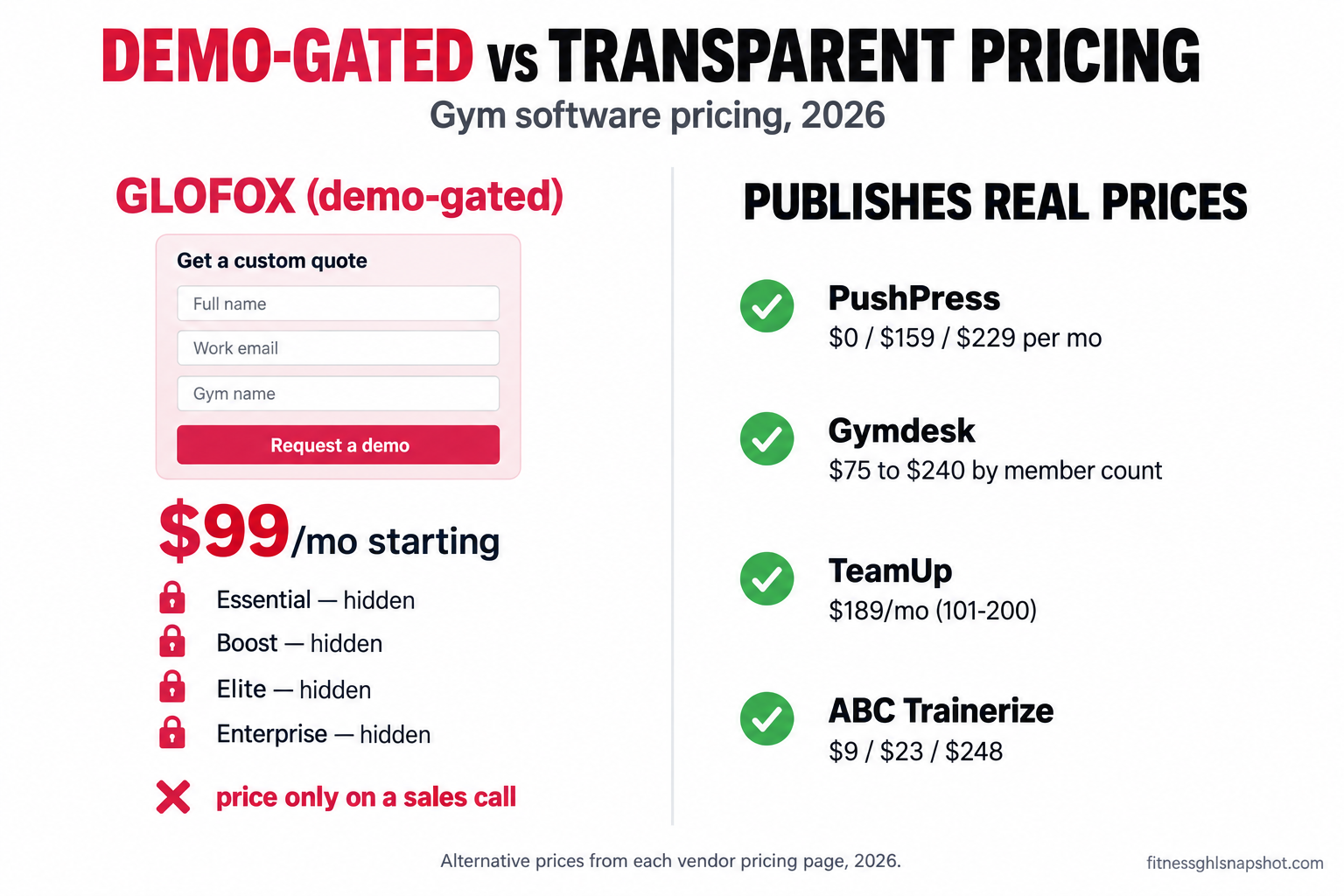
Transparent alternatives, 2026 (published on each vendor's own site)
| Plan | PushPress | Gymdesk recommended | TeamUp | ABC Trainerize |
|---|---|---|---|---|
| Price | $0 / $159 / $229 | $75–$240/mo | ~$189/mo (101–200) | $0 / $9 / $23 / $248 |
| Feature 1 | Free, Pro ($159/mo), Max ($229/mo) | Priced by active members, full platform on every plan | Scales by active customers, unlimited locations | Free (1 client), Grow $9, Pro from $23 |
| Feature 2 | Card processing 2.75–4.99% + $0.30, published | $75 (≤50) to $200 (151–250) with Gymdesk Payments | Payments and CRM in the core plan | Studio Plus $248/mo per location (5+ sites) |
| Feature 3 | Add-ons: Train $79, Grow $329, app $97 | No contracts, no setup fee, cancel anytime | No setup fee, no long-term contract | Priced by client seats, annual saves 10% |
| Feature 4 | Best fit: gyms and boxes wanting a free start | Best fit: studios that want one simple price | Best fit: class and course-based studios | Best fit: PT and coaching-led businesses |
| Feature 5 | Source: pushpress.com/pricing | Source: gymdesk.com/pricing | Source: goteamup.com/pricing | Source: trainerize.com/pricing |
A few honest notes on this table. PushPress publishes a free tier and its real processing rates right on the page (PushPress pricing), which is the opposite of hiding the processing cost. Gymdesk charges by your member count and includes the whole platform on every plan, with no contract and no setup fee (Gymdesk pricing), which is about as clean as pricing gets in this category. TeamUp scales with active customers and the one band it renders publicly is $189 a month for 101 to 200 active customers (TeamUp pricing). Trainerize is the odd one here, because it is owned by the same parent as Glofox, and even its own page contradicts itself in a few places, so use the base-plan card figures of $9, $23 and $248 and double-check at signing (Trainerize pricing). I wrote up what changed at Trainerize after the ABC acquisition separately.
The point is not that any of these four is automatically better software than Glofox. It is that you can compare them without a sales call, which means you can negotiate Glofox against a known number instead of a guess. A published price is free negotiating power.
Steal this: force a real number out of the demo
If you do book the Glofox demo, go in with a script, because an unscripted demo is where the pricing advantage lives for them. Here is the exact set of questions I give operators. Ask them in this order, early, before the feature tour, and write down the answers.
1. “What tier do you recommend for a studio my size, and what is the exact monthly price for it, in writing?” Pin the tier and the number together. Do not let “it depends” stand. Give them your member count and ask for the price for that count.
2. “Is that billed monthly or quarterly, and what is the contract length?” This is where the annual commitment and the three-months-upfront cash outlay live. A $250 monthly quote and a $3,000 annual contract are very different decisions.
3. “What is the one-time setup or onboarding fee?” Assume there is one until they say there is not, in writing.
4. “What is my total card processing cost, the full percentage and per-transaction fee, including any platform fee you add on top of Stripe?” Make them say the all-in rate, not just “we use Stripe.” The platform fee is the hidden line.
5. “Is the branded member app included in that tier, or is it extra?” If the app is why you are here, confirm the tier that includes it, not the starting one.
6. “If I leave, is there a data-export fee, and do I keep my member data?” Lock-in has a price. Find it before you sign, not when you are trying to migrate.
7. “PushPress is $159 a month with no contract and the price is on their website. What are you offering that is worth the difference, and can you match the transparency?” Name a published competitor. The moment you show you have a real alternative with a known number, the negotiation changes.
That last question is the whole game. The reason a demo gate works is that it keeps you from having a number to push against. Walk in with a competitor’s published price and you take that advantage back. For the wider market map, the gym software pricing breakdown and the Mindbody alternatives guide both give you more named numbers to bring to the table.
The contract is a cost: cancellation and lock-in
The contract is not a footnote. It is one of the most expensive parts of the deal, and it is the part studios think about least at signing.
Reviewers consistently report annual terms on Glofox’s upper tiers, often billed quarterly in advance. That means two things. First, you are committing for a year, so the “monthly” price is really an annual one divided into twelve. Second, your negotiating power is almost entirely at the point of signing. Once you are in, the cost of leaving, exporting your data, migrating members, retraining staff, rebuilding automations, climbs every month, and the vendor knows that, which is why mid-contract flexibility is rare.
Cancellation and auto-renewal are also a legal area in flux. The federal “click-to-cancel” rule that a lot of fitness-software content still tells you to prepare for was actually struck down in July 2025, and what governs your own member contracts now is a stack of state auto-renewal laws, which vary a lot by state. I wrote the full, sourced version of that in gym membership cancellation and auto-renewal law in 2026. The short operator takeaway: read the auto-renewal and cancellation terms in any gym-software contract as carefully as you read the price, because the renewal clause is where a “cheap” tool gets expensive.
If you want to avoid the lock-in question entirely, the structural answer is to own your system rather than rent it. A platform you own on your own account does not have an exit fee, because there is nothing to exit. That is the whole idea behind building your follow-up and retention layer on GoHighLevel instead of renting it inside a booking tool.
Questions operators ask before they sign
“Isn’t cheaper software just worse software?” Not here, and the prices prove it. Gymdesk puts its entire platform on every plan for $75 to $240 a month by member count, with no contract (Gymdesk pricing). PushPress has a genuine free tier (PushPress pricing). These are not stripped-down toys. The gap between them and Glofox is less about capability and more about the member-facing app and the sales motion. Pay the premium if the app is worth it to you. Do not pay it just because the price was hidden and felt expensive, so it must be good.
“I already pay for Glofox. Should I switch?” Not necessarily, and not in a hurry. If the booking and member app work and your members like them, ripping them out mid-contract to save $100 a month is rarely worth the disruption. The smarter move for most studios is to leave the booking tool in place and add the layer it does not have: automated trial follow-up, no-show recovery, and retention nudges. That is where the revenue is, and it does not require migrating anyone.
“Do I need to be technical to use something other than Glofox?” No. Gymdesk, PushPress, TeamUp and Trainerize are all self-serve with onboarding support, and you can sign up and see the price without talking to anyone. If you go the GoHighLevel route for the growth layer, a done-for-you Fitness Snapshot is installed for you, so you are not building workflows from scratch.
“Glofox has a branded app. Does the cheaper option?” Some do, as a paid add-on. PushPress offers a branded app for $97 a month, Gymdesk for $100 a month, TeamUp as an add-on (PushPress pricing; Gymdesk pricing). So “I need my own app” does not force you into a demo-gated contract. It is a line item you can price in public on three of the four alternatives.
“What if the rep offers me a discount to sign today?” Then you know the published starting price was never the real floor. A today-only discount is useful information: it tells you the number is soft and the vendor has room. Take the time you need, get every figure in writing, and compare it against a published competitor price before you commit to a year.
Frequently asked questions
How much does Glofox cost per month in 2026?
Glofox publishes only one figure, 'plans starting at $99 a month,' and gates every tier behind a quote form. Its four plans are Essential, Boost, Elite and Enterprise. Reviewers who collect operator quotes report the real working tiers landing roughly $110 to $150 for Essential, $160 to $250 for Boost, $250 to $600+ for Elite, and custom pricing for Enterprise, all for a single location. Glofox does not confirm any of these, so treat them as planning estimates and get your own quote in writing.
Why won't Glofox show its real prices?
Glofox's pricing page is a multi-step 'get a price quote' form with no numbers, and its plans page shows only a $99 starting figure plus four tier names. Gating the real price turns it into a negotiation rather than a published promise, which generally favors the vendor, because the salesperson knows the range and you do not. It is the same pattern Mindbody, Wodify and Mariana Tek use, while PushPress, Gymdesk, TeamUp and Trainerize publish full prices on their own sites.
Does Glofox charge a setup fee?
Multiple reviews report a one-time setup or onboarding fee on Glofox, but no authoritative page publishes an amount, so the honest answer is that a setup fee is likely but the number is only revealed in a quote. Ask for it explicitly and in writing during the demo, along with the contract length and the full card-processing rate.
Is Glofox owned by ABC Fitness?
Yes. ABC Fitness Solutions acquired Glofox in 2022 for a reported sum of at least €200 million, and the product is increasingly branded ABC Glofox. ABC Fitness also owns Trainerize, so two names that might appear on your shortlist are owned by the same parent company. That does not make Glofox a bad choice, but it is worth knowing who you are buying from and expecting pricing decisions to be made at the parent level.
What are the cheapest alternatives to Glofox?
Four platforms publish real prices without a demo. PushPress has a free plan plus Pro at $159 and Max at $229 a month. Gymdesk runs $75 to $240 a month priced by active member count with no contract. TeamUp is about $189 a month for a studio with 101 to 200 active customers. ABC Trainerize starts free, with Grow at $9 and Pro from $23 a month, scaling by client seats. All four let you price your year in minutes.
What does Glofox not do that costs me the most?
Glofox is strong at booking, scheduling and its member app, but it is not built to convert trial leads into members or to catch members before they quietly cancel. Automated speed-to-lead follow-up, no-show recovery and retention nudges are where most of the lost revenue in a studio sits, and that work usually lives in a separate system like GoHighLevel. The booking tool keeps your calendar full; the follow-up layer keeps your membership growing.
Should I switch off Glofox if I already use it?
Not necessarily. If the booking and member app work well and your members like them, switching mid-contract to save a little money is rarely worth the disruption. The smarter move for most studios is to keep the booking tool and add the growth layer it lacks: automated trial follow-up, no-show recovery and retention automation. That captures revenue without migrating a single member.
The real lesson of Glofox pricing is not that Glofox is expensive. It is that you cannot know whether it is expensive until you have forced the real number into the open, and the whole pricing design is built to keep that number out of reach until you are invested in the sale. So take the number back. Walk into the demo with a competitor’s published price in your hand, get every figure in writing, and remember that the part of your studio that actually grows, the trial follow-up and the retention work, is not the part any booking tool sells you. That part you can own outright.