
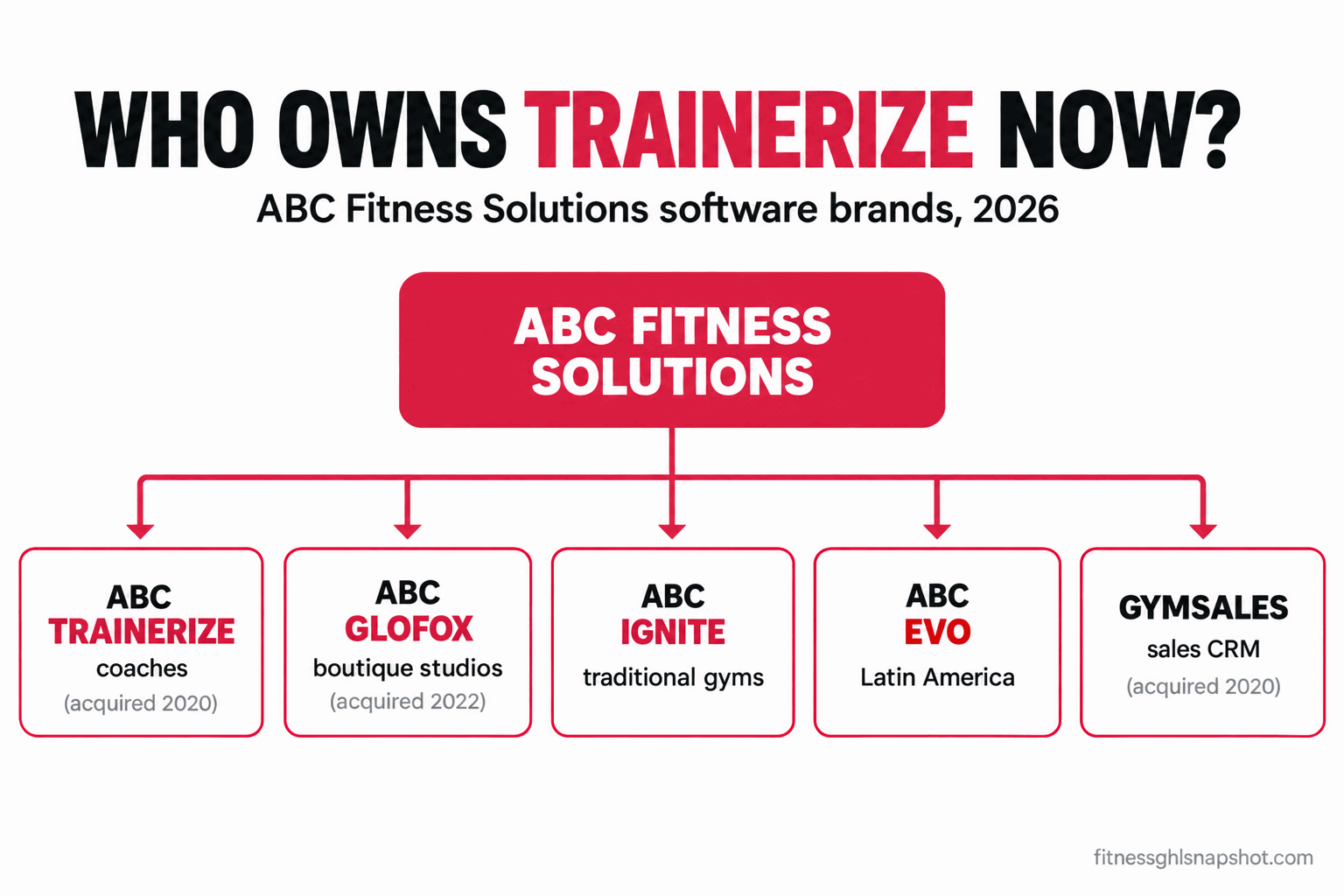
The short version: the app you still call “Trainerize” has been ABC Trainerize since ABC Fitness bought it in September 2020, and ABC now also owns Glofox, GymSales and Evo. The product did not get worse. It got bigger and more add-on driven. In 2026 Basic is free for one client, Grow is $9 a month for two, and a real roster lands in the Pro tiers that climb toward $200-plus before nutrition, payments and a branded app get bolted on. TrueCoach is the cleaner, simpler alternative; Everfit is the better-value one with a real free tier. But all three share one blind spot: they coach the clients you already have, and none of them chases the lead who filled out your form at 11pm. Here is the full breakdown.
It is 6:15am and you are setting up the rig before your first client walks in. Your phone has three notifications. A workout a client marked complete at 4:50am, synced through the app, nice. A payment that failed overnight. And a web form from someone who found you on Instagram last night, wants to start, and has almost certainly messaged two other coaches already. Your coaching app handled the first one beautifully and did nothing about the other two. If you have coached through Trainerize for a few years and quietly wondered what happened to it, who owns it now, and whether something cheaper would do the same job, this is the honest answer.
Table of contents
- Wait, who owns Trainerize now?
- What actually changed since ABC bought it
- What ABC Trainerize really costs in 2026
- Trainerize vs TrueCoach vs Everfit: 8 things that decide it
- Run the numbers: three real scenarios
- Steal this: the follow-up copy none of them writes
- The gap all three leave open
- Objections coaches raise before switching
- FAQ
Wait, who owns Trainerize now?
A lot of coaches never got the memo. Trainerize is not an independent Vancouver startup anymore. ABC Financial, the gym-billing giant now called ABC Fitness Solutions, bought it on September 15, 2020, when the press release counted 150,000 trainers on the platform and ABC served nearly 16,000 clubs worldwide (Thoma Bravo, 2020). The footer of the pricing page today reads “ABC Trainerize.”
Here is what matters when you shop for an alternative: you are often shopping inside the same house. ABC acquired GymSales in July 2020, Trainerize in September 2020, and Glofox in August 2022, in a deal reported at around $200 million (ABC Fitness, 2022). The resulting lineup is ABC Trainerize for coaches, ABC Glofox for boutique studios, ABC Ignite for traditional gyms, and ABC Evo for Latin America.
None of that is a scandal. Consolidation is normal. But it means “I’ll just switch to Glofox” is sometimes a lateral move to a sibling product, not an escape.
What actually changed since ABC bought it
If you have used Trainerize since before 2020, the changes came gradually, not in one ugly redesign. Here is what I see, and where each change can bite.
The product leaned harder into “total fitness.” The acquisition pitch was a mobile-first experience covering workouts, on-demand and live classes, virtual personal training, nutrition, and habit coaching (Thoma Bravo, 2020). The app got broader. For a coach who just wants to program, assign and message, that breadth is weight you carry whether you use it or not.
Nutrition moved behind a paywall. Advanced Nutrition Coaching is a paid add-on, $20 a month on Grow and the smaller Pro tiers and $45 on Pro 30 through 200 (Trainerize, 2026). Coaches budget the base plan, sell a “training and nutrition” package, then find the nutrition engine is a separate line item.
Payments became an add-on too. Integrated Stripe payments run $10 a month. You can bill elsewhere, but then your “all in one app” needs a second tool and a reconciliation habit.
The branded app is a real project, not a toggle. A Pro custom-branded app carries a $169 one-time setup fee, plus Apple’s $99 a year developer fee if you publish it yourself (Trainerize, 2026).
The gravity shifted toward Studio and Enterprise. Studio Plus starts at $248 a month per location, pitched at operators with five or more locations. The parent sells gym-scale platforms now, so the roadmap follows the bigger accounts, and a solo coach can feel like the smallest fish in a pond built for chains.
What did not change is the good news. Contracts stayed month to month, there are no long-term lock-ins, cancelling simply drops you to the free plan, and the client app and workout tracking are still the part people actually like (Trainerize, 2026). For a lot of coaches, that is enough to stay.
What ABC Trainerize really costs in 2026
Straight from the pricing page, this is the shape of it.
The headline prices are honest and public, which puts Trainerize ahead of the demo-gated crowd like Mindbody and Glofox. The trap is not the base plan. It is the add-ons. A coach with 30 clients who sells nutrition and takes payment in the app is not paying the “Pro” sticker. They are paying the Pro tier for that roster, plus $45 for Advanced Nutrition, plus $10 for payments, plus the one-time $169 for a branded app. The $23 you remember from the ad is the floor, not the ceiling.
Every tool in this category does the same: a clean base price and a menu of paid modules. The honest way to shop is to write down your real roster size and the features you actually need, then price each tool fully loaded. I ran that exercise across the wider market in what gym software actually costs in 2026, and the published number and the invoice are rarely the same.
Trainerize vs TrueCoach vs Everfit: 8 things that decide it
These three are the realistic shortlist for a coaching-first app, and all publish prices, so this is a fair fight you can do on paper. Here is how they land on the eight things that decide which one you keep.
The fast read: who each app is actually for
| Plan | ABC Trainerize | TrueCoach recommended | Everfit |
|---|---|---|---|
| Price | Free, then $9 to $248+/mo | About $30 to $165/mo | Free, then $19 to $430/mo |
| Feature 1 | Broadest feature set of the three, now ABC-owned | Simplest, cleanest coaching workflow of the three | Real free tier for up to 5 clients, best value entry |
| Feature 2 | Nutrition, payments and branded app are paid add-ons | Clients free; priced by active-client tier, lighter on studio | Strong automation (Autoflow), on-demand content, meal add-ons |
| Feature 3 | Best for: a coach who wants one broad app and may grow | Best for: a solo or small-team coach who wants less app | Best for: a budget-conscious coach scaling a roster |
| See full gym-software pricing | Mindbody alternatives for small gyms | Compare four gym tools on price |
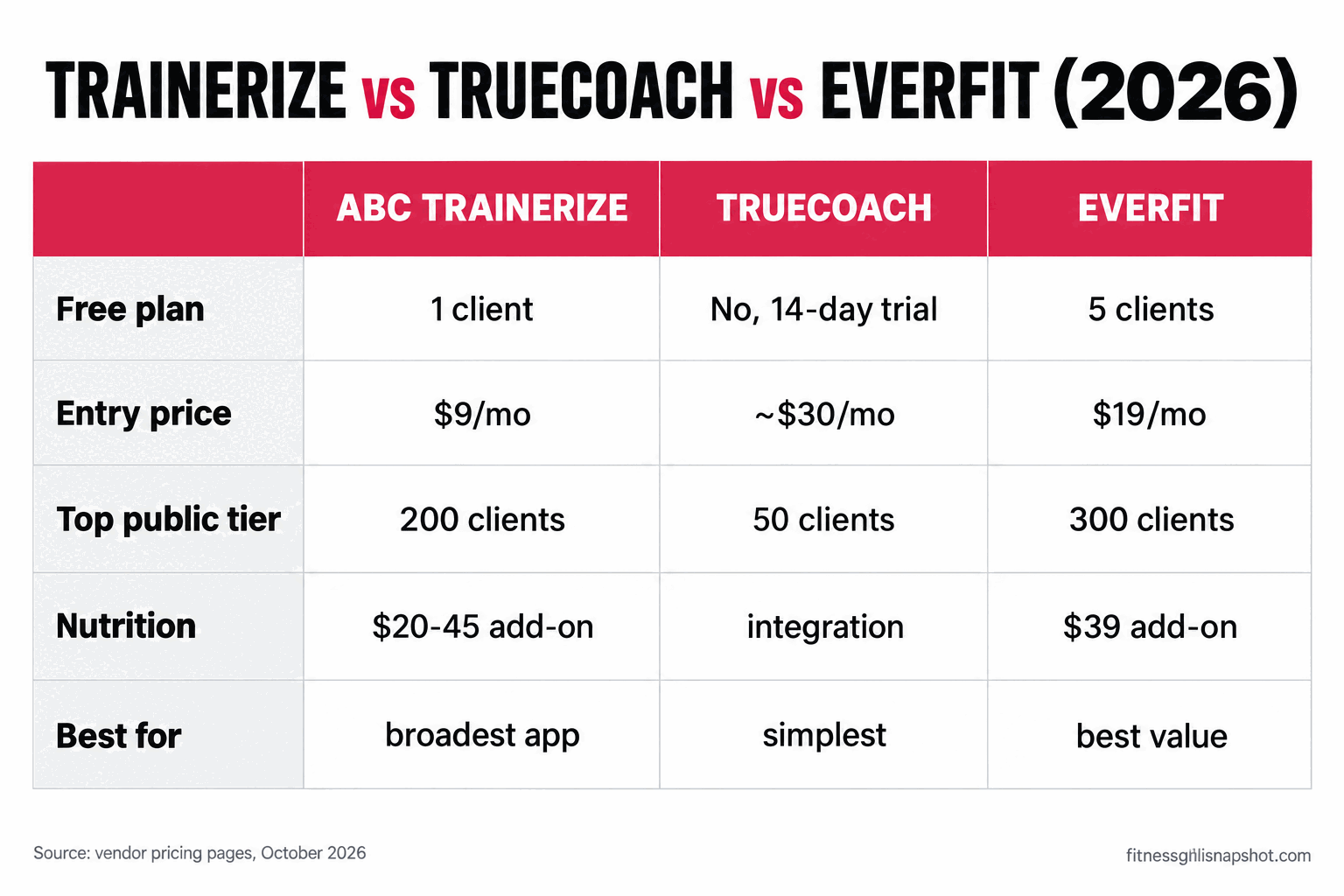
1. Entry price. Trainerize Basic is free for one client and Grow is $9 a month for two (Trainerize, 2026). Everfit’s Starter is free for up to five clients, a more generous free tier (Everfit, 2026). TrueCoach has no free plan, just a 14-day trial, with Starter at roughly $30 a month for up to five (TrueCoach, 2026).
2. How it scales. Trainerize Pro climbs in tiers from 5 to 200 clients. Everfit’s Pro runs from $19 a month at 5 clients to about $290 at 300, with a Studio track from $105 up to $430 (Everfit, 2026). TrueCoach tops out its public tiers at 50 clients on Pro, around $165 a month, then goes custom (TrueCoach, 2026). For a big roster, Everfit’s ladder is the most transparent.
3. Nutrition. On Trainerize it is a $20 to $45 add-on. On Everfit, meal plans are a separate module from about $39 a month. TrueCoach leans on integrations rather than a heavy built-in engine. None is free, so compare the loaded price.
4. Payments. Trainerize integrated payments are $10 a month; Everfit’s Payments module starts around $9. TrueCoach keeps billing lighter, expecting many coaches to invoice outside the app.
5. Automation. This is Everfit’s strong suit: its Autoflow builds client journeys from around $29 a month. Trainerize has solid automated messaging and program logic. TrueCoach is deliberately simpler, which some coaches love and others outgrow.
6. Clients pay nothing. All three give clients a free app. TrueCoach states plainly it is 100% free for your clients.
7. Studio and multi-location. Trainerize has a real Studio Plus tier built for five-plus locations, a direct result of the ABC gym-scale focus. Everfit has a Studio track. TrueCoach is the lightest here.
8. Lock-in. All three run month to month, no long-term contracts on standard plans. Switching cost is your time rebuilding programs and re-inviting clients, not a cancellation penalty.
Entry monthly price for a small roster, base plan before add-ons. Sources: Trainerize, TrueCoach, Everfit, checked October 2026.
Run the numbers: three real scenarios
The right answer changes with the size and shape of your business. Here are three.
The solo online coach, 15 clients, sells nutrition. You want one app, clean programming, and a meal engine. On Trainerize that is a Pro tier for 15 clients plus $20 Advanced Nutrition plus maybe $10 payments. On Everfit it is a Pro tier near the 20-client mark plus the meal-plan module. On TrueCoach it is the Standard plan at about $70 a month, with nutrition via an integration. If nutrition is central, price Everfit and Trainerize loaded. If you want the least app for the job, TrueCoach wins.
The hybrid PT, 35 in-person and remote clients, takes payment in the app. Now payments and automation matter. Trainerize Pro for ~35 clients plus payments plus nutrition can run past $100 a month all in. Everfit at that roster with Autoflow and payments is often a little cheaper. TrueCoach starts to feel tight near its 50-client ceiling. For a growing hybrid book, Everfit usually gives the most room per dollar.
The small studio or training gym, 120 members, two coaches. Here you have crossed out of pure coaching-app territory. Trainerize Studio Plus starts at $248 a month per location and is built for this (Trainerize, 2026); Everfit’s Studio track reaches these numbers too. But at 120 members your real problems are front-desk booking, trial follow-up, class fill and billing recovery, and a coaching app only covers a slice of that. This is the size where operators start looking at full gym platforms, or at adding a follow-up layer on top. I compared the options for this buyer in Mindbody alternatives for small gyms.
Steal this: the follow-up copy none of them writes
Here is the gap made concrete. Your coaching app is brilliant at serving the client who already signed. It writes nothing for the person who just found you. These are the messages that move a lead to a booked session. Paste them into whatever tool sends your texts, and keep them short. People read texts; they skip emails.
The 5-minute new-lead text (fires the moment a form or DM comes in):
Hey [First name], it’s [Your name] from [Studio]. Got your note about getting started, love it. Quick one: are mornings or evenings better for your first session? I’ll hold a spot.
The missed-call text-back (fires when a call rings out):
Hi [First name], sorry I missed you, I was on the floor coaching. This is [Your name] at [Studio]. Did you want to book a first session or ask about pricing? Text me right here and I’ve got you.
Day 2, no reply:
[First name], still keen to get started? I had two people ask about [class or program] this week and spots are tight. Want me to pencil you in for [day]?
Day 5, still cold:
No worries if the timing’s off, [First name]. I’ll leave the door open. When you’re ready to train, reply START and I’ll get your first session booked in two minutes.
The failed-payment nudge (fires when a card bounces):
Hi [First name], heads up, the card on file for your membership didn’t go through this month. No stress, you can update it here in 30 seconds: [link]. Shout if you need a hand.
Those five messages are not fancy. They are the difference between a lead who books with you and one who books with the coach who replied first. Speed is the whole game, which is why I wrote a full breakdown of speed to lead for gyms.
The gap all three leave open
Trainerize, TrueCoach and Everfit are coaching tools. They assume someone is already your client. They do not answer a prospect on your website at 11pm, fire a text when a call goes unanswered, or notice a member who has not checked in for three weeks and nudge them before they cancel. That is not a knock on them. It is just not their job.
The job belongs to a follow-up and front-desk layer. In our world that is GoHighLevel with the fitness automations loaded on top, so the lead gets a reply in minutes, the missed call gets a text back, and the fading member gets a check-in, automatically. (Disclosure: that GoHighLevel link is an affiliate link, so we may earn a commission if you sign up. It costs you nothing extra.) You keep coaching in the app you like, and you stop losing the leads your app was never watching. For the specific piece that catches calls you miss, read missed-call text-back for gyms.
The point is not to rip out Trainerize. For most coaches you should not. It is to stop expecting a programming app to do a sales job.
Objections coaches raise before switching
“I already pay for Trainerize and my clients know the app. Why move?” Mostly, don’t. If the app works and your clients are comfortable, switching costs real time rebuilding programs and re-onboarding people, for little gain. The better move is usually to keep Trainerize and add the follow-up layer it lacks. Only switch apps if you are paying for breadth you never use and a simpler tool like TrueCoach would cut your bill.
“Isn’t Everfit cheaper, so why would anyone pay more?” Everfit’s free tier and lower entry are genuinely strong. But “cheaper base” and “cheaper fully loaded” are different numbers. Price both with the add-ons you need and compare the real totals. Sometimes Everfit wins; sometimes the gap closes to a few dollars and you pick on feel.
“Do I need to be technical to run any of this?” No for the coaching apps, they are built for trainers, not engineers. The follow-up layer takes a little setup, but it is a one-time build. Once the messages above are wired to the right triggers, they run without you touching them.
“Will the automated texts annoy people?” Only if they sound like a robot. The copy above is one real message at a sensible moment, not a drip of five emails in a day. A fast, human text when someone just raised their hand is welcomed. The annoyance comes from volume and bad timing, both of which you control.
Frequently asked questions
ABC Trainerize in 2026, answered
Is Trainerize owned by ABC Fitness?
Yes. ABC Financial, now ABC Fitness Solutions, acquired Trainerize on September 15, 2020. The product is branded ABC Trainerize today, and the same parent company also owns Glofox, GymSales and Evo.
How much does ABC Trainerize cost in 2026?
The Basic plan is free for one client, Grow is $9 a month for up to two clients, Pro starts at $23 a month and scales by roster up to 200 clients, and Studio Plus starts at $248 a month per location for multi-location operators. Nutrition, payments and a branded app are paid add-ons on top.
Is TrueCoach or Everfit better than Trainerize?
It depends on your size. TrueCoach is the simplest for a solo or small-team coach who wants less app. Everfit has the best free tier and value for a growing roster. Trainerize has the broadest feature set and the clearest path to multi-location Studio plans. Price all three fully loaded before you decide.
Did Trainerize get worse after the acquisition?
Not really. The core coaching and client app stayed good and contracts stayed month to month. The product got broader and more add-on driven, and the company's focus tilted toward larger accounts. Nutrition and payments that some coaches expected to be included are now paid modules.
Can I switch coaching apps without losing my clients?
Yes, but it takes time. All three run month to month with no lock-in, so there is no cancellation penalty. The real cost is rebuilding programs and re-inviting clients, which is why many coaches only switch when the savings or simplicity clearly outweigh that effort.
Do any of these apps follow up with new leads automatically?
No. Trainerize, TrueCoach and Everfit are built to coach clients you already have, not to chase prospects. Automatic lead follow-up, missed-call text-back and churn alerts come from a separate follow-up layer, typically a CRM like GoHighLevel with fitness automations on top.
It is 6:15am again. The workout sync still lands. But now the 11pm form fill gets a text back before you have racked the first plate, and the bounced card gets a friendly nudge without you lifting a finger. The coaching app runs the training. Something else has to run the follow-up. Get both working together and you stop losing the leads you never replied to.