
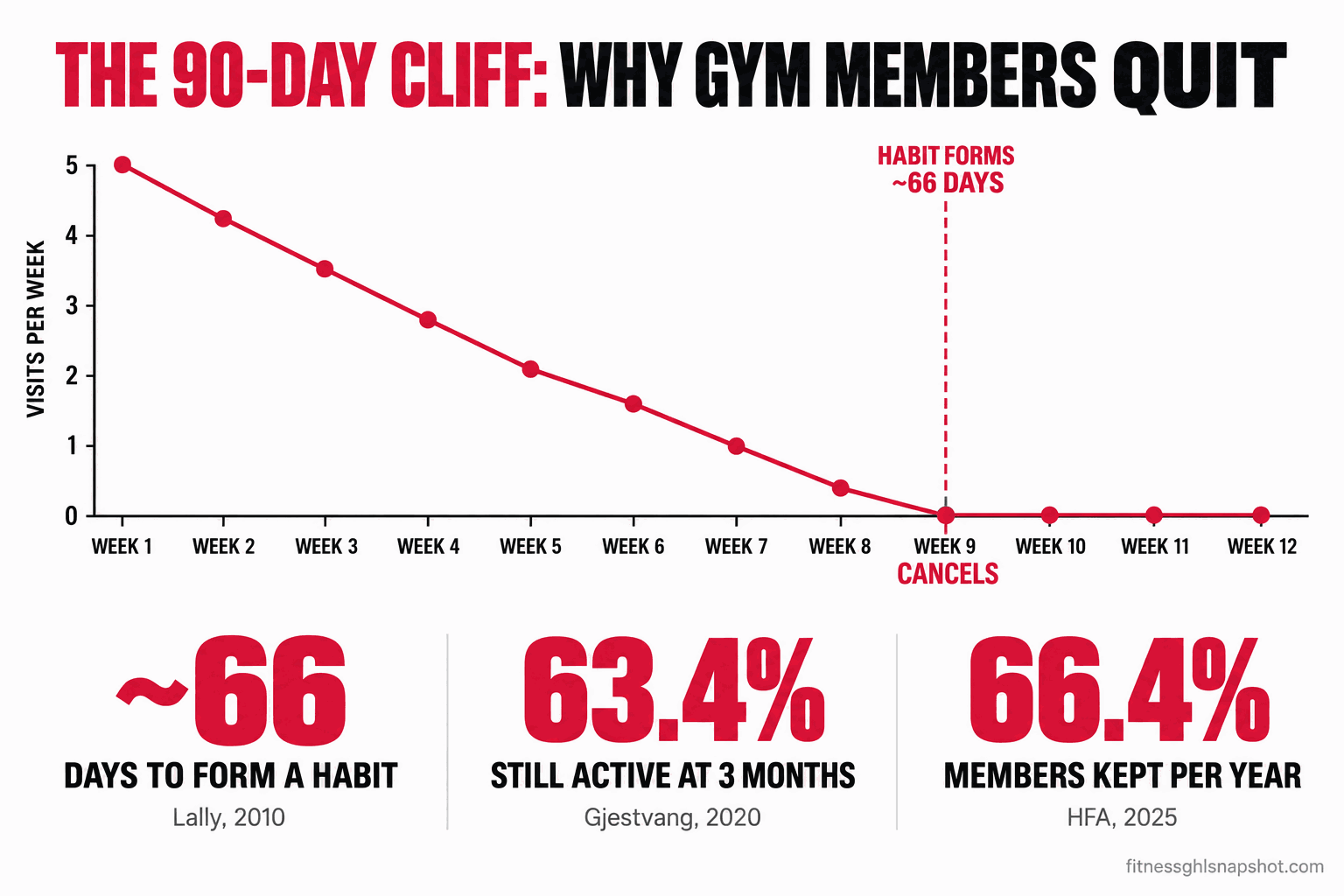
Here is the short version: most members who quit your gym do it in the first 90 days, and the reason almost never shows up as the reason. They do not cancel because your price is too high. They cancel because the habit never formed, their visits quietly dropped off, and nobody reached out in time. Dropout peaks in the first three months, low visit frequency is the single biggest warning sign, and a new behavior takes about 66 days on average to become automatic. A 90-day cancellation lands right when the habit should have locked in and didn’t. You fix it by watching attendance and reaching out before the card lapses, not with a better promo.
It is 9:10 on a Wednesday and you are checking the billing report. One name jumps out: a membership cancelled at 11 weeks. You remember her. She signed up in January, came three times the first week, looked thrilled. You scroll back through the door-swipe log and the whole story is in one column. Week one, three visits. Week four, one. Weeks six through nine, nothing. Then the cancel email. She did not rage-quit or complain. She faded, and the first time anyone noticed was the day the money stopped.
That is the 90-day cliff, the most expensive pattern in independent fitness because it stays invisible until it is over. This post is why it happens, the six stages a member walks before they ghost, and how to catch them.
Table of contents
- Why members quit after 3 months, in one honest answer
- What the 90-day cliff actually costs you
- The cliff is real, and the research backs it
- The six stages of a member walking toward the cliff
- Steal this: the check-in messages that catch a member in time
- The same cliff at three sizes
- One rule before you text anyone
- Objections operators raise
- Frequently asked questions
Why members quit after 3 months, in one honest answer
Ask ten owners why members quit and most say price, or “they lost motivation.” Those are the reasons members give on the way out because they are polite and easy. They are rarely the real cause, which is mechanical.
A new member arrives motivated, which carries them a couple of weeks. Then life gets in the way once, they skip a session, and nothing bad happens. They skip again. The gap between visits stretches. The routine never hardens into a habit, so showing up stays a daily decision instead of a thing they just do. Decisions are tiring, and eventually the easy one is to stop. By the time they formally cancel, they have been gone for weeks.
So the answer to “why do members quit after 3 months” is this: the first 90 days are when the habit either forms or it doesn’t, and most gyms do nothing to influence that window. They sell the membership, hand over a fob, and go quiet, leaving the member to build the hardest part alone. Plenty can’t, and you only find out when the billing report tells you.
What the 90-day cliff actually costs you
Retention decides whether your marketing budget builds anything or just replaces what leaked. The average health club keeps 66.4% of its members over a year, per the Health & Fitness Association’s 2025 Benchmarking Report covering more than 17,000 facilities. So about one in three members cancels every year, and most of that loss is front-loaded into the first quarter.
Put a dollar figure on it. At a $120 monthly membership, a member who stays a year is worth $1,440. One who quits at 90 days is worth about $360 and a bad taste. Across a year of signups, that gap is usually more lost revenue than your entire ad spend, plus the acquisition cost and the referrals they never made. That is why plugging the cliff beats buying more leads: a lead you pay for again, but a member you almost kept, you already paid for once. Full math in gym member lifetime value.
The cliff is real, and the research backs it
This is not a hunch. It shows up anywhere someone tracks members over time instead of just counting them. The largest recent study followed 20,908 fitness center members and found dropout risk spiked in the first three months, then declined and stabilized, driven hardest by short-term memberships and low attendance frequency (Clavel et al., 2025, Journal of Physical Activity and Health). The people most likely to quit are the ones barely showing up.
A separate one-year study tracked 250 brand-new members. By three months only 63.4% were still exercising regularly (at least two sessions a week), and dropout climbed from about 20% at three months to 28% by twelve (Gjestvang et al., 2020, Scandinavian Journal of Medicine and Science in Sports).
Now layer on the habit research. In the University College London study every behavior scientist cites, a new health behavior took an average of about 66 days to become automatic, with a range from 18 to 254 days (Lally et al., 2010, European Journal of Social Psychology). Forget the “21 days” line; the real number is more than double that, and only with consistency. Someone whose visits slid to once a week in month one never built enough repetition to get close. So month three arrives, the habit is not there, motivation is gone, and quitting is the easy path.
Days for a new behavior to become automatic, against the point most members cancel. The average is around day 66, but the range runs to 254, so a 90-day cancellation often lands before the habit was secure. Habit data: Lally et al., 2010.
The six stages of a member walking toward the cliff
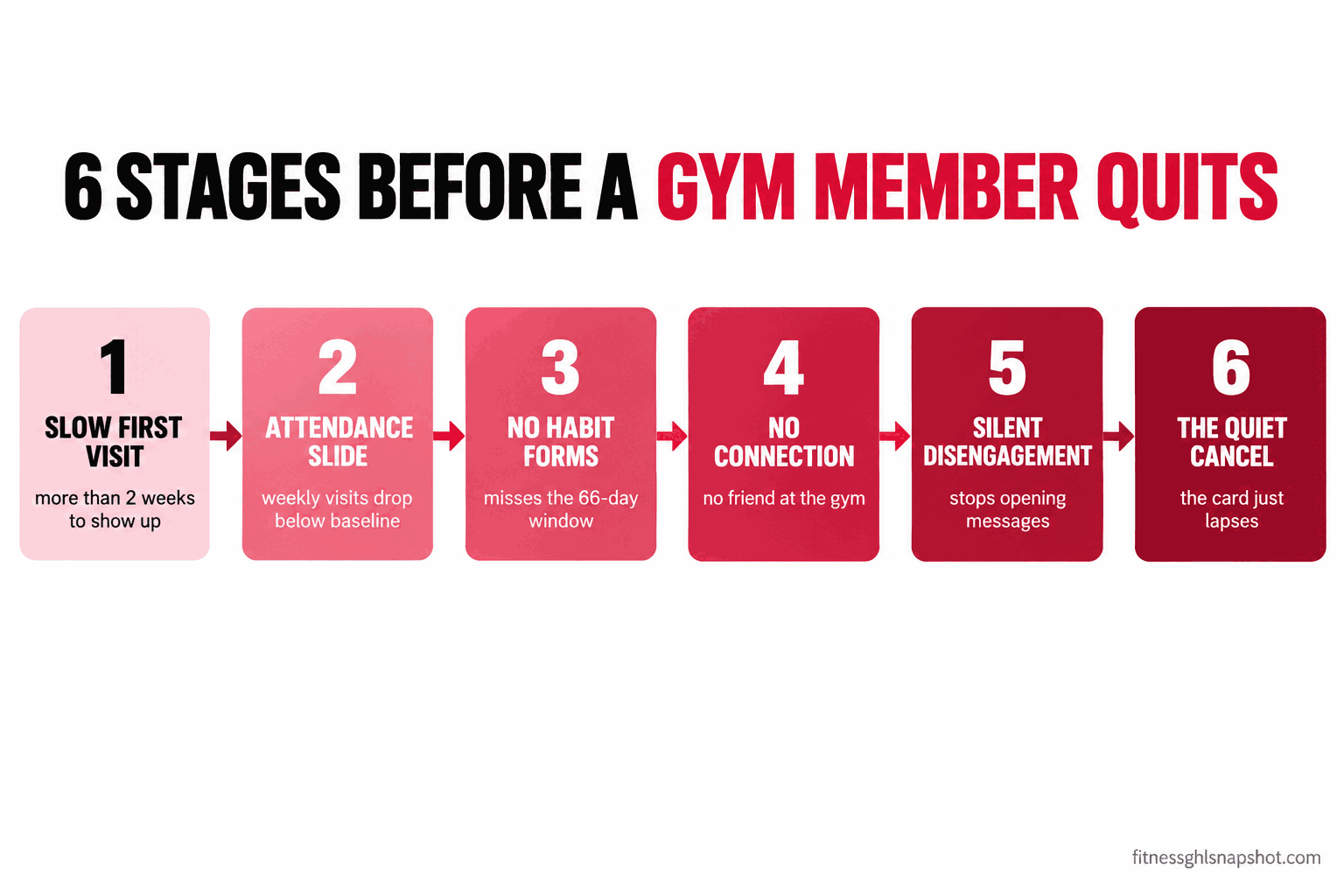
A member almost never quits in one moment. They slide through six stages, and every one leaves a signal you can see.
Stage 1: The slow first visit
The clock starts the day they join, not the day they first show up. Members who take more than two weeks to make their first visit are at much higher risk of quitting, because they never build enough frequency to see results (Hillsdon and Bedford, Health Club Management, from more than three million member records). What catches it: a booked first session within 72 hours with a reminder behind it, not an open invitation.
Stage 2: The attendance slide
This is the core signal, and almost nobody tracks it. A member who came three times in week one and once in week four is not settling in. They are sliding, and low attendance frequency is what the 20,908-member study flagged as a top driver of dropout. The trap is watching total member count, which stays flat, instead of the per-member visit trend collapsing under it. What catches it: if a member’s weekly visits drop below their own baseline for two weeks, that triggers a check-in to that specific person.
Stage 3: The habit that never forms
Visits build the habit and the habit drives visits. Break the loop early and it never spins up. This is the 66-day window, and most members who quit never got through it because their visits were too sparse to compound. What catches it: help them pick a routine, not just a membership. Members who lock in the same time and day each week stay about six months longer, so a booked recurring slot beats any pep talk.
Stage 4: No one at the gym knows their name
Fitness is social glue as much as exercise. Members who make a single friend at the gym in their first months are 40% less likely to cancel (Hillsdon and Bedford). A member who works out alone has nothing holding them but willpower, and willpower runs out. What catches it: a coach who learns new members by name, a fixed intro small-group, a “grab a buddy” nudge. Belonging is a retention feature, and it is free.
Stage 5: The silent disengagement
Before the cancel comes the quiet. They stop opening emails, skip the class they never used to miss, and do not reply to the check-in. This is silent churn, the largest leak at most studios because it never announces itself; we went deep on it in how to stop silent churn. What catches it: a missed class from a formerly regular member should trigger a human reach-out that week, not a survey after they are gone.
Stage 6: The quiet cancel
By now the work is almost impossible. They have not been in for a month, the habit is dead, and the cancel is a formality. The save-flow still matters, and we cover it in how to reduce gym membership cancellations, but a save here is a long shot. What catches it: the five stages before it.
Steal this: the check-in messages that catch a member in time
You do not need clever copy. You need the right message at the right trigger, sent while the member is in stage two or three, not stage six. Here are the exact texts, with the trigger and timing. Swap in your details and you have most of a retention system.
The booked first session (trigger: signup, within 1 hour).
Hey [first name], it’s [coach] at [gym]. Stoked to have you in. Let’s lock your first session so it actually happens. I’ve got [day] at [time] or [day] at [time] open this week. Reply 1 or 2 and I’ll put you down.
The no-show nudge (trigger: 3 days after signup, zero visits).
[First name], noticed we haven’t got you in yet. Totally normal, the first one is the hardest. Want me to just book you in? I’ll pick an easy class and send the two things to bring. Yes or no?
The attendance-slide check-in (trigger: weekly visits drop below the member’s own baseline for 2 weeks).
Hey [first name], missed seeing you this week. No pressure, I just want to make sure the schedule still works for you. Is there a day or time that would make it easier to get in? Happy to help you find a slot that sticks.
The win-back (trigger: cancellation or 30 days inactive).
[First name], sorry to see you go. No catch. If you ever want to come back, your first week is on me, just reply and I’ll set it up. And if there’s one thing we could have done better, I’d genuinely like to know.
The hard part is not writing these. It is firing them at the right trigger, for the right member, without you watching the door log by hand, which is what lifecycle automation handles for you.
The same cliff at three sizes
The cliff is universal, but what you do about it changes with your size.
Solo trainer or small PT team (20 to 100 clients). You know every client, so the “no one knows their name” stage barely applies. The risk is that everything lives in your head while you coach all day, so a slide goes unnoticed. Your move: a dead-simple rule you run from your phone. If a client misses two sessions in a row, you send the slide check-in yourself that evening. No software needed, just the discipline to send it.
Boutique studio (80 to 250 members, class-based). Your cliff hides in your class data. A member who dropped from four classes a week to one looks fine in your headcount and terrible in their own trend. Your move: automate the attendance-slide trigger off your booking system, and assign new members to a fixed intro block for their first month so routine and friendships form on purpose. This is where automation pays for itself fastest, because the manual version stops scaling past about 150 people.
Independent gym (150 to 500 members, 3 to 10 staff). Your enemy is diffusion of responsibility: with a front desk and several coaches, “someone” is supposed to notice the slide, which means no one does. Your move: make the signal a system, not a person’s job. Attendance triggers, lifecycle messages, and a weekly at-risk list in one owner’s hands every Monday.
One rule before you text anyone
Every message above is only as good as your permission to send it. Get clear SMS consent at signup (members agree to receive messages and can reply STOP), which in the United States keeps you right with the TCPA and the A2P 10DLC carrier rules; for email drips, honor CAN-SPAM with a real sender name and a working unsubscribe. It is a checkbox and a line of copy, and far cheaper than the alternative. Fuller breakdown in our gym membership cancellation and auto-renewal law guide.
Objections operators raise
“Won’t an automated check-in feel creepy?” It feels creepy when it is generic and badly timed, like a mass “we miss you” blast. It feels human when it is specific and early: one message, to one person who actually slid. The automation handles the timing and the trigger, not the tone.
“I already pay for Mindbody or PushPress. Doesn’t it do this?” Those tools are great at booking, billing, and logging check-ins. What most do not do out of the box is watch an individual member’s attendance trend and fire a personal text the moment it slips. They store the data; they rarely act on it, and that gap is where the cliff lives. More in connect your gym software to GoHighLevel.
“Do I need to be technical to set this up?” No, but someone does, once. The logic is simple, if visits drop, send this text, but wiring it to your booking data and phone number is a one-time build. After that it runs itself.
“Isn’t some churn just the cost of doing business?” Some, yes. People move, get injured, change jobs. But there is a huge difference between losing a member because their life changed and losing one because their visits slid for a month and nobody said a word. The second is a leak you can close, and it is most of the cliff.
Frequently asked questions
Why do most gym members quit after 3 months?
Because the first 90 days are when the exercise habit either forms or fails, and most gyms do nothing to influence that window. A study of 20,908 members found dropout peaked in the first three months, driven mainly by low attendance frequency (Clavel et al., 2025), and a new behavior takes about 66 days on average to become automatic (Lally et al., 2010). A member whose visits slid in month one often never built the habit that would carry them, and it is almost never about price.
What is the single biggest warning sign a member is about to quit?
A drop in visit frequency. Low attendance is one of the strongest predictors of dropout and almost always precedes the cancellation by weeks. A member who went from three visits a week to one is sliding toward the exit even though your total member count still looks healthy. Track each member's visits against their own baseline and reach out the moment it falls.
How long does it really take to form an exercise habit?
On average about 66 days, with a range from 18 to 254 days depending on the person and the behavior (Lally et al., 2010, University College London). The popular 21-day figure is a myth the research contradicts. In practice a new member needs consistent repetition for two to three months before showing up becomes automatic, which is why the first 90 days matter so much.
What percentage of gym members quit each year?
Industry-wide, the average health club retains 66.4% of its members over a year, per the Health & Fitness Association's 2025 benchmarking report. That means roughly one in three members cancels annually, and most of that loss is front-loaded into the first few months, which is why early retention work moves the yearly number so much.
Can I reduce early churn without lowering my prices?
Yes, and price cuts rarely help because price is seldom the real reason. The effective levers are a booked first session within 72 hours, a fixed weekly routine (routine-based members stay about six months longer), social connection (one gym friend cuts cancellation risk by 40%), and an attendance-slide check-in that fires the moment a member's visits drop. Those cost attention and a little automation, not margin.
Written by Divya Kapoor, Member Retention and Lifecycle Specialist. Divya ran member experience for a three-location boutique pilates and yoga group before joining the team to design retention systems. She is the person who noticed that silent churn, not formal cancellations, was eating most of her studios’ revenue, and she spends most of her time in the unglamorous attendance-and-lifecycle data that tells you who is about to leave before they do.