
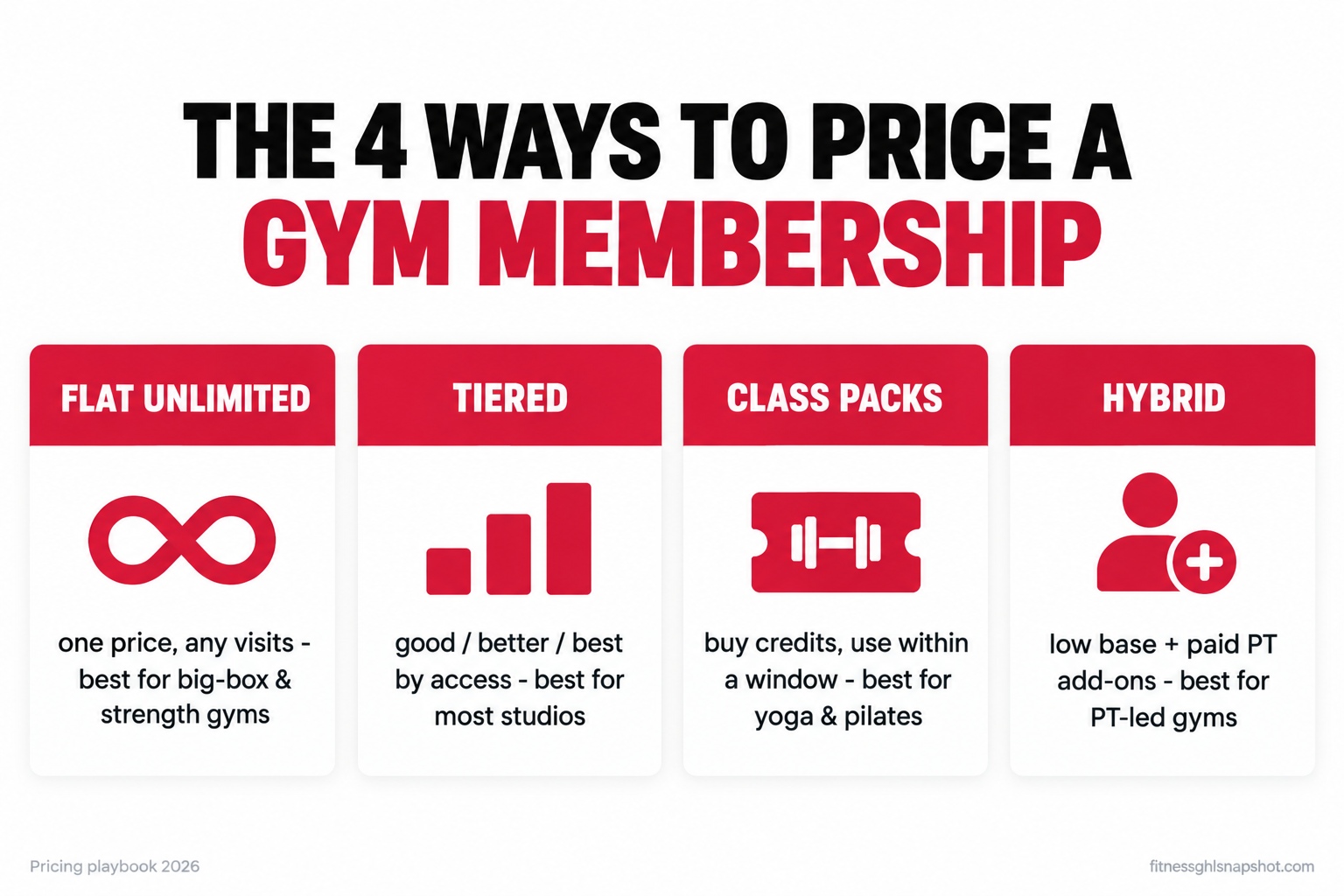
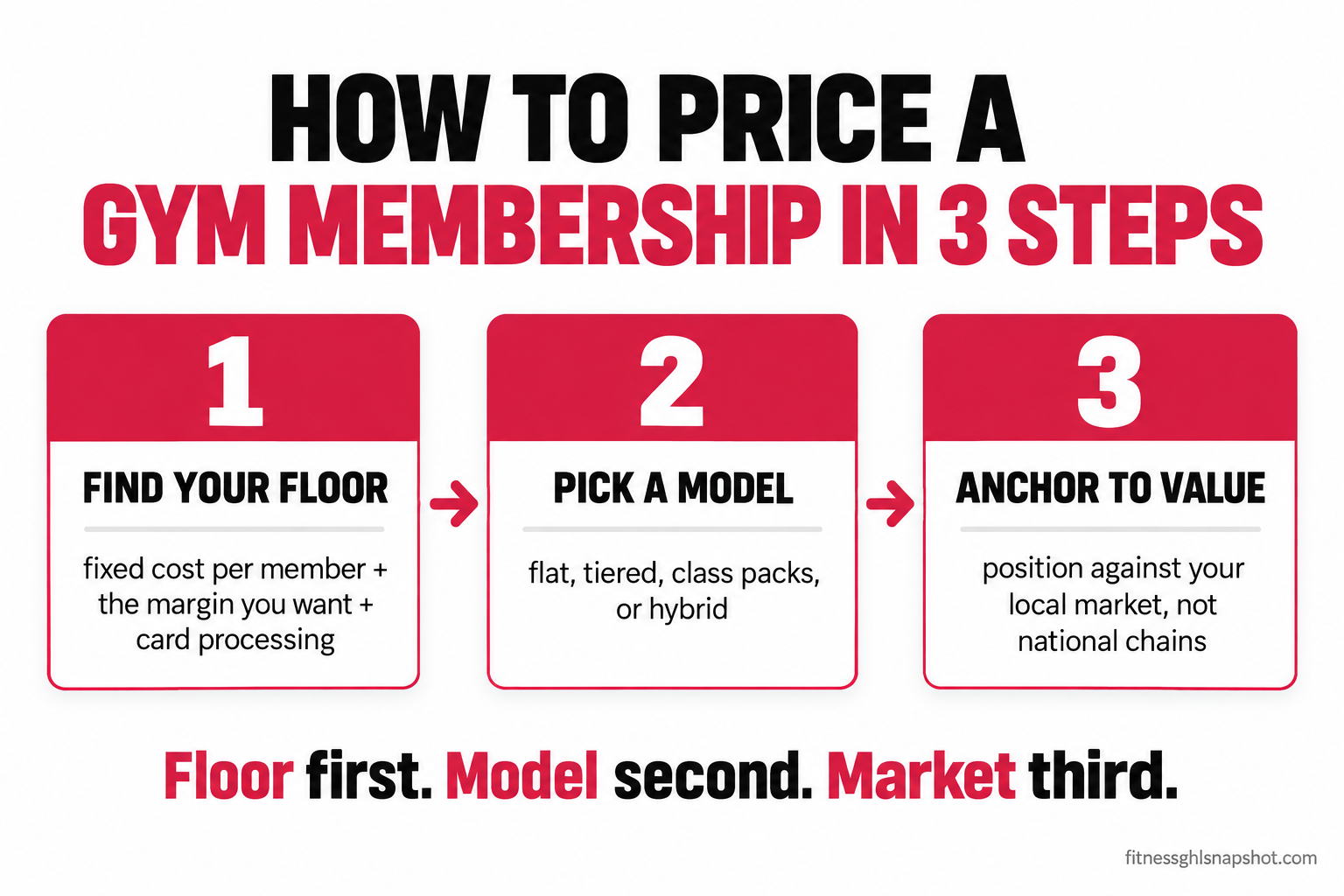
Here is the short version: price your membership off your own numbers, not the gym down the street. Start with the floor (what one member has to cover in fixed cost and margin before you make a dollar), then anchor to the value and the market, then pick the model (flat, tiered, class packs, or hybrid) that matches how your members actually buy. The most expensive mistake in independent fitness is not pricing too high. It is pricing too low, discounting out of fear, and then needing twice the members to make the same money. Get the number right and everything downstream (fill rate, hiring, whether you can pay yourself) gets easier.
It is the first of the month and a prospect is standing at your desk asking “so how much is it?” You hear yourself knock twenty dollars off before they even flinch, because the F45 two blocks over advertises a lower intro rate and you do not want to lose the sale. You just gave away margin you will never see again, on a member who might have paid full price. That reflex, repeated a few hundred times a year, is why a busy studio can run on fumes. This post is about replacing the reflex with a number you can defend.
Table of contents
- Why “what feels right” is the wrong way to price
- Step 1: find your price floor
- The four membership pricing models (and where each breaks)
- Step 2: anchor to value and the market
- Three worked examples: solo, studio, mid-size gym
- The discounting traps that cap your revenue
- How to raise prices without a cancellation spike
- How gym pricing breaks in the real world
- Steal this: the price-setting worksheet and the increase email
- Objections operators raise
- FAQ
Why “what feels right” is the wrong way to price
Walk into most independent gyms and ask how they landed on their membership price, and the honest answer is some version of “it felt about right, and it is close to what the other places charge.” That is pricing by vibe, and it quietly sets the ceiling on the whole business.
Here is the problem. Your competitor’s price tells you nothing about your costs. Their rent, payroll, member count, and average member lifespan are all different from yours, so copying their number copies their constraints onto your P&L, and you have no idea whether their number even works for them. Plenty of gyms that “feel busy” are underwater, as we covered in why a full gym can still be broke. Matching a broke gym’s price is not a strategy.
Price is also the most powerful lever you own, because it is the only input that is pure margin. Add a member and you add churn risk, a card to collect, and a slot in a class. Add five dollars to the price and almost all of it drops to the bottom line. That asymmetry is why a small, deliberate price change usually beats a hard push for volume.
The rest of this is a repeatable way to set the number: floor first, model second, market third.
Step 1: find your price floor
Before you look at a single competitor, work out the lowest number that still makes the business work. This is your floor, and no “intro rate” should ever drop below it for long.
Your floor has two parts. First, the fixed cost each member has to carry. Take your total monthly fixed costs (rent including CAM and triple-net, payroll including your own pay, software, insurance, utilities, baseline marketing) and divide by the number of members you can realistically serve in your space. That is the cost each member must cover just to keep the doors open. We walk through the full version of this in how many members your gym needs to break even, and the number surprises most owners, because rent and payroll do not shrink when the floor is quiet.
Second, the margin you actually want on top. Break-even is not a business, it is a job that pays nothing. Add owner pay and a real profit cushion to the stack before you divide.
Then subtract the one variable cost that matters: card processing. At Stripe’s standard 2.9% + 30¢ per charge (Stripe), a $140 membership costs about $4.36 to collect every month. On a $65 membership it is about $2.19. It is small per member and large across a roster, so it belongs in the floor.
The point of the floor is simple. If a price does not clear fixed cost per member plus your target margin plus processing, it is not a membership, it is a donation. Everything above the floor is a strategy decision. Everything below it is a slow bleed.
The four membership pricing models (and where each breaks)
Once you know your floor, you choose how members pay. There are four models that actually work in independent fitness. The mistake is picking the one your software defaulted to instead of the one that fits how people use your space.
| Model | How members pay | Best fit | Where it breaks |
|---|---|---|---|
| Flat unlimited | One monthly price, come as often as you like | Big-box and strength gyms where high usage costs you almost nothing | Class-based studios: heavy users crowd out capacity you cannot resell |
| Tiered (good/better/best) | 2 to 4 price points by access, classes/month, or perks | Most studios and mid-size gyms; lets price-sensitive and premium members self-sort | Too many tiers confuse buyers; a weak top tier leaves money on the table |
| Class packs / credits | Buy a bundle of classes, use within a window | Yoga, pilates, boutique studios, irregular attenders | No recurring revenue floor; packs expire and feel punitive, churn hides |
| Hybrid (base + add-ons) | Low base membership plus paid PT, nutrition, workshops | PT-led gyms and studios with real 1-on-1 or specialty revenue | Add-ons go unsold without a system to offer them at the right moment |
Flat unlimited is simplest to sell and run, and it works beautifully when extra usage is nearly free to you, as in an open-gym strength or big-box setup. In a class model it backfires: your most enthusiastic members book the 6am slots every day and you cannot resell those seats. You give away your scarcest asset to the people who least need the incentive to stay.
Tiered is the right default for most studios and mid-size gyms. A limited tier (4 or 8 classes a month), an unlimited tier, and often a premium tier with guest passes or a PT session let a tight-budget member and a money-is-no-object member each buy at the price they are willing to pay. The failure mode is a cluttered menu. Three tiers is plenty, four is the ceiling, and five makes buyers freeze.
Class packs fit studios with irregular attendance, like yoga or pilates, where a pure monthly can feel like a treadmill. The catch is no recurring floor: a member who bought a 10-pack in February and never returned looks fine in your revenue until you notice they are gone. Packs hide churn, the exact problem we flag in stopping silent churn before it hits billing, so pair them with a recurring option and watch for packs that stall.
Hybrid is where many PT-led businesses should live. A modest base membership covers access while the real money comes from personal training, small-group coaching, and workshops on top. The base keeps people in the building; the add-ons carry the margin. It breaks when nobody owns offering the add-on at the right moment, so it quietly becomes a cheap flat membership with a PT menu nobody reads.
Step 2: anchor to value and the market
Now, and only now, you look outward. The floor tells you how low you can go. Value and the market tell you how high you should go.
Anchor to value first. What does a member actually get that a $10 budget app does not? Coaching, a room full of people who know their name, accountability, a schedule that fits their life, results they can feel. Boutique and PT are not selling access to equipment, they are selling outcome and environment. That is why boutique classes command an average of $21.32 each and rising (Mariana Tek) while budget chains compete on a bare flat rate. If you deliver a boutique experience and price like a budget chain, you are not being generous, you are miscategorizing yourself in the member’s mind. Demand is on your side here: boutique fitness bookings grew 36% in 2025 (ClassPass), so the market is expanding, not contracting.
Then sanity-check the market. Look at three or four comparable businesses in your area, not the national chains with a different cost base. You are not copying them. You are confirming you are in a believable band and deciding where in that band you sit. Premium positioning means a price at or above the local top, backed by a reason. Discount positioning is a race you will lose to a franchise with more locations and a bigger ad budget.
Beware the demo wall when you benchmark. The transparent vendors publish real numbers: PushPress Pro is $159/mo and Max is $229/mo (PushPress), and Gymdesk runs $75 to $200/mo by member count (Gymdesk). The big platforms (Mindbody, Glofox, Wodify) hide pricing behind “book a demo,” which tells you something about how they want you comparing. We broke the whole market down in what gym software actually costs in 2026. The same opacity reflex shows up in gym pricing, and it is worth resisting: a clear, confident price converts better than a mysterious one.
Three worked examples: solo, studio, mid-size gym
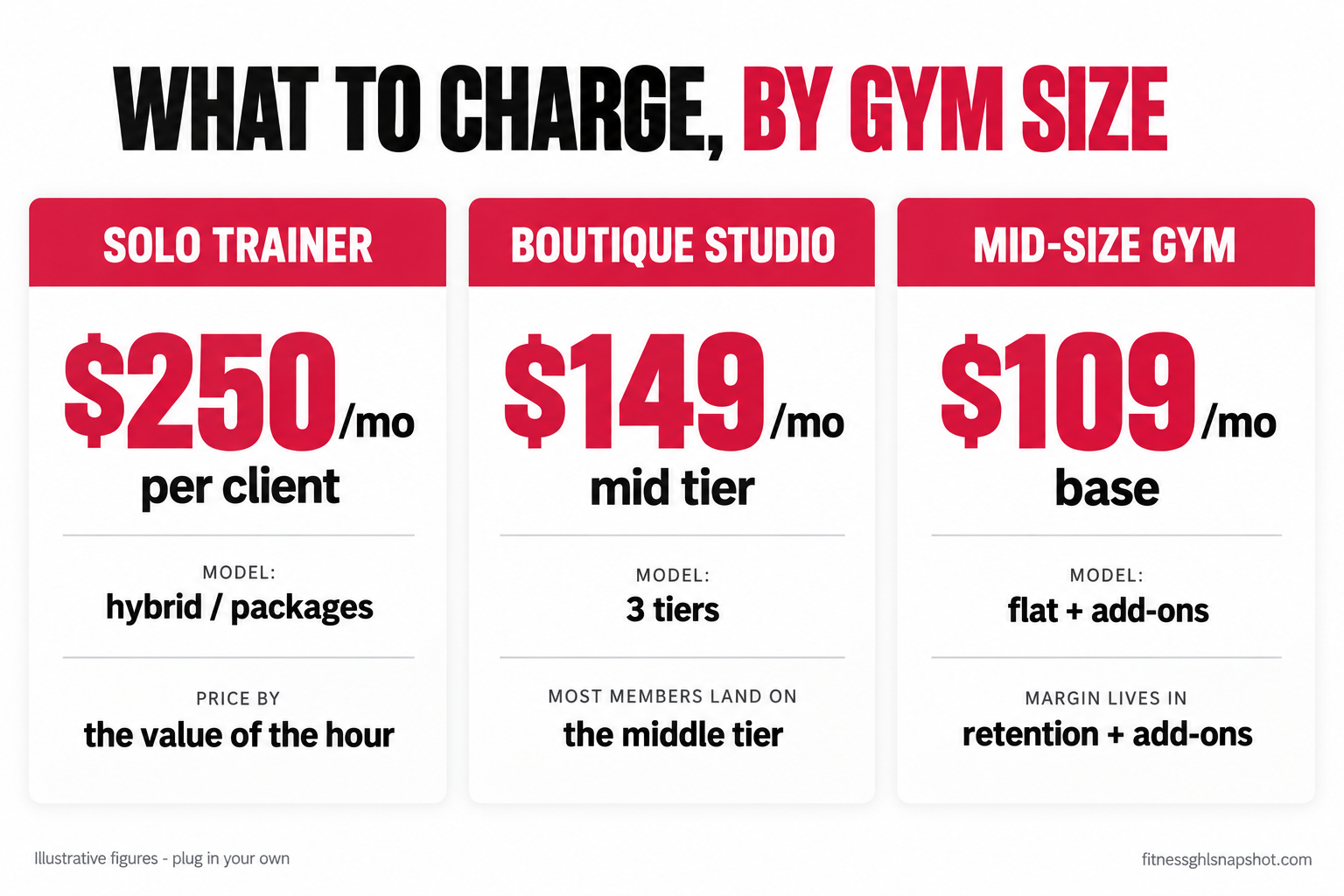
The method is the same for everyone. The right number, and the right model, change a lot with size. Every figure below is illustrative. Plug in your own.
The solo personal trainer (20 to 60 clients)
You sell your time, so your pricing is really about protecting hours. The floor is low (you have little fixed cost), so undercharging is the real risk.
- Model: hybrid or straight packages. A monthly coaching retainer plus session packs.
- Floor math: fixed costs around $800/mo, so a handful of clients cover the lights. That is misleading. Your cap is hours, not members.
- Price: a $200 to $300/mo coaching relationship, or $70 to $90 per session in packs, sits inside the national PT band and respects that you have maybe 30 sellable hours a week.
- The lesson: price by the value of the hour, not the cost of the room. Fill your calendar at $60 a session and you capped your own income. Raise the rate, lose the price-shoppers, keep the hours.
The boutique studio (80 to 250 members, 2 to 8 instructors)
Capacity and fill rate decide everything. Tiered pricing lets you sell the same room to different budgets.
- Model: three tiers. 4 classes/month, 8 classes/month, unlimited. Optional premium tier with a guest pass and priority booking.
- Floor math: fixed costs near $20,000/mo across rent, payroll, and software mean roughly 150 members at a $140 average just to break even.
- Price: limited tier around $99, mid around $149, unlimited around $189, premium around $229. Most members land in the middle, which is exactly where you want the anchor.
- The lesson: your unlimited tier should be priced so that a true everyday attender is still profitable given class capacity. If unlimited is a bargain for daily users, your keenest members become your least profitable.
The mid-size or multi-location gym (250 to 500+ members)
Volume and retention drive it. Price tends to be lower per member, so margin lives in keeping people and selling add-ons.
- Model: flat unlimited for open gym, plus paid add-ons (classes, PT, recovery) as a hybrid layer.
- Floor math: fixed costs near $46,000/mo mean well over 400 members at a $110 average to break even, a razor-thin position where every point of churn hurts.
- Price: $89 to $129 base depending on market, with PT and small-group packages carrying the real margin on top.
- The lesson: at this scale a $10 price move or a one-point churn improvement is worth more than a month of hard selling. Small levers, big roster, large dollars.
Illustrative monthly price points from the three examples above. Note the inverse of volume and price: the solo trainer charges the most per head and serves the fewest; the mid-size gym charges the least and serves the most. For market context, the average boutique class now runs $21.32 (Mariana Tek).
The discounting traps that cap your revenue
Discounting feels like a growth tool. Most of the time it is a margin leak dressed up as a promotion. Here are the traps that do the most quiet damage.
The permanent “intro” rate. You advertise a $99 intro to get people in, then never move them up because you are afraid they will quit. Now $99 is the price and you just lost the word “intro.” Worse, it becomes the anchor every new member hears about from the one who got it. If you run an intro, it needs a hard end date and an automatic step-up in the contract, or it is not an intro.
The Groupon spiral. Deep third-party discounts fill your floor with deal-seekers who bought the price, not the gym, and who vanish the day the deal ends. You pay to acquire members who were never going to stay. If you need volume, it is cheaper to fix lead follow-up than to rent bargain hunters, which is the point of speeding up your lead response.
The founding-member giveaway. Locking in your first members at a rock-bottom lifetime rate feels fair at launch. Three years later those are your most loyal, highest-usage members paying the least, and you cannot raise them without a fight you promised not to pick. Offer founders a time-boxed rate or a perk, not a permanent discount.
None of this means never discount. A short, time-boxed offer tied to a reason (a challenge, a launch, a seasonal push) is fine. The damage comes from the permanent, undated, apologetic discount that resets your whole price in the member’s head.
How to raise prices without a cancellation spike
Most owners under-price for years because they are terrified of a cancellation wave. Done right, a price increase loses very few members, because the people who value you are not shopping on five dollars. Here is the sequence that works.
Grandfather your existing members, at least at first. The new price applies to new members immediately; existing members stay at their rate or move up on a longer timeline. This removes the fairness objection entirely and lets you raise the public price today without touching a single current relationship.
Give real notice. Thirty days minimum, in writing, through the channel members actually read (text and email, not a sign on the wall). This is also where auto-renewal law lives: several states require advance notice of renewal and price changes, and the rules tightened after the federal click-to-cancel rule was struck down, which we cover in gym cancellation and auto-renewal law in 2026.
Frame it around what improved. Nobody minds paying more for more. Tie the number to a reason: “We added evening classes and upgraded the rig, so starting [date] the rate is [X]” invites a shrug, while “rates are going up” invites a fight.
Raise on a schedule, not in a crisis. A small annual increase that members expect beats a big, panicked jump every four years. Your costs are climbing whether you adjust or not: US fitness and recreation fees rose 6.3% in the year to December 2025 (BLS Producer Price Index), and the index covers gym memberships and classes directly (BLS factsheet). Build a modest review into your calendar so your price keeps pace, instead of falling further behind until you have to make a scary move.
How gym pricing breaks in the real world
This is the part nobody writes, and it is where the number actually goes wrong.
1. You price off billed revenue, not collected money. Failed cards, freezes, and discounts mean you collect less than your software’s “average” suggests. How it breaks: you think your price is working when your real yield is lower. What to do: price off collected revenue per member, and treat failed-payment recovery as margin you already earned and are leaving on the table.
2. You forget usage cost in a class model. Flat unlimited looks great until your 6am classes fill with members paying the same as someone who comes twice a month. How it breaks: your best members are your least profitable and you cannot sell their seats. What to do: cap or tier access, or price unlimited high enough that a daily attender is still profitable.
3. Your tiers do not actually separate buyers. Three tiers priced $129, $139, $149 are not tiers, they are one price with rounding. How it breaks: nobody self-sorts and you capture none of the premium willingness-to-pay. What to do: space tiers far enough apart that the choice means something, usually 25 to 40% jumps.
4. You never revisit the number. You set it at launch and left it for five years while rent and payroll climbed. How it breaks: your margin erodes silently until a slow month exposes it. What to do: review price on a calendar and move it in small steps.
5. You discount to close instead of selling value. The price objection gets answered with a lower price instead of a better pitch. How it breaks: you train your whole sales process to leak margin, and word gets around. What to do: hold the price and answer the objection with the outcome.
Steal this: the price-setting worksheet and the increase email
Copy these. The worksheet takes about twenty minutes with a bank statement and your billing report. The email is the one most owners are too nervous to send.
The price-setting worksheet
STEP 1: FLOOR
  Total fixed monthly costs (rent, payroll incl. you,     $ ______
    software, insurance, utilities, base marketing)
  Realistic members you can serve                           ______
  Fixed cost per member  = fixed ÷ members                $ ______

  Owner pay + profit you want, per member                 $ ______
  Processing (price × 0.029 + 0.30)                       $ ______
  FLOOR PRICE = fixed/member + margin/member + processing $ ______

STEP 2: MODEL   (circle one)
  Flat unlimited  /  Tiered  /  Class packs  /  Hybrid

STEP 3: ANCHOR
  3 to 4 comparable LOCAL businesses, their prices:
     ______   ______   ______   ______
  My value reasons to sit high (coaching, results, room):
     __________________________________________________
  TARGET PRICE (must be above FLOOR)                      $ ______

STEP 4: TIERS (if tiered; keep to 3, space 25–40% apart)
  Limited    $ ______
  Core       $ ______   ← anchor most members here
  Unlimited  $ ______
  Premium    $ ______   (optional)
The price-increase announcement (text + email)
Subject / first line:
  A heads-up about your membership, and what's new

Hi [First name],

Quick, honest note. Starting [date, 30+ days out], our [tier]
rate is moving to $[new price]. It's the first change in
[time], and it comes with real upgrades: [new coach / new
classes / new equipment / extended hours].

Here's the part that matters: your rate is locked at
$[current price] through [date] as a thank-you for being
with us. Nothing changes for you right now.

Questions? Just reply to this text, or grab me at the desk.
Thanks for training with us.

[Owner name], [Gym name]
Two messages, sent through the channel members read, turn a scary price move into a non-event. The ones who were going to leave over five dollars were leaving anyway. The ones who value you will barely notice.
Objections operators raise
“Won’t a higher price scare people off?” A few price-shoppers, yes, and those are the members who churn fastest and refer worst. The ones who stay twelve months and bring friends are buying the outcome and the room, not the lowest number in town. A well-framed increase loses a small single-digit percentage and raises revenue well past what those few members contributed.
“My competitor down the street is cheaper. Don’t I have to match?” No. You have no idea whether their price works for them, and matching it imports their cost structure onto your business. If they are a budget franchise, you cannot win on price and should not try. Win on what they cannot copy: coaching, community, and results.
“Do I need fancy software to run tiers and add-ons?” You need something that bills recurring plans reliably, handles failed cards, and lets you offer the add-on at the right moment. That can be a transparent platform like PushPress or Gymdesk, or a GoHighLevel setup that also runs your follow-up and retention. You cannot run tiers on a spreadsheet and good intentions; the billing has to be automatic or the model leaks.
“Should I just copy a big platform’s suggested pricing?” The big platforms hide their own pricing behind a demo, which tells you how much weight to give their pricing advice. Use the floor-model-anchor method on your own numbers. A price you can explain beats a price you borrowed.
Frequently asked questions
How much should a gym membership cost in 2026?
There is no single right number, because it depends entirely on your costs, model, and value, and there is no reliable national average worth copying. For context, the average boutique studio class now runs about $21.32 (Mariana Tek), and US fitness and recreation fees rose 6.3% in the year to December 2025 (BLS Producer Price Index), so prices are moving up. Set your actual price from your own floor (fixed cost per member, plus the margin you want, plus card processing), then anchor to the value you deliver and your local market.
Flat rate or tiered pricing, which is better for a studio?
For a class-based studio, tiered almost always wins. Flat unlimited gives your most scarce asset (class seats at popular times) to your heaviest users for the same price as a light user, and you cannot resell those seats. Three tiers (limited, unlimited, premium) let budget-conscious and premium members each buy at the price they are willing to pay, and most members land on the middle tier, which is where you want your anchor.
How often should I raise membership prices?
Build a small, expected annual review into your calendar rather than waiting years and making a scary jump. A modest yearly increase that keeps pace with rising rent, payroll, and added value loses very few members. Infrequent, large increases feel like a shock and drive the cancellations owners fear. Grandfather existing members and give at least 30 days written notice through text and email.
Is discounting ever worth it for a gym?
A short, time-boxed, reason-driven offer (a challenge, a launch, a seasonal push) is fine. Permanent, undated, apologetic discounts are the problem: they reset your price anchor for every future renewal and referral, and they come out of margin, not revenue, so a 20% discount can cut your real margin by 25% or more. If you run an intro rate, give it a hard end date and an automatic step-up.
How do I handle the price objection at the front desk?
Do not answer a price objection with a lower price, or you train your whole sales process to leak margin. Answer it with the outcome and the environment: coaching, results, the community, the schedule that fits their life. The members worth keeping are rarely the ones who needed the discount to say yes, and a confident, clearly explained price converts better than a nervous, negotiable one.
Should personal trainers price per session or per month?
Lead with a monthly coaching relationship and offer session packs as the alternative. A retainer gives you recurring revenue and treats training as an ongoing outcome rather than a series of one-offs, which is also how clients get results. Price by the value of your hour, not the cost of the room, because for a solo trainer the real constraint is sellable hours per week, not fixed cost.
The bottom line
Pricing is not a number you guess once and defend forever. It is a floor you calculate, a model you match to your members, and an anchor you set with confidence, then revisit on a schedule. The owners who do this well are not the ones with the lowest price in town. They are the ones who can say their number out loud, explain it in one sentence, and raise it a little every year without losing the people who matter. Price from your own numbers, hold the line at the desk, and let the gym down the street race to the bottom without you. Start with the worksheet above and the one number most owners skip: your floor.