
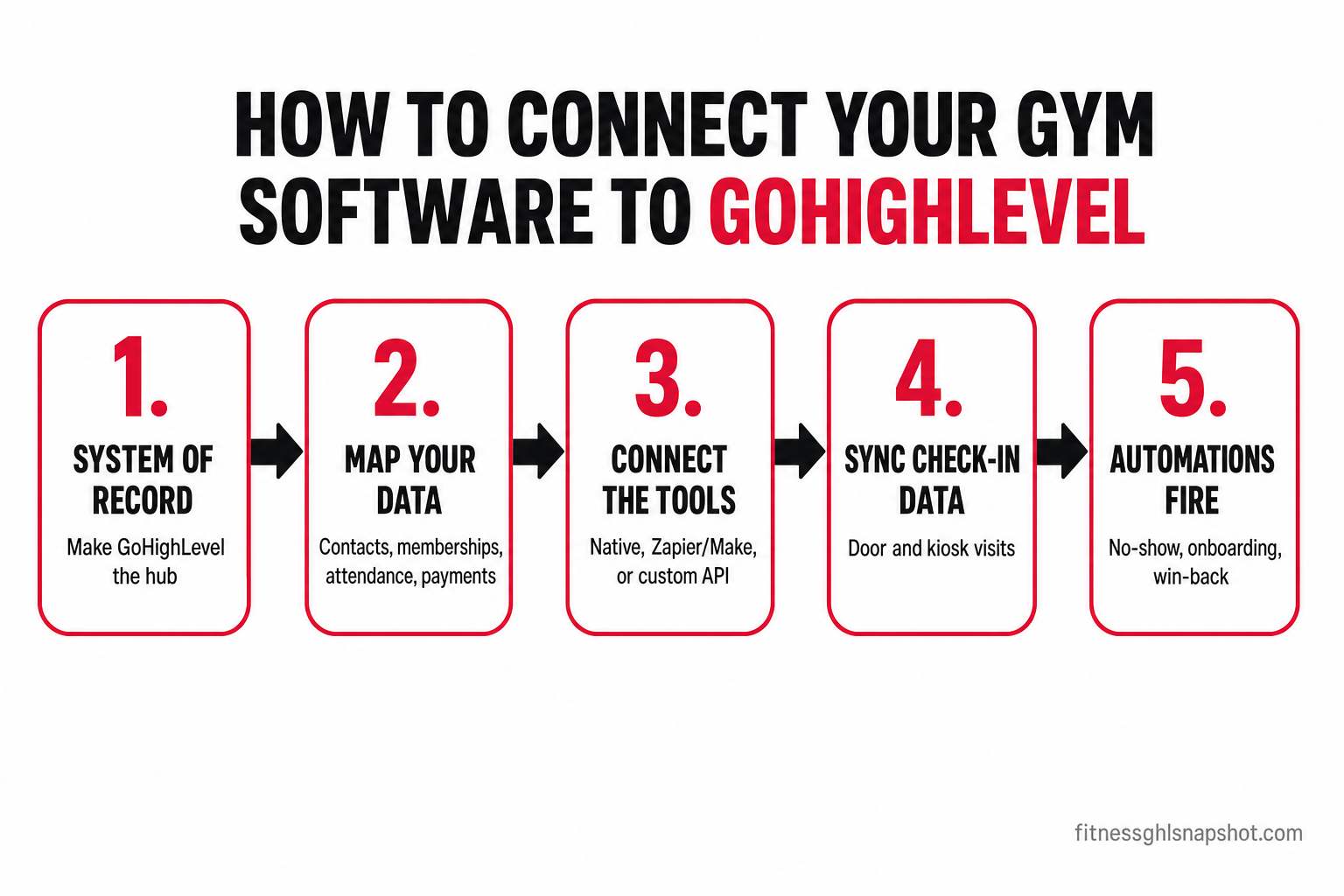
To connect your gym’s software to GoHighLevel, pick one system of record (GoHighLevel), map the five data types every studio runs on — contacts, memberships, classes, attendance, and payments — then wire each tool in through a native integration, an iPaaS connector like Zapier or Make, or a custom webhook/API build. Do that and every lead, booking, payment, and door check-in lands in one place, where automations can fire on it. The real prize isn’t tidiness. It’s that your check-in and attendance data finally reaches the system that runs your follow-up — and attendance is the single best early-warning signal you have for a member about to quit.
I spent eight years running the floor and front desk at a growing CrossFit box before I moved into GoHighLevel (GHL) automation full-time, so I’ve lived the Frankenstein stack: Mindbody for billing, a separate booking app, Stripe for a couple of PT packages, a key-fob system on the door, and a spreadsheet holding it all together with duct tape. This is the operator’s playbook for tearing that down — the exact order to connect things, the three ways to do it, and the retention math that makes it worth the afternoon.
Table of contents
- The short answer
- Why a disconnected gym stack quietly costs you money
- Start here: make GoHighLevel your system of record
- Step 1 — Map your gym’s data
- Step 2 — Pick your connection method
- Step 3 — Connect the money-critical tools first
- Step 4 — Sync check-in and attendance data (the retention unlock)
- Step 5 — Route events into automations
- Build vs. buy: when to hire a developer
- FAQ
The short answer
If you run a box, a reformer studio, a martial-arts school, or a PT business and you want your tools to finally talk to each other, here’s the compressed playbook:
- Choose one system of record — GoHighLevel. Every contact, pipeline, and automation lives here. Other tools feed it; they don’t compete with it.
- Map your five data types — contacts, memberships, classes/bookings, attendance/check-ins, and payments — so you know what has to flow and where it lands in GHL.
- Pick a connection method per tool — native integration, an iPaaS connector (Zapier/Make), or a custom webhook/API build for anything without a native path.
- Connect the money-critical tools first — booking and payments — then the retention-critical one: check-in and attendance data.
- Route the events into automations — no-show recovery, onboarding, churn-risk win-backs, review requests — so the data actually does work instead of just sitting there.
The rest of this article is the how and the why, with the numbers. Let’s start with what the disconnection is costing you right now.
Why a disconnected gym stack quietly costs you money
Most gyms don’t have a software problem. They have a connection problem. Each tool works fine on its own — Mindbody bills members, the booking app books classes, Stripe charges the PT packages, the fob system opens the door. The leak is in the gaps between them, where a human has to copy data by hand or, more often, where nobody does and the data just dies in a silo.
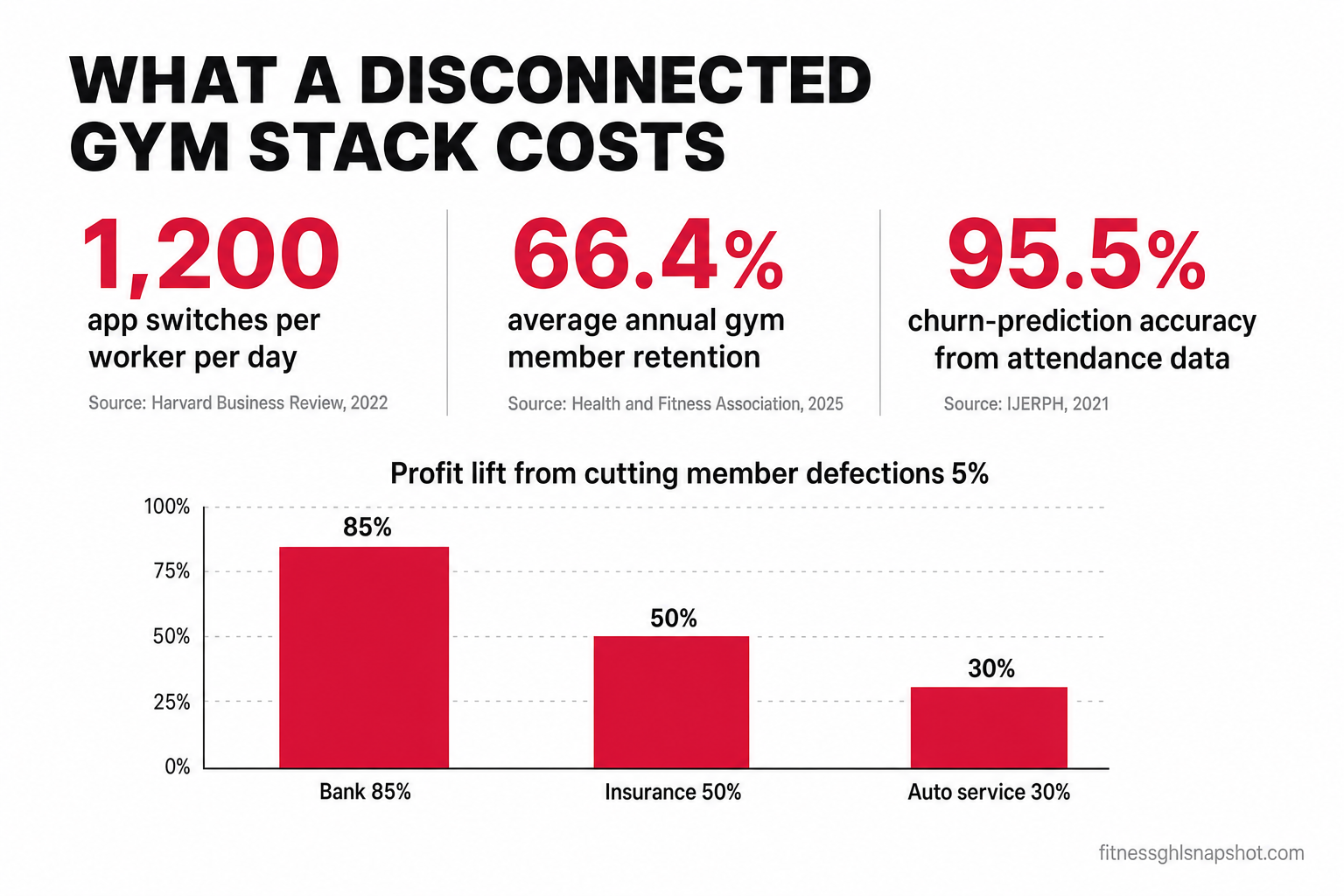
That gap has a measurable cost. Microsoft’s research team, writing in Harvard Business Review, found that workers toggle between different applications and websites about 1,200 times a day, and the constant reorientation — the “toggle tax” — burns just under 4 hours a week per person (HBR, 2022). For a front desk juggling five gym apps, that’s a day of payroll every week spent context-switching instead of selling trials and saving members.
Then there’s the data itself. When your member records live in five places, none of them is fully right — and bad data isn’t free. Gartner has estimated that poor data quality costs organizations an average of $12.9 million a year (Gartner). A single studio feels a smaller version of the same leak every month: the “cancelled” member you keep texting, the trial that never got followed up because it was stuck in the booking app, the failed payment nobody chased.
And the stakes are high because retention in this industry is already thin. The Health & Fitness Association’s 2025 benchmarking report — built on 17,000+ facilities — pegs average annual member retention at 66.4%, meaning roughly one in three members walks every year (HFA, 2025). In a US market of a record 77 million members (HFA, 2025), the studios that win aren’t the ones with the flashiest app — they’re the ones whose systems notice a member slipping and act on it automatically. That requires connected data.
Start here: make GoHighLevel your system of record
Before you connect a single tool, make one decision: what is the source of truth? Every integration project that fails skips this. You end up with two tools both claiming to “own” the member record, data syncing in circles, and nobody sure which phone number is current.
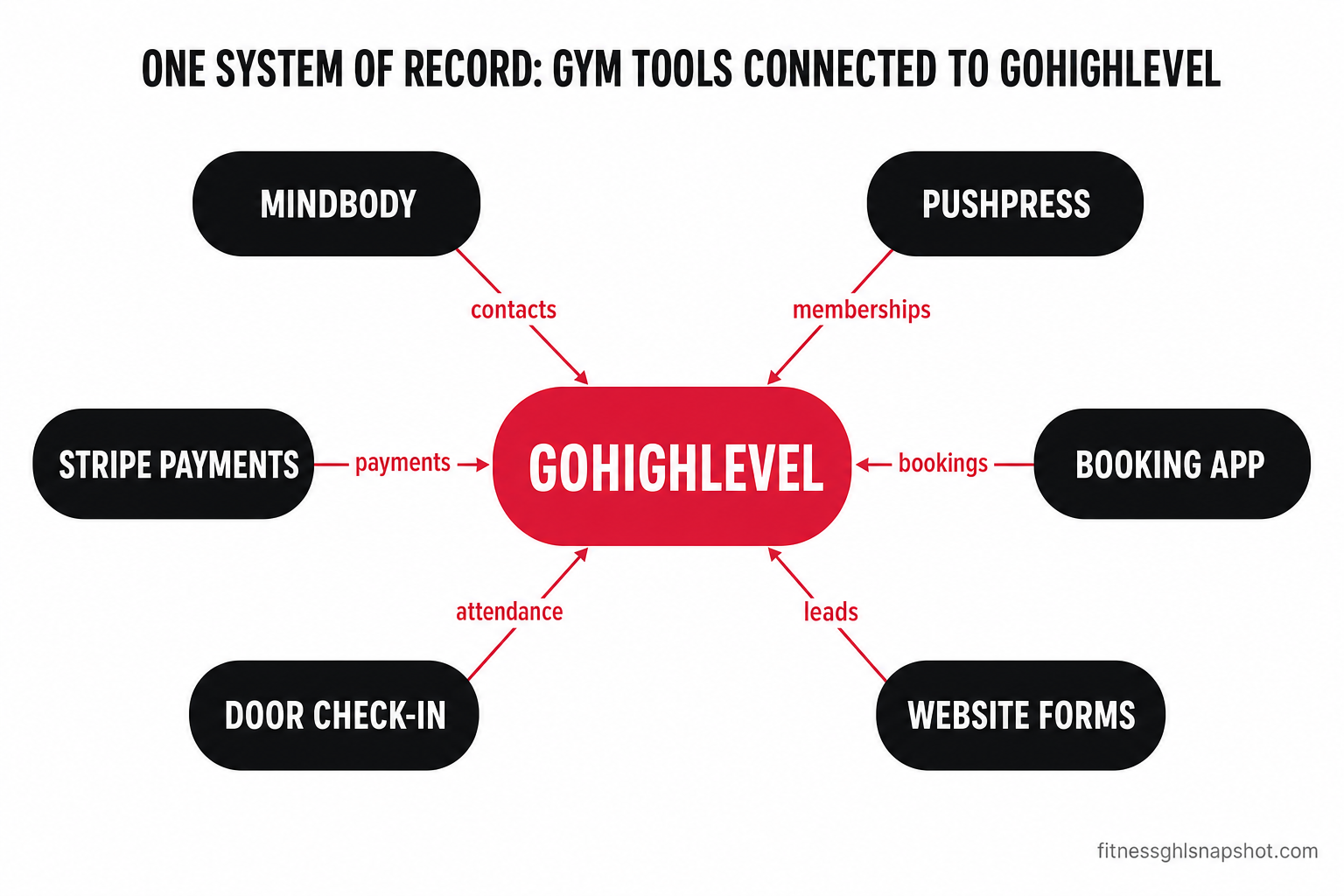
Pick GoHighLevel as your system of record — the hub every other tool feeds. There’s a practical reason it’s the right hub: GHL is already where your marketing, pipelines, calendars, SMS/email, and automations live, and HighLevel reports powering 2.2 million businesses and 6.9 billion leads on the platform (GoHighLevel). Your gym-management tool (Mindbody, Zen Planner, PushPress) can stay the source of truth for billing and class scheduling if you like — but contact identity, communication, and lifecycle automation should live in GHL. If you’re still choosing a platform or just getting oriented, start with our getting-started guide to GoHighLevel for gyms.
Step 1 — Map your gym’s data
You can’t connect what you haven’t mapped. Every gym, regardless of niche, runs on five data types. List where each one lives today and where it needs to land in GHL:
- Contacts & leads — names, phone, email, source, tags. Lives in: your booking app, ad platforms, website forms, spreadsheets. Lands in: GHL contacts + pipelines.
- Memberships & billing status — active, paused, past-due, cancelled. Lives in: Mindbody, Zen Planner, PushPress, Stripe. Lands in: GHL custom fields + tags.
- Classes & bookings — schedules, sign-ups, waitlists, no-shows. Lives in: your booking/scheduling tool. Lands in: GHL calendars + appointment triggers.
- Attendance & check-ins — who actually walked in the door, and when. Lives in: your fob/kiosk/access-control system. Lands in: GHL as visit events (the retention gold — more on this in Step 4).
- Payments — successful charges, failed charges, refunds, renewals. Lives in: Stripe, Mindbody billing, QuickBooks. Lands in: GHL for dunning and LTV tracking.
Write this as a simple table: source tool → data type → destination field in GHL → sync direction. This map is your integration spec. It’s also the document you hand a developer if you decide to outsource the build — and it’s exactly the exercise that reveals how much re-keying your team does by hand today.
Step 2 — Pick your connection method
There are three ways to connect a tool to GoHighLevel. Most studios end up using all three across their stack. Match the method to the tool:
Three ways to connect a tool to GoHighLevel
| Plan | Native Integration | iPaaS (Zapier / Make) recommended | Custom Webhook / API |
|---|---|---|---|
| Price | Easiest | Most flexible | Most powerful |
| Feature 1 | Built-in, point-and-click | No-code connector between apps | Direct code against the GHL API |
| Feature 2 | Best for: Stripe, Google/Facebook, calendars | Best for: booking apps, forms, Sheets | Best for: Mindbody, PushPress, door access |
| Feature 3 | Setup: minutes, no code | Setup: hours, visual builder | Setup: a developer build |
| Feature 4 | Two-way where supported | Trigger + action on most events | Any event, any direction, real-time |
| Feature 5 | Cost: included in GHL | Cost: ~$20–100/mo per tool volume | Cost: one-time build |
| Feature 6 | Limit: only tools GHL natively supports | Limit: per-task pricing at scale | Limit: needs dev skills or a partner |
| See features | How it works | Get a custom build |
How to choose, quickly: If GHL has a native integration for the tool, use it. If not, try an iPaaS connector (Zapier or Make) — it handles most booking apps, form tools, and spreadsheets with no code. Reach for a custom webhook/API build when the tool has no native or Zapier path, when you need true two-way sync, or when the data is real-time and high-volume (door check-ins are the classic example). Tools like Mindbody, Zen Planner, PushPress, Wodify, and most access-control systems fall into that last bucket — which is exactly what a GHL development team does.
Step 3 — Connect the money-critical tools first
Sequence matters. Connect the tools that touch revenue before the nice-to-haves, so the integration pays for itself while you finish the rest.
Payments (Stripe). GoHighLevel has a native Stripe integration — connect it first. Now successful charges, subscriptions, and failed payments all surface in GHL, where you can fire an automated dunning sequence the moment a card declines. Failed payments are one of the most recoverable forms of churn in the whole business; here’s the full failed-payment recovery playbook for gyms. If your billing lives in Mindbody or Zen Planner instead of Stripe, that’s a custom-sync job (Step 2, method 3).
Booking & scheduling. Whether prospects book trials through your website, a booking app, or a paid ad, those bookings have to hit a GHL calendar so reminders and no-show recovery can run. If your booking tool has a Zapier trigger, this is a 30-minute job; if not, a webhook does it. The payoff is speed — and speed is the whole game. The MIT/InsideSales lead-response study (15,000 leads, 100,000+ call attempts) found that reaching a lead within 5 minutes instead of 30 makes you 21x more likely to qualify it (MIT/InsideSales). A booking that sits in a disconnected app for two hours is a booking you’re losing on speed. (More on that in our speed-to-lead guide and the Seattle online-booking automation breakdown.)
Relative likelihood of qualifying a lead by speed of first response — replying within 5 minutes makes you up to 21x more likely to qualify the lead than waiting 30. Connecting your booking tool to GoHighLevel is what makes a 5-minute response automatic. Source: MIT / InsideSales Lead Response Management Study.
Step 4 — Sync check-in and attendance data (the retention unlock)
This is the step most gyms skip, and it’s the one with the highest ROI. Your door fob, kiosk, or access-control system knows something no other tool does: who is actually still showing up. Formal cancellations are the churn you can see. The dangerous churn is silent — the member who quietly stops coming, keeps paying for a month or two out of guilt, then cancels. By the time they cancel, the decision was made weeks ago.
The research here is unambiguous. In a peer-reviewed study of 5,209 fitness-center members, the number of days since a member’s last visit — their non-attendance streak — was the single most important predictor of dropout, and a gradient-boosting model using it flagged churners with 95.5% accuracy (Sobreiro et al., IJERPH, 2021). A separate analysis of a large gym-chain dataset found declining visit frequency was the top churn signal, second only to how long someone had been a member (Tilburg University, 2023).
Translation: if attendance data never reaches GoHighLevel, your retention automations are flying blind. Connect the check-in system — usually a custom webhook or an access-control bridge — so every visit posts to the member’s GHL contact. Then you can build the automation that actually saves members:
- Member hasn’t checked in for 10 days → auto-tag “at-risk” → send a friendly “we miss you” SMS.
- No check-in for 21 days → escalate to a coach task + a personal call.
- Check-in streak hits a milestone → automated congrats + a referral ask while they’re motivated.
The reason this matters so much is the raw economics of retention. Frederick Reichheld and W. Earl Sasser’s classic Harvard Business Review research found that cutting the customer defection rate by just 5% lifted profits by 30% to 85% across service businesses (Reichheld & Sasser, HBR). And keeping a member is far cheaper than replacing one — HBR estimates acquiring a new customer costs 5 to 25 times more than retaining an existing one (HBR, 2014). Attendance data is the cheapest retention lever in your building, and it’s sitting unused on your door.
Profit increase from cutting customer defections by just 5%, across three service industries. Retention is a profit lever — and attendance data connected to GoHighLevel is how a gym pulls it. Source: Reichheld & Sasser, “Zero Defections,” Harvard Business Review (via Bain).
Step 5 — Route events into automations
Connected data does nothing until you build automations on top of it. This is where GoHighLevel earns its keep: every event you just piped in becomes a trigger. Map each incoming event to an outcome:
- New booking → instant SMS/email confirmation + reminder sequence + no-show recovery if they miss (no-show playbook).
- New member → structured first-30-days onboarding sequence so they build the habit that keeps them (onboarding guide).
- Failed payment → dunning sequence with a self-serve card-update link.
- Attendance drop-off → at-risk tag + win-back sequence (Step 4).
- Positive milestone (streak, PR, renewal) → review request while they’re happy, feeding your Google profile.
You don’t have to build all of this by hand. Our fitness snapshot ships 50+ workflows pre-wired for exactly these triggers, so the integration you just did lights up a system that’s ready to run. The point is that the plumbing in Steps 1–4 is what makes any of it possible — automations can only fire on data they can see.
Build vs. buy: when to hire a developer
Be honest about where the line is. You can do a lot yourself:
- DIY with native + iPaaS if your stack is Stripe, a website form tool, Google/Facebook leads, and a booking app with a Zapier connector. Most single-location studios can wire this up in a weekend.
- Bring in a developer when you need to connect a tool with no native or Zapier path — Mindbody, Zen Planner, PushPress, Wodify, or a door access-control/kiosk system — or when you need real, two-way sync that stays reliable at volume. These are custom webhook/API builds, and doing them wrong (data loops, duplicate contacts, missed events) costs more than doing them right.
That’s the work our GHL Development team does: custom connectors, access-control bridges, two-way Mindbody/PushPress sync, and custom dashboards — fixed-price builds from $3K, or $75/hr with no minimums. If you’d rather not manage any of it, a dedicated GHL VA can run your whole connected stack from $997/mo. And when a gym genuinely outgrows what GHL plus integrations can do, that’s when custom software you own enters the picture — but connect what you have first; most studios never need to go further.
The bottom line
Your gym’s tools aren’t broken — they’re just not talking. The fix isn’t a rip-and-replace; it’s a system of record (GoHighLevel), a clear data map, and the right connection method for each tool. Do that in order — money-critical tools first, then the attendance data almost every gym leaves stranded on its door — and you turn a pile of disconnected apps into one system that notices a member slipping and acts before they cancel.
The math is on your side. Retention beats acquisition by 5–25x on cost, a 5% drop in defections can lift profits by up to 85%, and attendance is the most accurate churn signal you have. All of it depends on one unglamorous thing: getting your data into the system that runs your follow-up. Connect it once, and it pays you back every month.
Frequently asked questions
Can GoHighLevel integrate with Mindbody?
Not natively — GoHighLevel has no built-in Mindbody integration, and Mindbody's API is closed enough that Zapier can't fully bridge it either. Connecting the two (member, class, and booking data, two-way) is a custom webhook/API build. It's very doable, but it's a developer job rather than a point-and-click setup. That's one of the most common custom GHL integrations we build.
What's the easiest way to connect my gym's tools to GoHighLevel?
Start with native integrations for anything GHL supports directly (Stripe, Google, Facebook, calendars), then use an iPaaS connector like Zapier or Make for booking apps, form tools, and spreadsheets. Only reach for a custom build when a tool has no native or Zapier path — most often Mindbody, PushPress, Zen Planner, Wodify, or a door access-control system.
Why should I connect my check-in / door system to GoHighLevel?
Because attendance is the best early warning you have for churn. A peer-reviewed study of 5,209 members found days since last visit was the single strongest predictor of dropout (95.5% model accuracy). If that data never reaches GHL, your win-back automations can't see a member going quiet until they formally cancel — which is usually weeks too late.
Do I need a developer, or can I do this myself?
Most single-location studios can connect Stripe, website forms, ad leads, and a booking app themselves using native integrations plus Zapier or Make — a weekend project. You need a developer when you have to connect a tool with no native/Zapier path (Mindbody, PushPress, door access), or when you need reliable two-way sync at volume. Our GHL Development team handles those custom builds from $3K, or $75/hr.
Will connecting my tools create duplicate contacts or data loops?
It can, if you skip the planning step. That's why you pick one system of record (GoHighLevel), define the sync direction for every data type before you build, and use consistent match keys (usually email or phone) so records merge instead of duplicating. Getting this design right up front is exactly what separates a clean custom integration from a messy one.
How long does it take to connect a gym's stack to GoHighLevel?
Native and iPaaS connections take minutes to a few hours each. A custom connector (Mindbody two-way sync, an access-control bridge) is typically a scoped build measured in days to a couple of weeks depending on complexity. We start every custom build with a written scope, milestones, and a fixed price so there are no moving targets.
About the author
Bryce Kendrick is our Fitness Growth Strategist and GHL Snapshot Lead, based in Austin, TX. He spent eight years managing the floor and front desk at a fast-growing CrossFit box before moving full-time into GoHighLevel automation for gyms. He has built trial-to-member funnels and connected tool stacks for boxes, F45 franchises, and independent strength studios across Texas, and he writes the way he coaches: direct, numbers-first, and allergic to fluff.
Related posts
- Migrating a Gym From Mindbody to GoHighLevel: The Clean-Move Playbook
- Custom Software for Gyms: When Off-the-Shelf Stops Scaling
- Stop Silent Churn: Catch At-Risk Members Before They Ghost
- Failed Payment Recovery for Gyms: Plug the Most Recoverable Leak
- Member Onboarding: The First 30 Days That Decide Retention