
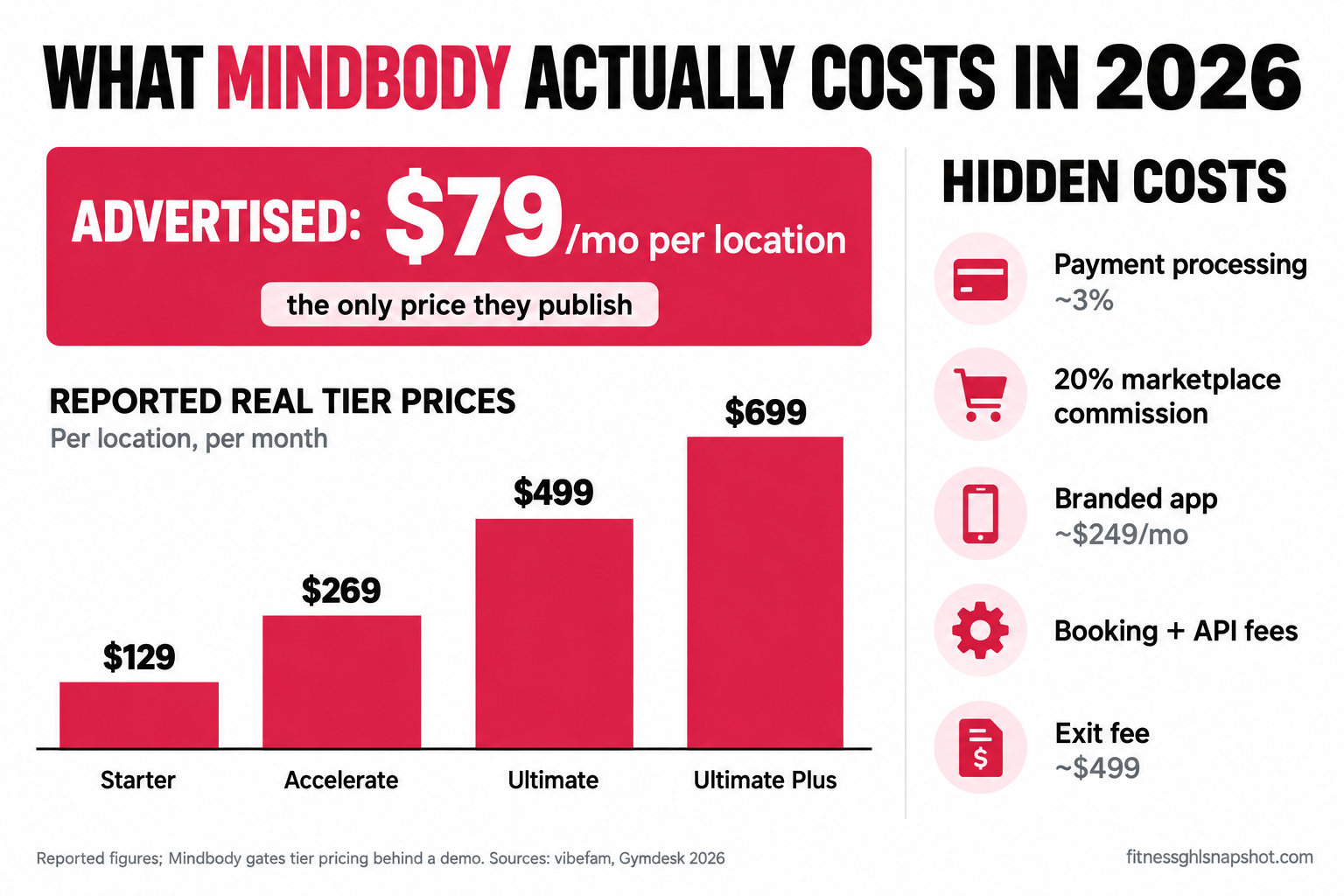
Short version: Mindbody advertises “starting at $79 a month per location,” but that number buys the smallest plan, for one location, before a single add-on. The tiers most studios actually need (Accelerate and Ultimate) are quote-only, and reported real prices run roughly $259 to $499+ per location per month, before payment processing, a 20% marketplace commission on app bookings, a branded-app add-on near $249 to $299 a month, booking-API fees, and a reported exit fee around $499 if you ever leave. A single boutique studio commonly lands between about $350 and $850 a month all-in; multi-location studios report $1,000 to $1,700 and up. The advertised price is a door, not a quote. Here is everything behind it, with sources, so you can budget without booking the call.
It is the first of the month and you are reading your Mindbody invoice line by line, because it is bigger again. The plan you signed at one number is now a different number, and there is a charge for the branded app, a charge that says “marketplace,” and a processing line that is quietly the second-biggest cost in the whole business after rent. You go to compare it against something cheaper and every competitor’s page says “book a demo.” I ran member experience for a three-location pilates and yoga group, so I have signed that invoice and sat through those demos. The game is always the same: show one small number, hide the rest until you are on a call with a salesperson who knows the real figure and knows you don’t. Let’s take it apart.
Table of contents
- What Mindbody actually publishes (and what it hides)
- The real tier prices in 2026
- The five costs the sticker price never shows
- What Mindbody actually costs, by studio size
- Steal this: force a real quote out of the demo
- The contract is a cost: cancellation and lock-in
- Is Mindbody worth it? Who it fits and who it doesn’t
- Questions operators ask before they sign
- FAQ
What Mindbody actually publishes (and what it hides)
Go to Mindbody’s pricing page right now and you will find exactly one price: “Starting at $79 USD/month per location.” There are tier names (Starter, Accelerate, Ultimate, and an Enterprise option), there are feature lists, and under every single tier there is a button that says “Let’s talk,” which opens a contact form (Mindbody pricing page, 2026). You cannot see what Accelerate costs. You cannot see what Ultimate costs. You see $79 and a form.
That is the whole strategy, and it is worth naming plainly, because it is doing work on you. When a vendor publishes a full price grid, that price is a promise you can hold them to. When a vendor publishes one teaser number and gates the rest, the real price becomes a negotiation, and in that negotiation the salesperson knows their floor and their ceiling and you know neither. Gym software splits almost perfectly along this line. PushPress, Gymdesk, TeamUp and Trainerize publish their full tiers; Mindbody, Glofox, Wodify and Mariana Tek make you book a demo. I covered that full market split in the gym software pricing breakdown. This post goes deep on the biggest demo-gated name of them all.
Two things are true at once, and keeping both in your head is how you avoid overpaying. Mindbody is a genuinely capable, mature platform that a lot of studios run happily. And the way it prices is designed to make the real number hard to find until you are emotionally invested in a sales process. You can respect the first and refuse the second.
That last number is context for why the pricing is so aggressive: in 2024, a record 77 million Americans, 25% of people aged six and older, held a gym, studio or fitness-facility membership (Health & Fitness Association, 2025 Consumer Report). That is a huge, growing market, which means a lot of studios to sell to and a lot of room to price by negotiation rather than by a published number.
The real tier prices in 2026
Because Mindbody doesn’t publish tier prices, every figure below is a reported or owner-reported number, pulled from current third-party roundups and operator accounts. Several of these sources are competitors, which I will flag, but their reported numbers line up closely with each other and with what studios describe paying. Treat them as a planning range, then force the real number out of the demo using the checklist further down.
Starter. The entry tier, and the one the $79 teaser points at. Owner-reported pricing runs about $99 to $159 a month per location (Gymdesk, 2026). It handles scheduling and basic client management. It does not include the branded app, and it leaves out most of the marketing and automation that studios actually buy Mindbody for.
Accelerate. The tier most independent studios end up on. Reported pricing is about $259 to $289 a month per location (vibefam, 2026). This is where the automated marketing, the richer reporting and the add-on access live. Note the jump: you go from a ~$130 plan to a ~$270 plan to get the features the demo showed you.
Ultimate. The full-featured tier, reported from about $499 a month per location and up (vibefam, 2026). This is aimed at larger studios and multi-location operators who want the complete marketing and AI tooling.
Ultimate Plus. A fourth tier that several sources report around $699+ a month per location, which bundles the branded mobile app that is otherwise a separate charge (vibefam, 2026). For a five-location operator, one roundup reports an Enterprise/Ultimate Plus base near $3,495 a month (FitBudd, 2026).
Advertised starting price from Mindbody’s pricing page; tier figures are reported midpoints per location per month from vibefam, 2026 and Gymdesk, 2026. Mindbody does not publish tier pricing; confirm your exact quote.
Mindbody reported tiers, 2026 (per location, per month)
| Plan | Starter | Accelerate recommended | Ultimate | Ultimate Plus |
|---|---|---|---|---|
| Price | ~$99–$159/mo | ~$259–$289/mo | from ~$499/mo | ~$699+/mo |
| Feature 1 | Scheduling + basic client management | Automated marketing + richer reporting | Full marketing + AI tooling | Bundles the branded mobile app |
| Feature 2 | No branded app | Add-on access (app, extras) | Branded app usually still extra | Top consumer-marketing features |
| Feature 3 | Limited marketing / automation | The tier most independents land on | Aimed at larger / multi-location | 5-location base reported near $3,495/mo |
| Feature 4 | Points to the $79 'starting at' teaser | Roughly 2x the Starter number | Quote-only, negotiable | Quote-only |
| Feature 5 | Best fit: a single small studio testing the water | Best fit: an established single studio | Best fit: multi-location or high-volume | Best fit: multi-location brands |
The pattern is the one to remember: the number that got you in the door ($79) and the number you will actually pay (roughly $270 to $500+ per location once you have the features a real studio needs) are not close.
The five costs the sticker price never shows
Even the reported tier price is not the real price, because the subscription is only one line on the invoice. Here are the five costs that turn a “$269 plan” into a $600 month.
1. Payment processing. This is the one that surprises operators the most, because it scales with your revenue, not your plan. Reported Mindbody rates run about 2.99% + $0.30 for card-present and 3.60% + $0.30 for online (card-not-present) transactions (vibefam, 2026 · FitBudd, 2026). Mindbody does not publish US rates; Gymdesk notes the company tells you to email for them, and that your recurring membership charges run at the higher card-not-present rate because they bill a stored card (Gymdesk, 2026). On $30,000 of card volume a year, that is roughly $1,000 to $1,100 in processing. On $90,000, it is north of $3,000. Processing is often the second-largest software cost in the business, and it never appears on the pricing page.
2. The 20% marketplace commission. When a client books or buys through the Mindbody consumer app, Mindbody takes 20% of the purchase price, excluding tax, with new-client commissions capped at $30 per transaction (Gymdesk, 2026). Gymdesk’s own examples: a $65 intro offer sends $13 to Mindbody, and a $320 package sends $64, with regular card processing charged on top of that. The pitch is that the marketplace brings you new clients you wouldn’t have found. Sometimes it does. But it also means a slice of revenue from clients you already had, if they happen to book in the app instead of on your own page, quietly leaves the building every month.
3. The branded mobile app. The app with your studio’s name on it, the one that looks great in the demo, is a paid add-on on most tiers rather than something included. Mindbody doesn’t publish a price; third-party reports put it around $249 to $299 a month, bundled only in the top Ultimate Plus tier (vibefam, 2026 · FitBudd, 2026). That one add-on can be larger than an entire competing platform’s base plan.
4. Booking and developer API fees. If you connect Mindbody to other tools or take bookings through an integration, there are usage fees. Gymdesk reports the public API is free under 5,000 calls per cycle then $0.002 per call, and consumer bookings run $15 per location per month plus $1.30 per class booking and $2.50 per appointment booking (Gymdesk, 2026). None of this is huge on its own, but it is the kind of line that grows with your success and that you never budgeted for.
5. The exit fee. Leaving has a price too. Operators report a data-export fee around $499 that only shows up when you try to cancel and take your member and payment history with you (vibefam, 2026). Separately, reports vary on setup: Gymdesk says standard onboarding and training are included with no setup fee, while larger practices with custom data conversion report setup running up to $10,000+ (Gymdesk, 2026 · FitBudd, 2026). Either way, the cost of getting in and the cost of getting out both belong in your math.
What Mindbody actually costs, by studio size
The right question is never “what does Mindbody cost,” it is “what does Mindbody cost for a business my size.” The answer genuinely differs, so here are three honest scenarios using the reported numbers above. These are planning estimates, not quotes.
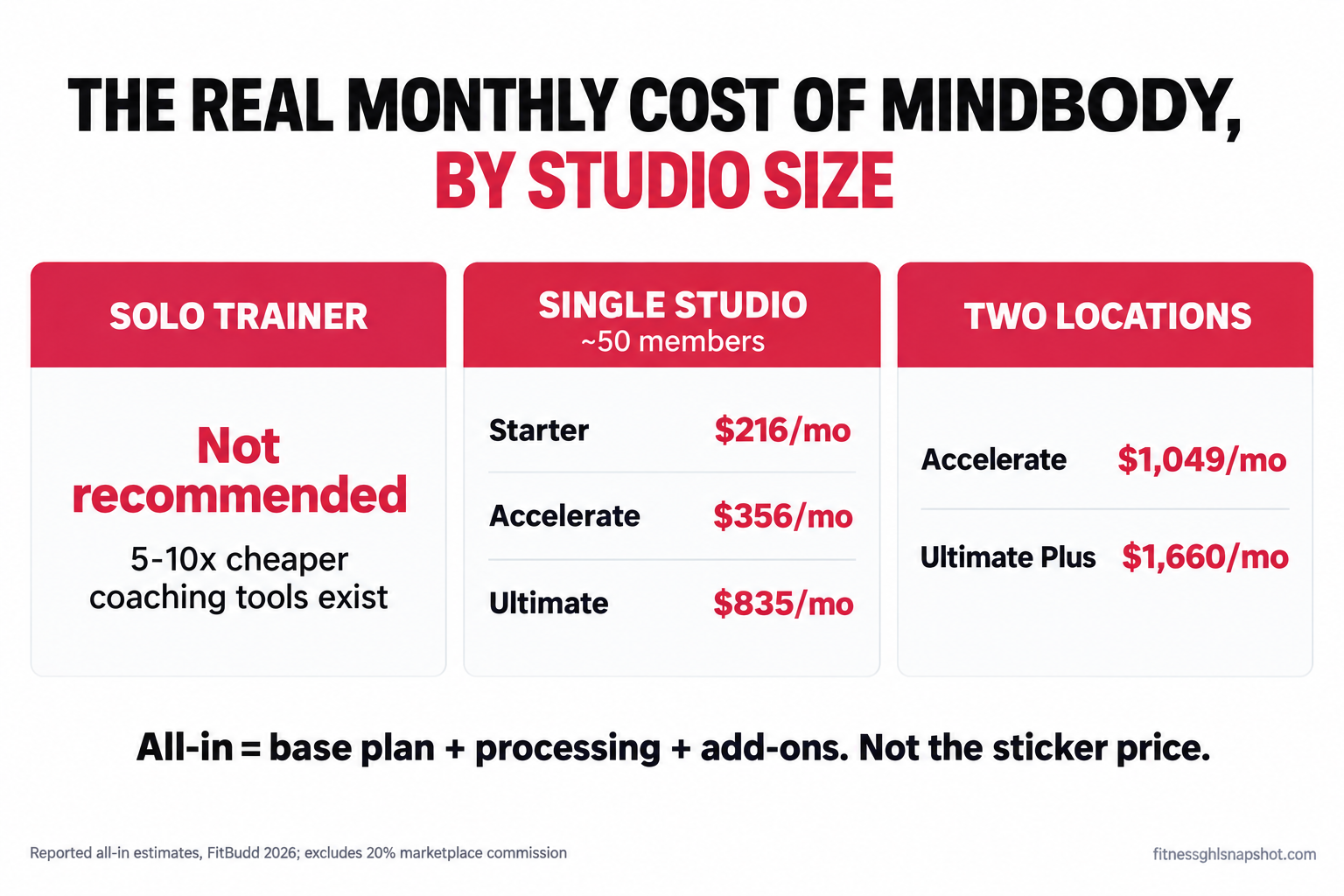
The solo trainer or coach. Mindbody is a poor fit here, and most roundups say so directly: for a one-person coaching business, dedicated coaching tools are reported to be roughly 5 to 10x cheaper for the core work (FitBudd, 2026). A solo PT paying $130 to $270 a month plus processing for a platform built around multi-staff studios is overpaying for a scheduling calendar. If this is you, look at the transparent, trainer-focused tools first.
The single boutique studio (~50 members). Assuming about $30,000 a year in card volume, FitBudd’s all-in math lands at roughly $216 a month on Starter ($129 base + ~$87 processing), $356 a month on Accelerate ($269 base + ~$87 processing), and $835 a month on Ultimate ($499 base + $249 branded app + ~$87 processing) (FitBudd, 2026). Most single studios need Accelerate for the marketing features, so budget $350 to $400 a month real cost, more if you add the app.
The multi-location studio. This is where it compounds, because pricing is per location. For two locations at ~$90,000 a year in volume, FitBudd reports roughly $1,049 a month on Accelerate ($538 base + $249 app + ~$262 processing) and $1,660 a month on Ultimate Plus ($1,398 base + ~$262 processing). A five-location brand on Ultimate Plus lands near $4,620 a month all-in (FitBudd, 2026). And remember the 20% marketplace commission sits on top of all of these and is not in those figures.
All-in monthly cost for a single ~50-member studio by tier, assuming ~$30k/year card volume: base plan + processing + (branded app on Ultimate). Reported by FitBudd, 2026. Excludes the 20% marketplace commission. Your number depends on volume and add-ons.
Here is the thing that is easy to miss in those scenarios: the booking software is the cheapest part of the job it is supposed to do. Mindbody schedules classes and takes payments well. What it does not do well, on any tier, is the lead follow-up and retention work that actually grows a studio: texting a trial lead back in minutes, chasing no-shows, catching a member before they quietly stop showing up. That gap is the same one every booking platform leaves, and it is why I wrote about why Mindbody feels broken to so many studios even when it is working as designed.
Steal this: force a real quote out of the demo
If you are going to sit through the sales call, make it pay. The goal is simple: get every real number in writing before you sign anything, so the invoice holds no surprises. Copy this list into your notes and make the salesperson answer each line. A rep who won’t put these in writing is telling you something.
The written-quote checklist:
Ask for ALL of this in writing before signing:

1. Base plan price for MY tier, per location, per month
2. Contract length (12 / 24 / 36 months?) and the exact monthly total
3. Card-present processing rate (% + per-transaction)
4. Online / card-not-present processing rate (% + per-transaction)
5. Does the 20% marketplace commission apply to my existing clients,
   or only new app-sourced ones? What is the cap?
6. Branded app: included or extra? Exact monthly price.
7. Any booking / API / integration fees for the tools I connect
8. One-time setup, onboarding, or data-conversion fees
9. Price at RENEWAL (not just the intro rate) and the % it can rise
10. Notice period to cancel + the data-export fee if I leave
The three questions that matter most, if you only ask three:
“What is my total monthly cost at renewal, all-in, including processing on my actual volume and every add-on I just saw in the demo?”
“If I want to leave in month 10, what does it cost me to cancel and take my data?”
“Is this rate locked, and for how long?”
Run the number they give you through this: true monthly cost = base plan + add-ons you'll actually use + (monthly card volume × processing rate) + (one-time fees ÷ 12). Then compare that number against a platform that publishes its price up front. You will often find the demo-gated option is not more capable, just more expensive and harder to leave.
The contract is a cost: cancellation and lock-in
There is a cost that never appears on any pricing page: how hard it is to get out. Multiple operator reports describe Mindbody contracts running 12, 24, or 36 months, auto-renewing unless you give written notice (often 30 days) through the specific channel the contract names, with early-termination penalties reported in the range of 30% to 50% of the remaining balance (vibefam, 2026). FitBudd similarly reports a standard 24-month contract with early-termination fees (FitBudd, 2026). A multi-year, auto-renewing contract is not neutral: it is a cost, because it removes your ability to leave when the price rises or the fit changes.
And if you are counting on the government to make cancelling easy, check the date. The FTC’s “click-to-cancel” Negative Option Rule was vacated by the Eighth Circuit on July 8, 2025, on procedural grounds, and is not in effect (Sidley Austin, 2025). Most content online still talks about that rule as if it is coming; it isn’t the live protection. What actually protects you is the federal Restore Online Shoppers’ Confidence Act (ROSCA) plus state auto-renewal laws, which more than half the states have, with California’s Automatic Renewal Law among the strictest. I broke down what that means for a gym’s own contracts in the 2026 membership cancellation law guide. The point for a buyer: read the renewal and export terms yourself, because the federal rule you were counting on is gone.
Is Mindbody worth it? Who it fits and who it doesn’t
Price without fit is meaningless, so here is the honest read, as someone who has run studios on this kind of software.
Mindbody can be worth it for an established, multi-staff studio or a multi-location brand that genuinely uses the consumer marketplace to acquire new clients, values the mature reporting, and has the volume to absorb the processing and commission. For that operator, the platform is capable and the ecosystem is deep.
Mindbody is usually not worth it for a solo trainer or a lean single studio watching every dollar. The per-location pricing, the add-on model, the processing rates, and the multi-year contracts stack into a number that is hard to justify when transparent alternatives publish lower prices with no lock-in. If the main thing you need is scheduling and payments, you are paying enterprise prices for a calendar.
And for everyone, there is the gap no tier closes. Booking software, Mindbody included, is built to run the schedule, not to chase the lead, recover the no-show, or catch silent churn. Those are the jobs that grow revenue, and they live in a different layer: a CRM and automation system like GoHighLevel that sits on top of whatever books your classes. (That GoHighLevel link is an affiliate link; if you sign up through it, we may earn a commission at no extra cost to you.) Whether you keep Mindbody or leave it, the follow-up layer is the part that actually pays for itself, and it is the part Mindbody’s pricing games distract you from buying.
Questions operators ask before they sign
“Isn’t the marketplace worth the 20% because it finds me new clients?” Sometimes, if you are in a dense market where people actually discover studios in the Mindbody app. But run the real math: if most of your bookings come from clients you already acquired through your own marketing, the 20% is a tax on revenue you earned, not a finder’s fee for revenue Mindbody created. Ask the rep what share of your bookings they project will be genuinely new marketplace clients, then decide if the cut is worth it.
“I’m already locked into a Mindbody contract. What now?” Don’t break it on impulse, the early-termination penalty is real. Instead, find your renewal date and your notice period today, set a reminder 45 days before it, and use the time to price alternatives and plan a clean migration of your data off Mindbody. Meanwhile, you can add the growth layer (lead follow-up, retention) alongside Mindbody now, so you are not waiting on the contract to start fixing the thing that actually loses you members.
“Aren’t these numbers just from Mindbody’s competitors?” Partly, and I have flagged every competitor source. That is a real limitation, and it exists because Mindbody hides its own prices. When a vendor won’t publish numbers, the only data that exists is reported and estimated. The responsible move is to treat these as a planning range, cross-check that the sources agree (they largely do), and then force the real figure out of the demo with the checklist above. The one number you can fully trust, the $79 teaser, is the one Mindbody chose to show you.
“Will a cheaper tool actually handle my classes and payments?” For most independent studios, yes. Gymdesk, TeamUp and PushPress all run class scheduling, memberships and payments at published prices below Mindbody’s reported tiers, with no multi-year lock-in. “Cheaper” here usually means “transparent and easier to leave,” not “missing the basics.” The capability gap between Mindbody and a well-run transparent competitor is far smaller than the price gap.
Frequently asked questions
How much does Mindbody actually cost per month in 2026?
Mindbody publishes only one price: 'starting at $79 a month per location' for the Starter tier. The tiers most studios need are quote-only, with reported real prices around $99 to $159 for Starter, $259 to $289 for Accelerate, and from about $499 for Ultimate, all per location per month. Once you add payment processing, the branded app and other fees, a single studio commonly pays $350 to $850 a month all-in, and multi-location studios report $1,000 to $1,700 and up.
Why won't Mindbody show its real prices?
Mindbody's pricing page lists tier names and features but gates every tier behind a 'Let's talk' contact form, showing only the $79 starting number. Demo-gating keeps the real price a negotiation rather than a published promise, which generally favors the vendor. It is the same pattern used by Glofox, Wodify and Mariana Tek, while PushPress, Gymdesk, TeamUp and Trainerize publish full prices.
What are the hidden fees in Mindbody?
The main ones are payment processing (reported around 2.99% card-present and 3.60% online, plus $0.30 per transaction), a 20% commission on bookings made through the Mindbody consumer app (capped at $30 for new clients), a branded mobile app add-on reported around $249 to $299 a month, booking and API fees (about $15 per location plus $1.30 per class booking), and a reported data-export fee near $499 when you cancel.
Does Mindbody charge per location?
Yes. Mindbody's advertised and reported prices are per location, not per business. A two-location studio on Accelerate pays roughly double a single location, which is why multi-location brands see all-in monthly costs of $1,000 to $1,700 and up before the marketplace commission.
Is there a cheaper alternative to Mindbody for a small studio?
Yes. Gymdesk publishes flat tiers reported around $75 to $200 a month with everything included and no contracts, TeamUp starts around $99 to $119 a month, and PushPress has a useful free plan plus paid tiers at $159 and $229. All three publish real prices and avoid multi-year lock-in, unlike Mindbody's quote-only main tiers. The best fit depends on your member count and whether you run class-based scheduling.
Does Mindbody have a cancellation fee or contract?
Operators widely report contracts of 12, 24 or 36 months that auto-renew unless you give written notice (often 30 days), with early-termination penalties reported at roughly 30% to 50% of the remaining balance, plus a data-export fee near $499 to take your data when you leave. Confirm the exact terms in writing before signing, because the federal click-to-cancel rule was vacated in 2025 and does not protect you here.
Is Mindbody worth the price?
For an established multi-staff or multi-location studio that actively uses the consumer marketplace and values the mature reporting, it can be. For a solo trainer or a lean single studio, the per-location pricing, add-ons and long contracts usually make it hard to justify versus transparent alternatives. And no Mindbody tier handles the lead follow-up and retention automation that actually grows a studio; that lives in a separate CRM and automation layer.
The honest takeaway: Mindbody is not a scam and it is not uniquely evil, but its pricing is built to keep the real number out of reach until you are on the phone. Now you have the range, the hidden costs, and the exact questions to ask, so you can walk into that demo already knowing what you should pay, and walk out knowing whether it is worth it. Price the all-in number, price the exit, and remember that the software that books your classes is never the software that grows your membership.