
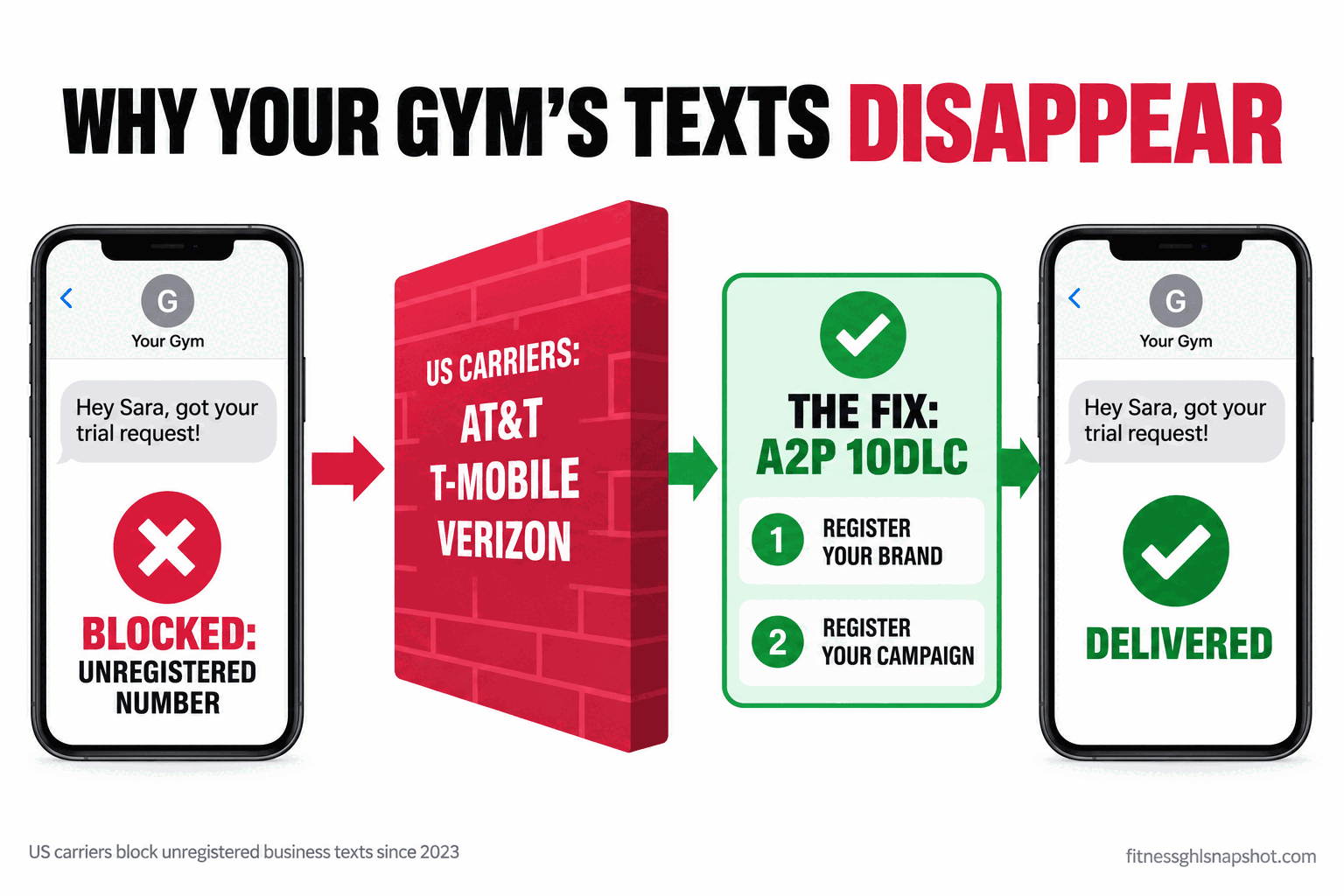
Here is the short version: if your gym texts leads or members from a regular 10-digit number and you never registered that number for A2P 10DLC, US carriers are quietly dropping some or all of those texts before they reach a phone. No bounce, no warning, nothing in your inbox. The lead just never replies, and you assume they went cold. Since late 2023 the big carriers have blocked business texts from unregistered numbers, and by 2025 that block is complete. Registration is a one-time setup that costs under $25 to start for most gyms, plus a small monthly fee. This post walks the whole thing: what A2P 10DLC is, the real costs, how to register inside GoHighLevel, the opt-in language carriers actually check for, the fines for breaking the content rules, and how the setup differs for a solo trainer, a boutique studio, and a multi-location gym.
It is 7:10pm and a woman fills out your “book a free trial” form from an Instagram ad. Your system fires the welcome text in four seconds: “Hey Sara, it’s Marcus from Iron District, got your trial request. Want Saturday 9am or Sunday 10am?” You never hear back. You figure she was a tire-kicker. She wasn’t. The text never hit her phone, because the number it came from was never registered with the carriers, and T-Mobile dropped it on the way. You paid for that lead. The carrier ate it. Here is how to stop that from happening to the next hundred.
Table of contents
- What A2P 10DLC actually is
- Why your texts vanish with no error
- What registration actually costs
- The 6-step registration path
- Sole Proprietor vs Standard Brand: pick your lane
- Steal this: the opt-in and consent copy carriers approve
- The content rules that get you fined
- Run it for your size: solo, studio, multi-location
- Objections operators raise
- FAQ
What A2P 10DLC actually is
A2P 10DLC stands for “Application-to-Person messaging over 10-Digit Long Codes.” Strip the jargon and it means this: any time software sends a text from a normal 10-digit phone number (not a human typing on their personal phone), that is A2P traffic. Your GoHighLevel account firing a trial reminder is A2P. Your front desk texting a member from their own iPhone is not.
Years ago, carriers could not easily tell the difference between a gym sending helpful trial reminders and a scammer blasting spam from a burner number. So the US carriers (AT&T, T-Mobile, Verizon) built a shared system. Businesses now register with a central database called The Campaign Registry before they can text from a 10-digit number. You register two things:
- Your Brand. This is your business identity: legal name, address, and your EIN or tax ID. It tells the carriers who you are.
- Your Campaign. This is what you send and why: the use case (customer care, marketing, mixed), sample messages, and proof that people opted in. It tells the carriers what you are going to text and that recipients agreed to it.
Once both are approved, your number carries a verified status and your texts flow. Skip it, and you are sending into a wall.
Why your texts vanish with no error
This is the part that burns gyms, because the failure is invisible. When a carrier drops an unregistered text, you usually do not get a clean “failed” status you would notice. The message shows as sent on your side. The member or lead simply never gets it.
Inside the plumbing, two error codes tell the story. Twilio error 30034 means the message came from a 10DLC number that is not tied to an approved A2P campaign, so it is an unregistered-traffic block (Twilio error 30034). Error 30007 means the carrier filtered the message, usually for content or a policy match, even if you are registered (GoHighLevel on error 30007). Most gym owners never open their message logs, so they never see either code. They just watch reply rates quietly fall and blame the leads.
Think about what that does to the two systems your business runs on. Your speed-to-lead follow-up depends on a text hitting a new lead inside five minutes. Your no-show recovery and your missed-call text-back depend on the text arriving at all. If the sending number is unregistered, every one of those automations is firing into a void, and the whole funnel looks broken for a reason that has nothing to do with your copy or your offer.
What registration actually costs
The sticker shock most operators brace for never comes. For a gym doing normal volume, the setup is cheap. Twilio’s published A2P pricing, which is what you pay through GoHighLevel and most gym tools, breaks down like this (Twilio A2P 10DLC overview):
- Low-volume standard registration (you have an EIN and send under 6,000 message segments a day, which covers almost every independent gym): $4 one-time to register the Brand, $15 one-time campaign vetting per campaign, and $1.50 to $10 per campaign per month depending on use case.
- Sole proprietor (no EIN, sending under 1,000 messages a day on one number): $4 one-time Brand, $15 one-time campaign vetting, $2 per campaign per month.
- High-volume standard registration (multi-location groups pushing over 6,000 segments a day): $44 one-time Brand, $15 campaign vetting, $1.50 to $10 per campaign per month.
So a single-location gym is looking at under $25 to get started and a few dollars a month after that. Compare that to one lost trial member. If your average member is worth several hundred dollars a year, the entire cost of being compliant is covered by rescuing a single text that would otherwise have been dropped.
The real cost of A2P is not the fee. It is the fine you eat if you register and then send content the carriers forbid. Those penalties are the number worth staring at.
T-Mobile per-violation fine tiers for non-compliant A2P messaging, in US dollars. Messaging providers pass these fines straight through to the business that sent the message. Source: US mobile network operator codes of conduct and non-compliance fines.
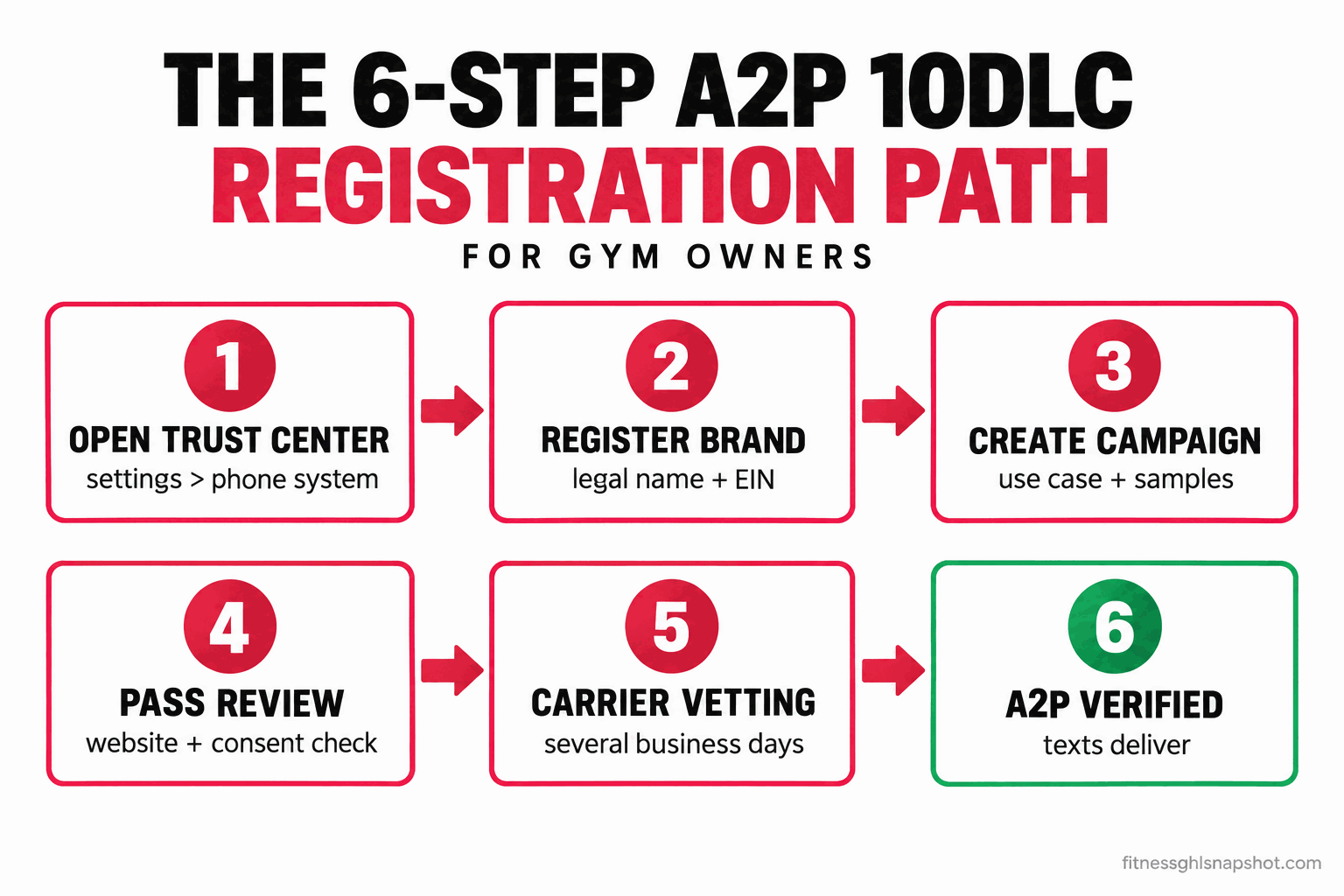
The 6-step registration path
Here is the whole journey, start to finish. I will describe it as it works inside GoHighLevel, because that is the platform the Fitness Snapshot runs on, but the steps are the same on any Twilio-based tool.
- •Step 1
Open the Trust Center
In GoHighLevel: Settings > Phone System > Trust Center, then the A2P Messaging (SMS) card.
- •Step 2
Register your Brand
Enter your legal business name, registered address, and EIN exactly as they appear in IRS records.
- •Step 3
Create your Campaign
Pick a use case, write sample messages, and declare your opt-in method and consent language.
- •Step 4
Pass the compliance review
GoHighLevel runs a website and consent checklist. Fix every failed check before you submit.
- •Step 5
Carrier vetting and propagation
The Campaign Registry and carriers review and propagate. This can take several business days.
- •Step 6
Confirm A2P Verified
Your sending number shows the green A2P Verified label. Now your texts deliver.
Step 1: Open the Trust Center. In GoHighLevel you go to Settings, then Phone System, then Trust Center, and start A2P registration under the A2P Messaging card (GoHighLevel registration guide).
Step 2: Register your Brand. You enter your legal business name, registered address, authorized contact, and your EIN. The single biggest failure here is a name or EIN that does not match IRS records exactly. If your EIN letter (the CP-575) says “Iron District Fitness LLC” and you type “Iron District Gym,” it can bounce. A brand-new EIN may also take time to show up in verification systems, so register the business, then wait a week or two before you register the Brand if the EIN is fresh.
Step 3: Create your Campaign. You pick a use case (most gyms are “mixed” because you send both account messages and marketing), write two or three realistic sample messages, and declare how people opt in. More on that copy below, because it is where most gyms get rejected.
Step 4: Pass the compliance review. GoHighLevel runs a checklist against your website and consent setup before it lets you submit. It checks that your site is live and public, shows your business name and contact details, and has a reachable privacy policy and terms page.
Step 5: Carrier vetting and propagation. After you submit, The Campaign Registry and the carriers review and propagate the registration. Plan for several business days, not minutes. Do not launch a big campaign the day you submit.
Step 6: Confirm A2P Verified. When it clears, your sending number shows a green “A2P Verified” label in your phone number settings. That label is your green light. If it is missing, your texts are still at risk, so check it before you trust the funnel.
Sole Proprietor vs Standard Brand: pick your lane
Your first real decision is which registration path fits. It comes down to whether you have an EIN.
| Sole Proprietor | Standard Brand | |
|---|---|---|
| Who it is for | Solo trainer or single-person business, no EIN | Any gym or studio with an EIN or tax ID |
| What you provide | Personal and business contact details | Legal business name + EIN matching IRS records |
| Daily volume cap | Under 1,000 messages a day, one number | Up to 6,000 segments a day (low volume); more on high volume |
| Numbers allowed | Single number only | Multiple numbers |
| Monthly campaign fee | About $2 | About $1.50 to $10 by use case |
| Best for | A trainer texting a small client list | A gym running real lead and member automations |
Here is the honest read. If you run a gym or studio as an LLC or corporation, you have an EIN, and you register as a Standard Brand. Do not try to squeeze into Sole Proprietor to save a couple of dollars a month. The volume cap and single-number limit will choke a real gym the first time you run a January promo. Sole Proprietor exists for the solo trainer who has not formally registered a business yet, and even then, getting an EIN (it is free from the IRS and takes minutes) and registering as a Standard Brand is usually the better long-term move.
Steal this: the opt-in and consent copy carriers approve
This is the section that gets your Campaign approved instead of rejected, and it is where almost every gym fumbles. The carriers are not grading your marketing. They are checking one thing: can you prove that every person you text actually agreed to it, and can they stop easily? Give them that in plain language and you sail through.
1. The web form consent checkbox. On your trial form, your “get our class schedule” form, any form that captures a phone number, add a checkbox. Do not pre-check it. GoHighLevel’s own guidance is that consent checkboxes must not be pre-selected (GoHighLevel campaign guide). Use copy like this:
[ ] I agree to receive text messages from Iron District Fitness about
my trial, classes, and offers. Message frequency varies. Message and
data rates may apply. Reply STOP to unsubscribe, HELP for help.
See our Privacy Policy and Terms.
2. The opt-in description you type into the Campaign. This is the box where the carrier wants you to describe, in sentences, how people opt in. Vague descriptions fail. Give them the real flow:
Contacts opt in by checking an unchecked consent box on the trial
booking form at irondistrictfitness.com/trial. The box states they
agree to receive SMS about their trial, classes, and offers, that
message frequency varies, that rates may apply, and that they can
reply STOP to opt out. Consent is not required to purchase.
3. The first text you send. Your first message to a new contact should re-identify you and carry the opt-out. This is good practice and good manners:
Iron District Fitness: Hey Sara, thanks for booking a trial! Reply
with a time and we'll lock it in. Msg & data rates may apply. Reply
STOP to opt out, HELP for help.
4. Your sample messages for the Campaign. When the registration asks for sample messages, give real ones that identify the sender and show the kind of content you send. Do not paste a template with unfilled {{merge fields}}, because reviewers reject those.
Sample 1: Iron District Fitness: Your free trial is tomorrow at 9am.
Reply C to confirm or R to reschedule. Reply STOP to opt out.

Sample 2: Iron District Fitness: We miss you, Jordan! Your first week
back is on us. Reply YES to reactivate. Reply STOP to opt out.If you want the full sequence of messages that sits on top of this (what to send on day one, day three, day seven), that lives in our gym lead follow-up sequence and the broader 2026 SMS playbook for gyms. A2P registration is the plumbing. Those posts are the water.
The content rules that get you fined
Registration gets your texts delivered. The content rules keep them delivered. Carriers maintain a list of forbidden categories, and the penalties are real money passed straight to you.
T-Mobile publishes a tiered fine schedule that providers pass through to the sender (carrier codes of conduct summary):
- Tier 1, $2,000 for phishing, smishing, and social engineering.
- Tier 2, $1,000 for illegal content, meaning content must be legal federally and in all 50 states.
- Tier 3, $500 for everything else, including SHAFT content that skips the rules.
SHAFT stands for Sex, Hate, Alcohol, Firearms, and Tobacco. For a gym this matters more than it sounds, because of the A: alcohol. If you run a members’ social, a “bring a friend and grab a beer” event, or any promotion that references alcohol, that message can trip the SHAFT rules without an age gate (GoHighLevel forbidden categories). Keep alcohol references out of your automated texts and route event invites that mention it through email instead.
The other quiet trap is cross-selling outside your registered use case. If you registered a “mixed” campaign for your gym and then start texting members to recruit them into a side MLM or a separate supplement business, that is unregistered traffic for a different brand and it reads as a violation. Keep your texting to what you registered.
Beyond the fines, T-Mobile reserves the right to permanently suspend a brand or campaign for repeated violations. That is the real nightmare: not a $500 fine, but losing your ability to text at all, right when your funnel depends on it.
Run it for your size: solo, studio, multi-location
The framework is the same, but what you actually do changes with your size.
Solo trainer, 20 to 100 clients. You may not have an EIN yet. Get one (it is free and fast from the IRS) and register as a Standard Brand anyway, because the moment you run a challenge or a referral push you will blow past the sole-proprietor caps. One campaign, “mixed” use case, is enough. Your opt-in is the checkbox on your booking link. Budget about $25 to start and a few dollars a month. The win for you is personal: when you text a client “class moved to 6:30,” it actually arrives, so you stop fielding “I didn’t get that” at the door.
Boutique studio, 80 to 250 members. You have an EIN, so you are a low-volume Standard Brand. You probably want one campaign that covers both your lead nurture and your member lifecycle. The thing to get right is volume planning around your busy windows: a reformer waitlist blast or a January promo can spike you toward the 6,000-segment low-volume ceiling in a single morning. Register early, because waiting until the week of your New Year push and then sitting in carrier review for several business days is how studios miss their biggest month. Your reactivation campaigns especially need the number verified before you pull the trigger on a big list.
Multi-location gym, 150 to 500+ members per site. Now the stakes change. You are likely a high-volume Standard Brand, and you have to decide whether each location texts from its own number under one Brand or everything flows through a central number. One Brand for the parent company, with campaigns mapped to how you actually operate, keeps it clean. Here the risk is not cost, it is a single sloppy location tripping a content violation and dragging the whole Brand’s reputation down. Lock your templates so no single front desk can freelance a text that mentions alcohol or strays off the registered use case. At this size, the deliverability of your automations is worth tens of thousands in rescued trials and saves, so treat A2P as infrastructure, not paperwork.
If you are building your own stack rather than buying a done-for-you system, you will need a GoHighLevel account to house all of this. You can start one through our partner link to GoHighLevel. (Disclosure: we earn a commission if you sign up through that link, at no extra cost to you.)
Objections operators raise
“I already text from my personal phone, so why bother?” If a human is thumbing out messages one at a time on a personal phone, that is not A2P and it is not blocked. The second you automate it (reminders, sequences, blasts through software) it becomes A2P and needs registration. And texting hundreds of people by hand is not a business, it is a second job you will quit in a week.
“My gym software already handles texting, isn’t it covered?” Your software provides the pipes, but the Brand and Campaign are registered to your business, not theirs. Most platforms, GoHighLevel included, make you complete your own registration in their Trust Center. Check for the green “A2P Verified” label on your number. If it is not there, you are not registered, whatever the sales page implied.
“This sounds too technical for me.” It is a form, not code. You need your legal business name, your EIN, a live website with a privacy policy, and the consent copy from the section above. An hour of focused work plus a few business days of waiting. If that is still too much, it is exactly the kind of setup a done-for-you system handles for you.
“Do I really get fined, or is that fear-mongering?” The fines are real and documented in the carrier codes of conduct, and providers pass them through. But you avoid them by doing two boring things: register honestly, and keep your texts to the content you registered. Do that and the fine schedule is just a reason not to text people about beer.
So back to Sara, the 7:10pm trial lead whose text never landed. Register the Brand, register the Campaign with a real opt-in, wait for the green Verified label, and that same four-second welcome text now arrives on her lock screen while she is still on your booking page. Same automation, same copy, same speed. The only thing that changed is that the carrier let it through. That one fix is often the difference between a funnel that looks broken and one that quietly fills your classes.
Frequently asked questions
Is A2P 10DLC registration legally required?
It is not a government law you are breaking, but it is a carrier requirement. Since late 2023 the major US carriers block business texts from unregistered 10-digit numbers, so in practical terms you cannot reliably text leads or members without it. Registration is how you keep access to texting at all.
How long does A2P 10DLC registration take?
The form itself takes under an hour if you have your legal business name, EIN, website, and consent copy ready. After you submit, The Campaign Registry and carriers review and propagate the registration, which typically takes several business days. Register well before any big campaign, not the week of.
What does A2P 10DLC cost for a gym?
For most independent gyms (an EIN holder sending under 6,000 message segments a day) it is roughly $4 one-time to register the Brand, $15 one-time per Campaign, and $1.50 to $10 per campaign per month, per Twilio's published pricing. A solo proprietor without an EIN pays about $2 a month on the campaign. Confirm the exact figure your platform shows.
Can I just use a toll-free number instead?
Yes, toll-free numbers use a separate verification process rather than A2P 10DLC Brand and Campaign registration, and some gyms use them. But a local 10-digit number usually feels more personal to a member and is the default in most gym software, so for a local gym 10DLC is normally the right path.
Why do my texts still get filtered after I registered?
Registration (fixing error 30034) stops the unregistered-traffic block. A separate issue, error 30007, is carrier content filtering, which can still hit registered senders whose messages look spammy, use shortened links, send too fast, or touch forbidden content. Keep messages identified, consent-based, and off the forbidden list to stay clear.
What happens to my existing contacts when I register?
Registration does not change your contact list. But you should only text people who actually opted in to receive SMS. If your old list has contacts who never clearly consented, do not blast them; get fresh consent first. Our SMS playbook and reactivation guide cover how to handle an old list the right way.
I run one gym. Do I need more than one campaign?
Usually no. A single mixed-use-case campaign covers both your account and marketing texts for one gym, which keeps your monthly cost low. You add campaigns only when you have genuinely distinct messaging programs, which most single-location gyms do not.