
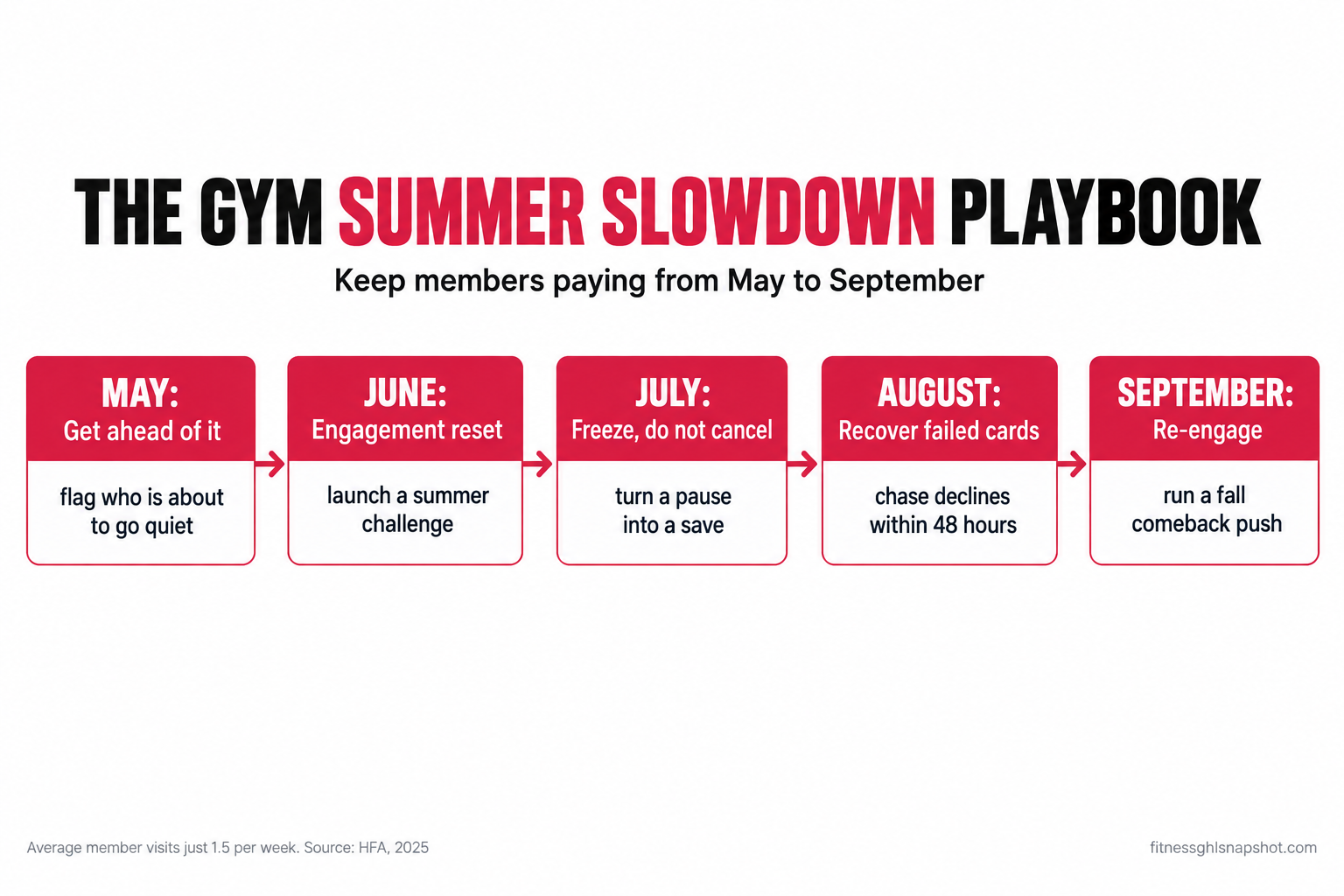
Here is the short version: the gym summer slowdown is real, it is predictable, and most of the damage is quiet. Members do not storm out in June. They travel, they skip, they ask to freeze, their cards fail while they are on vacation, and by September a chunk of them are gone without ever sending a cancellation email. The gyms that hold revenue through summer treat June to August as a retention season, not a dead season. They plan for it in May, reset engagement in early summer, turn cancel requests into pauses, chase the quiet faders before the charge fails, and run a real re-engagement push in September. This post is that playbook, month by month, with the exact texts you can copy.
It is the second week of June. Your Tuesday 6 a.m. class has nine people instead of eighteen. Two members emailed asking to “pause for the summer.” Your billing report shows three declined cards you have not chased because, honestly, you have been slammed. Nobody has quit. The schedule still looks full on paper. And yet the deposit hitting your account at month end is going to be smaller than May, and smaller again in July. If that pattern feels familiar, you are not imagining it, and you are not doing anything wrong. You are just running a gym in summer without a summer system.
Table of contents
- What the summer slowdown actually is
- What the quiet months really cost you
- The month-by-month playbook (the arc)
- May: get ahead of it
- Early June: the engagement reset
- The freeze conversation: turn cancel into pause
- Mid-summer: catch the fader before the cancel
- The failed-card double whammy
- September: the re-engagement push
- Three real summer scenarios
- The rules: freezes, auto-renewal, and texting in 2026
- Questions operators ask about the summer dip
- FAQ
What the summer slowdown actually is
Most owners picture the summer dip as a wave of cancellations. It is not. The cancellations come later, in September and October, and by then the cause is invisible. The real event happens in June, July, and August, and it has three quiet parts.
First, attendance drops. People travel, kids are home, and it is light until 9 p.m. The member who came three times a week in April comes once in July, and that matters because attendance is the single best predictor of who stays. The national picture is already fragile: a record 77 million Americans, 25% of people aged six and up, held a fitness-facility membership in 2024, but average attendance has settled at roughly 1.5 visits per week, down from 2.1 in 2019 (HFA, 2025). A member barely clinging to a habit lets it slide in summer, and a lapsed habit is a cancellation with a delay.
Second, freeze and pause requests spike. Handled well, a freeze is a save. Ignored or handled badly, it becomes a cancel, because the member who could not reach you to pause just cancels instead.
Third, failed payments climb. Summer is peak travel, which means expired cards, replacements, fraud holds, and declines that nobody is around to fix. A failed charge in July that you do not chase is a member who quietly stops paying and assumes they are no longer a member.
You also cannot recruit your way out of it. Sign-ups are seasonal and they run opposite to the slowdown: in North America, the three cooler months of January through March make up about 35% of annual sign-ups, while May is the lowest month at just 3.6% (GymMaster, 2025). Your lead flow is thinnest right as your retention is most at risk. That is why summer is won on keeping people, not finding them.
New sign-ups as a share of the year, by month, in North America. The cooler months (January through March) drive about 35% of annual joins, roughly 11.7% per month, while May bottoms out at 3.6%. Source: GymMaster, 2025. The takeaway: new sign-ups cannot backfill a summer retention gap, because sign-ups are lowest right when retention is most at risk.
What the quiet months really cost you
Here is why the slowdown is dangerous: it never shows up as a single scary number. It shows up as a slightly smaller deposit three months in a row, which is easy to explain away and easy to ignore until the fall, when the cancellations land all at once.
Run the math on your own gym and it stops being abstract. Say you have 300 members at an average of $140 a month. If 6% of them freeze or quietly lapse across the summer and you recover none, that is 18 members, or about $2,520 a month gone, and it compounds, because a paused member in July who never hears from you is a cancelled member in September. Add the failed cards: if summer travel pushes your decline rate from 4% to 7% and half never get fixed, that is another handful of members paying nothing while still filling a spot in your reporting.
The reason this deserves a whole playbook is that almost all of it is recoverable. A freeze you handle on purpose keeps the member and usually a small charge. A fader you text in week two comes back before the habit dies. A failed card you catch in 48 hours gets fixed because the member still thinks of themselves as a member. None of that happens by accident. It happens because you built a system that runs while you are teaching the 6 a.m. The engagement work your gym does in the first 30 days of membership is the same muscle, pointed at summer.
The month-by-month playbook (the arc)
The gyms that hold revenue through summer do not do one big thing. They do six small things on a calendar, and the calendar matters more than any single tactic. Miss May and you react all summer; nail May and the rest is mostly automated.
The arc: May, get ahead of it and flag who is about to go quiet. Early June, reset engagement with a reason to show up. All summer, turn every cancel request into a pause and catch faders before they cancel. July and August, recover failed cards fast. September, run a real re-engagement push. Each stage below has the setup, the exact copy, and the way it breaks.
May: get ahead of it
Summer retention is won in May, before a single member has gone quiet. The move here is simple: pull a list of who is most likely to fade, and open a friendly conversation before they have a reason to leave.
How to set it up. Pull two lists from your member data. First, members whose attendance has already dropped in April (they are the summer flight risk, not your regulars). Second, members who froze or lapsed last summer (behavior repeats). Then send a warm, no-pressure check-in that frames summer as something you are planning around together, not a problem.
Steal this (the May check-in text):
Hey [First name], summer’s almost here and schedules get weird. Traveling or taking any time off this season? Just reply and let me know, I’ll make sure your membership flexes with it so you’re not paying for weeks you’re away. We’ve also got a summer plan I think you’ll like. Talk soon, [Coach]
How it breaks. The mistake is only talking to your happy regulars, who were never going to leave. If you message everyone the same way, you waste the warmest outreach of the year on people who do not need it and miss the ones who do. Segment by attendance trend first. The second failure is making it feel like a billing email. It is a human check-in from a coach, not a notice from the front desk.
Early June: the engagement reset
A member who has a reason to show up in June does not drift in July. The strongest summer retention tool is not a discount, it is a goal with a deadline. Launch a summer challenge, a six-week program, or a simple attendance streak that gives members a concrete thing to come back for.
How to set it up. Pick one focused offer that runs six to eight weeks, roughly mid-June through early August, so it carries members across the deepest part of the dip. Keep it simple to join (reply or tap one link), build a group chat or a leaderboard so there is social pull, and text progress nudges weekly. The point is not revenue from the challenge. The point is attendance, because attendance is retention.
Steal this (the challenge launch text):
[First name], we’re kicking off the Summer Strong 6-week challenge on June 15. Three sessions a week, a private group for accountability, and a leaderboard. It’s the easiest way to not lose your momentum over summer. Want in? Reply YES and I’ll save you a spot.
How it breaks. Two ways. First, you launch it and then go silent. A challenge with no weekly nudges is a sign-up sheet, not a program; the texts during it do the work. Second, you promise a transformation. If your copy shows before-and-after photos or implies a specific result, you are into FTC Endorsement Guides territory and you need an honest “results vary” line. Sell the habit and the community, not a guaranteed body.
The freeze conversation: turn cancel into pause
This is the most important ten seconds of your summer. When a member says “I need to cancel for the summer,” what most of them actually want is to not pay full price for weeks they will be away. If the only option you offer is cancel, they cancel. If you offer a freeze, most take it, and a frozen member is a member you keep.
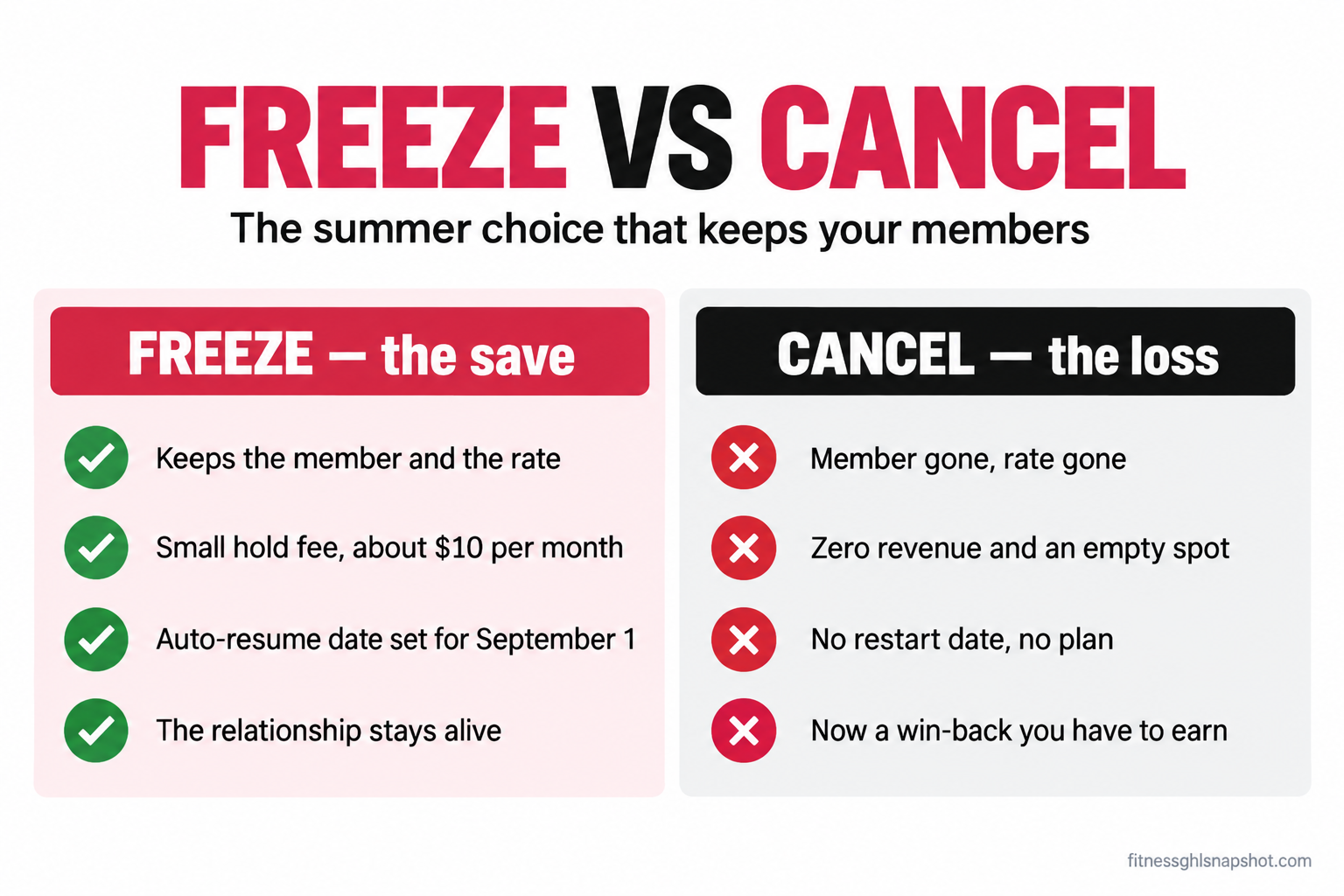
How to set it up. Make freeze the default response to any summer cancel request, and make it easy. Offer a low monthly hold fee (commonly $5 to $15) or a set number of free freeze weeks per year, with a clear auto-resume date. The auto-resume is the whole game: a freeze with no restart date is a slow cancel. Put the hold terms in writing and automate the “welcome back” that fires when the pause ends.
Steal this (the freeze-save text):
Totally get it, [First name]. Before you cancel, want to just freeze instead? You keep your rate and your spot, pay $10/month to hold it, and I’ll auto-resume you September 1. That way you’re not starting over in the fall. Want me to set the freeze up?
How it breaks. The freeze with no end date is the classic trap: it feels like a save but it is a cancellation in slow motion, because the member never comes back and you never charge them. Always set the resume date. The other failure is a freeze that is a hassle to request, so the member cancels out of friction. If pausing takes a phone call during business hours, you will lose the save. Make it a one-text yes. This is the same save-flow discipline that works on year-round membership cancellations; summer just concentrates the volume.
Mid-summer: catch the fader before the cancel
The quiet fader is the member you lose without a fight because you never noticed. They were a regular, their visits dropped off in July, and nobody said anything. Four weeks of silence later, they cancel, and it feels sudden, but it was visible the whole time if you were watching attendance.
How to set it up. Define a lapse trigger: no visit in 10 to 14 days for someone who used to come regularly. When a member crosses it, fire a warm, specific check-in, not a guilt trip. The tone is “we miss you and want to help,” never “you haven’t been here.” If they do not respond, a coach makes one personal follow-up. This is the summer version of the same signal-watching that catches silent churn all year.
Steal this (the attendance nudge text):
Hey [First name], noticed we haven’t seen you in a couple weeks and wanted to check in, everything good? Summer gets busy, no judgment. If you want, I’ll help you pick two realistic days to get back in this week. What works better for you, mornings or evenings?
How it breaks. The number-one mistake is making the member feel policed. “You have not attended in 14 days” reads like a parking ticket and pushes a wavering member toward the exit. Lead with care and offer a concrete, tiny next step (two days, this week), because “come back sometime” is too big to act on. The second failure is waiting too long. A nudge at day 30 is a win-back; a nudge at day 12 is a save, and saves are cheaper.
The failed-card double whammy
Summer is peak travel, and travel is peak payment failure: expired cards, replaced cards, fraud holds from out-of-town charges, and declines that nobody is home to fix. A failed charge you do not chase is not a glitch, it is involuntary churn, and in summer it stacks on top of everyone who is already half out the door.
How to set it up. The instant a charge fails, start a short, friendly recovery sequence: a same-day text, a backup email, and an easy one-tap link to update the card. Retry the charge on a schedule (for example day 1, day 3, day 7) rather than hammering it or giving up after one try. Keep the tone “your card just needs a quick update,” never “you owe us money,” because the vast majority of these are honest card problems, not people dodging payment. For the full mechanics, the failed-payment recovery playbook breaks down the dunning sequence step by step.
Steal this (the failed-card recovery text):
Hi [First name], quick heads up, this month’s payment didn’t go through (looks like a card update, super common). Here’s a 10-second link to fix it so your membership stays active: [link]. Thanks! [Gym]
How it breaks. Waiting is the killer. A card you chase in 48 hours gets fixed because the member still identifies as a member; a card you chase after 30 days gets ignored because they have mentally moved on. The other failure is a cold, accusatory tone that makes an honest card problem feel like a collections notice. Friendly and fast wins the charge back.
September: the re-engagement push
September is the mirror image of January: routines reset, kids go back to school, and people are ready to recommit. This is when you pull back everyone who drifted over summer, before they decide the lapse is permanent. The gym that runs a real September re-engagement push recovers a meaningful slice of the summer dip; the gym that just waits watches those members quietly cancel instead.
How to set it up. Build three lists and hit them in the first two weeks of September. First, the frozen members whose pause is ending (auto-resume plus a warm welcome-back). Second, the faders who went quiet but never cancelled (invite them to a fresh start). Third, the ones who did cancel over summer (a genuine win-back). Give each a concrete reason to come back now: a fall kickoff, a new class block, a “first week back is on us” session. The energy of the reset does half the work.
Steal this (the September welcome-back text):
[First name], welcome back, your membership resumes this week! Fall is the best time to rebuild momentum and the gym’s buzzing again. I saved you a spot in [class/time] to make the first one easy. See you there?
How it breaks. Treating September like any other month. The reset window is short and it is the single best re-engagement moment of the year, so if your win-back is a generic email in late September you have missed it. Hit it in the first two weeks, make it personal, and give a specific first step. For the members who fully cancelled, a structured win-back campaign converts far better than hoping they wander back.
Three real summer scenarios
The playbook is the same, but what you emphasize changes with your size and model. Here is how it actually plays out for three setups.
The solo or small-team personal trainer (20–100 clients)
Your summer risk is concentration: lose five clients to travel and that is real money, and you are the one who has to notice. Lean on: the May check-in (sent by hand, they land harder from you than from a brand) and the freeze. The trap: letting a traveling client cancel because you have no pause option. Build a simple summer hold (reduced rate or banked sessions) so “I’m away for a month” never has to mean “I’m cancelling.” At your scale, one saved client a month pays for every automation you set up.
The boutique studio (80–250 members, classes and waitlists)
Your summer risk is class fill rate and the freeze pileup. Half-empty classes read as low energy and quietly tell members it is fine to skip. Lean on: the June engagement reset (a challenge fills your best slots and creates social proof) and a clean, generous freeze policy with hard resume dates. The trap: collapsing the schedule in a panic. Cutting classes to match low attendance signals decline and trains members that the studio is winding down. Consolidate if you must, but protect the signature classes that carry your community.
The mid-size or multi-location gym (250–500+ members)
Your summer risk is scale and invisibility: the leaks are small per member, but there are hundreds of members and no front-desk person can watch them all by hand. Lean on: automated lapse triggers and failed-card recovery, because at your volume these cannot be manual. The trap: a 5% summer lapse on 400 members is 20 members, which at $140 is $2,800 a month walking out unnoticed. The fix is systematic, not heroic: triggers that watch attendance and billing for you. The lifetime value math makes the case obvious once you price what each of those members is worth over a year.
Illustrative monthly revenue at risk from a modest summer lapse at each size, at a $140 average membership: 5 of 100 clients (solo), 12 of 250 (studio), and 20 of 400 (mid-size). Your number depends on your rate and lapse rate; the dip is bigger than it feels.
The rules: freezes, auto-renewal, and texting in 2026
Three rules touch this playbook, and getting them wrong is more expensive than the slowdown itself.
Freezes and auto-renewal. A freeze changes your billing terms, so your membership agreement needs to say exactly how holds work: the fee, the maximum length, and the auto-resume date. If you think a federal rule makes cancellation and renewal simple, check the date: the FTC’s “click-to-cancel” Negative Option Rule was vacated by the Eighth Circuit on July 8, 2025, and is not in effect (Sidley, 2025). Your actual obligations run through state auto-renewal laws, which more than half of states have, with California’s among the strictest. Translation: your auto-resume after a summer freeze has to be clear and disclosed, not a surprise charge in September.
Texting. Every text here needs consent. Under the TCPA and the A2P 10DLC rules carriers enforce, you need the member’s permission to text, a clear opt-out (reply STOP), and a properly registered number. In practice this is easy: members opt in when they join, and good software handles STOP automatically. Do not buy a list and text strangers a summer offer.
Results claims. If your June challenge markets a transformation, the FTC Endorsement Guides apply. Use honest, typical outcomes and a plain “results vary” line, and if you show member before-and-afters, make sure they are real and disclosed.
Questions operators ask about the summer dip
“Isn’t a summer slowdown just normal? Why fight it?” It is normal, which is exactly why it is worth fighting. Normal means predictable, and predictable means you can build a system for it in advance. The gyms that accept the dip lose members every summer; the ones that plan for it keep most of them. Normal is not the same as unavoidable.
“Won’t freezes just cost me revenue I’d otherwise keep?” No, and this is the most common mistake. The choice is almost never “full price versus freeze.” It is “freeze versus cancel.” A member who asks to pause has already decided they are not paying full price for July. A $10 hold fee and a September resume keeps the relationship and the rate; forcing the issue just hands them a reason to leave entirely.
“Do I need to be technical to run any of this?” No. The hard part is not the software, it is deciding the triggers and writing the messages once, which you just got above. The texts send themselves off attendance and billing data, so the work happens while you coach. The gap most gyms have is not skill, it is time, which is why it has to be automated rather than remembered.
“I already send a summer email blast. Isn’t that enough?” A blast beats nothing, but it is not a system. The dip is not solved by one email to everyone; it is solved by the right message to the right member at the right moment (the fader at day 12, the freeze request in the moment, the failed card in 48 hours). Timing and targeting are the whole game, and a single blast has neither.
The bottom line
The gym summer slowdown is not bad luck and it is not your members losing interest in you. It is a predictable season of quiet leaks: faded attendance, freeze requests, and failed cards that drift into September cancellations if nobody is watching. You cannot recruit your way out of it, because sign-ups bottom out in exactly these months. You beat it by treating summer as a retention season and running the same six moves every year: get ahead of it in May, reset engagement in June, turn every cancel into a freeze, catch faders before they quit, recover failed cards fast, and run a real re-engagement push in September.
Most of what leaks in summer is recoverable, but only if the save happens on time, which means it has to be built, not remembered. Write the messages once, point them at the members who are actually at risk, and let the system work while you run your gym. That is the difference between a summer you dread and a summer you planned for.
Frequently asked questions
Why do gyms slow down in the summer?
Three things happen at once. Members travel and skip workouts, so attendance drops and a thin habit gets thinner (average attendance is already only about 1.5 visits per week, down from 2.1 in 2019, per the HFA). Freeze and pause requests spike as people leave town. And failed card payments climb, because summer is peak travel. None of it looks like mass cancellation in the moment, but it drifts into cancellations by September.
How much does the summer slowdown actually cost a gym?
It is bigger than it feels because it is spread across three months. For a 300-member gym at a $140 average membership, a 6% summer lapse is about 18 members, or roughly $2,520 a month, and it compounds because paused members who never hear from you become fall cancellations. Add involuntary churn from unfixed failed cards and the number climbs. Most of it is recoverable if you act on time.
Should I let members freeze their membership over summer?
Yes, almost always, because the real choice is freeze versus cancel, not freeze versus full price. A member asking to pause has already decided not to pay full price for the weeks they are away. A freeze with a small hold fee and a clear auto-resume date keeps the relationship, the rate, and usually a small charge. Just never offer a freeze without a set restart date, or it becomes a slow cancellation.
What's the best way to win back members who drifted over summer?
Run a focused re-engagement push in the first two weeks of September, when routines reset. Split your list into three: frozen members whose pause is ending (auto-resume plus a warm welcome-back), faders who went quiet but never cancelled, and people who fully cancelled. Give each a concrete reason to come back now, like a fall kickoff or a free first session, and make the first step specific and easy.
When should I start preparing for the summer slowdown?
May, before anyone has gone quiet. Pull two lists: members whose attendance already dropped in April, and members who froze or lapsed last summer. Reach out with a warm, no-pressure check-in that frames summer flexibility as something you are planning together. Getting ahead of it in May makes the rest of the summer automated reaction rather than scramble.
Are there legal rules around freezing memberships and texting members?
Yes. A freeze changes your billing terms, so your agreement must state the hold fee, maximum length, and auto-resume date clearly; your obligations run through state auto-renewal laws (the federal FTC click-to-cancel rule was vacated in July 2025 and is not in effect). Texts need consent and a clear opt-out (reply STOP) under the TCPA and A2P 10DLC carrier rules. Challenge marketing with transformation claims should follow the FTC Endorsement Guides with an honest 'results vary' disclosure.
Written by Divya Kapoor, Member Retention & Lifecycle Specialist. Divya ran member experience for a three-location boutique pilates and yoga group before joining the team to design retention systems. She is the person who noticed that silent churn, not formal cancellations, eats most of a studio’s revenue, and she spends her time in the unglamorous lifecycle data that tells you who is about to leave before they do.