
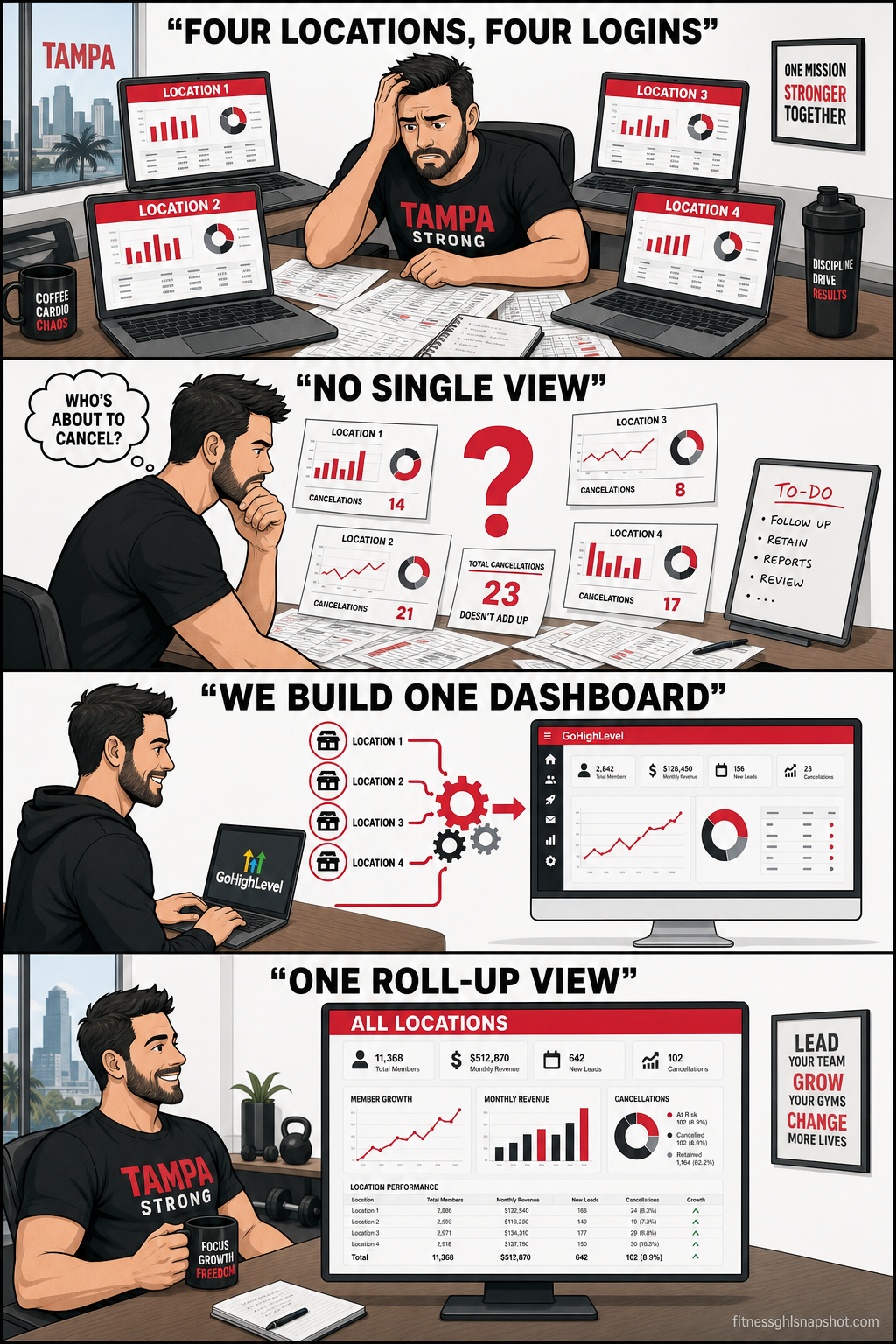
Running two or more gym locations on GoHighLevel usually means one sub-account per site — a separate login, a separate pipeline, and a separate set of numbers for each studio, with no built-in way to roll them up into a single view. That’s fine at one location. At three or four, it quietly becomes the most expensive blind spot in the business: you can’t see which studio is bleeding members, whose show-rate is slipping, or where a lead got dropped, without logging into each account and rebuilding the same spreadsheet by hand. The fix isn’t leaving GoHighLevel — it’s a custom GoHighLevel development layer that pulls every location into one roll-up dashboard, so you manage the group instead of babysitting four accounts.
I spent eight years on the floor and front desk of a fast-growing box before I moved into building GoHighLevel automation full time, and I’ve watched the same thing happen to every operator who opens a second and third location: the systems that ran one gym beautifully start hiding the numbers that matter across the group. This is the operator’s breakdown for Tampa — why the silo happens, what it costs, and exactly what custom GHL work fixes.
Table of contents
- The short answer for multi-location Tampa operators
- Why gyms end up with four GoHighLevel logins
- What the silo actually costs — the data
- The four things multi-location operators can’t see
- Why Tampa is exactly the market where this bites
- What custom GoHighLevel development fixes
- Default GHL vs off-the-shelf vs custom
- Is custom GHL development worth it for your gym group?
- The bottom line
- FAQ
The short answer for multi-location Tampa operators
If you run studios in South Tampa, a box in Seminole Heights, and a third location out in Brandon or St. Pete, the compressed verdict is this:
- GoHighLevel is the right platform — the default multi-location setup is the problem. GHL’s sub-account model gives each site its own clean workspace, but there is no native “group” view that sums four locations into one dashboard. That reporting job lands on you, in a spreadsheet, every week.
- The cost isn’t the software fee — it’s the blindness. What you can’t see across locations, you can’t manage: silent churn in one studio, a coach whose show-rate is sliding, leads that fall between two sub-accounts. It leaks quietly and never shows up as a line item.
- The fix is custom development on top of GHL, not a rip-and-replace. A custom GoHighLevel build reads every sub-account through the GHL API and rolls it into one dashboard — retention and churn-risk by location, show-rate by class and site, a single lead queue. You keep everything you’ve built; you just finally see it in one place.
The rest of this article is the why, with the numbers — and an honest look at when a custom build is worth it and when it isn’t.
Why gyms end up with four GoHighLevel logins
Nobody plans a fragmented back office. It happens by accident, in four predictable steps:
- Location one gets built right. You wire up a trial funnel, no-show recovery, a retention sequence, and clean pipelines inside one GoHighLevel sub-account. It works. Members convert, and the follow-up runs itself.
- Location two gets a copy. Rather than risk breaking what works, you clone the setup into a second sub-account. Now there are two logins, two pipelines, two sets of numbers — and no relationship between them.
- Locations three and four repeat the pattern. Each new studio is its own island. Your point-of-sale or check-in tool (PushPress, Mindbody, Zen Planner, or a door system) is also per-location, so the disconnected count doubles again.
- You become the integration layer. The only place the four locations “connect” is your head, and a Monday spreadsheet you rebuild by hand. You’re the human API between four systems that never talk to each other.
This isn’t a GoHighLevel flaw — it’s how sub-accounts are supposed to work. A sub-account is a walled workspace so one location’s data never bleeds into another’s. That isolation is exactly right for running a single site and exactly wrong for running a group. The moment you want to compare studios, spot the weakest performer, or route a lead to the nearest location, the walls that protected you become the thing in your way. (If you’re still standing up your first GHL account, start with GHL for gyms: getting started — build it clean before you clone it.)
What the silo actually costs — the data
Disconnected systems are not a gym-specific quirk. They’re the default state of modern business — which is exactly why it’s worth measuring the cost.
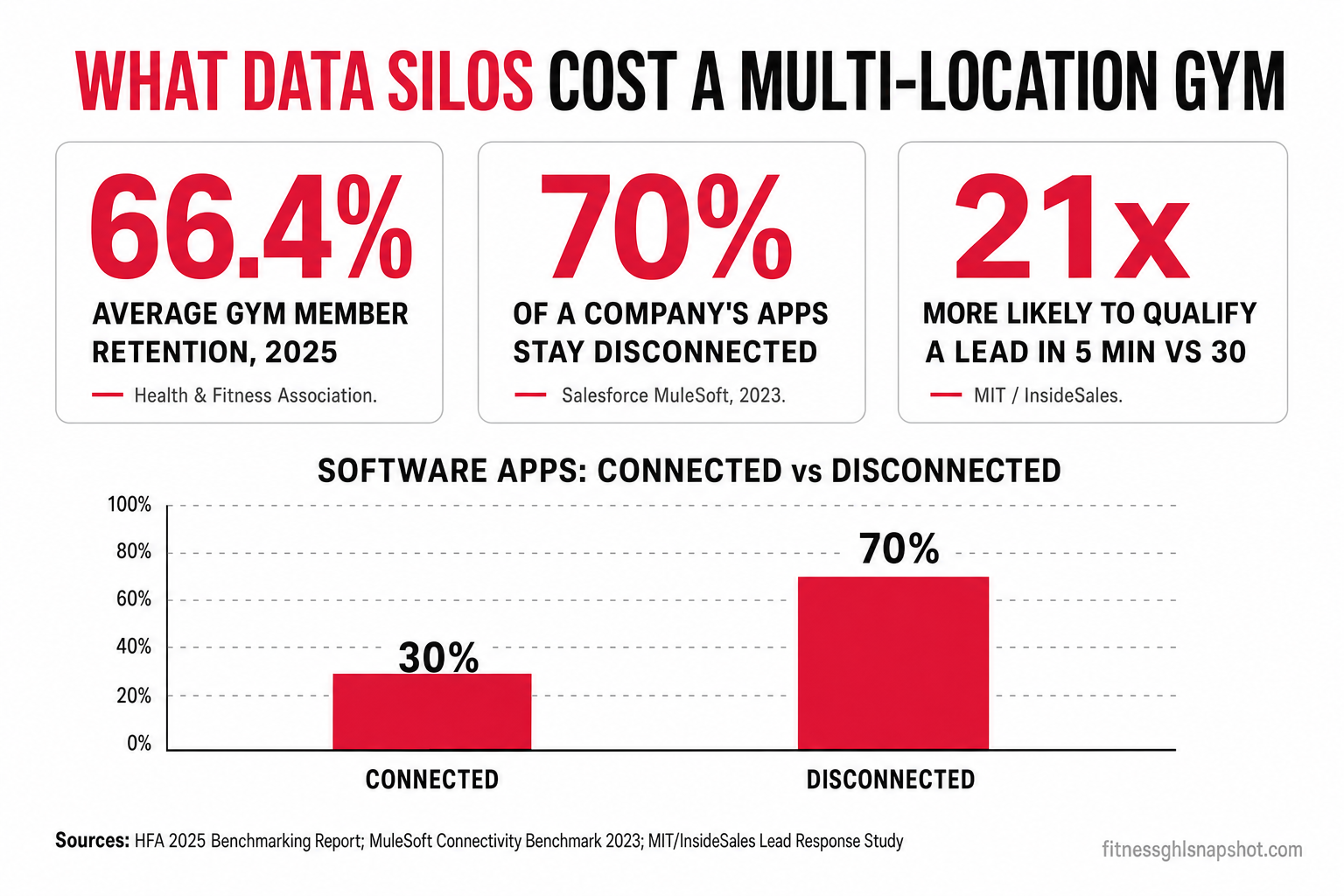
Start with the members, because that’s the number that pays your rent. Average gym member retention was just 66.4% in 2025, according to the Health & Fitness Association’s 2025 Benchmarking Report — a study drawn from 175 companies representing more than 17,000 fitness facilities. About one in three members walks each year, and most of it is silent churn: people who quietly stop showing up because nothing reached out in time. Now run that across four locations you can only see one at a time. If the box in Brandon is retaining at 71% and the St. Pete studio at 58%, that 13-point gap is the single most important fact about your business this quarter — and the default setup buries it in two separate logins.
Then the plumbing. The average organization runs more than 1,000 applications and leaves roughly 70% of them disconnected from one another, per the Salesforce MuleSoft Connectivity Benchmark (the 2025 edition puts it at only 29% integrated). Disconnected data isn’t just untidy — it’s data a human has to move by hand. That’s why analysts spend about 28% of their time simply preparing data before anyone can use it (Solutions Review). For a gym owner with no analyst, you are that 28%, and it’s coming out of coaching and selling time — the same trap that turns owners into unpaid CRM admins.
Across the average organization, only about 30% of applications are connected to each other — roughly 70% stay siloed. A multi-location gym on separate GoHighLevel sub-accounts plus per-location booking and check-in tools sits squarely in that 70%. Source: Salesforce MuleSoft Connectivity Benchmark, 2023.
And the silo doesn’t just hide problems — it slows the response that wins members. A web lead is up to 21x more likely to be qualified when you respond within 5 minutes instead of 30, per the landmark MIT / InsideSales Lead Response Management Study (15,000+ leads, 100,000+ call attempts). When a trial request lands in one location’s sub-account but the nearest available front desk is at another, the clock runs out before anyone even sees it.
Relative likelihood of qualifying a web lead by response speed: replying within 5 minutes is up to 21x more effective than waiting 30. Cross-location lead routing is what keeps the clock from running out. Source: MIT / InsideSales Lead Response Management Study.
The four things multi-location operators can’t see
Strip away the jargon and the silo hides exactly four things — and each one maps to money.
- Roll-up reporting. How is the group doing — members, revenue, trial conversion, MRR — this week versus last, without opening four accounts? The HFA’s 2025 report pegs median member growth at +5.5% and median revenue growth at +9.9% across the industry (HFA); you can’t tell whether your group is beating or trailing that if the numbers never sum.
- Churn-risk by location. Which members at which studio have gone quiet — no check-in, no booking, no reply — and are about to cancel? A per-location churn-risk score is the difference between saving a member and reading their cancellation email.
- Show-rate by class and site. Which locations and time slots have sliding attendance before it becomes empty classes and frustrated coaches? Show-rate is a leading indicator; the silo turns it into a lagging one.
- Cross-location lead routing. A prospect in downtown Tampa fills in a form — does it go to the nearest studio with an open trial slot, instantly, or sit in whichever sub-account the ad happened to point at? Given the 21x speed-to-lead math above, this is pure revenue.
None of these require abandoning GoHighLevel. All of them require something GHL doesn’t do out of the box: read across sub-accounts and present the group as one thing.
Why Tampa is exactly the market where this bites
Location matters here, because the pain scales with growth — and Tampa Bay is growing fast. The metro is now home to more than 3.4 million people, and roughly 53,836 new residents moved in between mid-2023 and mid-2024 alone (Axios Tampa Bay, citing Census data). Planning agencies project the region will add around 397,000 more residents by 2030 (Plan Hillsborough).
For a gym operator, in-migration means one thing: trial-lead volume, and the pressure to open more locations to catch it. That’s the growth curve that turns a two-location setup into a four-location one — and the exact point where siloed sub-accounts stop being a minor annoyance and start being the ceiling on how big you can run cleanly. Tampa operators aren’t unusual for hitting this wall; they’re just hitting it sooner because the market is handing them the growth.
It’s a national pattern underneath. The U.S. now counts about 55,294 health-club and studio locations serving 77 million members (Health & Fitness Association), and the segment is increasingly franchise- and multi-unit-operated — Planet Fitness alone runs 2,896 clubs, 89.9% of them franchisee-operated (Club Solutions Magazine). Multi-location is where fitness is going. The tooling has to follow.
What custom GoHighLevel development fixes
Here’s the good news: the fix is additive. You don’t migrate, you don’t rebuild, and you don’t ask your front desk to learn a new system. A custom GoHighLevel development layer sits on top of the sub-accounts you already have and reads them through the GHL API.
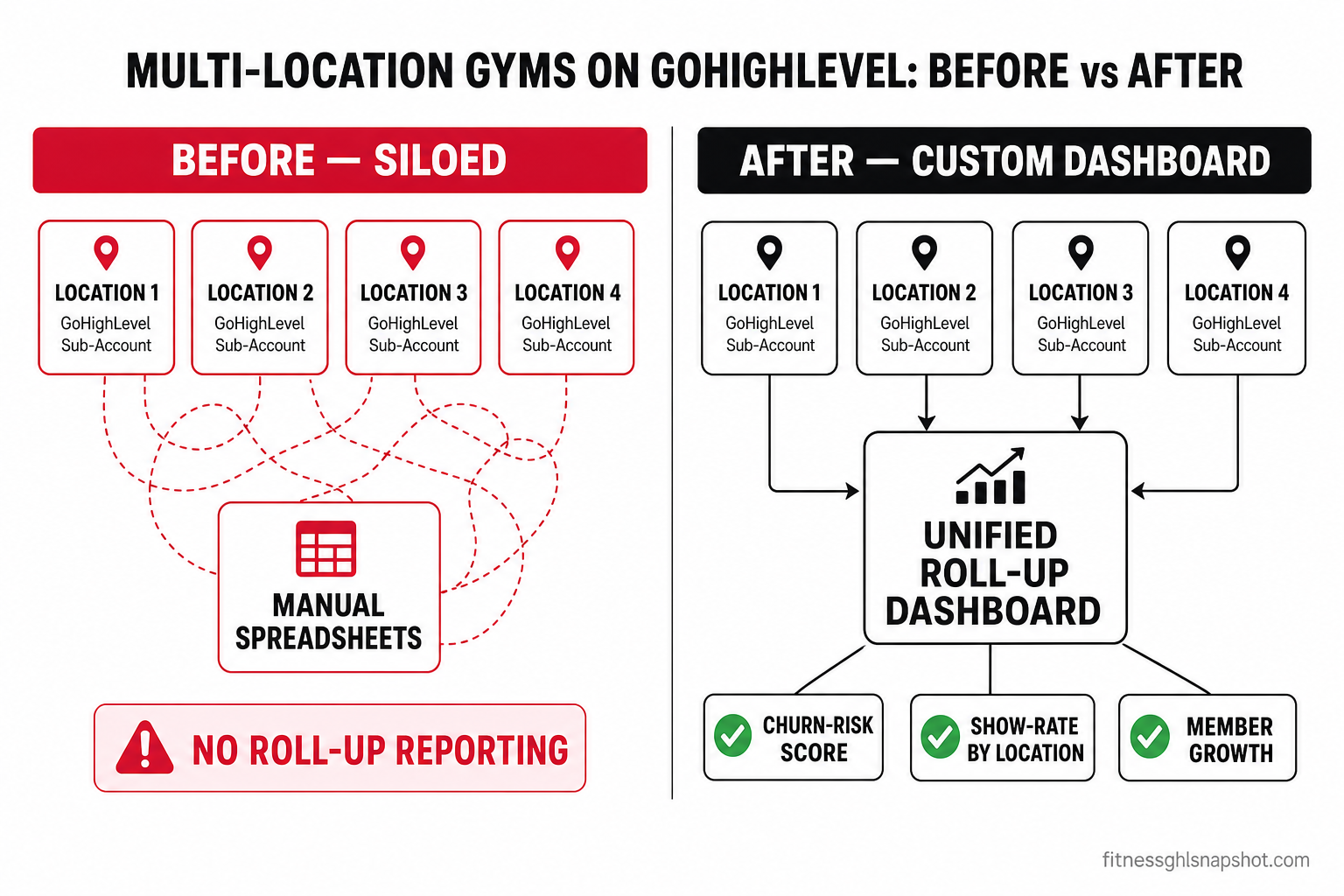
Concretely, that means:
- A unified roll-up dashboard. One screen that sums every location — members, MRR, trials booked, trial-to-member conversion, no-show rate — with per-location breakdowns underneath. Your Monday spreadsheet becomes a live view.
- A churn-risk score per member, per location. Pull attendance and engagement signals from GHL (and your check-in tool) into a simple flag: green, watch, at-risk. The retention workflows you already run get pointed at the members who actually need them, at whichever studio they’re in.
- Cross-location integrations. Two-way sync between GoHighLevel and PushPress, Mindbody, Zen Planner, or Trainerize — across every location, not one at a time — so attendance and membership status stay in agreement everywhere. (This is the multi-site version of a single integration playbook.)
- Franchise roll-up and lead routing. Group-level reporting for owners or franchisors, plus a shared lead queue that routes each inbound trial request to the nearest location with capacity — fast enough to matter.
This is standard custom-GHL work, not moonshot engineering. The same discipline that powers a clean Mindbody-to-GoHighLevel migration or a purpose-built custom software layer for a growing gym builds the roll-up dashboard — it’s read-and-present against the GHL API, scoped to a fixed timeline.
Default GHL vs off-the-shelf vs custom
There are three honest ways to run a multi-location gym’s data. Here’s the trade-off, without spin.
Three ways to run multi-location gym data
| Plan | Default GHL sub-accounts | Off-the-shelf multi-site software | Custom GHL dashboard (ours) recommended |
|---|---|---|---|
| Price | Included, but manual | $$$ /mo, often per location | One-time build |
| Feature 1 | Separate login per location | Some group reporting built in | One roll-up view across every sub-account |
| Feature 2 | No native cross-location roll-up | Rigid — reports the vendor decided you need | Churn-risk + show-rate by location, built for you |
| Feature 3 | Weekly reporting done by hand in spreadsheets | Per-location fees stack as you grow | Cross-location integrations & lead routing |
| Feature 4 | Churn visible only one studio at a time | No custom churn-risk score for your programs | Built on the GHL you already run — no migration |
| Feature 5 | Leads land in whichever account the ad points at | New platform for your team to learn | Fixed scope, fixed timeline, 30-day bug-fix warranty |
| Get a build quote |
The default option is “free” only if your Monday mornings are free. Off-the-shelf multi-site platforms solve reporting but hand you someone else’s idea of the right metrics — and re-introduce the migration and per-location-fee problems you were trying to escape. Custom development is the one path that keeps GoHighLevel, fits your actual programs, and stops charging you again every time you open a location.
Is custom GHL development worth it for your gym group?
Straight answer: it depends on how many locations you run and what a lost member is worth to you. Custom work isn’t the move for everyone, and I’d rather tell you that up front.
It’s probably worth it if:
- You run two or more locations on GoHighLevel and already rebuild a manual report to compare them.
- A member is worth several hundred to a few thousand dollars in lifetime value, so catching churn a week earlier pays for the build quickly.
- You’re planning to open more — a dashboard built at three locations scales to six for near-zero marginal effort.
- You’re an agency or franchisor reselling GHL to fitness clients and need group roll-ups to prove value.
It’s probably not worth it yet if:
- You run a single location — the standard snapshot and its 50+ workflows already give you everything you need in one account.
- You’re pre-revenue or very early, where the honest first move is nailing trial-to-member conversion at one site before you optimize a group.
- Your locations are genuinely independent businesses with no shared reporting need.
If you’re not sure which bucket you’re in, that’s exactly what a scoping call is for — you’ll get a straight read on whether a build pays for itself, not a pitch. We scope every project up front with a fixed timeline, and if a build genuinely isn’t the right call, we’ll say so.
The bottom line
GoHighLevel is the right platform to run a multi-location gym on. The default setup — one walled sub-account per site — is what quietly caps how big you can run cleanly. It hides your weakest studio, buries churn you could have caught, and slows the lead response that wins members, all while eating your Monday mornings in spreadsheets.
You don’t fix that by leaving GHL. You fix it by building the one thing GHL doesn’t do out of the box: a view of the whole group. For a Tampa operator riding real market growth, that dashboard is the difference between managing four accounts and running one business.
Frequently asked questions
Multi-location GoHighLevel, answered
Can GoHighLevel show one dashboard across multiple gym locations?
Not out of the box. GoHighLevel isolates each location in its own sub-account, and there's no native report that sums two or more sub-accounts into a single group view. To see members, revenue, trial conversion, and churn across every studio on one screen, you need a custom dashboard built on top of GHL that reads each sub-account through the GoHighLevel API and rolls the numbers up. That's a standard custom GHL development project, not a platform switch.
Do I have to migrate off GoHighLevel to get roll-up reporting?
No — and that's the point. A custom roll-up dashboard is additive: it sits on top of the sub-accounts you already have, so your funnels, pipelines, workflows, and team's day-to-day don't change. You keep everything you've built in GHL and simply gain a group-level view. Migration is only relevant if you're moving to GoHighLevel from another platform, which is a separate project.
How much does a custom multi-location GHL dashboard cost?
It's scoped per project as a fixed-price build rather than a per-location monthly fee, so the cost doesn't stack every time you open a studio. The right way to price it is a short scoping call where we map exactly which locations, metrics, and integrations you need. Every fixed-price build includes a 30-day bug-fix warranty, and ongoing upkeep can run through a dedicated GHL VA or an hourly retainer. Book a call for a quote.
Can you connect PushPress, Mindbody, or Zen Planner across all my locations?
Yes. We build two-way syncs between GoHighLevel and PushPress, Mindbody, Zen Planner, Trainerize, and similar tools — across every location, not one at a time — so attendance, membership status, and check-in data stay in agreement everywhere. That cross-location sync is what makes an accurate churn-risk score and a shared lead queue possible in the first place.
I only run one gym. Do I need this?
Probably not yet. A single location gets everything it needs from a well-built GoHighLevel account and the standard snapshot workflows — trial funnels, no-show recovery, retention nudges — all in one sub-account with no roll-up needed. Custom dashboards start paying off at two or more locations, or when you're actively planning to expand.
Is this useful for a GHL agency serving fitness clients?
Very. If you resell GoHighLevel to gym and studio clients, group roll-up reporting and franchise-level dashboards are exactly what prove your value and justify retention. The same custom build that serves a four-location operator serves an agency managing multiple gym sub-accounts — one view of every client's performance. Start at GHL development.
About the author — Bryce Kendrick, Fitness Growth Strategist & GHL Snapshot Lead. Bryce spent eight years managing the floor and front desk at a fast-growing CrossFit box before moving full-time into GoHighLevel automation for gyms. He has built trial-to-member funnels for boxes, F45 franchises, and independent strength studios across Texas, and he obsesses over the seven days around a prospect’s first class. He writes the way he coaches: direct, numbers-first, and allergic to fluff.
Related posts
- GoHighLevel VA for Atlanta Gyms: What Running It Yourself Really Costs — who keeps the automations healthy across locations.
- Custom Software for NYC Gyms: When Off-the-Shelf Stops Scaling — when a gym outgrows the tools it started on.
- How to Connect Your Gym’s Software to GoHighLevel — the single-integration playbook behind cross-location sync.
- Stop Silent Churn: Catch At-Risk Members Before They Ghost — the workflow a churn-risk dashboard points at.
- Migrate a Gym From Mindbody to GoHighLevel — moving onto GHL cleanly, one location at a time.
Outcomes vary by operator effort, market conditions, pricing, and how completely a system is implemented. Statistics are sourced and current as of publication; see linked sources for methodology.