
To get your Raleigh gym recommended by ChatGPT, Google’s AI Overviews, and Perplexity, you need Answer Engine Optimization (AEO): a claimed and accurate Google Business Profile, answer-first pages that directly respond to the questions prospects ask, valid structured data (schema) that tells the machines exactly what you are and where, and a fast, clean, crawlable website with a maintained llms.txt. Do those things and the AI answer that a Raleigh gym-goer sees when they type “best CrossFit box near me” starts including your name — before they ever scroll a list of ten blue links. Ignore them and you become invisible in the exact moment more people are searching this way.
I’ve spent years buying local ads for gyms and martial-arts schools, and the pattern is always the same: the funnel behind the click matters more than the click. AI search is the same story, one layer earlier. The “auction” is now happening inside the answer box, before a human ever chooses which website to open. This is the operator’s guide to winning that box in Raleigh — what AEO and GEO actually are, why they matter right now, and the seven concrete steps to get your studio cited, with the sourced numbers behind each one.
Table of contents
- The short answer for Raleigh gym owners
- Why AI search now decides who finds your gym
- AEO vs GEO vs SEO: what the terms actually mean
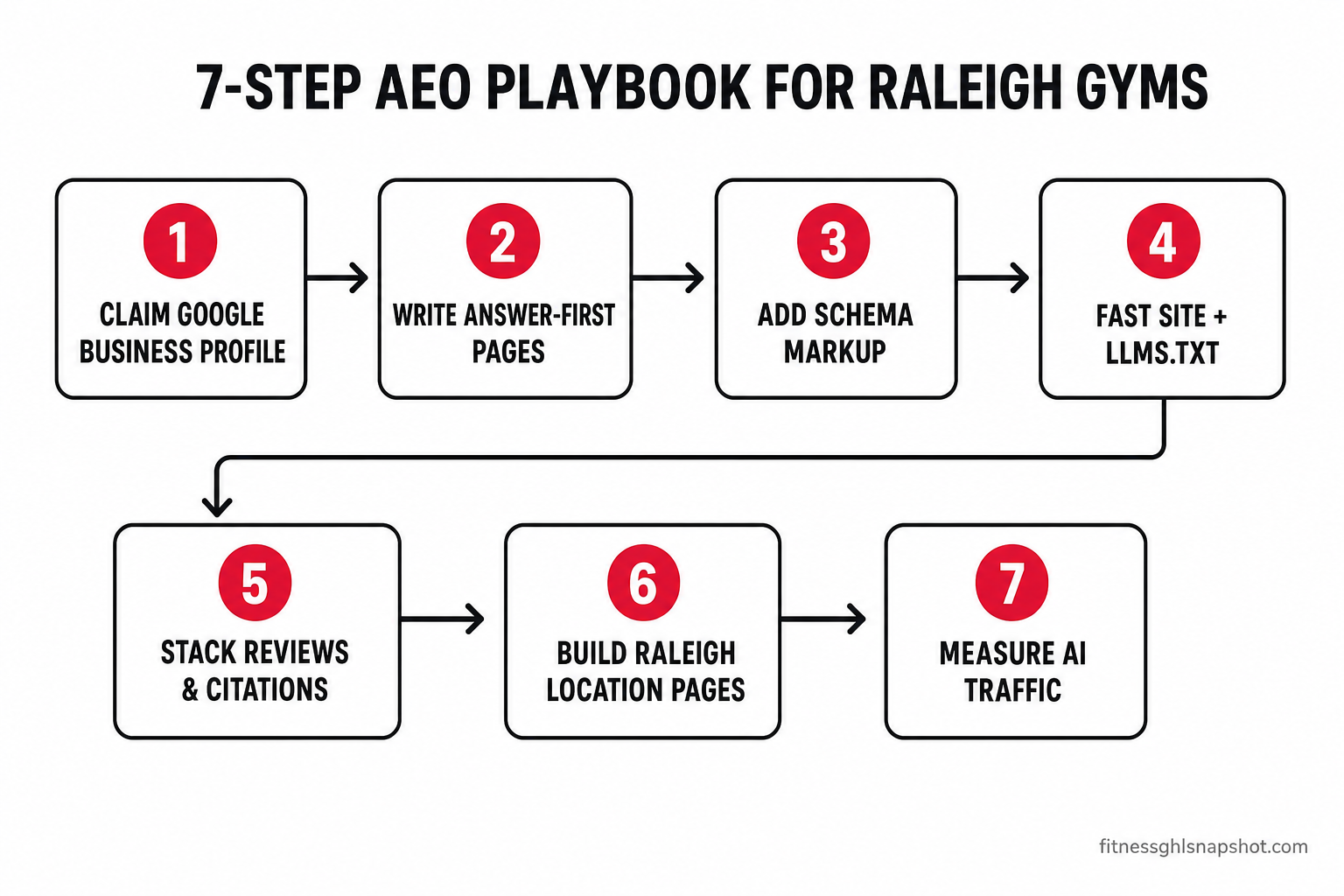
- The 7-step AEO playbook for Raleigh gyms
- What showing up in AI search is worth
- Do it yourself vs done-for-you
- FAQ
The short answer for Raleigh gym owners
If you run a box in Downtown Raleigh, a reformer studio in North Hills, or a PT business near NC State, here’s the compressed version of what wins the AI answer:
- Claim and perfect your Google Business Profile. It’s the single biggest input into local AI answers and the Map Pack. Your name, address, and phone (NAP) must be identical everywhere.
- Answer real questions in plain text on your site. AI engines quote self-contained passages. A page that clearly says “Our Raleigh gym offers a free 7-day trial, drop-in passes, and month-to-month memberships” is quotable; a hero image with the words baked into a graphic is not.
- Add structured data.
LocalBusiness/SportsActivityLocationandFAQPageschema tell the machines what you are, where you are, your hours, and your prices — in a format they trust. - Be fast and crawlable. If your site is slow or renders everything in JavaScript, AI crawlers struggle to read it. A static, fast page with a clean
robots.txtandllms.txtis easy to read and quote. - Stack local proof. Reviews, consistent citations, and Raleigh-specific content are the signals that make an AI confident enough to name you specifically.
The rest of this article is the how, with the numbers. None of it is exotic. It’s the same fundamentals that win local SEO — pointed at a new front door.
Why AI search now decides who finds your gym
For a decade, “getting found” meant ranking on Google’s first page. That’s still true, but a second front door has opened fast — and a lot of your prospects now walk through it first.
Start with adoption. Pew Research Center found that 49% of US adults use AI chatbots as of 2026, up from 33% in 2024 and just 23% in 2023, and that 60% of adults have read an AI-generated search summary (Pew Research Center). Separately, Pew reported that 34% of US adults had used ChatGPT by mid-2025, roughly double the share two years earlier (Pew Research Center). ChatGPT itself grew to around 800 million weekly active users by late 2025 and about 900 million by early 2026 (TechCrunch).
Share of US adults who use AI chatbots, by year. Source: Pew Research Center, 2026.
At the same time, Google is answering more searches on the results page itself. Semrush’s study of over 10 million keywords found AI Overviews grew from appearing on 6.49% of queries in January 2025 to 15.69% by November, peaking near 25% mid-year (Semrush). The knock-on effect: in 2026, fewer than one in three Google searches still sends a click to the open web, according to clickstream analysis (SparkToro).
Percentage of Google queries that showed an AI Overview across 2025. Source: Semrush AI Overviews study, 2025.
Read those two trends together and the takeaway for a Raleigh gym is blunt: a growing share of people who want to work out are getting a named recommendation from a machine, often without clicking anything. If the machine doesn’t know you exist — or can’t read your site well enough to be confident — it recommends the box down the street instead.
AEO vs GEO vs SEO: what the terms actually mean
Three acronyms get thrown around. Here’s the plain-English version for an operator:
- SEO (Search Engine Optimization): getting your pages to rank in the traditional list of links on Google. Still essential — AI engines often pull from the same top-ranking, well-structured pages.
- AEO (Answer Engine Optimization): structuring your content so an answer engine — Google AI Overviews, ChatGPT, Perplexity — can extract a clean, correct answer and cite you. Think self-contained paragraphs, clear headings that match questions, and FAQ schema.
- GEO (Generative Engine Optimization): the broader practice of getting mentioned and recommended inside generative AI answers, including the local signals (reviews, citations, entity clarity) that make an AI confident enough to name a specific business.
You don’t have to pick one. In practice they overlap: the same clean, fast, well-structured, locally-proven site wins all three. What’s changed is that “well-structured and machine-readable” went from a nice-to-have to the thing that decides whether you’re quotable at all.
The 7-step AEO playbook for Raleigh gyms
Here’s the operator’s checklist, in order. Do them top to bottom.
Step 1 — Claim and perfect your Google Business Profile
Your Google Business Profile (GBP) is still the biggest single input into local AI answers, the Map Pack, and “near me” results. Claim it, verify it, and fill in everything: correct category (e.g. “Gym,” “Personal Trainer,” “Yoga Studio”), hours, phone, website, service area, photos, and attributes. Make sure your NAP — name, address, phone — is byte-for-byte identical on your site, GBP, and every directory. Inconsistent NAP is the fastest way to make an AI unsure which business you are.
This isn’t optional busywork. BrightLocal’s 2024 survey found 93% of consumers searched online for a local business in the past year (BrightLocal), and Google’s own research found 76% of people who search for something nearby on their phone visit a related business within a day (Think with Google). Local intent is high-intent, and GBP is where it lands.
Step 2 — Write answer-first pages that answer real questions
AI engines quote self-contained passages. The single highest-leverage writing change you can make is to answer the question in the first sentence, then support it.
Instead of a hero that says “Welcome to the Triangle’s premier fitness experience,” write a line a machine can lift verbatim: “Iron Oak Fitness is a strength-and-conditioning gym in Downtown Raleigh offering a free 7-day trial, month-to-month memberships from $99, and 6 a.m.–9 p.m. hours.” Build pages and FAQs around the actual questions prospects ask — “how much is a gym membership in Raleigh,” “do Raleigh gyms have free trials,” “best beginner gym near NC State” — and answer each in plain, quotable text near a matching heading.
Step 3 — Add structured data (schema)
Structured data is how you hand the machines a labeled, machine-readable summary of your business: what you are, where, your hours, your prices, your FAQs. Use LocalBusiness (or the more specific SportsActivityLocation), Organization, and FAQPage schema in JSON-LD.
Does it move anything? Google publishes case studies of exactly that: pages shown as rich results earned up to 82% higher click-through for Nestlé, Rotten Tomatoes saw a 25% higher CTR on pages with structured data, and Food Network reported a 35% increase in return visits (Google Search Central).
Sources: Google Search Central (structured-data case studies); Pew Research Center, 2026.
If schema sounds like developer territory, that’s the point of a done-for-you build — see Step 4.
Step 4 — Ship a fast, crawlable site with llms.txt
AI crawlers are like fast, impatient readers. If your site is slow, or renders its content with heavy JavaScript that only appears after the page hydrates, crawlers can miss the very text you want quoted. A static, fast page with clean HTML is the easiest thing for both Google and an AI engine to read.
Two files matter here. A correct robots.txt lets the right crawlers in (including AI bots you want indexing you). And an emerging standard, llms.txt, is a plain-text file that gives AI models a clean, curated map of your most important pages — your trial offer, pricing, hours, location — in a format built for them. This is exactly why we build gym sites on the Astro framework: static-first pages that load fast and ship a maintained llms.txt and clean sitemap by default. (For the page-speed side of the same argument, see our breakdown of Astro vs WordPress gym websites and why speed to lead compounds it.)
Step 5 — Stack reviews, citations, and entity signals
An AI won’t confidently recommend a business it isn’t sure is real and reputable. You build that confidence with entity signals: a steady flow of recent Google reviews, consistent citations (Yelp, Apple Maps, fitness directories) with matching NAP, and mentions of your gym around the Raleigh web. Reviews do double duty — they feed the AI’s trust and they give it fresh, specific language to quote (“great beginner coaching,” “clean facility near Cameron Village”). Automating review requests after a member’s first month is one of the highest-ROI habits a gym can build; here’s the Google reviews automation playbook and the broader local SEO guide for gyms.
Step 6 — Build a Raleigh-specific content layer
Generic content ranks generically. To be the gym an AI names for Raleigh searches, you need pages that are unmistakably about Raleigh: neighborhood-specific location pages (Downtown, North Hills, Cary, near NC State), local landmarks, parking, and the questions Triangle residents actually ask. This is what turns “a gym” into “the gym in your neighborhood” in the model’s mental map. It matters more here than in most cities: Axios reported that downtown Raleigh now has 23 fitness businesses, 15 of which opened since the pandemic, and that 11 of downtown Durham’s 19 studios opened in just the past two years (Axios Raleigh). In a crowded market, specificity is how you get singled out.
Step 7 — Measure AI referral traffic and iterate
You can’t improve what you don’t watch. Add your site to Google Search Console, and in your analytics, segment referral traffic from AI sources (chatgpt.com, perplexity.ai, gemini, and Google AI Overviews). Watch whether AI-referred visits are growing and how they behave — then double down on the pages the engines are actually quoting. The reason to bother: Adobe found traffic from generative-AI sources doesn’t just grow fast, it converts — AI-referred visitors browse more pages and bounce less, and during the 2025 holiday season Adobe measured AI-referred shoppers converting about 31% more than other traffic (Adobe Analytics).
What showing up in AI search is worth
Let’s put dollars around it. The US fitness market is at a record high — health and fitness facilities served 77 million members in 2024, up 5.6% year over year, roughly one in four Americans age 6 and up (Health & Fitness Association). Demand isn’t the problem in Raleigh; visibility at the moment of decision is.
That moment is increasingly an AI answer, and the traffic it sends is unusually good. Adobe Analytics found generative-AI referral traffic to US sites surged roughly 1,200% between July 2024 and February 2025, and that those visitors were more engaged than average — longer sessions, lower bounce, more pages per visit (Adobe Analytics).
Sources: Pew, Semrush, Adobe Analytics, Health & Fitness Association.
Do it yourself vs done-for-you
You can do all seven steps yourself. Plenty of operators do. The honest trade-off is time and technical depth: schema, llms.txt, fast static pages, and location-page architecture are exactly the parts most gym owners don’t have the hours (or the developer) to maintain well.
AEO for your Raleigh gym: DIY vs done-for-you
| Plan | Done-for-you (Get a Website) recommended | Do it yourself |
|---|---|---|
| Price | $97/mo + $499 one-time | Your time + tools |
| Feature 1 | Fast Astro site, guaranteed 90+ PageSpeed | Fast site depends on your platform & upkeep |
| Feature 2 | Schema, sitemap, robots.txt & llms.txt shipped by default | You hand-write JSON-LD schema & maintain llms.txt |
| Feature 3 | Raleigh location & FAQ pages built for you | You build and update every location page |
| Feature 4 | Prices & timetable refreshed weekly | You keep prices & hours current everywhere |
| Feature 5 | Researched local articles published for you | You research and write every article |
| Feature 6 | Managed hosting, domain & SSL included | You manage hosting, security & updates |
| See website plans | — |
Our Get a Website service is built for exactly this: a blazing-fast Astro gym site with a guaranteed 90+ Google PageSpeed, schema and a maintained llms.txt shipped by default, Raleigh-specific location and FAQ pages, weekly price and timetable updates, and researched local articles — from $97/month plus a $499 one-time build fee (charged only after you’re live). Want to see the underlying build first? Here’s the prebuilt gym website feature. And once you’re getting found, the fitness snapshot is what books the trial, recovers the no-show, and follows up — automatically.
The bottom line
AI search didn’t kill SEO — it added a faster, higher-stakes front door, and it rewards the same fundamentals done cleanly: a perfect Google Business Profile, answer-first content, real structured data, a fast crawlable site with llms.txt, local proof, and Raleigh-specific pages. Nearly half of US adults are already asking machines for recommendations, Google is answering more searches without a click, and the traffic AI does send converts better than average. The Raleigh gyms that get their house in order now will be the names those answers repeat for years. The ones that wait will keep wondering why a competitor with a worse gym keeps getting mentioned.
Being the recommended answer is the cheapest customer acquisition there is — you just have to be readable enough to earn it.
Frequently asked questions
What is AEO, and how is it different from SEO for a gym?
SEO gets your pages ranking in Google's traditional list of links. AEO — Answer Engine Optimization — structures your content so answer engines like Google AI Overviews, ChatGPT, and Perplexity can extract a clean, correct answer and cite your gym directly. In practice they overlap: the same fast, well-structured, locally-proven site tends to win both. What's new is that being machine-readable now decides whether an AI can quote you at all.
How do I get my Raleigh gym mentioned by ChatGPT or Google's AI Overviews?
Claim and perfect your Google Business Profile with consistent NAP; write answer-first pages that respond to the real questions prospects ask; add LocalBusiness/SportsActivityLocation and FAQ schema; ship a fast, crawlable site with a clean robots.txt and a maintained llms.txt; stack recent Google reviews and consistent citations; and build Raleigh-specific location pages. Those signals are what make an AI confident enough to name your gym specifically.
Is AI search actually big enough to matter for a local gym?
Yes. Pew Research found 49% of US adults use AI chatbots as of 2026, up from 23% in 2023, and 60% have read an AI-generated search summary. Google's AI Overviews appeared on about 15.7% of queries by November 2025 (Semrush), and fewer than a third of Google searches still send a click in 2026 (SparkToro). For a local, high-intent purchase like a gym membership, that shift is already showing up in how people choose.
What is llms.txt and does my gym website need one?
llms.txt is a plain-text file that gives AI models a clean, curated map of your most important pages — trial offer, pricing, hours, location — in a format built for them, similar to how robots.txt and sitemaps help search crawlers. It's an emerging standard, and pairing it with fast, static, well-structured pages makes your site easy for AI engines to read and quote. Our Astro builds ship a maintained llms.txt by default.
Can I do AEO myself, or should I hire it out?
You can absolutely do it yourself — the seven steps in this guide are the whole playbook. The trade-off is time and technical depth: hand-writing JSON-LD schema, maintaining llms.txt, keeping a fast static site, and building location pages are the parts most gym owners don't have hours for. Our Get a Website service handles all of it from $97/month plus a $499 one-time build fee, so the machine-readable groundwork is done and stays maintained.
About the author
Cole Hartman is our Local Marketing & Paid Acquisition Lead, based in Tampa, FL. He started out buying Facebook and Instagram ads for personal trainers and martial-arts schools, then learned the hard way that the funnel — and the page — behind the ad matter more than the creative. He writes about ad funnels, Google review flywheels, local and AI search, and turning local visibility into booked trials.