
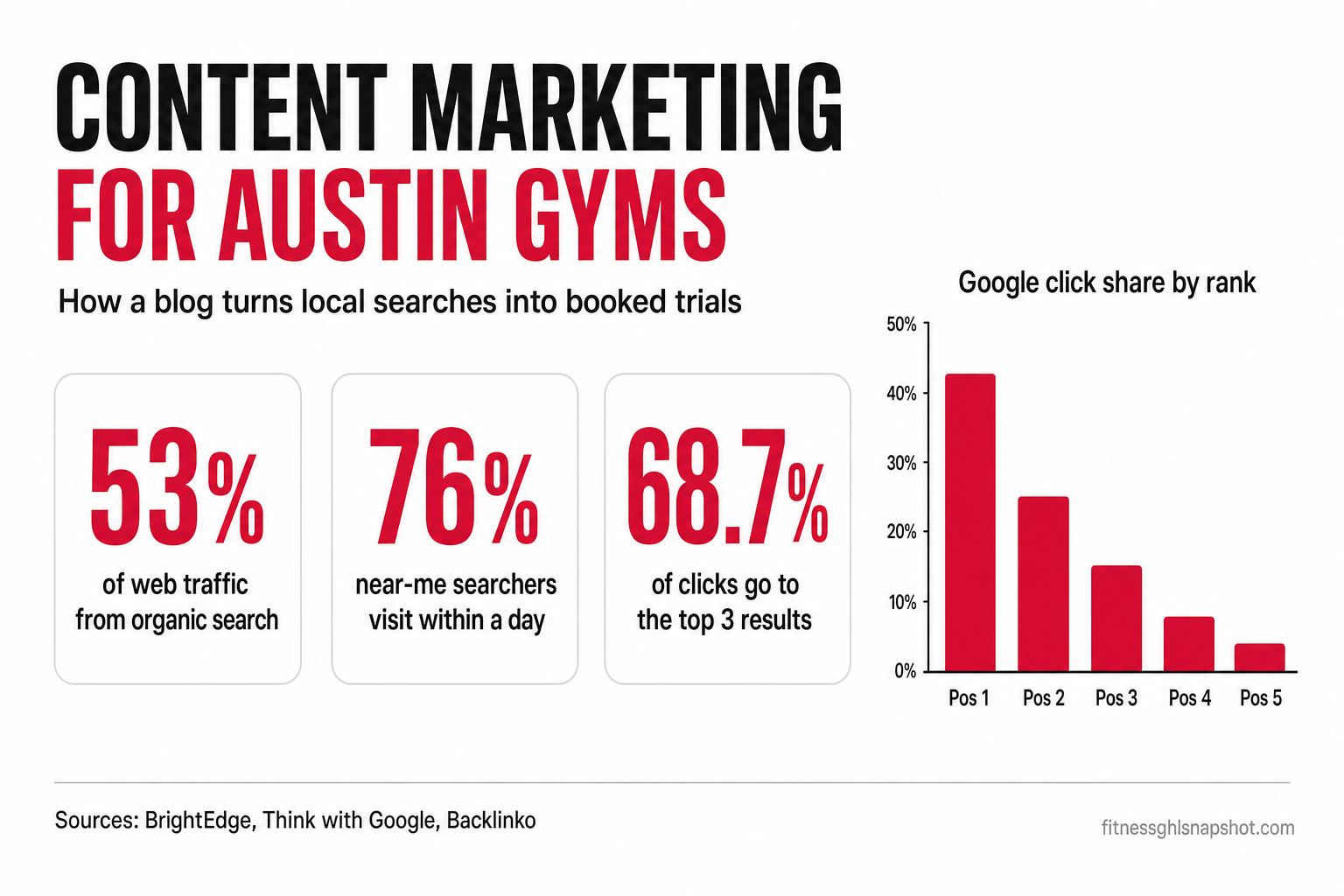
For an Austin gym, studio, or personal-training business, content marketing is the cheapest reliable way to put your offer in front of people who are actively searching to join — and a blog is the engine that does it. A researched article that answers the exact question a prospect types (“best beginner CrossFit in East Austin,” “how much does a pilates membership cost”) can rank on Google, get quoted inside an AI answer, and route a reader to your trial page — 24 hours a day, months after you published it. Organic search already drives about 53% of all trackable website traffic (BrightEdge, via Search Engine Land), and for a local, high-intent purchase like a gym membership, being the page that answers the question is what wins the walk-in.
I’ve bought paid ads for gyms and martial-arts schools long enough to know the problem with ads: the moment you stop paying, the leads stop. Content is the opposite. It’s an asset that compounds. This is the operator’s playbook — the 7 steps to turn an Austin gym blog from “four posts nobody reads” into a system that books trials, with the sourced numbers behind why it works.
Table of contents
- The short answer for Austin gym owners
- Why a gym blog is a trial-booking machine
- The Austin content-marketing math
- The 7-step content engine playbook
- DIY vs a done-for-you content engine
- Mistakes Austin gyms make with content
- The bottom line
- FAQ
The short answer for Austin gym owners
If you run a box in East Austin, a reformer studio off South Lamar, or a PT business in Round Rock, here’s the compressed version before the detail:
- A blog is not a diary — it’s a lead channel. Every post should target one real question an Austin prospect is searching, answer it clearly, and point them to your trial offer.
- Depth and consistency win. One 3,000-word article that fully answers a question beats ten 500-word posts that answer none. Publishing on a real cadence is what compounds into rankings.
- You’re optimizing for two readers now: Google and the AI answer engines (Google AI Overviews, ChatGPT, Perplexity) that increasingly sit between the searcher and your site.
- It pays for itself slower than ads, then never stops. Ads rent attention. Content buys an asset that keeps working after you stop touching it.
The rest of this article is the how — the 7-step engine, with the data behind each step.
Why a gym blog is a trial-booking machine
Joining a gym is a local, researched, high-intent purchase. Someone in Austin decides “okay, I’m finally doing this,” opens their phone, and starts searching — for classes, for prices, for “is CrossFit good for beginners,” for a studio near their apartment. The business whose content answers those questions is the one that earns the click and the trust.
The numbers back up how much of that decision happens in search. Organic search drives about 53% of all trackable website traffic — more than paid search (15%) and social combined (BrightEdge). And 98% of consumers used the internet to find information about a local business in 2024 (BrightLocal Local Consumer Review Survey). Your future members are already searching. The only question is whether they find you or the studio down the road.
Here’s the part most gym owners underestimate: ranking is close to binary. If you’re not in the top few results, you effectively don’t exist. Backlinko’s study of 4 million Google results found the #1 organic result earns 39.8% of clicks, and the top three together take about 68.7% (Backlinko). Position 5 gets about 5%. Page two gets a rounding error.
Google organic click-through rate by ranking position (% of clicks). Source: Backlinko, analysis of 4M search results.
That’s why “just have a website” isn’t enough. A single homepage can rank for maybe one or two terms. A body of researched content can rank for hundreds — every long-tail question a prospect might ask on the way to joining. And local intent turns those rankings into foot traffic fast: per Google, 76% of people who run a “near me” search visit a business within 24 hours, and 28% of local searches result in a purchase (Think with Google).
The Austin content-marketing math
Content marketing works partly because the demand is enormous and growing. 81 million Americans belonged to a gym or fitness studio in 2025 — an all-time high, up 5.2% from 2024 (Health & Fitness Association), and Americans made nearly 7 billion gym visits that year. Austin — one of the fastest-growing, most fitness-obsessed metros in the country — has more of that demand per capita than almost anywhere. The people are searching. Content is how you get in front of them without paying per click.
Sources: Health & Fitness Association, 2025; BrightEdge; Think with Google.
There’s a retention angle, too. The median gym holds onto about 66.4% of members year to year — meaning roughly a third churn out annually (HFA 2025 Benchmarking Report). Content doesn’t just acquire members; onboarding guides, “how to get the most from your first 30 days,” and class explainers keep the ones you have. Every retained member is one you don’t have to re-acquire — which is exactly why a blog pays off on both sides of the ledger.
The 7-step content engine playbook
Here’s the actual system. Follow it in order. It’s the same process our team runs for gym clients — just written out so you can run it yourself if you have the hours.
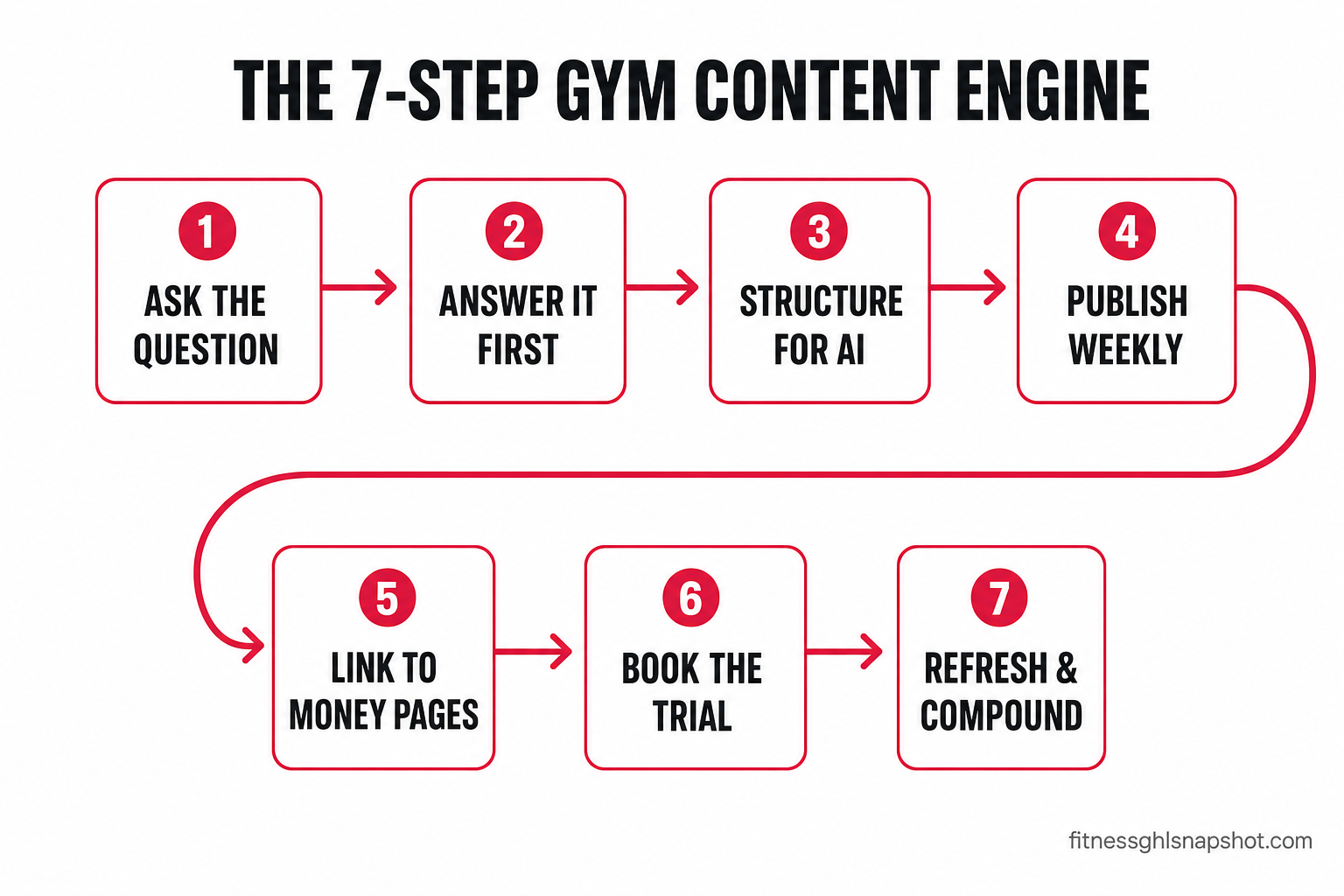
Step 1 — Start with the question your Austin prospect is actually typing
Content fails when it’s written for the owner, not the searcher. Don’t write “Welcome to our blog.” Write the answer to a real query: “How much does CrossFit cost in Austin?” “Is hot yoga good for beginners?” “Best gyms near downtown Austin with childcare.”
Find these questions by mining Google autocomplete, the “People also ask” box, your own front-desk FAQs, and the DMs your team answers every week. Each one is a post. Each post is a door into your funnel. Prioritize high-intent, local, long-tail queries — they have less competition and the person searching them is closer to buying.
Step 2 — Answer it first, then earn the depth
Lead with the answer in the first two sentences — the way this article opens. This “answer-first” structure is what earns featured snippets and AI citations, and it respects a reader who’s on their phone deciding in 90 seconds.
Then earn the depth. Thin, 500-word posts don’t rank anymore. Our content engine writes 2,500–3,200 words per article because that’s the length it takes to actually, fully answer a question and cover the follow-ups a searcher has — pricing, objections, comparisons, what to expect. Depth is what makes a page the last click a searcher needs to make.
Step 3 — Structure it for humans, Google, AND the AI answer engines
This is the step that separates 2026 content from 2019 content. There’s now a machine between the searcher and your site. Google AI Overviews grew from about 6.5% of queries in January 2025 to a peak of 24.6% in July, settling near 15.7% by November (Semrush via Search Engine Land). Meanwhile ChatGPT hit roughly 800 million weekly users (DemandSage), and fewer than a third of Google searches still send a click as AI answers absorb the rest (SparkToro).
Share of Google searches showing an AI Overview, 2025. Source: Semrush data via Search Engine Land.
To be the source an AI quotes, your content needs clean HTML, clear question-shaped headings, self-contained passages an engine can lift, valid structured data (Article, FAQPage, LocalBusiness/SportsActivityLocation schema), and a maintained llms.txt. That’s a big reason we build gym sites on the Astro framework — fast, static, machine-readable by default. For the full technical breakdown, see our guide to AI search optimization for gyms and why page speed decides who books the trial.
Step 4 — Publish on a real cadence
One post a quarter does nothing. Content is a compounding asset, and the compounding only starts when you publish consistently. HubSpot’s benchmarking found businesses publishing 16+ posts a month get about 3.5x the traffic and 4.5x the leads of those publishing zero to four (HubSpot). You don’t need 16 — but you need a real, repeatable cadence, because Google rewards freshness and topical authority, and both are built by showing up every week.
This is exactly where most gym owners fall off. You’re on the floor coaching. The blog is the first thing to slip. That’s the case for systematizing it (Step 7) or handing it off entirely.
Step 5 — Internally link every post to a money page
A post that ranks but doesn’t route the reader anywhere is a leak. Every article should link to the next logical step: your trial offer, your pricing page, your class schedule, or a related post that moves them closer. Internal links do double duty — they guide readers toward booking and they tell Google how your pages relate, which lifts the whole site’s rankings. Link your “how much does it cost” post to your pricing page; link your beginner guides to your trial funnel; link your local guides to your booking page. (See how speed to lead compounds the moment they act.)
Step 6 — Turn readers into trials
Traffic isn’t the goal — booked trials are. Every post needs a clear, low-friction next step: a trial CTA, a lead-capture form, or a chat widget that answers the last question and books the appointment. A reader who just spent four minutes reading your beginner guide is warm. Don’t make them hunt for the “book” button. Pair strong content with an automated review flywheel and local SEO fundamentals and the same visitor sees ranking, proof, and a path to book — in one visit.
Step 7 — Measure, refresh, and compound
Content is not “publish and forget.” Check which posts rank and which stall, update the winners with fresh data, and add internal links from new posts to old ones. A two-year-old article, refreshed with current numbers and re-linked, often outperforms a brand-new one because it’s already earned authority. The gyms that win at content treat it like a system with a maintenance schedule — not a burst of effort that fizzles by March.
DIY vs a done-for-you content engine
You can absolutely run this playbook yourself — the seven steps are the whole system. The real question is whether you have the hours, week after week, to keep it going. Here’s the honest trade-off.
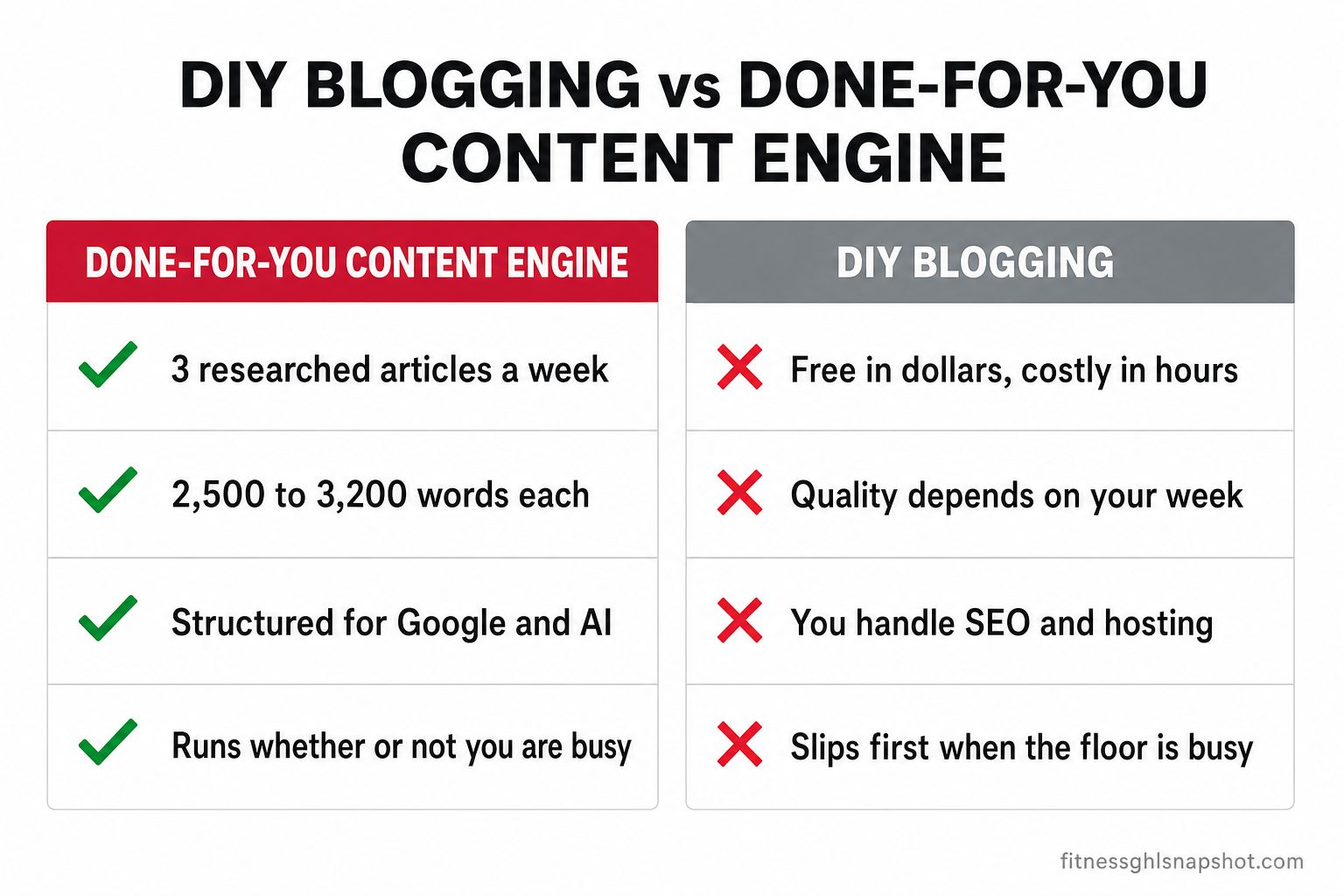
DIY blogging vs a done-for-you content engine
| Plan | Content Engine (Our Build) recommended | DIY blogging |
|---|---|---|
| Price | $597/mo + $597 build | Your time |
| Feature 1 | 3 researched articles/week, 2,500–3,200 words | Free in dollars, expensive in hours |
| Feature 2 | Built around your classes & Austin neighborhoods | Full creative control & voice |
| Feature 3 | Answer-first, schema & llms.txt for AI engines | Quality & cadence depend on your week |
| Feature 4 | Fast Astro site with 90+ PageSpeed included | You handle SEO, schema & hosting yourself |
| Feature 5 | Weekly price & timetable updates | Easy to start, hard to sustain past month 2 |
| Feature 6 | You stay on the floor — we run the engine | Slips first when the floor gets busy |
| See website plans | — |
The difference isn’t whether content works — it does, for anyone who sustains it. The difference is sustainability. An engine that publishes whether or not you had a good week is what turns content from “we tried blogging once” into a channel that compounds. If you’d rather run your gym than run a publishing schedule, that’s the case for handing it off — and the full Get a Website breakdown has the plan details and pricing.
Mistakes Austin gyms make with content
- Writing for yourself, not the searcher. “Our new spring schedule is here” ranks for nothing. “CrossFit vs F45 for beginners in Austin” answers a real question.
- Thin, sporadic posts. Five 400-word posts a year won’t move anything. Depth and cadence are the whole game.
- No local signal. Generic fitness advice competes with the entire internet. Naming neighborhoods, landmarks, and Austin-specific context is what makes you rank locally — and gets you into local AI answers.
- Ignoring the AI layer. If your content isn’t structured for machines (clean HTML, schema, answer-first passages), you’ll be invisible in the AI Overviews and chatbots that now front a growing share of searches.
- No path to book. Traffic with no CTA is a vanity metric. Every post needs a next step.
- Quitting before it compounds. SEO content takes months to mature. The gyms that win are the ones still publishing in month six, when the early posts finally start ranking.
The bottom line
Content marketing is the cheapest, most durable customer-acquisition channel an Austin gym has — but only if it’s run like a system, not a hobby. The demand is there: 81 million Americans in gyms, most of them searching before they join, the top three results taking two-thirds of the clicks, and AI answers increasingly deciding who gets named. A blog that answers real questions, published consistently, structured for both Google and the machines, and wired to your trial funnel, becomes an asset that books members while you coach.
You can run the seven steps yourself, or you can hand the engine to a team that does it three times a week. Either way, the gyms in Austin that start building a body of content now will be the names Google — and ChatGPT — repeat for years. The ones that wait will keep wondering why a competitor with a worse gym keeps showing up first.
Frequently asked questions
How long does content marketing take to work for a gym?
Expect meaningful organic traffic in roughly 4–6 months of consistent publishing, with results compounding after that. SEO content matures slowly — a post published today earns its authority over months as Google trusts it and other pages link to it. That's why cadence matters more than any single article, and why the gyms that win are the ones still publishing when the early posts start ranking. Anyone promising page-one rankings in 30 days isn't being honest.
How often should an Austin gym publish blog posts?
As often as you can sustain quality — consistency beats bursts. HubSpot's benchmarking found businesses publishing 16+ posts a month get about 3.5x the traffic and 4.5x the leads of those publishing zero to four. Most gym owners can't sustain that alone, which is why our Content Engine plan publishes three researched, 2,500–3,200-word articles a week. Even one solid post a week, every week, will out-perform a dozen thin posts dumped in one month.
Is a blog still worth it now that AI answers so many searches?
Yes — arguably more than ever. AI answer engines like Google AI Overviews and ChatGPT don't invent facts; they pull from and cite web content. Well-structured, answer-first content with valid schema is exactly what they quote. The gyms whose content is machine-readable get named in those answers; the ones whose isn't are invisible. AI didn't kill content — it raised the reward for content that's structured cleanly.
What should an Austin gym blog actually write about?
Write the answers to what prospects search on the way to joining: pricing questions ('how much does a CrossFit membership cost in Austin'), beginner questions ('is hot yoga good for beginners'), comparisons ('F45 vs Orangetheory'), local guides ('best gyms near downtown Austin with childcare'), and onboarding content that retains the members you already have. Each targets one real, local, high-intent query and links to your trial or pricing page.
Can I do gym content marketing myself, or should I outsource it?
You can absolutely do it yourself — the seven steps in this guide are the whole playbook. The trade-off is time and consistency: researching, writing 2,500+ word articles, handling schema and hosting, and never missing a week is a real job, and it's the first thing to slip when you're coaching all day. Our Get a Website Content Engine handles all of it — three researched articles a week on a fast Astro site — for $597/month plus a $597 one-time build, so the engine runs whether or not you had a busy week.
About the author
Cole Hartman is our Local Marketing & Paid Acquisition Lead, based in Tampa, FL. He started out buying Facebook and Instagram ads for personal trainers and martial-arts schools, then learned the hard way that the content and the page behind the ad matter more than the creative. He writes about ad funnels, Google review flywheels, local and AI search, and turning local visibility into booked trials.