
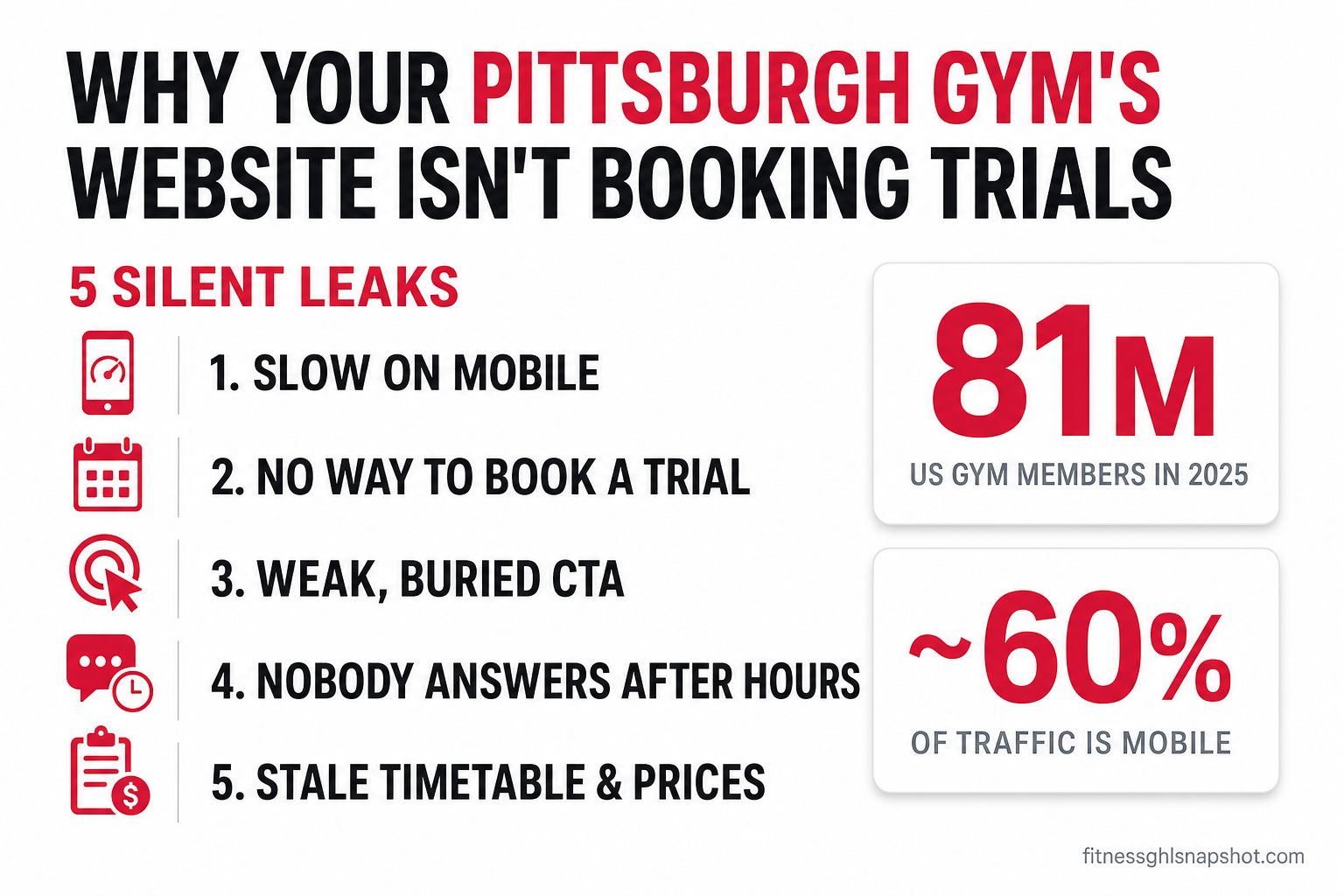
Most Pittsburgh gym websites aren’t short on visitors — they leak the trial bookings they already earn. The traffic lands, then quietly slips away because the site is slow on a phone, there’s no way to book a trial on the spot, the “Get Started” button is buried, nobody answers after the front desk closes, and the timetable on the page is a month out of date. Each of those is a silent leak, and together they hand your highest-intent prospects to the studio one search result down. The good news: every one of these leaks is fixable, and the fix pays for itself faster than another round of ads.
I started out buying Facebook and Instagram ads for personal trainers and martial-arts schools, and the hard lesson was always the same — the ad isn’t usually the problem, the site behind it is. You can pour money into clicks, but if someone taps through at 9 p.m. on their phone and can’t book a class in three taps, that click is gone. This is the operator’s teardown for Pittsburgh: the five ways your website is losing trials, what each one costs, and how to plug them for good.
Table of contents
- The short answer for Pittsburgh gym owners
- The demand is there — your website is the bottleneck
- Leak #1: Your site is slow on a phone
- Leak #2: There’s no way to book a trial on the spot
- Leak #3: The call-to-action is weak or buried
- Leak #4: Nobody answers after hours
- Leak #5: The timetable and prices are out of date
- What each leak really costs a Pittsburgh gym
- The fix: a fast site that books the trial for you
- FAQ
The short answer for Pittsburgh gym owners
If you run a CrossFit box in Lawrenceville, a reformer studio in Shadyside, a boxing gym on the South Side, or a PT business out in Cranberry, the compressed diagnosis is this: your website is almost certainly getting more visitors than it converts, and the reason is friction, not traffic.
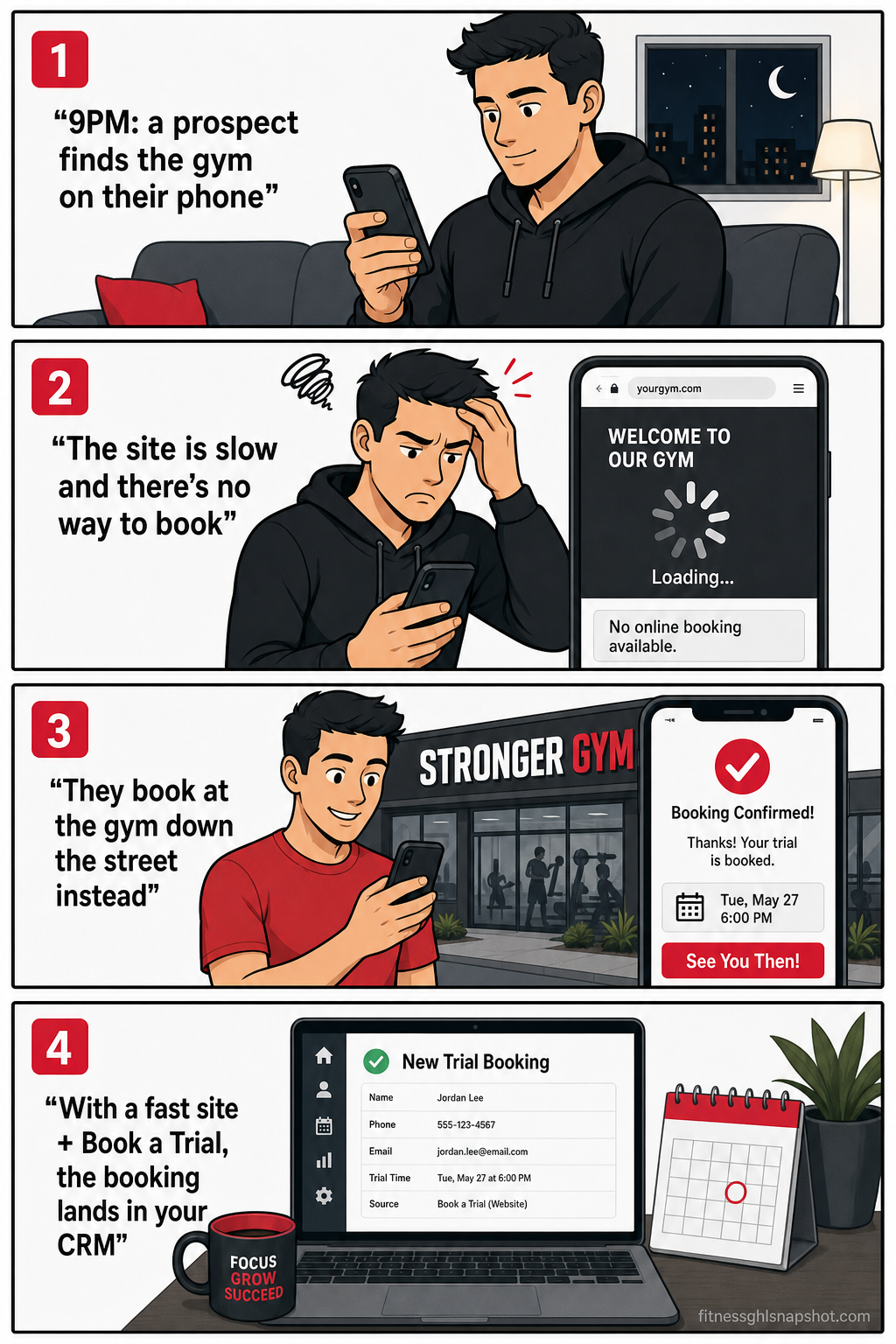
A prospect finds you on Google or Instagram, taps through on their phone, waits a beat too long for the page to load, can’t find an obvious “book a free class” button, fills out a contact form instead — and then hears nothing until you get off the floor tomorrow. By then they’ve booked at the gym that let them reserve a spot in three taps. Nothing about that is a marketing problem. It’s a website problem, and it’s costing you booked trials every single week.
The rest of this teardown walks the five leaks in order, with sourced numbers, and ends with the exact build that closes them.
The demand is there — your website is the bottleneck
Start with the encouraging part: you are not fighting for scraps. Gym demand is at an all-time high.
A record 81 million Americans were members of a fitness facility in 2025 — up 5.2% year over year and an all-time high, according to the Health & Fitness Association. Pennsylvania is a real market inside that: roughly 3,779 gym, health, and fitness-club businesses worth about $1.5 billion statewide (IBISWorld). More shoppers means more people landing on your site — and more competitors one tab away.
That’s exactly why the website matters. When demand is high and the market is crowded, the gym that converts its existing traffic best wins, without spending a dollar more on ads. And most of that traffic is arriving on a phone: around 60% of all web traffic is mobile (Statista), and for local “gym near me” research that skews even higher. If your site is anything less than instant and effortless on a phone, you’re leaking the demand the whole industry says is out there.
Leak #1: Your site is slow on a phone
Speed is the leak nobody sees, because you’re not the one bouncing — your prospects are. And the data on slow pages is brutal.
Google’s mobile research found that as a page’s load time grows from one second to three, the probability that a visitor bounces rises 32%. Push it to five seconds and bounce probability is up 90%; at ten seconds it’s up 123% (Think with Google).
Increase in the probability a mobile visitor bounces as page-load time grows from a 1-second baseline. Source: Think with Google — Mobile page speed benchmarks (2017; still Google’s canonical figure).
It’s not just bounce — speed moves the whole funnel. In the landmark Deloitte and Google “Milliseconds Make Millions” study of 30 million user sessions, a mere 0.1-second improvement in mobile speed lifted retail conversions by 8.4% and travel conversions by 10.1%, with average order values rising alongside.
Percentage lift from a 0.1-second mobile-speed improvement across 30M sessions. Source: Deloitte + Google, “Milliseconds Make Millions” (2020).
Portent’s analysis of tens of millions of pageviews reached the same conclusion from the other side: the highest conversion rates land on pages that load in 0–4 seconds, and the first five seconds of load time carry the biggest impact on whether a visitor converts (Portent).
Here’s the catch for gyms specifically: WordPress, Wix, Squarespace, and GHL-built sites bloat fast. Page-builder overhead, plugin stacks, and heavy image galleries pile on until the site that felt fine on your laptop takes four-plus seconds on a member’s phone on the bus. We break down the platform-by-platform speed differences in Astro vs WordPress & GoHighLevel websites for gyms — but the short version is: if your site isn’t built speed-first, you’re paying the bounce tax on every visit.
Leak #2: There’s no way to book a trial on the spot
Most gym sites end the journey with a contact form — “fill this out and we’ll get back to you.” That’s a leak disguised as a lead-capture feature, because it defers the one action the prospect is ready to take right now: booking a class.
The moment you turn a live, high-intent visitor into a “we’ll call you back” task, you’re fighting the clock — and the clock wins. Foundational lead-response research from MIT and InsideSales found that contacting a lead within 5 minutes makes you 21x more likely to qualify it than waiting just 30 (MIT / InsideSales Lead Response Study). A page that only collects a form can’t hit five minutes when you’re mid-class or asleep. A page with a live Book a Trial button doesn’t have to — the prospect books the slot themselves, on the spot, and it drops straight into your calendar.
Leak #3: The call-to-action is weak or buried
Even when the page is fast and booking is possible, the button that starts it is often the weakest element on the screen — same color as the body text, below three folds of hero copy, or competing with five other links.
Landing-page conversion data shows how much headroom that leaves on the table. Unbounce’s 2024 benchmark report puts the median wellness landing-page conversion rate at 8.2% (healthcare sits around 5.1%) (Unbounce). Even a strong page turns most visitors away — so burying the one button that matters guarantees you land at the bottom of that range instead of the top.
A high-converting gym page does the opposite: one obvious, high-contrast primary action (“Book Your Free Class”) repeated at the top, after the offer, and at the end; a single job per page; and nothing competing with the trial CTA. It’s not a design flourish — it’s the difference between an 8% page and a 3% one. If you’re already paying for traffic, that gap is pure margin: the same $52.98 average Facebook lead (WordStream) either books a trial or bounces, depending on whether it can find the button.
Leak #4: Nobody answers after hours
Gym research happens at night. Someone finishes their own workout, opens their phone at 9:30 p.m., and starts comparing studios. If your site can answer “How much is unlimited?” and “When’s the 6 a.m. class?” and book them in — in that moment — you win them. If they have to wait until you open, you’ve handed them to whoever answered.
The response-time reality is stark. Across 2,241 companies, Harvard Business Review found the average first response to a web lead was 42 hours, only 37% responded within an hour, and 23% never responded at all (HBR). A dark front desk is the default, and it’s a default that loses.
This is where a site earns its keep after close. An AI chat widget greets the late-night visitor, answers hours, pricing, and class questions instantly, and books the trial straight onto your calendar — and an AI receptionist does the same for the calls that come in while you’re coaching. Both capture the name, phone, and email into GoHighLevel even when the visitor doesn’t book, so nothing goes dark. We covered the full build in AI chat widgets for gyms — the point for Pittsburgh is simple: your website should never be the reason a 9 p.m. prospect goes unanswered.
Leak #5: The timetable and prices are out of date
The quietest leak of all is a trust leak. A prospect checks your timetable, sees a class time that turns out to be wrong, or a price that’s three months stale — and now they don’t trust anything else on the page. Worse, most owners know the site is out of date but can’t easily fix it, because editing a DIY builder or waiting on an hourly agency is its own chore. So it stays wrong.
An accurate, current site isn’t a nice-to-have; it’s the baseline for a booking. If the class the prospect wants to attend shows the wrong time, the booking never happens. A managed site where prices, class times, and capacity are refreshed for you every week removes the leak entirely — and removes the 11 p.m. “I need to update the website” job from your plate.
What each leak really costs a Pittsburgh gym
Put the leaks together and the math gets loud. Say your site gets 1,000 visits a month — modest for a gym running any ads or local SEO. At a healthy 8% booking rate you’d book 80 trials; at the 3% a slow, form-only, buried-CTA site delivers, you book 30. That’s 50 lost trial bookings a month from the same traffic.
Now price the traffic. If even a third of those visits came from paid ads at the $52.98 average health-and-fitness Facebook lead cost (WordStream), you spent real money to send people to a page that dropped them. And every leaked trial is a leaked membership — a member who trials and joins is worth far more than a single sale over their lifetime, which is why the cheapest growth most gyms can buy isn’t more ads, it’s a site that converts the traffic they already have. (We break down the membership math in gym member lifetime value.)
That’s the whole case for fixing the website first: you’re not buying more demand, you’re keeping the demand you’re already paying for.
The fix: a fast site that books the trial for you
Every leak above traces back to the same root cause — a website that was built to look like a brochure instead of work like a front desk. The fix is a site engineered speed-first and wired to book, and it’s a done-for-you build, not another project on your plate.
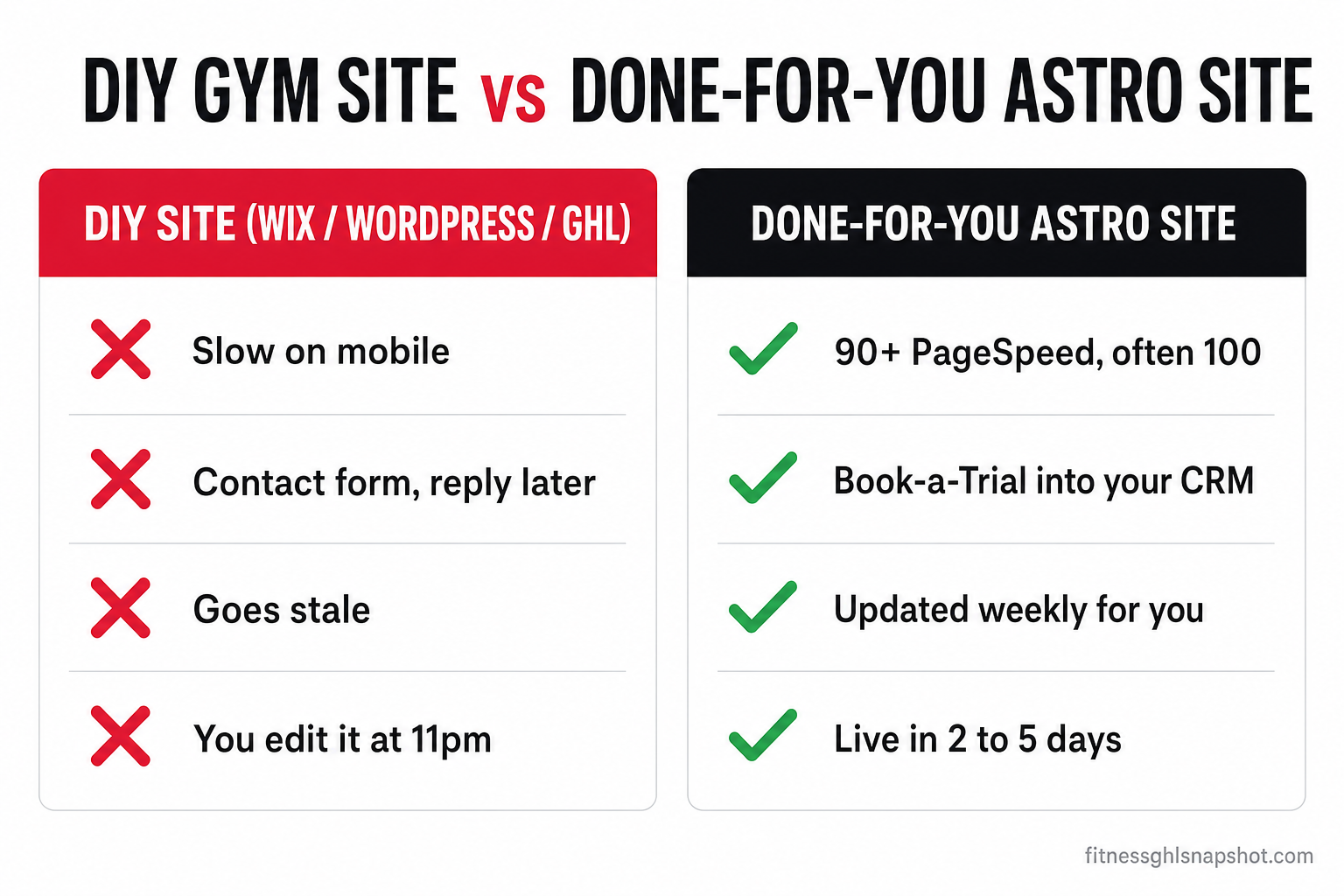
The DIY gym site vs. a done-for-you Astro site
| Plan | Typical DIY site (Wix / WordPress / GHL) | Done-for-you Astro site recommended |
|---|---|---|
| Price | Cheap upfront | $117/mo + $597 build |
| Feature 1 | Slows down as plugins and pages pile up | 90+ PageSpeed guaranteed, often a perfect 100 |
| Feature 2 | Usually a contact form — you reply later | Book-a-Trial button drops straight into your CRM |
| Feature 3 | Form only; no instant after-hours follow-up | Every enquiry lands in GoHighLevel with an instant reply |
| Feature 4 | You edit the timetable (or it goes stale) | Prices, class times & capacity refreshed weekly for you |
| Feature 5 | DIY at 11pm, or hourly agency billing | 5 revisions/mo included, then a flat $20 — no hourly billing |
| Feature 6 | Built once, then it's on you | Done-for-you and live in 2–5 working days |
| See Get a Website |
We build gym and studio sites on the Astro framework, which ships almost no JavaScript and serves static-first pages from Cloudflare’s edge — so the page opens in a blink on a phone, which is where nearly all your traffic is. There’s no plugin stack to bloat and no page-builder overhead, and we guarantee a 90+ Google PageSpeed score on mobile and desktop, frequently a perfect 100. That closes Leak #1 on day one.
Then it’s wired to convert. A prominent Book a Trial button on every page books the class and drops the lead straight into the GoHighLevel CRM your front desk already runs — closing Leaks #2 and #3. Add the AI chat widget and it answers and books 24/7, closing Leak #4. And because it’s fully managed, prices, class times, and capacity get refreshed every week for you — five revisions a month are included, then a flat $20 each, with no hourly billing anywhere — which closes Leak #5 for good.
None of this requires you to become a web developer, and none of it happens at 11 p.m. after coaching. It’s the front desk your website should have been all along — fast, always open, and built to book the trial before the prospect closes the tab.
Frequently asked questions
Why isn't my Pittsburgh gym's website booking trials even though it gets traffic?
Almost always it's friction, not traffic. The most common causes are a page that's slow on mobile (bounce probability rises 32% as load time goes from 1 to 3 seconds, per Think with Google), a contact form instead of a live Book-a-Trial button, a weak or buried call-to-action, no way to answer or book after hours, and a stale timetable that breaks trust. Each one leaks the visitors you already earned. Fixing speed, adding on-page booking, and capturing leads 24/7 typically recovers the most bookings.
How fast does a gym website need to be?
Aim for a 90+ Google PageSpeed score on mobile, and a load that feels instant. Google's data shows bounce probability climbs sharply after 3 seconds, and Deloitte found even a 0.1-second improvement lifted conversions by 8–10%. Since around 60% of web traffic is mobile and gym research skews even more mobile, the phone experience is the one that decides the booking. We build on Astro and guarantee 90+, often a perfect 100.
Should my gym site use a contact form or an online booking button?
A live booking button, every time. A contact form converts a ready-to-act visitor into a callback you owe them later — and lead-response research shows the average business takes 42 hours to reply and 23% never do. A Book-a-Trial button lets the prospect reserve the class themselves on the spot, and the booking drops straight into your CRM. Keep a form only as a fallback.
How much does a done-for-you gym website cost?
Our managed Astro websites start at $117/mo for the fully managed site, $227/mo with the AI Engine, and $597/mo with the Content Engine, each with a one-time $597 build fee. You pay only the monthly invoice up front; the build fee is charged after your site is live and you're happy with it. Five revisions a month are included, then a flat $20 each — no hourly billing.
Can the new site connect to the GoHighLevel and booking tools I already use?
Yes. Every form and Book-a-Trial button pushes into the GoHighLevel CRM you already run, so leads and bookings land in one place with an instant reply. Connecting other gym-management or payment platforms is quoted separately and always priced before we build it, so nothing shows up on an invoice as a surprise.
How long does it take to build and go live?
A typical gym or studio site is live in about 2 to 5 working days, and every revision after launch is completed within 2 to 5 working days of you sending it, no matter the size. A price change or a moved class time is usually same-day or next-day.
About the author
Cole Hartman is our Local Marketing & Paid Acquisition Lead. He started out buying Facebook and Instagram ads for personal trainers and martial-arts schools, then learned the hard way that the funnel behind the ad matters more than the creative. He now pairs paid acquisition with GoHighLevel follow-up so gyms stop paying for leads that never show, and he writes about ad funnels, Google review flywheels, and turning local visibility into booked trials.
Related posts
- Astro vs WordPress & GoHighLevel Websites for Gyms: Page Speed Compared
- AI Chat Widget for Gyms: Turn Website Visitors Into Booked Trials
- Online Booking Automation for Gyms: Book Trials While You Coach
- Speed to Lead for Gyms: Why the First 5 Minutes Decide Who Becomes a Member
- Gym Member Lifetime Value: The Math That Should Drive Every Decision