
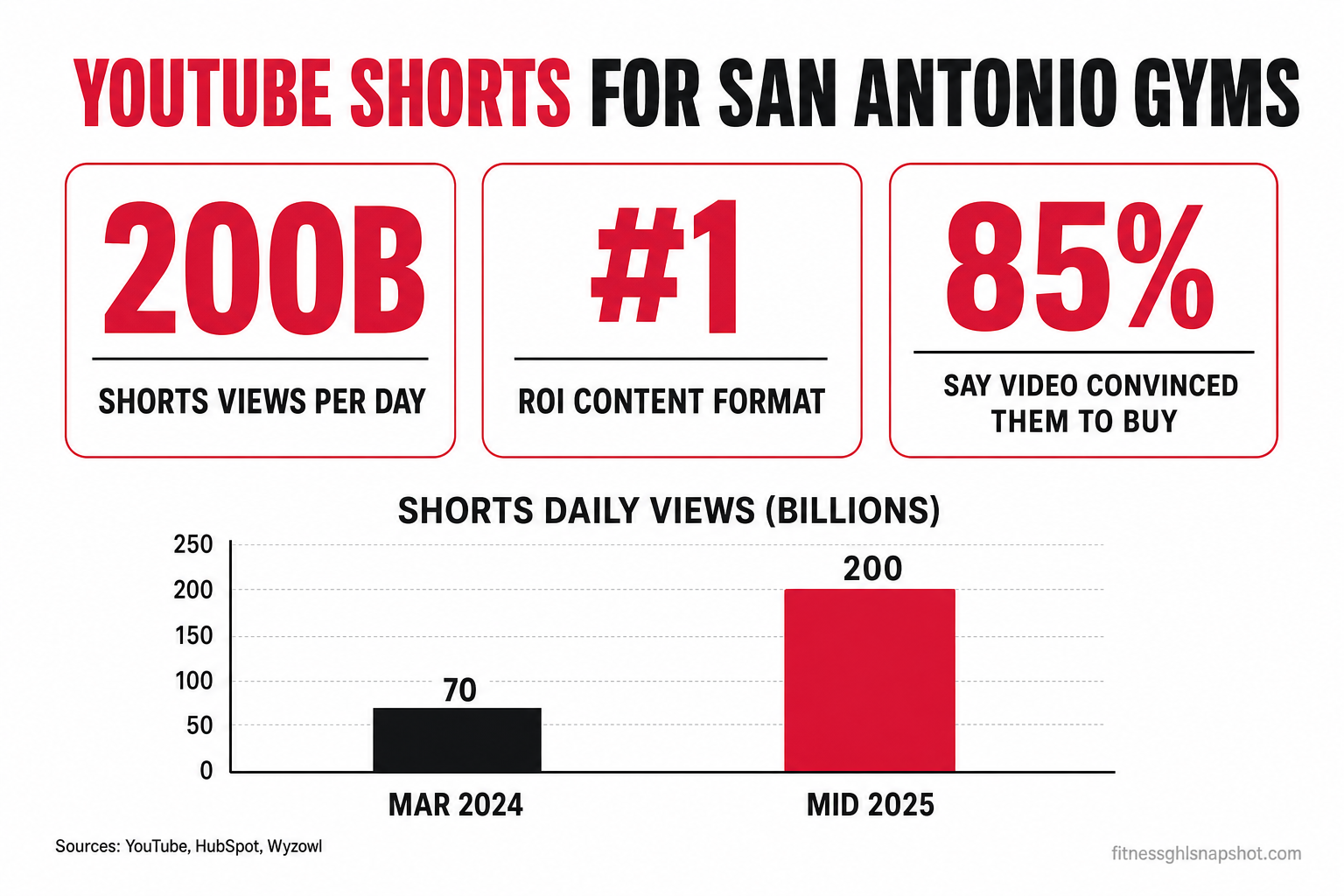
For a San Antonio gym, studio, or personal-training business, YouTube Shorts is the highest-leverage free channel you’re probably not using — a single 30-second workout clip can reach thousands of local people, build the trust that decides a membership, and route them to your trial page for months after you post it. Shorts now averages 200 billion views a day (The Wrap), short-form video is the #1 return-on-investment content format marketers report (HubSpot 2026 State of Marketing), and 85% of people say a video has convinced them to buy something (Wyzowl). This is the operator’s playbook — six steps to turn the clips you’re already able to film on the floor into a Shorts channel that books trials in San Antonio.
I’ve bought paid ads for gyms and martial-arts schools long enough to know the trap: the moment you stop paying, the leads stop. Organic short-form video is the opposite — it’s an asset that keeps working. Below is the exact system, the sourced math behind why it works, and where the done-for-you route makes sense.
Table of contents
- The short answer for San Antonio gym owners
- Why YouTube Shorts is the highest-leverage channel for a local gym
- The San Antonio Shorts math
- The 6-step YouTube Shorts playbook
- DIY vs a done-for-you video engine
- Mistakes San Antonio gyms make with Shorts
- The bottom line
- FAQ
The short answer for San Antonio gym owners
If you run a box on the North Side, a reformer studio near the Pearl, or a PT business off 1604, here’s the compressed version before the detail:
- Shorts is a discovery engine, not a highlight reel. Unlike Instagram, YouTube pushes your Shorts to people who don’t follow you yet — the exact strangers in San Antonio deciding whether to join a gym.
- Trust is the product. People don’t join a gym they’ve read about; they join one they’ve seen. A clip of your actual coach, your actual floor, and a real member doing the work is what converts.
- Consistency beats production value. A phone, decent light, and a post-a-day rhythm will out-perform one cinematic video a month. The algorithm rewards volume and watch-time, not budget.
- The clip is only half the system. The other half is a link that sends viewers to a trial offer and a fast reply to every comment — otherwise the reach evaporates.
The rest of this article is the how — the six-step engine, with the data behind each step.
Why YouTube Shorts is the highest-leverage channel for a local gym
Three forces make short-form video on YouTube the best free bet a San Antonio gym has right now.
First, the raw reach. YouTube Shorts hit 200 billion daily views in 2025, announced by CEO Neal Mohan at the Cannes Lions festival — up from 70 billion in March 2024 (The Wrap). No local gym needs a fraction of that; you need a few thousand of the right views, and Shorts’ discovery feed is built to find people by interest and location.
YouTube Shorts average daily views (billions). Source: The Wrap reporting YouTube CEO Neal Mohan, Cannes Lions 2025.
Second, it’s where the money is. In HubSpot’s 2026 State of Marketing report, the top three ROI-driving content formats are all video — and short-form video ranks #1, cited by 49% of marketers, ahead of long-form (29%) and live streaming (25%) (HubSpot). Video overall keeps proving out: 93% of marketers say video gives them a good ROI (Wyzowl).
Share of marketers naming each video format a top-ROI content format. Source: HubSpot 2026 State of Marketing.
Third, video is what actually flips the decision. Joining a gym is a trust purchase — people want to see the room, the vibe, and whether they’ll look foolish. Video answers that before they ever walk in. 85% of people say watching a video has convinced them to buy a product or service (Wyzowl). And YouTube’s footprint is enormous: roughly 175 million U.S. users, and it’s now the most-watched platform on American TV screens at 12.5% of total viewing (DemandSage). Your future members are on it daily.
The San Antonio Shorts math
Here’s how the reach turns into booked trials, in plain operator terms.
You don’t need to go viral to win. Say a modest San Antonio channel posts one Short a day. Even at a small local scale, a handful of clips that each pull a few thousand views a month put your gym in front of more strangers than a $1,000 ad budget would — for the cost of your time and a phone. A slice of those viewers are people within a few miles who’ve been meaning to “finally join somewhere.” The clip earns the trust; the link in your description and pinned comment earns the click; your trial funnel earns the booking.
The compounding is the point. A blog post or a Short you publish this week can still be surfacing new viewers a year from now. Ads rent attention. Short-form video buys an asset that keeps paying — which is exactly why marketers rank it their highest-ROI format (HubSpot).
The 6-step YouTube Shorts playbook
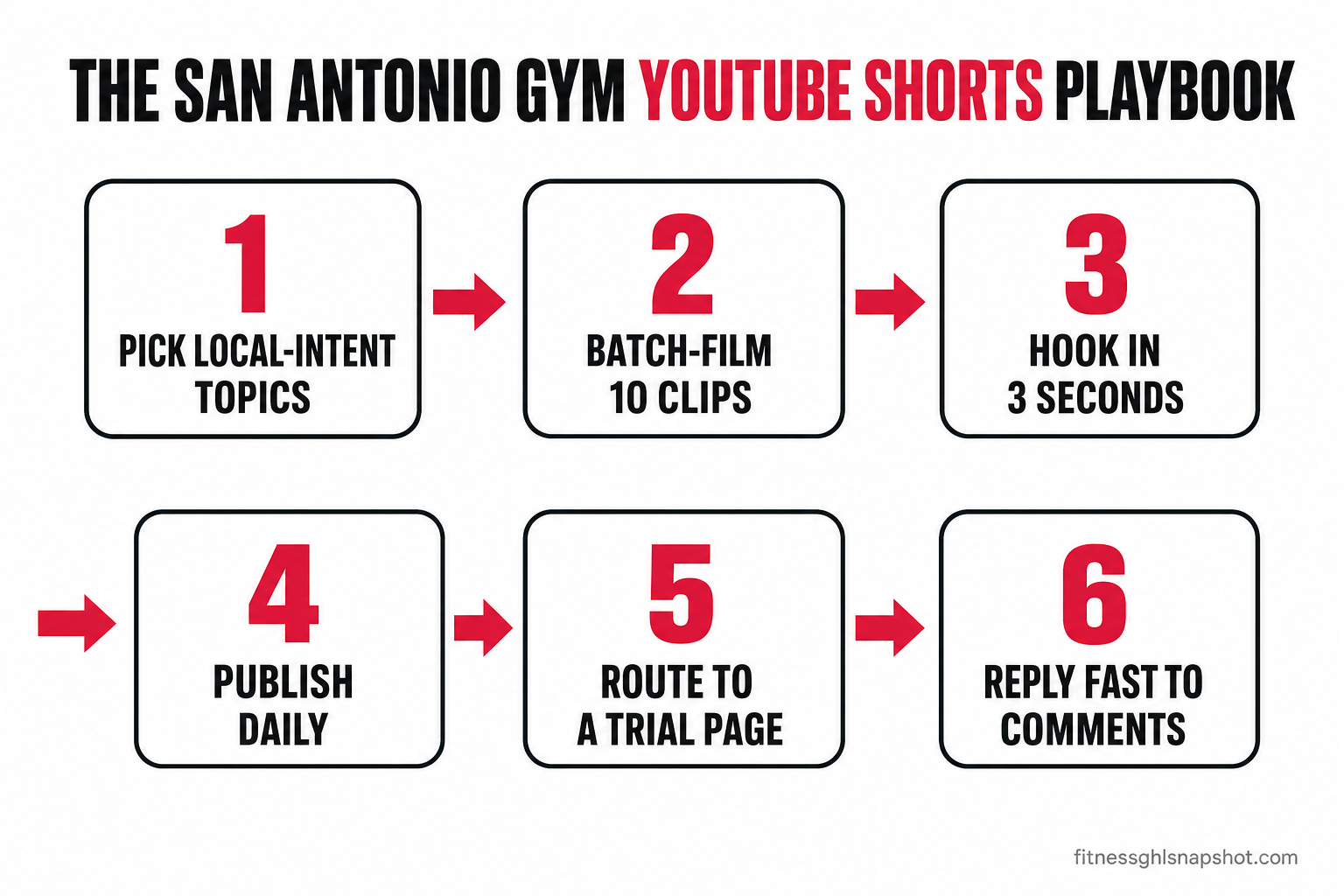
Step 1 — Pick topics with local buying intent
Don’t film generic “5 tips for abs” clips that compete with Chloe Ting. Film the things a San Antonio person searches and wonders on the way to joining:
- “What a beginner’s first CrossFit class in San Antonio actually looks like”
- “How much does a pilates membership cost here — and what you get”
- “3 things to check before signing a gym contract in Texas”
- Coach intros, member transformations, class energy, form fixes for common lifts.
Each clip should answer one real question and quietly show your room, your coaches, and your community. Sprinkle “San Antonio” into titles and spoken intros so YouTube and AI search associate you with the city.
Step 2 — Batch-film 10 clips at once
The reason gyms quit short-form video is they treat every clip as a project. Don’t. Block one hour a week, set a phone on a tripod in good light, and film 10 clips back to back — a few form tips, a class snippet, a member win, a “why we do on-ramp this way.” Batching is what makes a daily cadence survivable when you’re coaching all day.
Step 3 — Win the first three seconds
Shorts live or die on the hook. The first frame needs an on-screen line that stops the scroll: “The #1 mistake San Antonio lifters make on deadlift day.” No slow intros, no logo animation. State the payoff immediately, deliver it, and end with a soft nudge (“we run beginner on-ramps every week — link below”). Add captions; most people watch muted.
Step 4 — Publish consistently (volume beats polish)
The algorithm rewards watch-time and frequency, not budget. One decent Short a day, every day, will out-perform one cinematic video a month. Consistency also gives you more shots at a breakout — because you’re posting daily, a single clip going wide can fill your intro classes for a month.
Step 5 — Route every viewer to a trial page
Reach without a destination is a vanity metric. Every Short should point to one place: a trial-class booking page. Put the link in the description, pin it in a comment, and add it to your channel banner. This is where most gyms leak the whole funnel — the clip does its job, and there’s nowhere for the interested viewer to go. Send them to a single, fast trial-booking page and let the automation take the booking.
Step 6 — Reply to every comment within minutes
Comments are warm leads raising their hand. “Do you have evening classes?” is a buying question. Speed matters: the studio that answers in two minutes wins the trial over the one that answers in two days. At volume this is impossible to do by hand, which is exactly what the AI comment-and-DM agents in our done-for-you social service handle — instant, on-brand replies that push the conversation toward a booked trial. (See our deep dives on Instagram & Facebook comment automation and DM automation for how that works.)
DIY vs a done-for-you video engine
The six steps above are the whole playbook — you can absolutely run them yourself. The honest trade-off is time and consistency. Filming, editing, captioning, publishing daily, and replying fast is a real job, and it’s the first thing that slips when you’re on the floor coaching. Here’s the straight comparison.
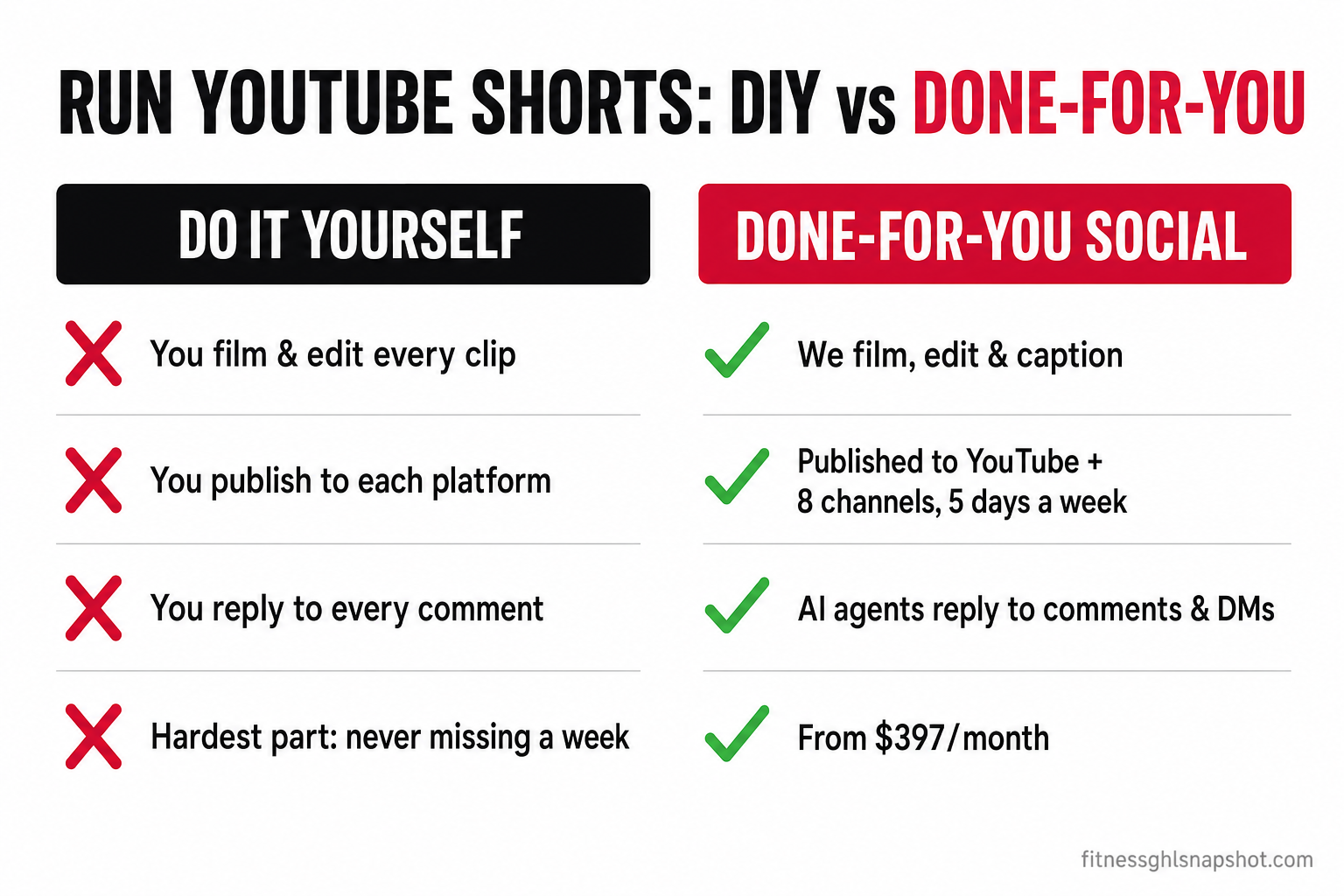
Run Shorts yourself vs a done-for-you engine
| Plan | Done-for-you social (our service) recommended | Do it yourself |
|---|---|---|
| Price | from $397/mo | $0 + your time |
| Feature 1 | We film, edit & caption short vertical video | You film & edit every clip |
| Feature 2 | Published to YouTube + 8 channels, 5 days/week | You publish and reformat per platform |
| Feature 3 | 3 AI agents reply to comments, DMs & web chat | You monitor and reply to every comment |
| Feature 4 | Every lead routed into your CRM/calendar | You build and maintain the trial funnel |
| Feature 5 | Monthly performance report per channel | Full control, zero monthly cost |
| Feature 6 | White-label · cancel with 15 days' notice | Hardest part: never missing a week |
| See the service |
If you have a team member who genuinely enjoys video and will never miss a week, DIY is the cheaper path. If short-form video is the thing that keeps falling off your list, a done-for-you engine is what turns it from a good intention into a channel that actually books trials. Either way, the framework is the same — the only question is who runs it.
Mistakes San Antonio gyms make with Shorts
- Filming for other gym owners, not members. Industry jargon and PR-speak don’t convert. Film for the nervous beginner deciding whether to walk in.
- No link, no destination. The most common leak: great clips pointing nowhere. Always route to a trial page.
- Quitting at week three. Discovery compounds slowly, then quickly. The gyms that win are still posting when the early clips start surfacing.
- Ignoring comments. A dead comments section reads as a dead gym. Fast, human-sounding replies are trust signals — and buying signals.
- Chasing trends over locality. A trending sound is nice, but “best beginner gym near Alamo Heights” is the search that fills your classes. Stay local.
- Hardcoding one platform. Film once, publish everywhere. The same clip belongs on YouTube Shorts, Instagram Reels, and TikTok — see our Reels playbook and social media guide for gyms.
The bottom line
YouTube Shorts is the rare channel where a San Antonio gym can reach thousands of the right local strangers for the price of a phone and an hour a week. The reach is proven — 200 billion views a day (The Wrap) — the format pays back best (HubSpot), and video is what actually convinces people to join (Wyzowl). Run the six steps consistently, route every viewer to a trial page, and reply fast. Do that, and Shorts becomes a trial-booking engine that keeps working long after you post.
And if it’s the thing that always slips? That’s exactly what a done-for-you video and social engine is for — so the clips ship whether or not you had a busy week. Want to see the full picture of automating your front desk? Start with our pricing or book a free walkthrough.
Do YouTube Shorts actually work for a local gym in San Antonio?
Yes — arguably better than any other free channel. Unlike Instagram Reels, which mostly re-serves content to your existing followers, YouTube's Shorts feed is a discovery engine that pushes clips to strangers by interest and behavior, including local viewers. With Shorts averaging 200 billion views a day (The Wrap), a local gym only needs a few thousand of the right views — people in your area deciding whether to join a gym — to fill trial classes. The clip builds trust; a link to your trial page turns that trust into a booking.
How often should a gym post YouTube Shorts?
Aim for one Short a day, or at minimum five a week. The algorithm rewards watch-time and frequency far more than production budget, so consistent daily posting out-performs one polished video a month. It also gives you more shots at a breakout clip — because you're posting daily, a single Short going wide can fill your intro classes for weeks. The practical trick is batch-filming: block one hour a week and shoot 10 clips at once so a daily cadence is actually sustainable.
What should San Antonio gyms film for Shorts?
Film the questions a local prospect wonders on the way to joining: what a beginner's first class looks like, how much membership costs and what's included, form fixes for common lifts, coach intros, member transformations, and class energy. Each clip should answer one real, local, high-intent question and quietly show your actual room and coaches. Work 'San Antonio' into your titles and spoken intros so YouTube and AI search associate your gym with the city.
Do I need expensive gear to make gym Shorts?
No. A recent phone, a cheap tripod, decent light, and captions are enough — production value matters far less than consistency and a strong first three seconds. What actually moves the needle is the hook (an on-screen line that stops the scroll), showing real people, and posting on a steady rhythm. Save the budget; spend the hour.
Should I do gym video marketing myself or outsource it?
You can do it yourself — the six steps in this guide are the entire playbook. The trade-off is time and consistency: filming, editing, captioning, publishing daily, and replying to every comment fast is a real job, and it's the first thing to slip when you're coaching all day. Our done-for-you social media service handles all of it — filming, editing, and publishing short vertical video to YouTube and 8 other channels 5 days a week, plus AI agents that reply to comments and DMs — from $397/month, so the engine runs whether or not you had a busy week.
About the author
Cole Hartman is our Local Marketing & Paid Acquisition Lead, based in Tampa, FL. He started out buying Facebook and Instagram ads for personal trainers and martial-arts schools, then learned the hard way that the funnel behind the ad matters more than the creative. He now pairs organic short-form video and paid acquisition with GoHighLevel follow-up so gyms stop paying for leads that never show.