
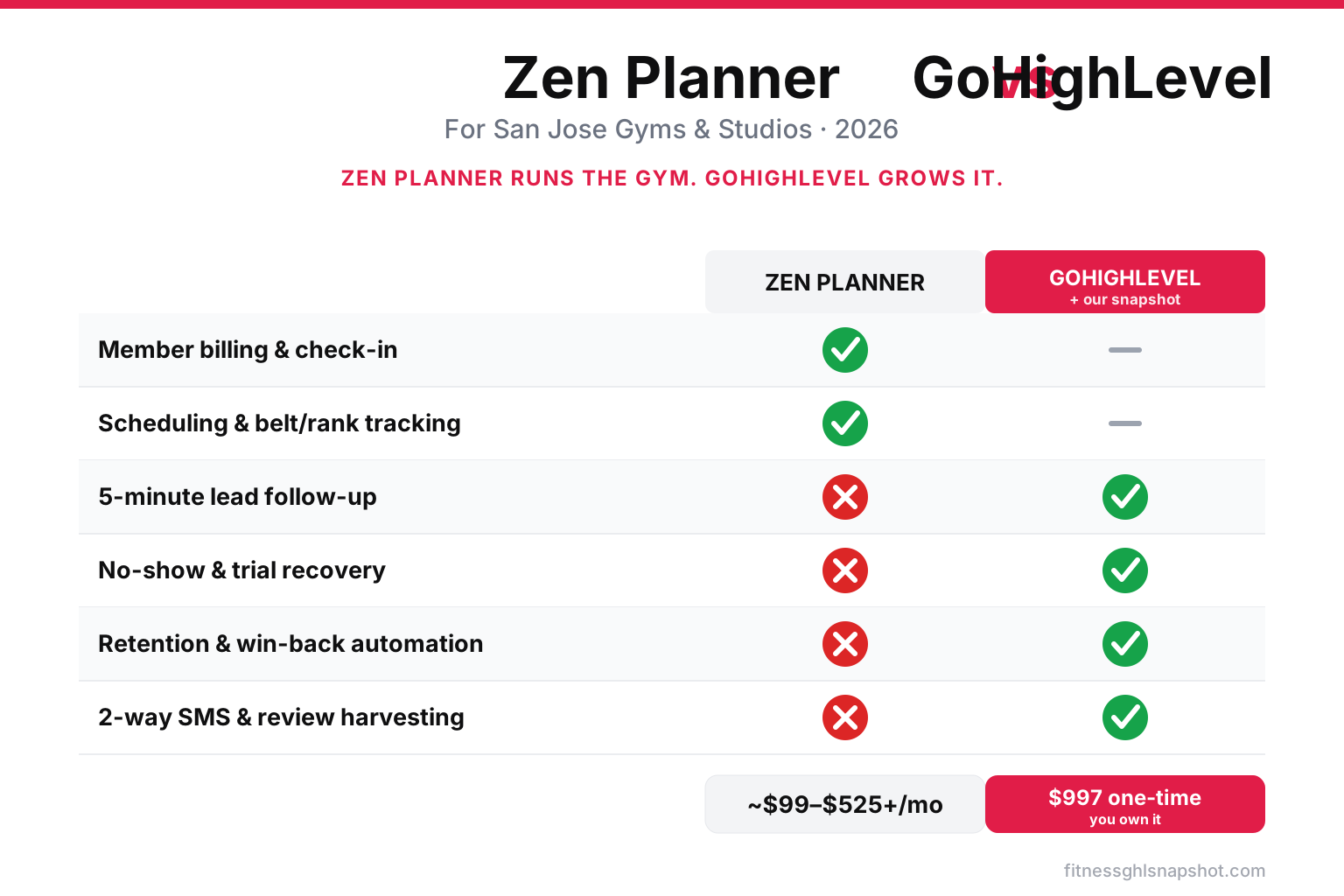
For a San Jose gym or studio, Zen Planner and GoHighLevel aren’t the same tool — and picking one over the other usually means comparing the wrong things. Zen Planner (a Daxko product) is member-management software: billing, scheduling, check-in, and rank tracking. GoHighLevel is a sales-and-marketing automation platform: capturing trial leads, following up in the first five minutes, recovering no-shows, and catching members before they quietly cancel. Zen Planner runs the gym. GoHighLevel grows it. The honest answer for most San Jose operators isn’t “which one” — it’s “keep the tool that runs your operation, and put your sales and retention on GoHighLevel,” because that’s the layer where trials are won or lost.
I spent eight years on the floor and front desk of a fast-growing box before I moved into GoHighLevel automation full-time. I’ve watched studios pay for great member-management software and still leak members out the back — because the software that checks people in was never built to chase the lead who filled out a form at 9 p.m., or to text the member who’s quietly stopped showing up. This post is the operator’s comparison: what each platform is actually built for, where Zen Planner stops, the sourced numbers on what that gap costs, and how a San Jose studio should think about running them together in 2026.
Table of contents
- The short answer for San Jose gym owners
- Zen Planner vs GoHighLevel: they’re not the same tool
- What Zen Planner does well — and where it stops
- What GoHighLevel does that Zen Planner can’t
- Head-to-head comparison
- The San Jose math: what a slow follow-up costs
- Retention: the leak member software doesn’t plug
- Do you have to rip out Zen Planner?
- Pricing: what each actually costs
- FAQ
The short answer for San Jose gym owners
If you run a CrossFit box in Willow Glen, a reformer studio downtown, or a Brazilian jiu-jitsu academy off Stevens Creek and you’re weighing Zen Planner against GoHighLevel, here’s the compressed verdict:
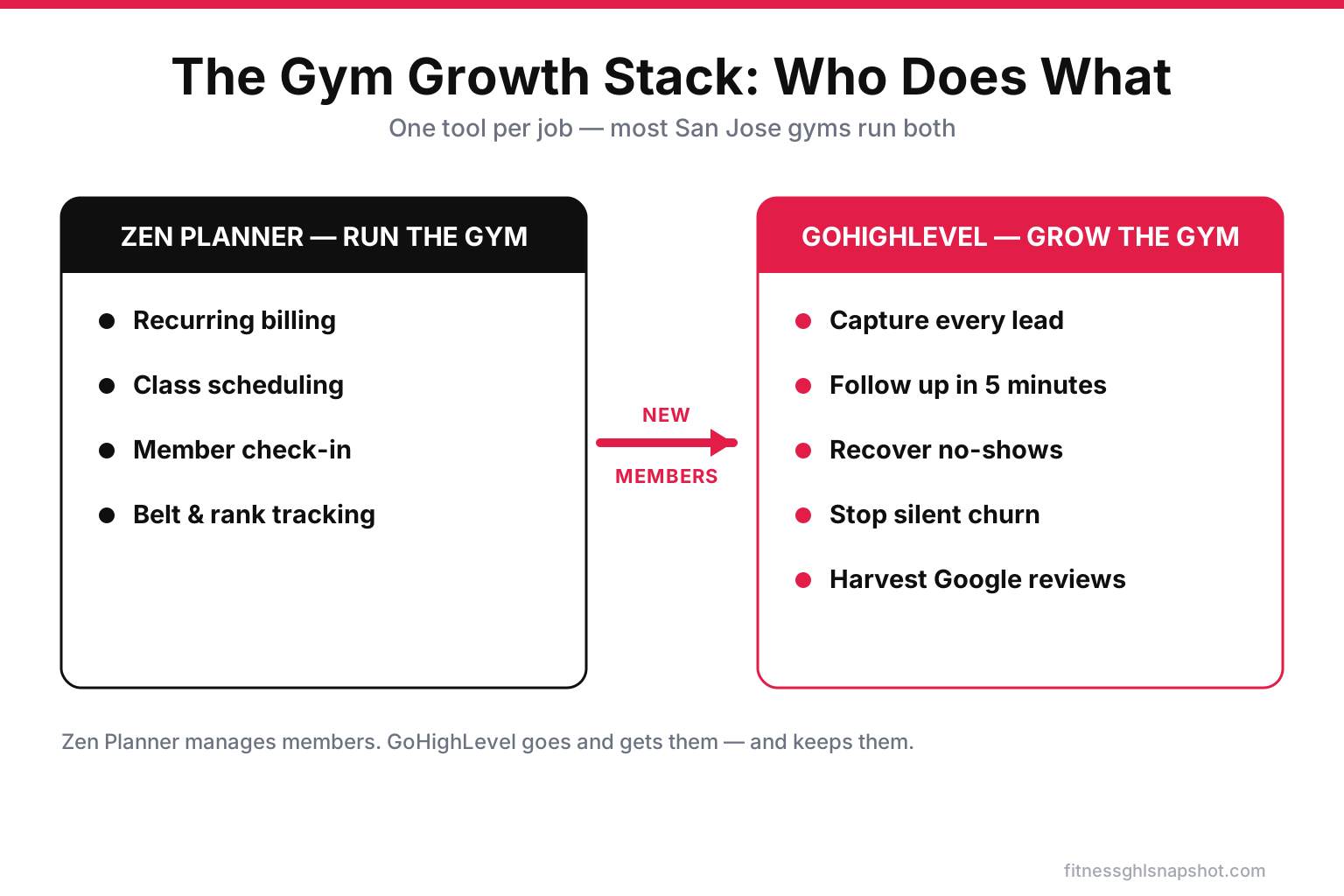
- Zen Planner is the right tool for running the gym: recurring billing, class and appointment scheduling, attendance and check-in, and — a real strength for martial arts — belt and rank tracking. It was founded in 2006 by martial artists and has been a Daxko product since 2017.
- GoHighLevel is the right tool for growing the gym: capturing every trial lead, following up instantly by text and email, recovering no-shows, running retention and win-back campaigns, and harvesting Google reviews. It’s a CRM and marketing-automation platform, not a check-in system.
- Most studios should run both. Keep the software that runs your operation. Put your lead follow-up, retention, and reviews on GoHighLevel — because a booked trial that no one follows up on is a member you paid for and lost.
The rest of this article is the why, with the numbers. The mistake I see San Jose operators make isn’t choosing the “wrong” software — it’s assuming the tool that manages members will also go get them. It won’t. Those are two different jobs.
Zen Planner vs GoHighLevel: they’re not the same tool
Here’s the distinction that clears up most of the confusion:
Zen Planner is back-office software. Its job starts the moment someone is already a member (or a trial who’s already booked). It bills their card, puts them on the schedule, checks them in, tracks their attendance streak, and — for a martial arts school — moves them up a belt. It’s built around the operation you already have.
GoHighLevel is front-office software. Its job is everything before and around the membership: the lead who filled out your “free week” form, the prospect who called during a class and got voicemail, the trial who booked but didn’t show, the member who’s gone quiet three weeks running. It captures, nurtures, follows up, and re-engages — the sales and retention motion, automated.
You can feel the difference in a single scenario. A prospect in San Jose Googles “jiu jitsu near me” at 8:40 p.m., lands on your site, and fills out a form. Zen Planner will happily manage that person’s membership — once they become one. GoHighLevel is what texts them back within 60 seconds, offers three intro-class times, books it into the calendar, and reminds them the morning of so they actually walk in. That first job is where new members come from, and it’s not what member-management software is built to do.
What Zen Planner does well — and where it stops
Credit where it’s due: Zen Planner is a mature, capable member-management platform, and for certain gym types it’s genuinely strong.
Where it’s strong:
- Membership and billing. Recurring payments, membership types, class packs, and family accounts — the money side of running a gym.
- Scheduling and check-in. Class calendars, appointments, attendance tracking, and a member app for self-service booking.
- Martial arts rank tracking. Belt and skill classification is a real differentiator — most generic tools can’t do it, and it’s why so many BJJ and karate schools land on Zen Planner.
- Reporting. Membership and revenue reporting that a studio owner can actually run the business on.
Where it stops:
- Speed-to-lead. Zen Planner isn’t built to text a brand-new web lead in the first five minutes automatically. That follow-up is manual, or it depends on marketing add-ons.
- No-show and trial recovery. Reminders exist, but a full “book → remind → recover the no-show → re-offer” workflow is not its core job.
- Retention automation. Catching a member who’s quietly stopped attending — before they cancel — requires behavior-triggered outreach. Zen Planner offers a marketing add-on (Engage, reported around $249/mo), which stacks another subscription on top of the base plan.
- Reviews and reputation. Automated Google-review harvesting after a milestone class isn’t a native strength.
- Two-way conversational SMS. Real back-and-forth texting with leads and members — the channel that actually gets read — isn’t what it’s designed around.
None of that is a knock on Zen Planner for what it is. It’s a member-management tool doing member management. The problem is when an owner expects it to also be the growth engine — and then wonders why booked trials don’t convert and quiet members disappear.
What GoHighLevel does that Zen Planner can’t
GoHighLevel is a CRM and marketing-automation platform — the category built for exactly the “before and around” work above. It’s serious infrastructure, not a hobby tool: in April 2024 it took a minority growth investment from General Atlantic, the same growth-equity firm behind a long list of category leaders.
For a gym, the pieces that matter most are:
- Instant speed-to-lead. The moment a form is submitted or a call is missed, an automated text and email go out — in seconds, not hours. This is the single highest-ROI automation a gym can run, and the data backs it up (see below).
- Missed-call text-back + 2-way SMS. A missed call during a busy class fires an automatic “Sorry we missed you — want to book your free class?” text, then holds the conversation by SMS. Texts get read; email mostly doesn’t.
- No-show and trial recovery. Booked-but-didn’t-show trials get an automatic re-offer sequence instead of vanishing.
- Retention and win-back. Attendance drop-offs trigger a check-in touch; lapsed members get a win-back campaign — stopping silent churn before it hits your billing report.
- Automated Google-review harvesting. After a member’s first month or a PR, an automated ask sends happy people to Google — the reviews that win the next “gym near me” search.
- Prebuilt CRM workflows. A pipeline that actually speaks trials, on-ramp, and class packs — not a generic sales CRM.
Here’s the honest part: GoHighLevel is not a drop-in replacement for Zen Planner’s check-in and billing. It doesn’t track your belt ranks or run your class turnstile the same way. What it does is the growth layer — and that’s the layer most gyms are missing, not the billing layer they already have.
That’s precisely what our done-for-you Fitness GHL Snapshot is: the entire growth layer above, pre-built for gyms and studios and installed for you, so you’re not assembling workflows from scratch.
Head-to-head comparison
Read this as “different jobs,” not “winner takes all.” The check marks reflect what each platform is built to do — not a claim that GoHighLevel checks members in or that Zen Planner is bad software.
Zen Planner vs GoHighLevel for a San Jose gym
| Plan | Zen Planner (Daxko) | GoHighLevel + Our Snapshot recommended |
|---|---|---|
| Price | ~$99–$525+/mo | $997 one-time |
| Feature 1 | Built for member management & billing | Built for lead capture, sales & retention |
| Feature 2 | Class scheduling & check-in: native ✓ | Class scheduling & check-in: via integration, not native |
| Feature 3 | Recurring billing & payments: native ✓ | Recurring billing: light — pairs with your processor |
| Feature 4 | Belt / rank tracking: native ✓ (great for martial arts) | Belt / rank tracking: not its job |
| Feature 5 | 5-minute automated lead follow-up: manual / limited | 5-minute automated lead follow-up: built in ✓ |
| Feature 6 | No-show & trial recovery workflows: limited | No-show & trial recovery workflows: built in ✓ |
| Feature 7 | Retention & win-back automation: Engage add-on (~$249/mo) | Retention & win-back automation: built in ✓ |
| Feature 8 | Automated Google review harvesting: limited | Automated Google review harvesting: built in ✓ |
| Get the snapshot |
The pattern is clear: Zen Planner owns the top rows (running the gym), GoHighLevel owns the bottom rows (growing it). A studio that only has the top half is leaving the growth half unautomated — and paying for it in lost trials and quiet cancellations.
The San Jose math: what a slow follow-up costs
San Jose is a dense, competitive fitness market inside a huge and growing industry. In 2024, 77 million Americans — about 25% of the population aged 6+ — held a fitness membership, up from 72.9 million in 2023, the second straight year of 5%+ growth (Health & Fitness Association, 2025 Consumer Report). Demand isn’t the problem. Speed is.
When a prospect fills out a form or calls, the clock starts immediately — and it’s brutal. The landmark MIT/InsideSales study (Dr. James Oldroyd, analyzing 15,000+ leads and 100,000+ call attempts) found that leads contacted within five minutes are 21× more likely to qualify than leads contacted after 30 minutes (summary). Yet Harvard Business Review’s follow-up research found the average B2B company took 42 hours to respond to a web lead, and 23% never responded at all (HBR, “The Short Life of Online Sales Leads,” 2011).
Relative likelihood of qualifying a lead by response time. Contacting within 5 minutes is roughly 21× more likely to qualify than waiting past 30 minutes. Source: MIT / InsideSales (Oldroyd, 2007).
A front desk juggling a packed 6 p.m. class cannot win that race by hand. An automation can — it replies in seconds, every time, day or night. That’s the gap between “we got the lead” and “we booked the trial,” and it’s the gap speed-to-lead automation is built to close.
The channel matters too. SMS open rates are commonly reported around 98%, versus roughly 20–28% for email, and about 90% of texts are read within three minutes (Sender, 2026). If your follow-up lives only in an email that never gets opened, the trial never gets booked. Two-way SMS is where the conversation actually happens — and it’s a core GoHighLevel strength, not a Zen Planner one.
Retention: the leak member software doesn’t plug
Getting the member is half the job. Keeping them is the other half — and it’s where the money quietly drains out. The HFA 2025 Fitness Industry Benchmarking Report, built on data from 175 companies and more than 17,000 facilities, put average annual member retention at 66.4%. That means roughly one in three members leaves every year — and top-performing clubs still only push past 75%.
Most of that loss isn’t a dramatic cancellation call. It’s silent: a member stops showing up in week three, drifts for a month, then cancels — or just lets the card keep charging until they notice and churn angry. Catching that member requires behavior-triggered outreach: attendance dropped → send a “we miss you” text → offer a check-in with a coach. That’s automation work. Your check-in system sees the attendance drop; it doesn’t act on it. GoHighLevel does.
The same logic applies to trials. Industry estimates suggest a gym trial-to-membership conversion of roughly 19% with no structured follow-up, rising to about 38% with one (Glofox / Fitness Business Pro, 2024) — treat those as directional benchmarks, not lab numbers, but the direction is the whole point: structured, automated follow-up roughly doubles how many trials become members.
Illustrative trial-to-member conversion rate, with and without a structured automated follow-up process. Source: Glofox / Fitness Business Pro, 2024 (industry estimate).
For a San Jose studio adding, say, 40 trials a month, moving from 19% to 38% conversion is the difference between roughly 8 and 15 new members — every month, from leads you already paid to generate. That’s the ROI case for the growth layer in one line. (For the deeper playbook, see our trial-to-member conversion guide and member lifetime value breakdown.)
Do you have to rip out Zen Planner?
No — and you usually shouldn’t. This is where the “which one” framing falls apart. If Zen Planner runs your billing, scheduling, and rank tracking well, keep it. The smart move for most San Jose gyms is to run GoHighLevel as the growth layer alongside your member-management tool, connecting the two so a booked trial flows into your check-in system and a new lead flows into your follow-up automation.
Three common setups:
- Keep Zen Planner, add GoHighLevel for growth. Zen Planner runs the operation; GoHighLevel runs lead capture, follow-up, retention, and reviews. You connect the two so data stays in sync. This is the most common fit.
- Consolidate onto GoHighLevel if your billing and scheduling needs are light and you’d rather not pay for a full member-management suite plus its marketing add-ons. Our GHL development team handles the migration and custom integrations.
- Multi-location or franchise? GoHighLevel’s structure makes running several locations from one system straightforward — a real edge if you’re scaling beyond one San Jose box.
Pricing: what each actually costs
The two tools price on opposite models, and it changes the math.
Zen Planner is a recurring subscription. Published plans are commonly cited as Studio ~$99/mo, Essentials ~$198/mo, and Ultimate ~$348/mo, priced by active member count, with add-on modules (marketing automation, branded app, website) that push many studios into the $348–$525+/mo range as of 2026 (Zen Planner pricing · GymDesk review, 2026). Current base pricing is increasingly routed through a “contact sales” quote, so confirm your number directly. Over three years, a mid-tier setup can run well past $12,000–$18,000.
Our Fitness GHL Snapshot is a $997 one-time build you own outright — no per-member scaling, no monthly platform lock-in on the automation layer itself (you run it on your own GoHighLevel account). It’s the complete growth engine, installed for you. For agencies serving the fitness niche, it’s also resellable — deploy it for every gym client instead of rebuilding funnels from scratch.
Cost models compared
| Plan | Zen Planner | Fitness GHL Snapshot recommended |
|---|---|---|
| Price | ~$99–$525+/mo | $997 one-time |
| Feature 1 | Recurring subscription, scales by member count | One-time build — you own it |
| Feature 2 | Marketing automation is a paid add-on (~$249/mo) | Growth automation is the whole product, not an add-on |
| Feature 3 | You rent it — costs grow as you grow | Runs on your own GoHighLevel account |
| Feature 4 | 3-year cost often $12,000–$18,000+ | Resellable for agencies serving gyms |
| Buy the snapshot |
The point isn’t that Zen Planner is overpriced — it’s that you’re paying it to run your gym, and it’s a fair price for that. The question is whether the growth work is being done at all, and whether stacking a $249/mo marketing add-on onto member-management software is the best way to do it, versus a purpose-built automation snapshot you own.
The bottom line for San Jose gyms
Stop asking “Zen Planner or GoHighLevel.” Ask “who’s running my growth?” Zen Planner is a solid member-management platform — keep it if it runs your billing, scheduling, and ranks well. But it was never built to text a lead back in five minutes, recover a no-show, or catch a member before they ghost. That’s the growth layer, and in a market where 77 million Americans hold memberships and one in three leave every year, the growth layer is where your next 15 members come from — and where your current ones stay.
Run Zen Planner to run the gym. Run GoHighLevel to grow it.
Frequently asked questions
Is GoHighLevel a replacement for Zen Planner?
Not directly. Zen Planner is member-management software (billing, scheduling, check-in, belt/rank tracking); GoHighLevel is a CRM and marketing-automation platform (lead capture, follow-up, retention, reviews, 2-way SMS). Most San Jose gyms keep their member-management tool and add GoHighLevel as the growth layer. If your billing and scheduling needs are light, some studios do consolidate onto GoHighLevel — our GHL development team handles that migration.
Can Zen Planner and GoHighLevel work together?
Yes. The common setup is Zen Planner running your operation and GoHighLevel running lead capture, follow-up, retention, and reviews, with the two connected so booked trials and new members stay in sync. See our guide on connecting gym software to GoHighLevel.
Why does speed-to-lead matter so much for a gym?
Because fitness is an impulse, mobile, local purchase. The MIT/InsideSales study found leads contacted within five minutes are about 21× more likely to qualify than those contacted after 30 minutes, yet most businesses take hours to respond. A booked trial that no one follows up on fast is a member you paid for and lost. GoHighLevel automates that instant follow-up; member-management software generally doesn't.
How much does Zen Planner cost in 2026?
Third-party sources report published plans historically starting around $99/month (Studio), rising to roughly $198 (Essentials) and $348 (Ultimate), priced by active member count, with add-on modules pushing many studios to $348–$525+/month. Zen Planner increasingly routes base pricing through a contact-sales quote, so confirm your exact number with them directly.
What does the Fitness GHL Snapshot cost, and do I own it?
It's a $997 one-time build that you own and run on your own GoHighLevel account — the complete growth layer (lead capture, follow-up, no-show recovery, retention, reviews) pre-built for gyms and studios. See pricing and how it works. Agencies serving the fitness niche can also resell it.
I run a martial arts school — does GoHighLevel do belt tracking?
No — belt and rank tracking is a Zen Planner strength, and one of the best reasons to keep it. GoHighLevel handles the growth side: getting new students in the door, converting trials, and retaining members. Run both, and each does what it's built for.
Written by Bryce Kendrick — Fitness Growth Strategist and GHL Snapshot Lead. Bryce spent eight years managing the floor and front desk of a fast-growing CrossFit box before moving full-time into GoHighLevel automation for gyms, building trial-to-member funnels for boxes, franchises, and independent strength studios. He writes the way he coaches: direct, numbers-first, and allergic to fluff.