
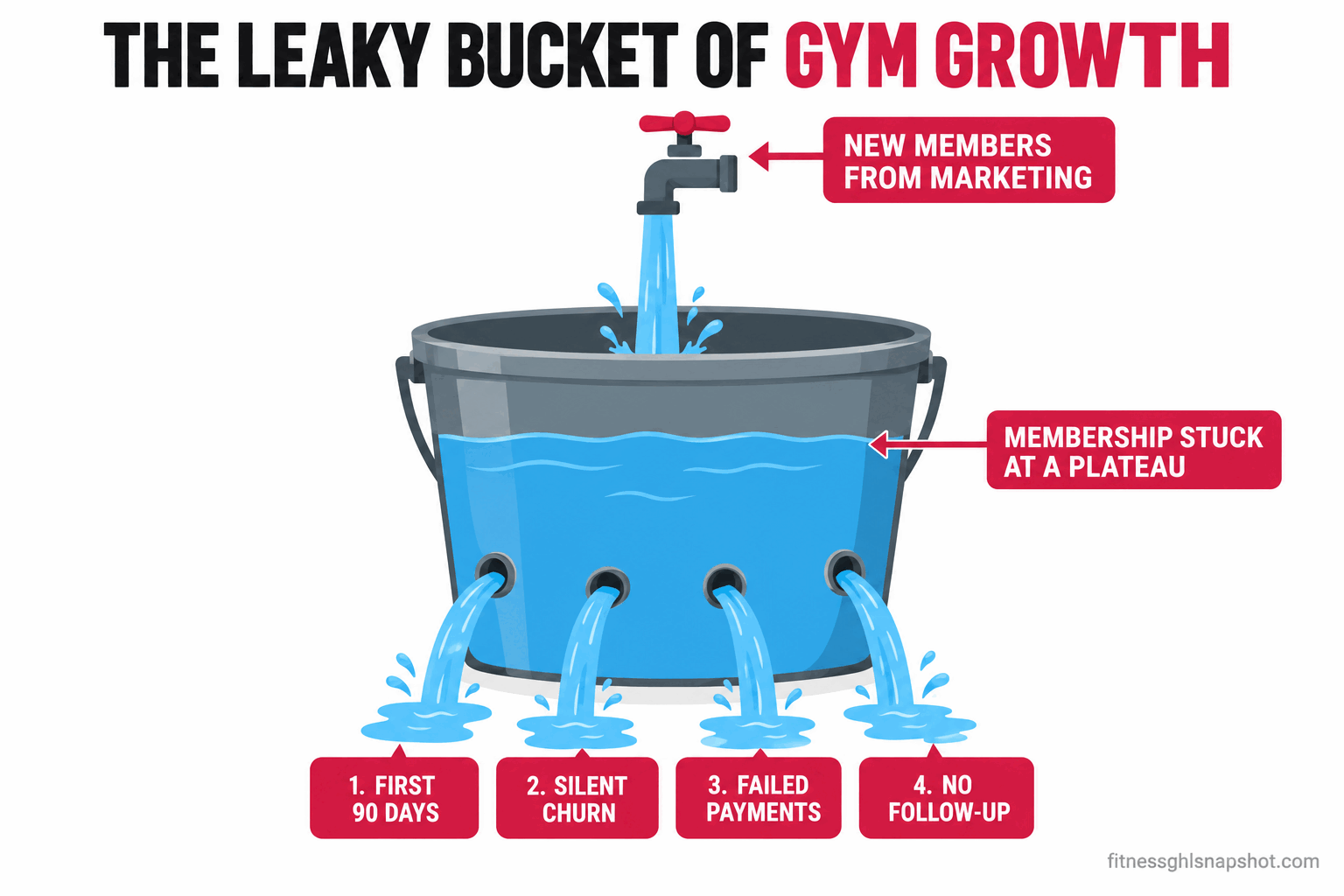
Here is the short version: if your gym keeps adding members but the total on your roster will not move, you do not have a marketing problem. You have a leaky bucket. Every new sign-up is water going in the top, and churn is water running out four holes near the bottom, and right now those two are roughly equal. So you pour more in, you work harder on ads and posts and referrals, and the level stays exactly where it was. The fix is not a bigger tap. It is plugging the holes. A gym loses most of its members in four predictable places: the first ninety days, silent churn from members who drift off without telling you, failed card payments nobody chases, and leads and lapsed members who never get a follow-up. Measure how fast each one leaks, plug them in order, and the same marketing you already do starts actually growing the business instead of just keeping the bucket full.
It is a Tuesday and you are looking at your membership number for the third month in a row. Three hundred and change. It was three hundred and change in the spring, and it was three hundred and change last fall. You know you are signing people up, because you see the new faces and the welcome texts going out. Your Instagram is busy, you ran a six-week challenge, you got a handful of referrals. By every measure of effort, the gym should be bigger than it was a year ago. It is not. And the quiet, nagging question underneath it is the one nobody at the front desk wants to say out loud: if we are working this hard and nothing is growing, what is the point?
The point is that you are measuring the wrong end of the bucket. You can see the water going in, the new sign-ups, because those are loud and they feel like progress. You cannot see the water going out, because churn is silent. A member does not announce that they stopped coming. They just fade, and three months later their card finally fails, and nobody ever counted them as a loss. This post is about the other end of the bucket: where members actually leak out, how to measure it, and the exact system that plugs each hole so your growth finally shows up on the roster.
Table of contents
- What a plateau actually is: the leaky bucket
- What the leak is costing you right now
- The four holes in the bucket
- Hole 1: The first ninety days
- Hole 2: Silent churn
- Hole 3: Failed payments nobody chases
- Hole 4: Leads and lapsed members with no follow-up
- The texts to steal
- The same fix at three sizes
- Keep it legal: texting and auto-renewal
- Objections operators raise
- FAQ
What a plateau actually is: the leaky bucket
Start with the only equation that matters for growth, because once you see it you cannot unsee it. Your net member growth over any period is new members joined minus members lost. That is the whole thing. If you add ten members in a month and lose ten, you grew by zero, and it does not matter that the ten you added came from a brilliant campaign. The loss cancels the win. A plateau is simply the state where those two numbers have quietly settled into a tie.
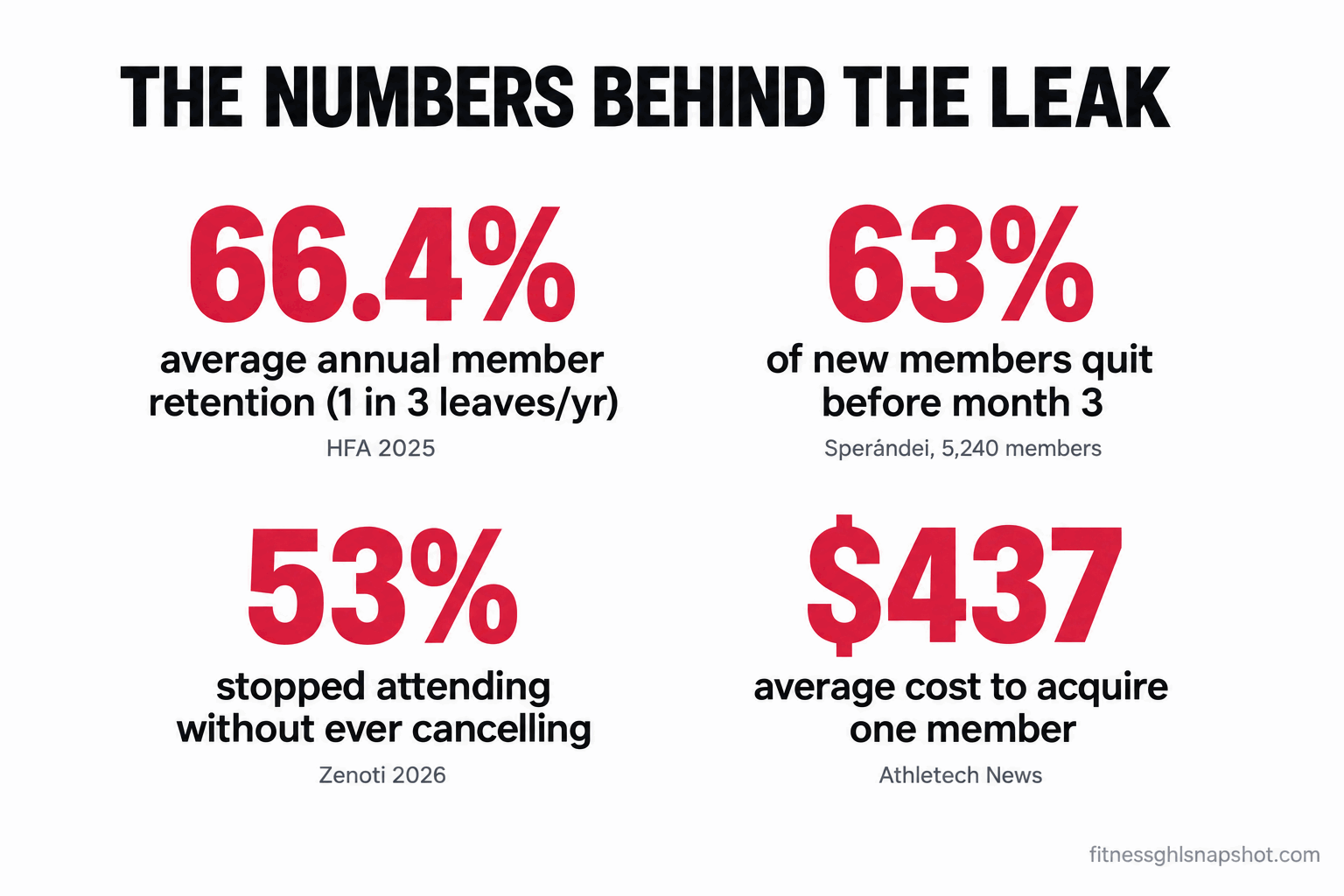
Here is why that tie is the natural resting place for most gyms. The fitness business runs on retention, and retention on average is not strong. In the Health & Fitness Association’s 2025 benchmarking data, average annual member retention came out around 66.4%, which is another way of saying roughly one in three members leaves every year (HFA 2025, via Gymdesk). So a gym sitting at 300 members is not holding 300 steady. It is losing about 100 members over the year and, if it is working hard, replacing about 100. The roster looks frozen. The reality underneath is a hundred people walking out the back while a hundred different people walk in the front.
The chart below models that for a 300-member gym at the industry retention rate. You lose roughly a hundred, you work hard to add roughly a hundred, and you end the year almost exactly where you started. All of that marketing bought you four net members.
Illustrative one-year model for a 300-member gym applying the 66.4% average annual retention figure. Join and loss numbers are a worked example, not a measured stat; your gym’s numbers will differ. Retention source: HFA 2025, via Gymdesk.
The important move here is a mindset flip. When growth stalls, the instinct is to open the tap wider: more ads, more posts, another challenge, a referral push. That can help, but if the holes are open, a bigger tap just means more water rushing out faster. You spend more to acquire members who leak away at the same rate, which is how a gym can get busier and more expensive to run without getting any bigger. The real gains are at the bottom of the bucket, not the top. Plug the holes and the tap you already have starts raising the level.
What the leak is costing you right now
Put a dollar figure on it, because the plateau is not free. Every member who leaks out is one you have to re-acquire to stand still, and acquisition is not cheap. The average cost to acquire a gym member runs about $437 when you blend channels, with organic running near $318 and paid near $557 (Athletech News). Those numbers move a lot by market and are an industry estimate, not a promise, but the shape is not in doubt: filling a leaky bucket is a spending habit.
Average member acquisition cost per gym member, in US dollars, by channel. Source: Athletech News.
Run the math on our 300-member gym. If it leaks 100 members a year and each replacement costs around $437, that is roughly $43,700 a year spent just to keep the roster flat. Not to grow it. To stand still. If you could cut that leak in half, you would free up around twenty grand a year, and more to the point, half of those retained members would stop cancelling your growth out, so the roster would finally start climbing. The cheapest member you will ever add is the one you did not lose. We put real numbers on what each member is worth over their lifetime in the gym member lifetime value breakdown, and it reframes every retention decision you make.
The leak is also front-loaded, which is good news because it means it is fixable. Nearly half of new members cancel within their first six months, and in one study of 5,240 new members, 63% stopped training before their third month (Gymdesk). The biggest hole in your bucket is not your loyal members quietly aging out. It is new members leaving before they ever became regulars. That is the hole to plug first, and it is the one most within your control.
The four holes in the bucket
Before the fixes, name the holes. Across gyms and studios, members leak out in four predictable places. You almost certainly have all four open right now. The job is to measure which leaks fastest for you and plug them in order, biggest first.
| The hole | Where it shows up | Who it hits hardest | The plug |
|---|---|---|---|
| First 90 days | New members who come twice and vanish | Every gym; worst for high-volume trial funnels | A real onboarding sequence that earns the second and fourth visit |
| Silent churn | Members who stop coming but keep paying, then cancel | Boutique studios, class-based gyms | Attendance-based at-risk alerts and a human check-in |
| Failed payments | Declined cards that quietly end a membership | Every gym on recurring billing | A dunning sequence that recovers the card before the member is gone |
| No follow-up | Trial leads and lapsed members who never hear from you again | Gyms relying on DMs and memory | Fast lead response and a scheduled win-back of the old list |
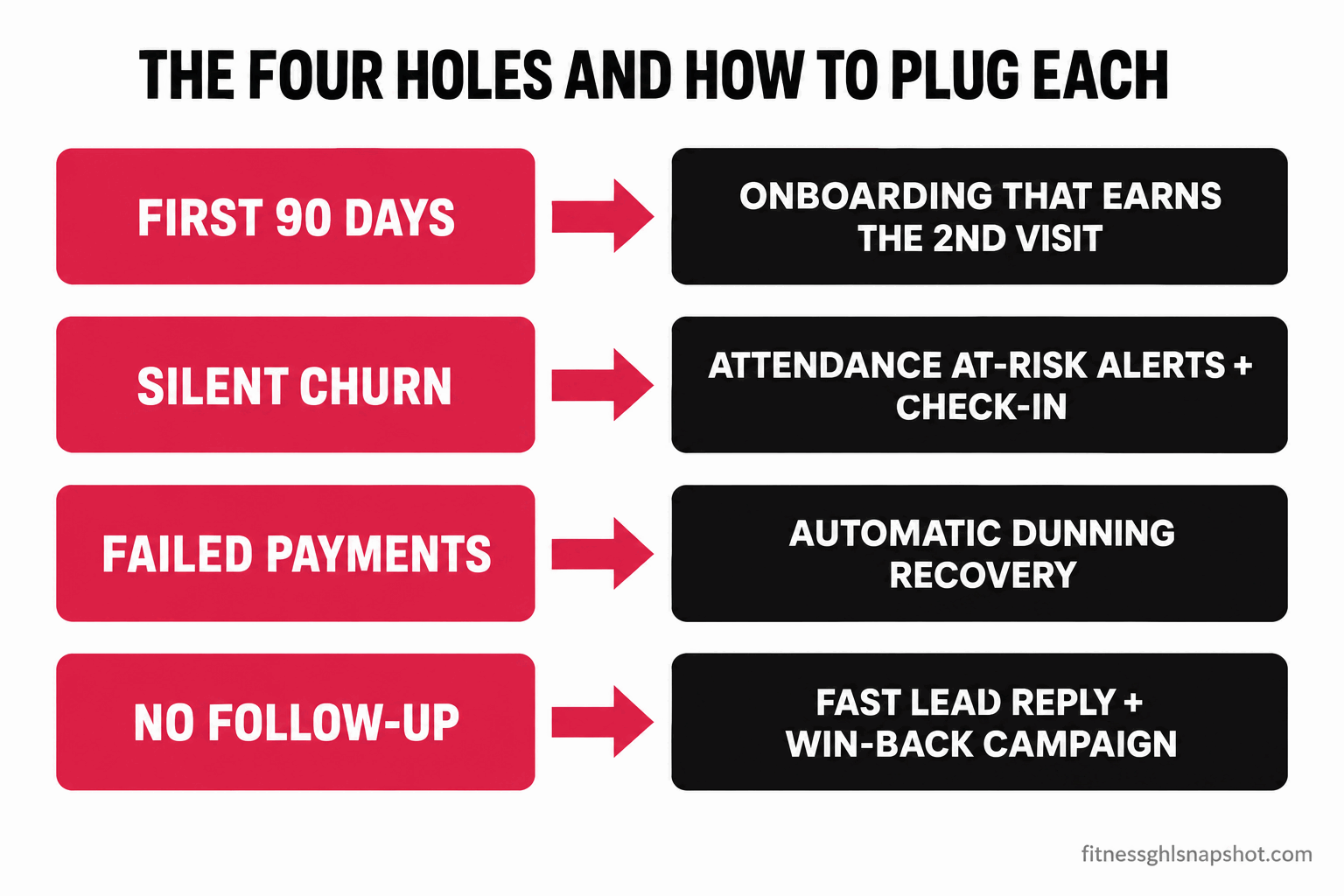
Two of these holes are about keeping members you already have (the first ninety days and silent churn), one is about not losing them to a billing glitch (failed payments), and one is about actually using the people who already raised their hand (follow-up). Fix all four and you are plugging both ends: fewer members leak out, and more of the ones who showed interest actually make it in. The next four sections are the build for each.
Hole 1: The first ninety days
This is the biggest hole, and it is where the data is most brutal. If 63% of new members quit before month three, then the first ninety days is not a honeymoon, it is a cliff, and most gyms do nothing deliberate during it. A new member signs up, gets a wave and a locker code, and is left to figure the place out alone. The ones who happen to find a class they like and a face they recognize stay. The rest drift, and drifting is how early churn works. It is rarely a decision. It is an absence of reasons to come back.
The plug is a real onboarding sequence that engineers the early wins instead of hoping for them. The single most important number in a new member’s life is their second visit, and then their fourth, because attendance in the first two weeks predicts whether they are still around at month three. So you build a lightweight sequence that drives those visits: a warm welcome that sets the first session, a nudge if they have not booked within a few days, a check-in after the first workout, and a specific invitation to the second and third. It is not a drip of generic tips. It is a series of small, timed pushes to get a body in the room again before the habit dies. We lay out the full cadence in the gym member onboarding sequence and why members quit after three months.
How it breaks. The onboarding “sequence” is one automated welcome email that nobody opens, and then silence. A welcome message is not onboarding. Onboarding is the four or five touches over the first three weeks that get the member back in, each tied to whether they actually showed up. The other failure is running the same sequence for everyone regardless of behavior, so a member who has already come three times keeps getting “we noticed you haven’t been in” texts, which reads as a gym that is not paying attention. Tie the touches to real attendance data, so the member who is thriving gets a high five and the member who is drifting gets a hand.
Hole 2: Silent churn
The second hole is the quietest and the most expensive to ignore, because the member keeps paying while they leak. Silent churn is the member who stops coming but does not cancel. They are still on your roster, still being billed, so they do not show up as a loss. Then one day they cancel, or their card fails and they do not bother to update it, and you record the loss on that date even though the real leaving happened months earlier. By the time it is a cancellation, the member is long gone and impossible to save.
It is not a rare edge case. In Zenoti’s 2026 fitness consumer survey of 1,393 US gym members, 53% said they had stopped attending at some point without ever formally cancelling (Zenoti 2026). More than half of your members have ghosted a gym before, which means a big share of the names on your roster right now are mid-drift and you cannot see it. The plug is to make the invisible visible: flag the at-risk member by their attendance, not their billing. When a member who used to come three times a week has not scanned in for ten or fourteen days, that is your signal, long before the cancellation. A simple rule inside your CRM can watch for the drop in visits and raise a flag, and then a human sends one genuine, no-sell check-in. We cover the full approach in stop silent churn before it empties your gym.
How it breaks. You wait for the cancellation to act, which means you only ever talk to members who have already decided to leave. By then the save rate is near zero. Move the trigger upstream to the attendance drop, where the member is wobbling but still reachable. The second failure is automating the check-in into a robotic “we miss you” blast that feels like what it is, a bulk text to a dead list. The alert should be automated; the message that follows should feel like a person noticed one specific member was gone, because that noticing is the entire point.
Hole 3: Failed payments nobody chases
This is the leak that has nothing to do with whether a member likes your gym, which is what makes it so maddening to lose them to it. A card expires. A bank flags a charge. A member switches banks and forgets to update the autopay. The payment fails, and in most gyms, nothing happens except that the member quietly stops being billed and, often, keeps coming for a while until someone notices and has an awkward conversation, or never notices at all. This is involuntary churn, and it is pure leak: a member who wanted to stay, lost to a billing glitch.
The plug is a dunning sequence, which is just a fixed set of friendly, escalating reminders that fire automatically when a payment fails. The card gets declined, and within hours the member gets a text and an email: “Hey, heads up, your payment for this month didn’t go through, probably just an expired card. Here’s a link to update it in ten seconds.” If that does not land, a second reminder follows a couple of days later, then a third, then a human reaches out before the membership is cancelled. The whole thing runs on its own and recovers members who never meant to leave. We walk through the exact cadence and copy in failed payment recovery for gyms.
How it breaks. There is no sequence at all, so a failed card is either caught by luck or not at all, and a paying member silently becomes a non-paying one on the roster. The fix is to make the retry and the reminder automatic the moment a charge fails. The other failure is a single cold “your payment failed” notice with no easy fix-it link, which puts the work on the member and makes it easy to shrug off. Give them a one-tap way to update the card, make the tone light rather than accusatory, and chase it more than once, because the first reminder is often just missed, not ignored.
Hole 4: Leads and lapsed members with no follow-up
The last hole is at both edges of the bucket at once: people who were about to come in and never did, and people who left and could come back. Both are warm, both are cheap compared to a cold prospect, and both get ignored in most gyms because there is no system watching them. A trial lead fills out a form at 9pm, nobody replies until the next afternoon, and by then they have booked somewhere that texted back in two minutes. A member cancelled eight months ago and has never heard a word since, even though their life may have completely changed. That is growth money sitting on the floor.
The plug has two halves. First, speed on new leads: an automated instant reply the second a form comes in or a DM lands, so the conversation starts while the lead is still holding the phone, with a human following fast behind it. This is where two-way texting earns its keep, and you can wire it with the same SMS automation that runs the rest of your member messaging. Second, a scheduled win-back of the people you already paid to acquire once. The list of lapsed members and dead trial leads in your account is the cheapest lead source you own, and almost no gym works it. A short, respectful reactivation campaign a few times a year pulls members back for a fraction of a new acquisition. We lay out exactly how in reactivating dead gym leads.
How it breaks. Lead follow-up depends on whoever is working the desk remembering to reply, which means nights, weekends, and busy mornings are dead zones where leads cool off. Automate the instant first response so speed never depends on a human being free. On win-back, the failure is never running it at all, or blasting the whole dead list one time with a discount and calling it done. Run it as a short sequence, a few times a year, with a real reason to return, and tag the ones who come back so you learn which messages work.
The texts to steal
A system only runs if the messages are already written, because a message you have to compose on a busy Tuesday is a message that never gets sent. Here is a starter set for the four holes. Keep them short, human, and specific, and always give one clear next step.
The same fix at three sizes
The four holes are the same everywhere, but who owns the fix and how much you automate changes with your setup.
Solo trainer or small PT team (20 to 100 clients). Your leak is almost entirely attention. With a small list you can technically track everyone in your head, right up until you cannot, and the one client who drifted gets forgotten because you were coaching. You do not need a dashboard, you need two automations: an onboarding sequence that locks in the early sessions, and an at-risk alert that pings you when a regular goes quiet. Let the system remember so you can coach. The win-back is you, personally texting the handful who lapsed, which at your size still works beautifully because it is genuinely personal.
Boutique studio (80 to 250 members, a couple of instructors). Silent churn is your biggest hole, because class-based members drift in and out and the attrition hides in the schedule. Here the fix is making attendance the signal the whole team watches, with at-risk flags routed to one person who owns retention so the check-ins stay warm and consistent instead of varying by whoever is at the desk. Automate onboarding and dunning fully, because at this volume a few failed cards and a weak first month add up to real monthly revenue walking out quietly.
Mid-size gym (150 to 500 members, 3 to 10 staff). At this size the leak is an operations number, not a feeling, and you should be able to see all four holes on a report: new-member ninety-day retention, the count of at-risk members this week, failed payments recovered versus lost, and win-backs returned. Those belong next to your core gym metrics. Automation is not optional here, because no team hand-tracks four leaks across hundreds of members without some slipping, and every slip is a member turning into a silent cancel. This is also where a flat roster hides the most, since the busy classes make it feel like you are growing even when the leaks are eating every new sign-up, the exact trap in why your gym is busy but not making money.
Keep it legal: texting and auto-renewal
Plugging these leaks means sending a lot of automated texts and restarting billing, which is exactly where consumer-protection rules apply. None of this is legal advice, check your own setup with a lawyer, but keep three things clean.
First, the texts. Every message in these sequences is an automated business text, which puts you under the Telephone Consumer Protection Act. Keep clear consent to text, honor STOP every time, keep the operational messages transactional rather than promotional blasts, and register your number for A2P 10DLC business texting before you rely on any of it, because unregistered traffic gets filtered by carriers and your check-in silently never arrives. TCPA damages run $500 per message, and $1,500 for willful violations, with no aggregate cap (Nextiva).
Second, auto-renewal, which is where the failed-payment and win-back work lands. More than half the states have an auto-renewal statute, and California’s is among the strictest. California’s Automatic Renewal Law, amended by AB 2863 with changes effective July 1, 2025, requires express affirmative consent to the auto-renewing charge, online cancellation at will for members who signed up online, cancellation through the same medium they used to enroll, and an annual reminder of the charge and how to cancel (Cooley LLP). When a recovered card restarts billing, the member needs to have clearly agreed to that.
Third, the myth to drop. There is no federal “click to cancel” rule in force in 2026. The Federal Trade Commission’s version was vacated by the US Court of Appeals for the Eighth Circuit on July 8, 2025, so the rule most content still says is coming never took effect (Fenwick & West). The operative rules are state auto-renewal law and the existing FTC Act, not one tidy federal regulation. The full breakdown for gyms lives in gym membership cancellation and auto-renewal law in 2026.
Objections operators raise
“I don’t have a growth problem, I have a marketing problem.” Maybe, but prove it with the math before you spend. If your churn roughly equals your sign-ups, more marketing just fills the bucket faster while it drains at the same rate, and you pay around $437 a head for the privilege. Open your numbers: how many did you add last year, how many did you lose. If those are close, the leak is your constraint, not the tap. Plug a hole and watch whether the same marketing suddenly moves the roster. Usually it does, because the marketing was never the problem.
“Isn’t some churn just normal and unavoidable?” Yes. People move, get injured, have babies, change jobs. A chunk of churn is life and no system saves it. But that is not where most of your leak is. Most of it is the new member who quit in month two because nothing pulled them back, the member who drifted off while still paying, and the card that failed and nobody chased. Those are not life events. They are process gaps, and process gaps are fixable. Do not use the unavoidable slice as an excuse to ignore the avoidable majority.
“I already post every day and run ads.” Good, that is the tap working. Now ask where that effort goes. If a lead who finds you at 9pm waits until tomorrow for a reply, and a new member who signs up gets no onboarding, your ad spend is pouring straight through the holes. Top-of-bucket effort and bottom-of-bucket leaks are not either-or. The fastest return you will get is making the members your marketing already won actually stick, because you have already paid to acquire them.
“Do I need to be technical to fix this?” No. Every plug here is a form, a handful of saved messages, and a few rules that watch attendance and billing dates, all configured once in a CRM built for local business and then left running. You can build the basics yourself over a few weekends, or have the whole set installed done-for-you and connected to your member list so it just runs. Platforms like GoHighLevel, which our own system is built on, do all four natively, as do most modern CRMs with workflows and two-way texting. The CRM and workflow layer is what ties the four holes into one system watching the whole bucket.
The bottom line
Go back to that Tuesday, staring at three hundred and change for the third month running. In a gym with the holes open, you respond the way most owners do: you push harder on marketing, spend more on ads, run another challenge, and next quarter you are still at three hundred and change, just more tired and more out of pocket. In a gym with the holes plugged, the same effort finally compounds. New members get a real first ninety days and most of them stay. Drifting members get caught at the attendance drop, not the cancellation. Failed cards get recovered in a day. Old leads and lapsed members get worked instead of forgotten. The loss number drops, the gap between joins and losses opens up, and the roster starts climbing for the first time in a year.
Nothing about your market changed. You did not need more demand. You needed to stop losing the members you were already winning. A plateau is not a sign that your gym has peaked. It is a sign that the bucket is leaking exactly as fast as you can fill it. Find the four holes, plug the biggest first, and let the tap you already have do what it was doing all along.
Frequently asked questions
Why has my gym stopped growing even though I keep signing up new members?
Because net growth is new members minus lost members, and your churn has quietly caught up to your sign-ups. When those two numbers are roughly equal, you grow by zero no matter how good your marketing is. New sign-ups are visible and feel like progress, while churn is silent, so most owners only see one side of the equation. With average annual retention around 66.4%, a 300-member gym loses roughly 100 members a year and, if it works hard, replaces about 100, leaving the roster flat. The fix is not more marketing, it is reducing the loss side: plug the first-90-day leak, silent churn, failed payments, and missing follow-up, and the same marketing starts moving the number.
What is a good gym churn or retention rate?
Industry benchmarking from the Health & Fitness Association puts average annual member retention around 66.4%, which means roughly one in three members leaves each year. That is an average, not a target, and the healthiest independent gyms and studios run meaningfully better by fixing early churn. The number to watch most closely is new-member retention, because nearly half of new members cancel within six months and one large study found 63% quit before month three. If you only track one thing, track what share of new members are still active at 90 days, because that is where the biggest and most fixable leak lives.
How do I calculate my gym's churn rate and net member growth?
Net member growth for a period is simply members joined minus members lost in that period. For churn rate, divide the number of members who cancelled during the period by the number of members you had at the start, then multiply by 100. For example, a gym that started a month with 300 members and lost 9 had a monthly churn rate of 3%, which annualizes to a bit over 30%. Track joins and losses side by side every month rather than just watching the total, because the total can sit flat while a large number of members churn and get replaced underneath it. That hidden churn is the plateau.
Is it cheaper to keep a member or get a new one?
Keeping is almost always cheaper. The average cost to acquire a gym member runs about $437 blended, roughly $318 through organic channels and $557 through paid ads. A member you retain costs you nothing extra to keep on the roster, while every member you lose has to be replaced at acquisition cost just to stand still. For a gym losing 100 members a year, that is around $43,700 spent annually just to hold the line. Cutting the leak frees that spend and lets your marketing grow the gym instead of replacing what drained out, which is why plugging retention leaks is the highest-return work most gyms can do.
Where do gyms lose the most members?
In four predictable places. The biggest is the first 90 days, since nearly half of new members cancel within six months and most early churn is drift, not a decision. The second is silent churn, members who stop attending but keep paying until they eventually cancel; in one 2026 survey, 53% of members said they had stopped attending without ever formally cancelling. The third is failed payments, where an expired or declined card quietly ends a membership nobody meant to lose. The fourth is missing follow-up on trial leads and lapsed members who never hear from the gym again. Measure which leaks fastest for you and plug the biggest first.
Can I fix a membership plateau without spending more on marketing?
Usually, yes, and it is often the faster path. A plateau means your loss rate equals your acquisition rate, so reducing losses moves the roster just as surely as adding sign-ups, and it is cheaper because you are not paying acquisition cost on every member. Start by onboarding new members through a real first-90-day sequence, flag at-risk members by their attendance before they cancel, recover failed payments automatically, and follow up fast on leads and lapsed members. These fixes use members and leads you already have, so they cost little beyond setting up the system once. Only after the bucket stops leaking does spending more on marketing reliably translate into growth rather than faster churn.
Written by Divya Kapoor, Member Retention & Lifecycle Specialist. Divya ran member experience for a three-location boutique pilates and yoga group before moving full-time into retention systems. She is the person who noticed that silent churn, not formal cancellations, was eating most of her studios’ revenue, and she builds the lifecycle automations that catch members before they ghost.
Related posts
- Why Members Quit After 3 Months: The 90-Day Cliff and the Signals You Keep Missing
- How to Stop Silent Churn at Your Studio
- Failed Payment Recovery for Gyms: The Dunning Playbook
- The Gym Member Onboarding Sequence That Locks In the Second Visit
- Gym Member Lifetime Value: The Number That Changes How You Spend
- How to Reactivate Dead Gym Leads